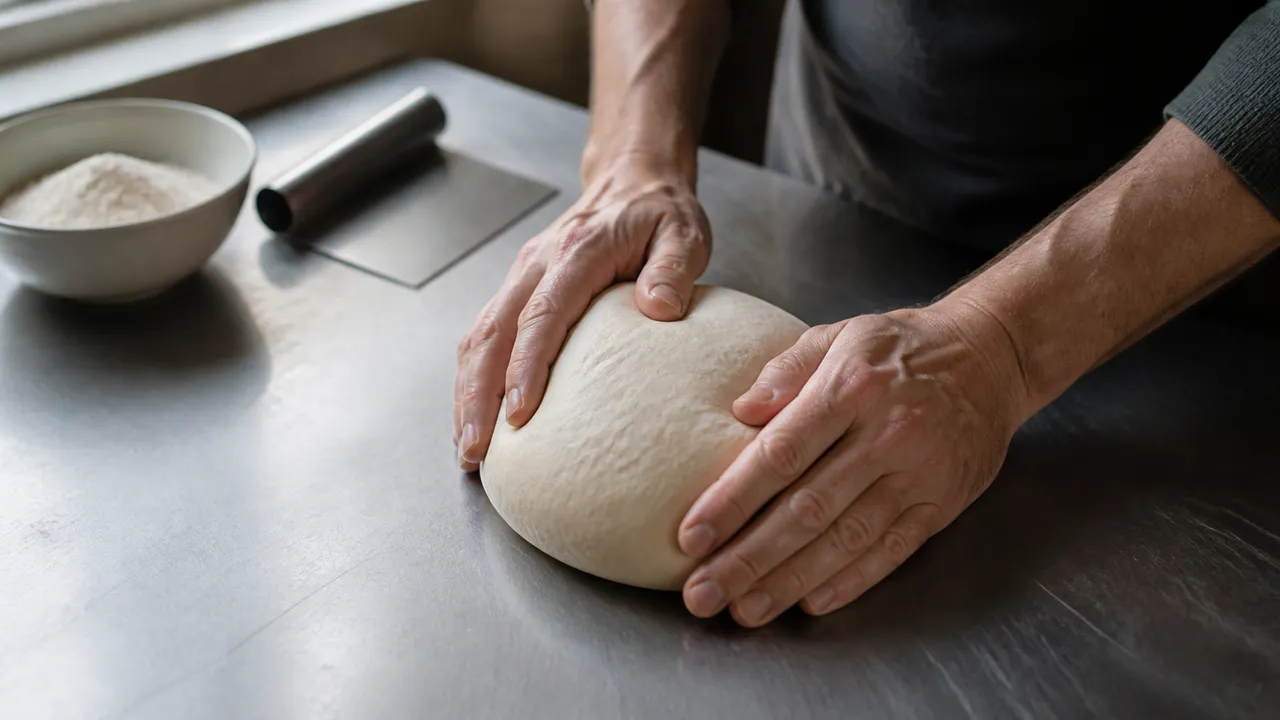
Yes, you can knead dough on a stainless steel counter or work surface. The surface should be sound, clean, stable, and large enough for the dough. Stainless does not make kneading automatically easier, but its smooth surface works with the same fold, push, turn, and scrape techniques used on other hard counters.
Sticking depends more on dough hydration, flour type, gluten development, and handling than on a single surface material. Follow the recipe rather than adding flour until the dough stops sticking completely. Some doughs are supposed to remain tacky.
Check the surface before the dough comes out
Run a clean hand over the work area. It should be flat and free of sharp seams, burrs, deep damage, flaking material, or residue. A stainless-looking surface is not automatically suitable for food contact. Construction, finish, condition, and intended use all matter, as our food-grade stainless steel guide explains.
Make sure a removable steel mat or board cannot slide. Place it only on the support recommended by its maker. Do not bridge a flexible sheet across a sink or gap. Kneading applies repeated forward pressure, so even a small movement becomes distracting.
Clear enough room to stretch and turn the dough without hitting a backsplash, appliance cord, or container. Keep the bench scraper within reach before your hands become coated.
How to knead dough on stainless steel
Use the method and duration in your recipe. A practical hand-kneading sequence is:
- Clean and dry the stainless surface.
- Apply only the flour, water, or oil treatment the recipe calls for.
- Place the mixed dough on the work area.
- Fold part of the dough over itself.
- Push it away with the heel of your hand without tearing it deliberately.
- Turn the dough and repeat.
- Use a bench scraper to lift dough that adheres to the counter.
Le Creuset’s current kneading technique likewise starts with a floured surface, then uses a fold and a push with the heel of the hand. That is a general motion, not a fixed rule for every bread. Enriched, whole-grain, high-hydration, and gluten-free formulas can need different handling.
Avoid scraping the surface with the sharpened edge of a knife. A broad bench scraper is easier to control and is made for moving dough and clearing the work area. Hold it at a shallow angle rather than gouging a finished counter.
What to do when the dough sticks
Do not assume that every sticky dough needs more flour. Adding flour without reference to the formula changes the ingredient balance and can produce a drier result.
First, pause and use the scraper to gather the dough. Continue the recipe’s fold-and-rest cycle if one is specified. Gluten development and rest can change how the dough handles. For very wet dough, King Arthur Baking’s current work-surface guidance demonstrates using a bench knife as part of the handling method.
If the recipe permits flouring, use a light, even dusting and add more only as directed by the dough cues in that recipe. If it calls for wet or oiled hands, follow that method instead. Mixing these approaches at random makes the result harder to repeat.
A smooth steel surface makes residue visible, which helps you see whether dough is smearing across a large area. It does not guarantee easy release. Scratches and brushed grain can also hold a thin film of dough until it is lifted with the scraper.
Does the cool surface affect dough?
Stainless steel can feel cool because it exchanges heat with your hand and dough readily. The actual effect depends on room temperature, the surface beneath the steel, ingredient temperatures, dough mass, and contact time.
Do not treat the counter as a refrigerator or use touch alone to judge dough temperature. If a recipe specifies a target temperature, measure with an appropriate thermometer. If it specifies a warm proof, move the dough to the stated container and environment after kneading.
For mixing and proofing vessels, size and shape matter alongside material. Our stainless steel mixing bowl guide covers capacity, base stability, and lid fit without claiming that the bowl controls fermentation by itself.
Stainless compared with other kneading surfaces
Stainless steel is smooth, washable, and compatible with a bench scraper. It can also be noisy, show fine scratches, and feel less forgiving when a tool strikes it. A removable steel sheet may ring or move if it is thin or unsupported.
Wood can offer a warmer feel and a different friction level, but it has its own cleaning and maintenance requirements. Stone is heavy and stable but can be cool and may have seams or sealant considerations. Synthetic mats can provide grip and measurement marks, yet they must lie flat and remain undamaged.
No material replaces technique. The useful surface is the one that is stable, cleanable, in good condition, and suited to the recipe and tools you use.
Cleaning before and after kneading
Start with a surface that has been washed, rinsed, and dried according to its maker’s instructions. Remove cleaner residue before food contact. If the worktop previously held raw meat, poultry, fish, or eggs, follow food-safety cleaning guidance before making dough. USDA FSIS advises washing food-contact surfaces with hot, soapy water after contact with those foods in its cleanliness guidance.
After kneading, lift loose flour and dough with the bench scraper. Do not wash a large mass of dough into the drain. Wash the surface with a compatible detergent, rinse, and dry it. Clean handles, seams, and the underside of a removable mat if flour or moisture reached them.
Avoid assuming that stainless sanitizes itself. A cleanable material still needs cleaning, and a deep crevice or loose seam can make thorough cleaning difficult.
If the dough will bake on metal, the baking surface is a separate decision. Our stainless steel baking sheet guide explains rim, gauge, rack fit, and heat-use differences.
Common questions
Will sourdough react with stainless steel?
Brief food preparation on a suitable, intact stainless work surface is different from long storage in an unknown or damaged metal container. Do not infer suitability from appearance or a grade label alone. Use surfaces intended for food preparation, keep them in good condition, and move dough to the recipe’s proofing container.
Can I use a stainless cutting board for kneading?
Only if its maker permits the use, it lies flat without sliding, and it is large and rigid enough for the dough. A thin cutting sheet can flex under forward pressure. Check edges and supports before beginning.
Will a metal bench scraper scratch the surface?
Contact can leave fine marks depending on the finish, scraper edge, pressure, and trapped grit. Use a clean, smooth scraper at a shallow angle and accept that a working stainless surface may develop cosmetic wear. Stop if either edge has a burr.
Bottom line
Stainless steel is a workable kneading surface when it is clean, sound, stable, and intended for food preparation. Use the recipe’s flour and handling cues, keep a bench scraper nearby, and measure dough temperature when the formula makes it important. The surface supports the technique; it does not replace it.