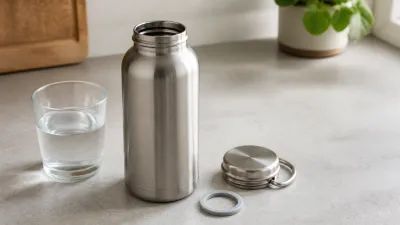
You can put a carbonated drink in a stainless steel bottle only when the manufacturer approves that exact bottle, lid, and configuration for carbonation. Stainless steel is not a pressure rating. A closure intended for still water may leak, spray, or release abruptly when carbon dioxide raises pressure inside it.
The safest evidence is an explicit statement in the current manual or product instructions. A “leakproof” label, an insulated body, a familiar alloy name, or carbonation approval for another lid does not answer the question.
The September decision rule
Use this evidence order before treating a bottle as carbonation-compatible:
- Match the exact bottle model, capacity, and lid or cap.
- Find a current manufacturer statement that explicitly allows carbonated beverages for that configuration.
- Read every stated temperature, care, inspection, and use restriction.
- If the instructions are silent, conflicting, or refer to another lid, treat the bottle as not approved.
This model-and-closure evidence rule is the substantive update to the August article. Search results now repeat broad advice about special vents and slow opening, but those design features do not let a reader certify an unknown bottle. Only the manufacturer can state the intended use of the complete configuration.
A stainless bottle designed for a carbonation system
For a Drinkmate OmniFizz setup, the manufacturer’s 0.7-liter stainless steel bottle is a relevant option to check. Drinkmate identifies compatibility with its standard fizz infuser, an internal maximum-fill line, and a top cap intended to preserve carbonation. This is a specific bottle-and-system recommendation; it does not make an ordinary stainless water bottle suitable for pressurized drinks.
Check the exact machine compatibility and supplied instructions before ordering or filling it. Follow the marked fill limit and the manufacturer’s carbonation and pressure-release procedure. Drinkmate lists the bottle as dishwasher-safe but directs owners to hand-wash the cap separately to protect its seal.
Why the bottle and lid matter more than the alloy
Carbonated drinks contain dissolved carbon dioxide. In a closed vessel, released gas can press against the closure. The bottle body may remain intact while a gasket, straw, valve, thread, latch, or cap becomes the weak point.
That is why three common marketing phrases are not enough:
| Claim | What it proves | What it does not prove |
|---|---|---|
| Stainless steel | Body material | Pressure approval |
| Insulated | Heat-transfer design | Carbonation compatibility |
| Leakproof | Performance under stated conditions | Safe behavior with a pressurized drink |
Bare stainless does not contain BPA, but a material-composition fact cannot approve the complete bottle for pressure. Lids and seals also contain other materials whose limits matter.
What current manufacturer guidance shows
Owala FreeSip
Owala’s current product guidance excludes carbonated liquids from the stainless steel FreeSip. It warns that pressurized contents can leak or spray and can make the spout cover open abruptly.
The same company permits carbonation in some other named products. That contrast is useful evidence: brand ownership, stainless construction, and a similar appearance do not transfer approval from one model to another.
YETI Rambler Chug Cap
YETI says not to use the Rambler Bottle Chug Cap with carbonated beverages. The warning concerns the cap configuration, so the bottle body’s other capabilities do not override it.
Hydro Flask Wide Mouth configurations
Hydro Flask publishes guidance by product and cap. Its 32-ounce Wide Mouth with Flex Cap does not explicitly grant carbonation approval on the product page, while the Wide Mouth with Flex Straw Cap explicitly excludes carbonation.
Silence is not permission. When an exact configuration lacks a clear approval, use the original beverage package or a vessel whose instructions expressly include carbonated drinks.
What a carbonation-safe product claim must identify
A useful approval names the complete product, not merely a feature. Look for the model, lid, allowed beverage type, and any operating limits in the current manual. Retailer descriptions, snippets, forum advice, and videos are secondary and can omit exclusions.
A pressure-release feature may be part of a purpose-built design. Its presence in a photo or its similarity to another product does not establish a rating. Do not test, modify, drill, swap, or improvise a vent to make an ordinary water bottle handle carbonation.
The product instructions also need to remain current. If a replacement lid, gasket, or accessory changes the configuration, recheck the manufacturer guidance rather than relying on the original bottle purchase.
Quick yes-or-no table
| Container | Use for carbonation? | Evidence standard |
|---|---|---|
| Original unopened soda container | Yes | Packaged for its contents by the producer |
| Exact reusable bottle and lid explicitly approved | Yes, within its instructions | Current manufacturer approval |
| Owala stainless steel FreeSip | No | Manufacturer exclusion |
| YETI Rambler with Chug Cap | No | Manufacturer exclusion |
| Bottle labeled only “leakproof” | No | Still-water leakage claim is not pressure approval |
| Bottle with no carbonation guidance | No | Missing evidence |
This is intentionally conservative. It avoids turning a general article into an unofficial pressure test for products whose materials, tolerances, age, and damage are unknown.
How to inspect an approved configuration
Inspection does not create approval. It can only identify reasons not to use a product that the manufacturer already allows for carbonation.
Check that the model and lid match the instructions and that all named parts are present. Do not use the bottle if the cap, threads, latch, gasket, valve, or body is cracked, distorted, missing, or altered. Follow the maker’s current care and replacement directions.
Do not borrow restrictions or procedures from another brand or model. If the instructions are unavailable, the closure no longer matches, or a part appears damaged, return to a clearly approved container.
Our stainless steel water bottle recommendations are primarily for still water. A recommendation for hydration does not silently add carbonation approval.
Does acidity make soda unsuitable for stainless steel?
Pressure approval is the first decision because it concerns the complete sealed system. Food-contact suitability, beverage composition, contact time, surface condition, and cleaning remain separate questions.
Do not assume every grade is inert in every drink or that an undamaged-looking interior proves compatibility. Use the beverage types named by the manufacturer and follow its care instructions. Our food-storage container guide explains why lids, liners, seals, temperature, and product condition have to be checked separately.
Sugary or flavored residue can collect in threads, valves, straws, and gaskets. Clean every approved removable part as directed. A stainless body does not make the closure self-cleaning.
Will an approved bottle keep soda fizzy?
It may retain carbonation while its approved closure remains sealed, but carbonation retention is a performance question, not a safety approval. Transfers and repeated opening can release carbon dioxide. Product instructions and real-world seal condition determine the result.
Do not choose an unapproved bottle merely because you want a tighter seal. The appropriate sequence is approval first, condition second, and fizz retention last.
Can you put sparkling water in a stainless steel bottle?
Only if the exact bottle and lid are approved for carbonated beverages. Unsweetened sparkling water still releases carbon dioxide and can pressurize a closure. Lack of sugar does not turn it into still water.
Can you put soda in a stainless steel bottle?
Use soda only in a configuration whose manufacturer explicitly permits it. Acidity and sugar do not remove the pressure question, and a stainless body does not answer for the cap.
What about beer?
This page owns bottle-and-lid carbonation approval for soda, sparkling water, and similar fizzy drinks. Beer serving quality, open cups, growlers, and brewery-specific handling belong in our separate guide to drinking beer from stainless steel.
Do not transfer evidence in either direction. A professionally filled growler does not approve a water bottle, and a carbonation-rated consumer bottle does not establish beer flavor, sanitation, or brewery fill policy.
What if the wrong bottle already contains a fizzy drink?
Stop using the container, keep people away, and consult the manufacturer’s instructions or support channel for that exact model. If the closure is distorted, leaking, jammed, or behaving unexpectedly, do not improvise a procedure from general internet advice.
This article deliberately does not provide filling, venting, headspace, opening, fermentation, dry-ice, or pressure-testing instructions. Those details must come from the maker of a product designed for the use.
The bottom line
A stainless steel bottle is suitable for a carbonated drink only when its exact body-and-lid configuration has current manufacturer approval. Alloy, insulation, leak resistance, and visible vent-like parts cannot substitute for that evidence. If guidance is missing, choose the original package or a clearly approved product.
The coffee and travel mug guide and stainless thermos guide also separate leak resistance from carbonation approval.
Sources
- Drinkmate, 0.7L stainless steel bottle compatibility and care (checked 2026-09-07)
- Owala, current product guidance (rechecked 2026-08-19)
- YETI, Rambler Bottle Chug Cap guidance (rechecked 2026-08-19)
- Hydro Flask, 32 oz Wide Mouth with Flex Cap (rechecked 2026-08-19)
- Hydro Flask, Wide Mouth with Flex Straw Cap (rechecked 2026-08-19)