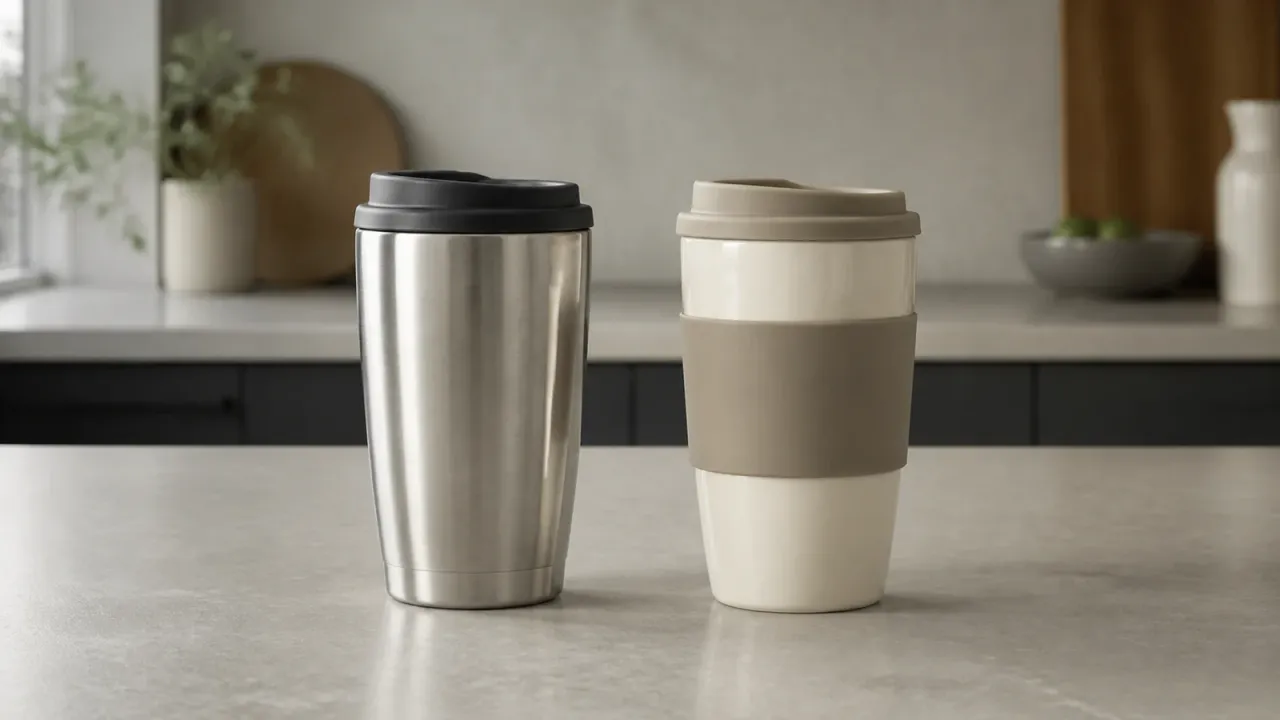
Choose a bare stainless steel travel mug when you want a clearly identified metal food-contact surface, a handled insulated design, and the simplest replacement-part path. Choose ceramic-lined metal when you want a stainless vacuum body with a ceramic coating between the drink and the steel. Choose a solid ceramic travel mug only when its maker documents the lid, thermal-use limits, and care instructions for the way you carry it.
There is no universal safety or taste winner here. “Ceramic travel mug” can mean a solid ceramic body, a ceramic coating over stainless steel, or a ceramic insert. Those are different constructions. The lid, gasket, rim, exterior, and the condition of the surface matter just as much as the material name on the front of the package.
Stainless steel vs ceramic travel mugs at a glance
| Decision | Bare stainless steel | Ceramic-lined metal | Solid ceramic | Best starting point |
|---|---|---|---|---|
| Drink-contact surface | Stainless steel interior, when the maker identifies it | Ceramic coating over a stainless body | Ceramic body or liner, if the maker identifies it | Match the documented surface to your priority |
| Carrying in a bag | A maker’s leak claim and replacement seal matter more than the word stainless | Same closure check; the coating does not make a lid leakproof | Use a bag only when the exact maker documents a suitable closure | The exact lid and seal |
| Insulation | Often paired with a vacuum body, but construction is product-specific | Often paired with a vacuum stainless body | May be double-walled, but do not infer vacuum performance from ceramic | The exact construction and test conditions |
| Damage concern | Can dent or scratch; inspect the rim and interior | The coating can be damaged independently of the metal body | Ceramic can crack or chip, and thermal shock is a separate risk | The damage mode you can manage |
| Cleaning and repair | Some handled mugs have official replacement lids | Check coating care and replacement gasket availability | Check for thermal-shock rules and replacement-part support | A documented care and parts path |
| Taste language | Do not generalize from the material name | A maker may make a ceramic-interior taste claim | Do not assume every glaze behaves the same way | Treat taste statements as product-specific |
This table is a decision framework, not a certification or a head-to-head test. A stainless body can have a plastic or ceramic drink-contact surface, and a ceramic-bodied mug can have a silicone lid with its own care limits. Read the exact product page and instructions before treating any travel mug as suitable for food or drink contact.
Which travel mug is better for a bag?
Start with the closure, not the body material. Thermos describes the Stainless King Mug’s DrinkLock lid as leakproof when it is closed and properly assembled. Fellow describes the Carter Move’s twist-to-lock seal as leak-proof. Those are maker claims for those exact lid systems. They are not properties shared by every stainless or ceramic mug.
The solid ceramic Beverlin Hills Travel Mug reviewed for this comparison has a BPA-free silicone lid with a soft, splash-resistant seal. Its maker page does not make the same leakproof transport claim. That difference is enough to change the carrying decision. A splash-resistant desk mug should not be treated as a bag-safe mug merely because its lid fits snugly.
Inspect the drinking opening, gasket, threads, and lid alignment before carrying any mug around electronics or documents. Follow the maker’s assembly and cleaning directions, and replace a seal or lid with the exact compatible part when one is available. If the maker does not document a transport claim, keep the mug upright and use it in a setting where a spill is manageable.
For a broader set of closure and capacity decisions, our best stainless steel coffee and travel mugs guide covers handled mugs and bottle-shaped options separately. This comparison stays focused on what the body and drink-contact surface change.
Which material is easiest to evaluate for food contact?
The most useful question is not whether stainless steel or ceramic is “safer” in the abstract. Ask which finished surface touches the drink, whether the manufacturer identifies the material and intended use, and whether the surface remains smooth and intact.
The FDA Food Code is a model code used as a reference by jurisdictions and food-service operators. Its food-contact provisions say materials should not allow harmful migration or impart colors, odors, or tastes, and describe surfaces that are safe, durable, corrosion-resistant, nonabsorbent, smooth, and easy to clean. The code also addresses chips, cracks, pits, crazing, scratches, and distortion. It is a useful framework for questions to ask, not a blanket certification of a particular travel mug.
Ceramic needs one extra check. The Food Code includes lead limits for ceramic, china, and crystal food-contact utensils, with limits that vary by vessel type. A product page that merely says “ceramic” does not establish its migration test results or compliance. Do not turn the material label into a lead-free claim.
Food-contact materials
| Surface or part | Verified material | Source and limit |
|---|---|---|
| Thermos Stainless King body and interior | Thermos identifies 18/8 stainless steel construction; no ceramic coating is listed on the reviewed exact product page | Thermos Stainless King Mug identifies the construction. Confirm the current exact model and instructions. |
| Fellow Carter Move body and interior | Fellow identifies an 18/8 stainless steel body, an inner ceramic coating, and a BPA-free plastic lid | Fellow Carter Move identifies the body, coating, and lid materials. |
| Beverlin Hills Travel Mug body and lid | Beverlin Hills identifies a double-walled ceramic tumbler and a BPA-free silicone lid | Beverlin Hills Travel Mug identifies the ceramic body and silicone lid. The reviewed page does not publish a lead or migration result. |
| Food-contact surface generally | The FDA model code calls for food-contact materials and surfaces that meet safety, cleanliness, and condition requirements | FDA 2022 Food Code, §§4-101.11, 4-101.13, and 4-202.11. This is a model-code reference, not product certification. |
This also explains why a ceramic-lined mug is not the same thing as a solid ceramic mug. In the Carter Move, the drink reaches the ceramic coating, while the structural body is stainless steel. In the Beverlin Hills example, the maker identifies the tumbler body itself as ceramic. A ceramic interior may address a maker’s taste or surface goal without giving the mug the crack and thermal-shock behavior of a solid ceramic body.
Which mug keeps a drink hot or cold?
Insulation depends on the whole construction: wall arrangement, vacuum or air gap, lid, opening, fill level, starting temperature, and test method. It is not possible to rank stainless steel against ceramic using the material names alone.
The reviewed Thermos page describes a double-wall vacuum body and claims up to seven hours hot and eighteen hours cold for the 16-ounce Stainless King Mug. Fellow describes the Carter Move as double-wall vacuum insulated and lists maker claims of twelve hours hot and twenty-four hours cold. Those figures come from different products and test conditions, so they are not a controlled comparison. They show what each maker documents, not what either material universally achieves.
A solid ceramic body can be double-walled too. Beverlin Hills describes its mug as double-walled and warns users to avoid sudden temperature changes to help prevent thermal shock. The page does not provide a cross-brand retention test or a vacuum specification. Treat that as a construction and care distinction, not proof that solid ceramic is a poor insulator.
If heat retention is your deciding factor, compare the exact maker’s test conditions, lid design, opening size, and care limits. Our guide to the best stainless steel thermoses covers larger, flask-style vessels, but a thermos result should not be transplanted into a travel-mug comparison without checking the design.
If you are really choosing a bottle-shaped vessel for a longer carry, see the best stainless steel water bottles. Bottle openings, caps, and cleaning access create a different set of tradeoffs than a handled travel mug.
Which construction is easiest to clean and repair?
Cleaning access is a stronger buying signal than the body label. Travel mugs collect residue around the lid, gasket, threads, splash guard, and drinking opening. Separate those parts only as the maker allows, let them dry fully, and do not assume a dishwasher-safe body makes every lid or seal dishwasher safe.
Thermos lists top-rack dishwasher care for the Stainless King Mug and sells a genuine replacement DrinkLock lid for compatible SK1000, SK1005, and H101 models. That gives the bare stainless example a documented way to address a worn or lost closure without replacing the whole mug. Confirm the model number before ordering a replacement.
Fellow lists the Carter Move as top-rack dishwasher safe and publishes cleaning guidance that separates the lid and gasket while they dry. Fellow also documents replacement gaskets for Carter Move and Carter Wide mugs. The inner ceramic layer remains a coating, so inspect it during cleaning and follow Fellow’s guidance if it is chipped, peeling, or otherwise damaged.
Beverlin Hills says its ceramic travel mug is top-rack dishwasher safe but recommends hand washing and warns against sudden temperature changes. The reviewed page does not provide replacement-lid or replacement-gasket information. That does not make the mug unusable; it means the long-term repair path is less documented in the evidence reviewed here.
Do not use abrasive tools or improvised replacement seals just because a mug is made from stainless steel or ceramic. The finished surface and closure are a system, and a mismatched gasket can defeat an otherwise well-designed lid.
How should damage change the decision?
Bare stainless steel generally gives you a dent or scratch to assess, while ceramic introduces crack, chip, and thermal-shock concerns. That is a difference in inspection, not a universal durability ranking. A deep dent can distort a rim or lid fit, and a scratch, pit, or corrosion spot can change whether a surface remains smooth and cleanable.
Ceramic-lined metal adds a third damage mode. The metal body may look intact while the inner coating has been damaged. A coating is not the same as a solid ceramic liner, and it should not be treated as interchangeable with one. If the coating no longer looks continuous or the maker’s care instructions no longer cover the condition, stop using the mug for drink contact and ask the manufacturer about replacement or disposal.
With solid ceramic, inspect the rim, body, and base for cracks or chips. A crack can be difficult to see when the mug is empty, and a chipped rim can create a sharp edge. Follow the maker’s instructions about temperature transitions. Beverlin Hills specifically warns against sudden temperature changes; that warning belongs to the exact product and should not be generalized to every ceramic mug.
The FDA model code’s smooth-surface and condition language is a useful reminder to examine the finished article, not just the raw material. When the surface has a break, chip, open seam, deep pit, or other defect that interferes with cleaning or safe use, the material comparison is over. Replace the part or mug according to the maker’s instructions.
Representative exact examples
These examples show how the material distinction appears in current products. They are not ranked winners or hands-on test results. Ratings and review counts below come from dated exact-ASIN marketplace records captured on August 22, 2026. Construction, closure, thermal, and care statements come from the current maker pages linked in the article.
Ceramic-lined metal example

Fellow Carter Move Mug 16 oz
4.5 out of 5 (33 ratings, as of August 22, 2026)
A 16-ounce 18/8 stainless travel mug with an inner ceramic coating, twist-to-lock seal, splash guard, and maker-documented vacuum insulation.
- Fellow identifies the ceramic interior as a coating rather than a solid ceramic body
- Twist-to-lock seal and removable splash guard are documented
- Exact marketplace record captured on August 22, 2026
Pros
- Keeps the stainless structural body while giving the maker's ceramic-interior option
- Current maker guidance covers cleaning and replacement gaskets
- The exact model has a clearly documented body, interior, and lid material split
Cons
- The ceramic layer is still a coating and needs inspection for damage
- Maker retention and taste statements are not a controlled comparison with other mugs
- Marketplace ratings and availability can change after the dated capture
Considerations
Best when you specifically want ceramic at the drink-contact surface but prefer a stainless insulated body. Follow Fellow's care guidance if the coating or seal is damaged.
Bare stainless example
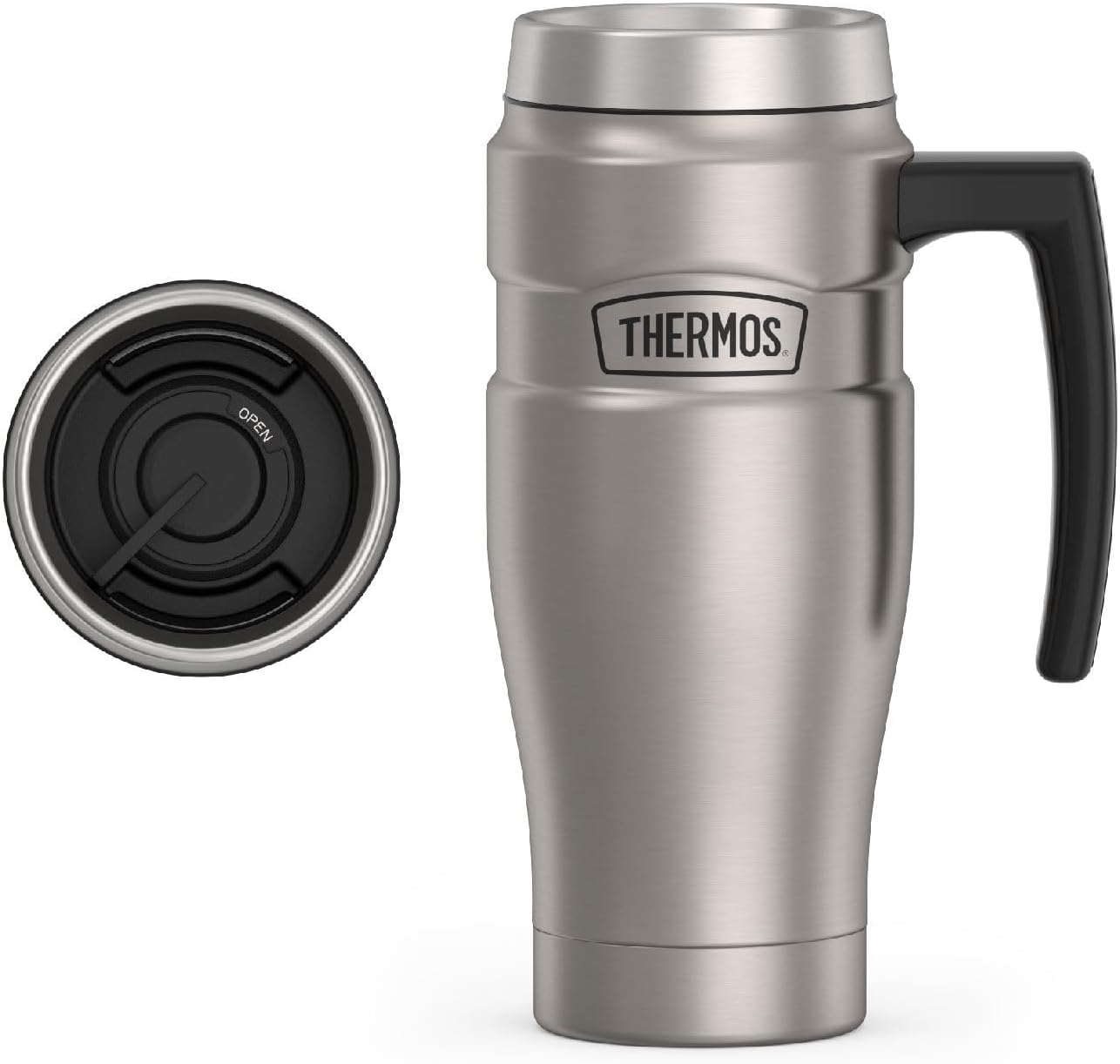
THERMOS Stainless King 16-Ounce Travel Mug
4.5 out of 5 (124 ratings, as of August 22, 2026)
A 16-ounce double-wall vacuum mug with 18/8 stainless construction, DrinkLock lid, handle, tea hook, and cup-holder fit.
- 18/8 stainless construction with a double-wall vacuum body
- DrinkLock lid, side handle, tea hook, and cup-holder-compatible shape
- Exact marketplace record captured on August 22, 2026
Pros
- The maker's food-contact construction is straightforward to identify
- Official replacement-lid support gives the closure a documented parts path
- The handled shape suits a desk or car-cup-holder routine
Cons
- The leak claim depends on a closed, correctly assembled lid
- A bare stainless interior does not establish a universal taste or safety result
- Marketplace ratings and availability can change after the dated capture
Considerations
Best when a documented stainless construction and replaceable DrinkLock lid matter more than a ceramic interior. Confirm the exact model before buying replacement parts.
The solid ceramic category remains a useful choice to evaluate, but it does not receive a product card here. The current Beverlin Hills page identifies a double-walled ceramic body, silicone lid, hand-washing recommendation, and thermal-shock warning, but the evidence reviewed did not establish a current exact marketplace ASIN, a leakproof transport claim, or a published lead or migration result. Preserving those unknowns is more useful than treating a solid ceramic example as a verified shopping recommendation.
How we compared
This is a research-based comparison, not a hands-on or side-by-side test. I reviewed the FDA 2022 Food Code as a general food-contact framework, current manufacturer pages for the Thermos Stainless King, Fellow Carter Move, and Beverlin Hills Travel Mug, and dated exact-ASIN marketplace records for the two representative card examples. The exact product search and records were captured on August 22, 2026.
I compared drink-contact construction, lid and seal wording, insulation documentation, damage modes, cleaning access, and replacement-part support. I did not taste-test drinks, measure heat retention, run a leak or drop test, inspect hidden layers, test migration, or verify every ceramic product’s regulatory documentation. I also did not use price, hands-on impressions, or a generic “ceramic is safer” or “stainless tastes better” rule.
The scope is intentionally narrow. This article compares bare stainless interiors, ceramic-lined or ceramic-coated stainless mugs, and solid ceramic travel-mug construction. It does not replace a general travel-mug roundup, a thermos guide, a water-bottle guide, or a product-specific care manual. For a related question about flavor claims, see does stainless steel affect coffee taste, while keeping its research limits in mind.
Travel mug questions
Is ceramic safer than stainless steel in a travel mug?
Neither material name settles that question. Look for the finished drink-contact surface, maker documentation for the exact product, a smooth and intact surface, and care instructions that fit your use. For ceramic, do not infer lead or migration compliance from the word “ceramic.” For stainless, do not assume every lid, liner, coating, or finish is stainless steel.
Does a ceramic travel mug always have a solid ceramic body?
No. A ceramic coating can sit over a stainless steel body, as Fellow documents for the Carter Move. A solid ceramic body is a different construction with different crack, chip, and thermal-shock considerations. Read the material breakdown rather than relying on the product title.
Can I put a ceramic travel mug in my bag?
Only when the exact maker documents a closure suitable for transport and the seal is correctly assembled and undamaged. A splash-resistant lid is not automatically leakproof. When the maker is silent, keep the mug upright and use a separate protective approach for valuables.
What should I do if a coating chips or the ceramic cracks?
Stop and inspect the surface, then follow the exact maker’s replacement or disposal guidance. Do not keep using a mug with a crack, sharp chip, peeling coating, or damaged seal simply because the outer body still looks usable.
Is a stainless travel mug always better for taste?
No universal taste result follows from the material label. A maker may describe a ceramic interior as reducing lingering flavors, but that is a product claim, not a controlled result for every drink or mug. Cleaning, the lid and gasket, the drink, and the condition of the interior can all affect the experience.
Which should I buy?
Choose bare stainless when its straightforward food-contact construction and replacement-lid path fit your routine. Choose ceramic-lined metal when you specifically want a documented ceramic interior with a stainless insulated body. Choose solid ceramic only after checking the exact lid, thermal-shock, cleaning, and food-contact evidence for the product you intend to carry.