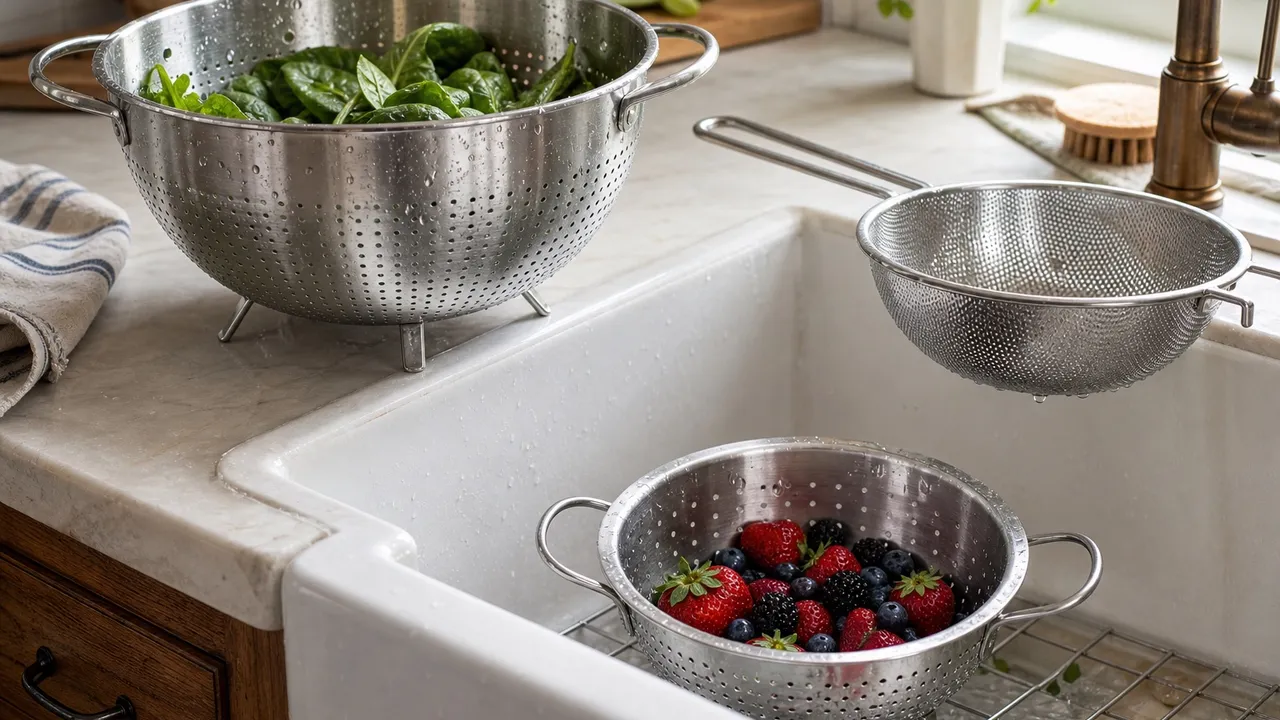
The OXO Good Grips five-quart colander is the best stainless steel colander for most kitchens. It has a useful pasta-sized capacity, raised feet for sink clearance, and broad non-slip handles that are easier to grip when the bowl is hot and full.
Choose Bellemain for micro-perforations and a plain all-steel rim, ExcelSteel for a lighter conventional design, or P&P Chef when you need three nesting capacities.
Our stainless steel colander picks
| Pick | Best for | Capacity | Hole pattern | Base |
|---|---|---|---|---|
| OXO Good Grips | Most kitchens | 5 qt | Conventional | Raised feet |
| Bellemain | Rice and small food | 5 qt | Micro-perforated | Ring base |
| ExcelSteel | Lightweight handling | 5 qt | Conventional | Self-draining ring |
| P&P Chef set | Multiple batch sizes | 1, 3, and 5 qt | Micro-perforated | Raised feet |
1. Best overall: OXO Good Grips Five-Quart Colander
OXO balances a full-size stainless bowl with handles that have non-slip grip zones. The raised feet keep perforations above the sink surface and help water escape under the bowl.
The OXO product page confirms the 5-quart capacity, non-slip handles, and nesting compatibility with OXO mixing bowls. The handle material is a separate component from the stainless food-contact bowl, so keep it away from direct flame and follow the exact dishwasher guidance.

OXO Good Grips Five-Quart Stainless Steel Colander
4.8 out of 5 (2,291 ratings, as of July 26, 2026)
A five-quart stainless steel colander with raised feet and broad non-slip handles.
- Five-quart stainless steel bowl
- Non-slip side handles
- Raised self-draining feet
Pros
- Handles remain easy to grip when the bowl is full
- Capacity suits a household batch of pasta
- Feet keep the perforations above the sink floor
Cons
- Grip material adds seams to clean around
- Conventional holes may pass small grains
Considerations
The best general-purpose balance of capacity, secure handling, and drainage for pasta and vegetables.
2. Best micro-perforated colander: Bellemain Five-Quart Colander
Bellemain replaces larger punched holes with many small perforations. That pattern retains rice, orzo, and small beans better while still draining water across a broad area.
The all-steel handles are riveted to the bowl and the ring base supports it above the sink. Rivets and the folded rim need attentive cleaning because grains and starchy foam can collect around joints.

Bellemain Five-Quart Micro-Perforated Stainless Steel Colander
4.7 out of 5 (7,783 ratings, as of July 26, 2026)
A five-quart all-steel colander with fine perforations, riveted handles, and a stable ring base.
- Five-quart stainless steel bowl
- Micro-perforated drainage pattern
- Riveted side handles and ring base
Pros
- Retains small pasta, grains, and beans
- Broad perforated area drains without one large opening
- All-steel body has no bonded grips
Cons
- Fine holes take more effort to clear
- Rivet areas can trap starchy residue
Considerations
Choose it when small-food retention is more important than the fastest possible drainage.
3. Best lightweight colander: ExcelSteel Five-Quart Colander
ExcelSteel follows the familiar punched-hole design with side handles and a self-draining ring base. The exact listing gives a light 8-ounce product weight, which makes it easier to lift but also less substantial than the OXO or Bellemain picks.
Larger holes clear water and vegetable debris quickly. They are less suitable for rice or tiny pasta shapes unless you add a separate fine-mesh strainer.

ExcelSteel Five-Quart Stainless Steel Colander
4.5 out of 5 (8,133 ratings, as of July 26, 2026)
A light five-quart mirror-polished stainless steel colander with conventional drainage holes.
- Five-quart bowl
- Side handles and self-draining base
- Light 8-ounce listing weight
Pros
- Easy to lift and store
- Large holes drain pasta and vegetables quickly
- Simple familiar design
Cons
- Small food can escape through the holes
- Light construction may flex more under load
Considerations
A straightforward choice for pasta and vegetables when low weight matters more than small-grain retention.
4. Best set: P&P Chef Three-Piece Colander Set
P&P Chef includes 1-, 3-, and 5-quart colanders. The small bowl handles berries and single servings, the middle size covers everyday produce, and the large one drains pasta.
All three use micro-perforations, side handles, and raised bases. Multiple nested bowls save cabinet width but can trap water, so separate them until every surface is dry.

P&P Chef Three-Piece Stainless Steel Colander Set
4.6 out of 5 (2,596 ratings, as of July 26, 2026)
Three micro-perforated stainless steel colanders in one-, three-, and five-quart capacities.
- One-, three-, and five-quart colanders
- Micro-perforated stainless steel bowls
- Side handles and raised feet
Pros
- Capacity for small rinsing through full pasta batches
- Fine holes retain small ingredients
- Bowls nest for storage
Cons
- Three pieces may be unnecessary in a small kitchen
- Nested bowls must be dried separately
Considerations
Best when you routinely rinse different batch sizes and will use all three capacities.
How we chose
This is an editorial comparison, not a hands-on drainage-speed test. We reviewed exact-ASIN Amazon snapshots captured through Bright Data on July 26, 2026, then checked capacity, handles, base clearance, hole pattern, and cleanability. Our food-grade stainless steel guide explains the limits of a broad material label.
We prioritized:
- Stainless steel as the bowl’s food-contact material.
- A stable base that permits drainage above the sink.
- Handles that suit the expected loaded weight.
- Hole sizes matched to a clear use.
- Joints and rims that can be cleaned and dried.
Micro-perforated versus conventional holes
Micro-perforations retain rice, small pasta, and beans. Because there are many holes, they can still drain quickly, but starch and seeds may require a brush to remove.
Conventional larger holes shed water and debris easily. They work well for standard pasta and vegetables but can lose grains. Neither pattern replaces a fine-mesh sieve for flour, stock, or very small seeds.
How large should a colander be?
A 5-quart colander is the versatile household size. It holds a typical pasta batch while leaving enough room to shake and drain. A 1-quart bowl is convenient for berries but cannot safely receive a large pot of boiling water.
Match the colander to the pot before lifting. The best stainless steel stockpots roundup covers large pasta vessels, while stainless steel steamer pots use fitted perforated inserts for a different job.
Perforation size also matters in other prep tools: our stainless steel potato ricer guide compares fixed, adjustable, and removable-disc systems for cooked food rather than drainage.
How to drain hot food safely
- Clear the sink before carrying the pot.
- Keep the colander stable and do not balance it on dishes.
- Turn pot handles inward and use dry mitts.
- Pour away from your face and body.
- Let steam escape before shaking the bowl.
- Confirm the sink is clean if food might touch it.
A colander is not automatically a stovetop steamer. Use one over heat only when its construction, handles, and fit are suitable and the maker approves that use. The steamer basket guide explains the setup.
Stainless steel colander questions
Can you drain rice in a stainless steel colander?
Yes, if the holes are smaller than the grains. A micro-perforated colander is more reliable than one with conventional pasta holes.
Can a stainless steel colander go in the dishwasher?
Many can, but grip materials and finishes vary. Follow the exact product guidance, clear food from perforations, and dry nested pieces separately.
Is a colander the same as a strainer?
A colander is usually a bowl with larger holes for rinsing and draining. A strainer or sieve often has fine mesh for smaller particles and liquids. Product names are inconsistent, so choose by hole size and task.