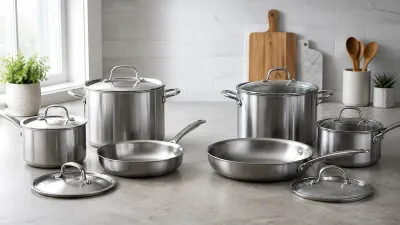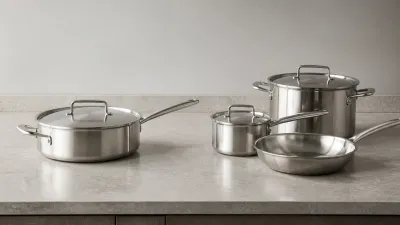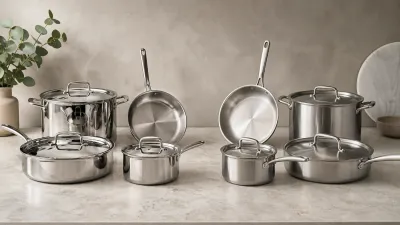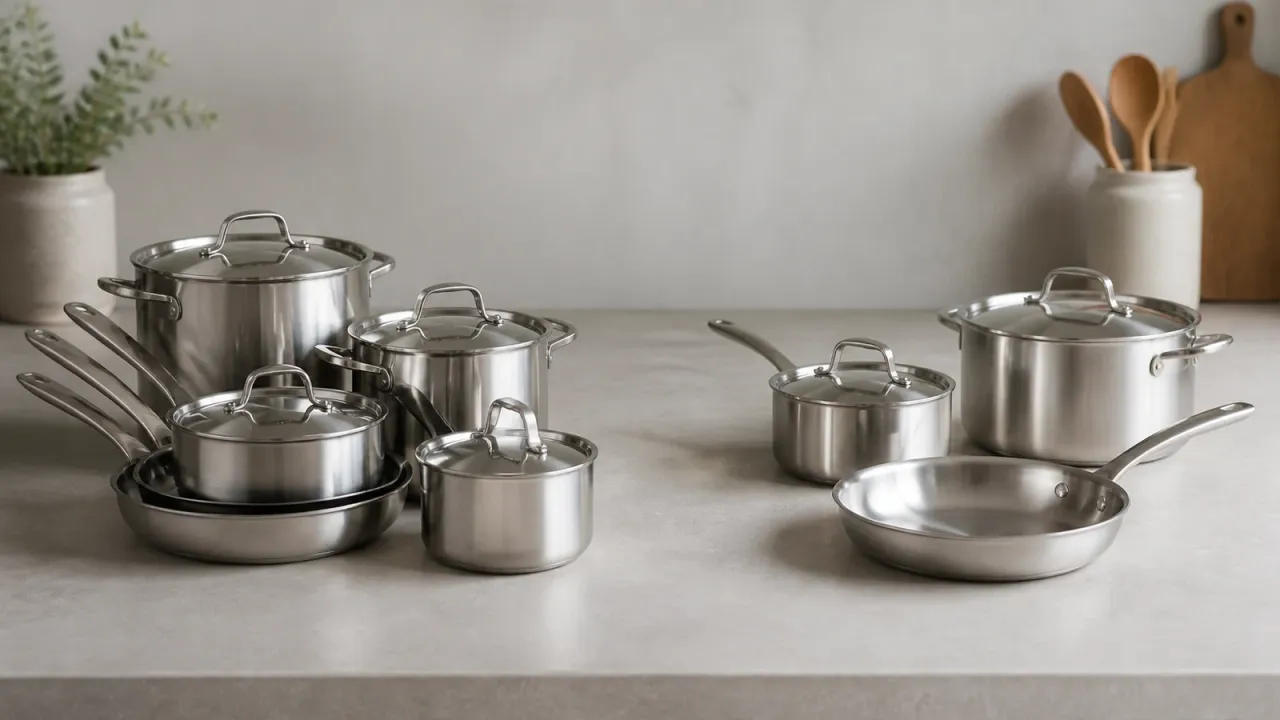
Choose a cookware set when most of its cooking vessels match how you cook and you have room to store the group. Buy individual stainless steel pieces when you already own useful pans, need one specific size, or want to replace a single gap without adding duplicates.
For cookware set vs individual stainless steel pieces, start with the vessels you will use, then check lids, storage, construction, and the replacement path. A ten-piece box can be a tidy starting point, but its advertised count may include lids and a shape you rarely use.
Cookware set vs individual pieces at a glance
| Decision | A cookware set | Individual pieces | Better fit |
|---|---|---|---|
| Vessel coverage | Several common shapes arrive together | Add only the shapes and sizes on your list | Set for a new kitchen; pieces for a stocked one |
| Duplicate risk | High if you already own pans or do not use every size | Low when each purchase fills a named gap | Pieces |
| Lids and piece count | Matching lids may count as separate pieces | Buy a lid only when the vessel needs one | Depends on the set |
| Storage | Nesting can help, but the full group needs a home | Fewer additions at a time | Pieces for tight cabinets |
| Replacement | A single damaged vessel may not match the rest | Replace one vessel in the same line when available | Pieces |
| Value check | Compare the live set price with only the vessels you need | Sum the live prices for the same needed vessels and lids | Use the worksheet below |
| Construction and limits | One line may give you consistent materials and compatibility | You can change line or shape for each gap | Depends on evidence and priorities |
How we compared
This is a research-based comparison, not a hands-on or side-by-side test. I used Bright Data Amazon discovery, then checked exact-ASIN marketplace records and current All-Clad maker pages on August 21, 2026. The representative line is All-Clad D3 Stainless because its current maker site lists a ten-piece set and individual vessels in the same tri-ply family.
The exact set record used here is ASIN B005H8KD3E. Bright Data reported an All-Clad D3 Stainless ten-piece set, a 4.5 rating from 1,227 ratings, and an In Stock state at retrieval. Its marketplace model number was 11644502768. The current D3 ten-piece maker page lists maker model 401488LR and maker SKU 8400002424, the same six cooking-vessel roles and four lids, stainless steel material, a polished stainless exterior, a 600°F oven and broiler limit, hand-wash-only care, and a limited lifetime warranty. Those identifiers are related evidence, not interchangeable SKU numbers.
The individual example is ASIN B004T6PS80, the D3 three-quart saucepan with lid. Bright Data reported a 4.7 rating from 4,346 ratings and In Stock at retrieval; its marketplace model number was 11644502270. The current D3 three-quart saucepan maker page lists model 4203R SC, a two-piece pan-and-lid count, stainless steel material, the same 600°F oven and broiler limit, hand-wash-only care, and a limited lifetime warranty.
The maker pages exposed an add-to-cart path, but not a comparable explicit inventory quantity. Amazon availability is a dated snapshot, not a promise that the same listing, seller, or variant will be available when you shop. I did not use article prices, calculate savings, or treat a rating as a test result.
Representative exact products, not a roundup
These cards show how to reconcile a set and a single replacement piece. They are illustrative evidence for the buying method, not the site’s picks for the best set, skillet, saucepan, or stockpot.
Illustrative matched set
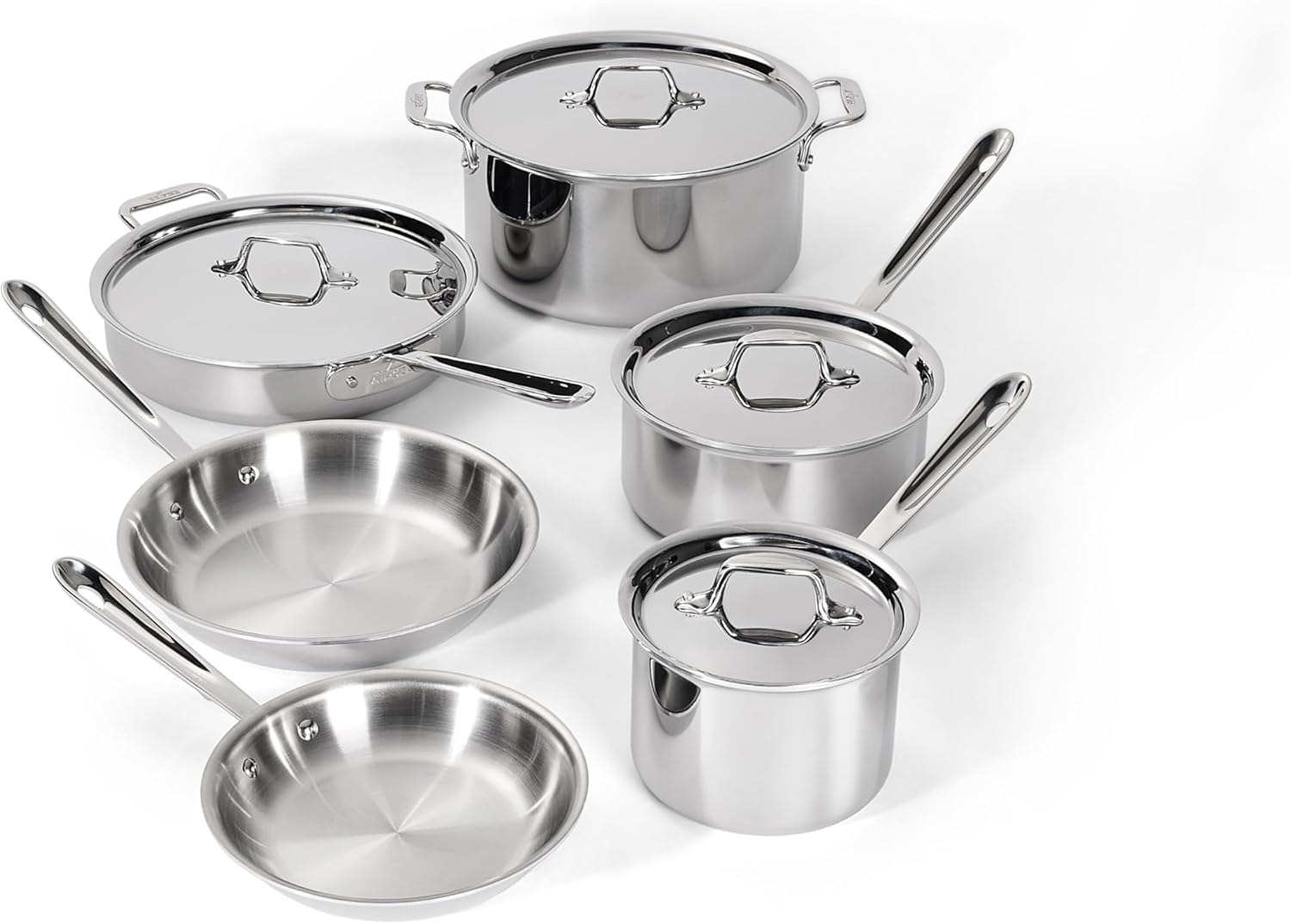
All-Clad D3 Stainless 10-Piece Cookware Set
4.5 out of 5 (1,227 ratings, as of August 21, 2026)
Best for: A new kitchen that will use most of the listed fry pans, saucepans, sauté pan, and stockpot
- Contents
- 8- and 10-inch fry pans, 2- and 3-quart saucepans, 3-quart sauté pan, 8-quart stockpot, and four lids
- Construction
- D3 fully bonded tri-ply with an aluminum core and stainless steel surface
- Limits
- All cooktops including induction; oven and broiler safe to 600°F
Trade-off: The box is efficient only when its vessel list matches your inventory. The Amazon model number and maker model number differ, so verify the current contents before ordering.
Check price on AmazonIllustrative individual piece

All-Clad D3 Stainless 3-Quart Saucepan with Lid
4.7 out of 5 (4,346 ratings, as of August 21, 2026)
Best for: A cook who needs one covered three-quart saucepan without buying a full assortment
- Contents
- One 3-quart saucepan and one matching lid
- Construction
- D3 fully bonded tri-ply with an aluminum core and stainless steel surface
- Limits
- All cooktops including induction; oven and broiler safe to 600°F
Trade-off: A single piece fills a clear gap, but adding several unmatched sizes can leave you managing different lids, handles, care rules, and warranty terms.
Check price on AmazonThe maker’s D3 three-quart saucepan page is the source for the component, construction, compatibility, care, and warranty claims beside the card. The exact marketplace record and maker page use different model strings, so use the ASIN to locate the listing and the maker page to check the current specification.
Start with a vessel-inventory decision tree
Work through these questions before opening a set page.
- Do you need most of the cooking vessels in this exact set during the next buying cycle? If yes, compare the set’s contents with your list. If no, start with individual pieces.
- Do you already own a useful fry pan, saucepan, sauté pan, or stockpot? Mark that vessel as covered. Do not count a duplicate as value simply because it is included.
- Does the set contain the sizes you actually use? A 3-quart saucepan and an 8-quart stockpot solve different jobs; a similar count does not make them substitutes.
- Will the set’s lids fit the vessels you use most? Count each lid separately, and check whether the set includes a lid for the shape you plan to cover.
- Can every piece nest or stand in the storage area you have? Include handles, lid knobs, helper handles, and the space needed to lift a lower pan out.
- If one vessel is damaged, can you buy that exact size and lid later? A line with individual replacement pieces has a different ownership path from a set that becomes a mixed collection after one replacement.
If your answers are “yes, most of the vessels fit” and “yes, I can store them,” a set is a sensible route to price-check. If you answer “no” to either, buy the named gaps separately and revisit a set only when the inventory changes.
The vessel-inventory worksheet
Fill this in with your own sizes and cooking frequency. Use one row per vessel, not one row per marketing piece.
| Cooking role | Size I need | Already own? | Matching lid needed? | Used at least monthly? | Set overlap or gap? | Buy now? |
|---|---|---|---|---|---|---|
| Fry pan | ||||||
| Saucepan | ||||||
| Sauté pan | ||||||
| Stockpot | ||||||
| Other shape |
The worksheet keeps two questions separate: “Would I use this vessel?” and “Is it included in the box?” Only vessels you would otherwise buy belong in the set-versus-pieces value comparison. Unwanted duplicates get no assumed value.
Set contents and the break-even worksheet
Piece counts need a close read. The selected D3 set has six cooking vessels and four lids, which totals ten pieces. The selected saucepan listing has one pan and one lid, which totals two pieces. A set with inserts, steamer baskets, or utensils may count those accessories too. Compare the actual components, not the largest number in the title.
The Viking and All-Clad 10-piece set comparison shows how equal piece counts can contain different pan sizes. The Hestan ProBond and All-Clad D3 set comparison gives another vessel-by-vessel example for filling out your worksheet.
Use your own live prices at the time you shop. Do not copy a remembered sale price into the calculation, and do not treat an unwanted duplicate as a discount.
Set route = current price for the exact set + delivery or tax that applies

Individual route = current price of each needed vessel
                  + current price of each needed lid or insert
                  + delivery or tax that applies

Set-only extras = vessels, lids, or accessories I would not otherwise buy
The set route passes the value test only when its exact contents cover enough of your worksheet to justify the extra storage and care. If the set includes two pans you will never use, leave them out of the useful-vessel count. If individual pieces require several separate deliveries, include that friction in your own comparison without assuming the result will hold for another sale or seller.
Redundancy, storage, and replacement
Redundancy is the main reason a set loses its appeal after the first kitchen inventory. Two fry pans can be useful when you cook several components at once, but a second pan is clutter when one already covers the job. A second lid can be helpful only if it fits a vessel you use; a lid for an unwanted size is still storage.
Storage changes the decision in small ways that product pages rarely show. Nested pans can save shelf width, while long handles can block a drawer. Lids may nest poorly even when the vessels nest well. Measure cabinet depth and opening width, then account for the set’s tallest knob and widest helper handle. Individual purchases let you pause after each useful addition, which can be easier in a small kitchen.
Replacement deserves its own line on the worksheet. Ask whether the maker sells the same vessel and lid individually, whether the replacement has the same size and construction, and whether the warranty covers a manufacturing defect under its current terms. A replacement from a different family can create a mixed set with different oven limits, finishes, or care directions. That may be acceptable, but it should be a deliberate choice.
For the larger-vessel part of the inventory, our guide to choosing a durable stainless steel stockpot for home cooks is a separate stockpot decision. It should inform a gap in your worksheet, not turn this comparison into a ranking of stockpots.
Construction, food contact, and compatibility
The D3 example uses tri-ply construction: a stainless steel cooking surface and exterior around an aluminum core, bonded through the vessel body according to the maker. The core is enclosed in the intact clad construction. Read what fully clad cookware means if a set listing only says “tri-ply” without explaining whether the layers reach the sidewalls.
Construction and food contact answer different questions. The maker lists stainless steel material and a stainless steel surface for the selected D3 set and saucepan. That does not establish a health outcome, a nickel exposure level, or a universal food-safety conclusion. For broader tradeoffs, see the pros and cons of stainless steel cookware.
Both selected D3 maker pages list compatibility with all stovetops, including induction, and an oven and broiler limit of 600°F. They list hand washing, rather than a dishwasher permission, as the care path. Check the exact vessel and lid before transferring a family-level limit to a different collection or accessory.
Food-contact materials
This review separates the surface that touches ingredients from the enclosed core, exterior, handles, and lids. The table records what the current maker pages identify and what they leave unspecified.
| Surface or component | Verified material | Source and limit |
|---|---|---|
| D3 set cooking surfaces | Stainless steel surface; the page describes an aluminum core enclosed by stainless layers and does not describe a chemical nonstick coating | Current D3 ten-piece maker page. The page does not publish a separate migration report or a full alloy grade for every vessel. |
| D3 three-quart saucepan cooking surface | Stainless steel material and surface; the exact marketplace record also calls the surface 18/10 stainless | Current D3 three-quart saucepan maker page. The maker page is the primary source here and does not provide a separate lab report. |
| Enclosed core | Aluminum inside the tri-ply body, not the named food-contact surface | D3 ten-piece maker page describes the tri-ply construction. The conclusion assumes an intact vessel, not a damaged or altered one. |
| Lids and handles | Stainless material is listed for the line, but the pages do not separately identify every lid interior or handle alloy | D3 three-quart saucepan maker page. Lids and handles are not treated as cooking surfaces. |
The practical material conclusion is narrow: the selected D3 set and saucepan document stainless steel cooking surfaces with an enclosed aluminum core. If a particular grade, nickel question, coating, or food-contact test matters to your decision, ask the maker for current documentation for the exact model.
When individual pieces make more sense
Buy pieces when you have a working collection and one vessel is missing. This route also fits cooks who need an unusual capacity, want to replace one pan without changing every other pan, or have cabinets that cannot take a complete set. Keep the line, material, lid fit, oven limit, and care directions in your worksheet so the collection remains coherent.
Buy a set when its exact cooking-vessel list fills most of the gaps in one buying cycle. A set can simplify matching construction and lids, but the convenience disappears if you pay for shapes that stay in the back of the cabinet. Use the best stainless steel cookware sets roundup when you have already decided that a set is the route; this page owns the set-versus-pieces method.
For a single fry-pan gap, use the same worksheet and then move to a dedicated stainless steel frying-pan guide. That keeps a vessel recommendation separate from the purchase-method decision here.
What we rejected and what remains uncertain
I did not use a current maker page for a different D3 ten-piece variant that labels its three-quart vessel a casserole. Its set contents and maker model 401877LR differ from the selected page’s two-saucepan assortment and model 401488LR, so combining those descriptions would blur the inventory decision. I also did not use an exact skillet ASIN as a card because this article only needs one individual-piece example and the selected set-plus-saucepan pair already has shared image-map coverage.
Bright Data records and maker pages are snapshots. They do not show how a pan feels in the hand, how food releases in a controlled test, how evenly it heats, or how a finish changes after years of use. I did not perform cooking, temperature, weight, storage, cleaning, or long-term ownership tests. Re-check the exact ASIN, maker model, set contents, availability, compatibility, care, and warranty before ordering.
The short answer
Choose the set if your worksheet marks most of its vessels as needed, the lids fit your routine, and the storage plan works. Choose individual stainless steel pieces if you need one or two gaps, already own the common shapes, or want replacement flexibility. In either case, compare the exact vessel list and current evidence before you compare the headline piece count.