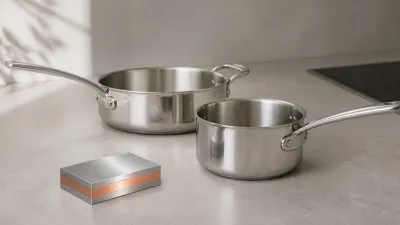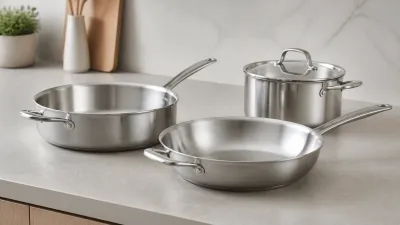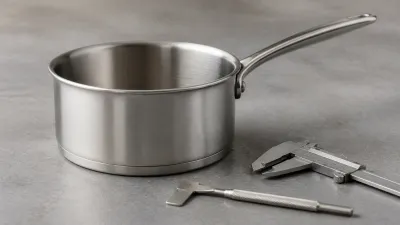
Fully clad cookware bonds multiple metals across the entire vessel, from the cooking surface through the base and up the sidewalls. The usual design puts a conductive aluminum or copper core between stainless steel layers, combining more even heat movement with a durable, nonreactive cooking surface.
Cladding coverage, not ply count, is the defining feature. A three-ply pan can be fully clad, while cookware advertised with a multi-layer base may carry its conductive material only under the cooking floor.
What does fully clad mean?
Fully clad means that bonded metal layers continue from the bottom into the walls of a pot or pan. Tramontina’s explanation of tri-ply clad cookware describes stainless steel around an aluminum core, with all three layers running from base to rim. That coverage distinguishes it from a bonded or encapsulated disc attached only to the bottom.
The phrase does not identify one fixed recipe. Manufacturers can vary the core metal, the thickness of each layer, the exterior alloy, and the overall gauge. Some five-ply designs alternate stainless steel and aluminum. Others use a thick aluminum core plus additional alloys for induction compatibility. Read the construction diagram rather than treating “fully clad” as a complete specification.
Why does stainless steel cookware need a conductive core?
Stainless steel makes a durable cooking surface, but it conducts heat much less readily than aluminum or copper. A conductive core spreads burner energy across more of the cooking surface. The surrounding stainless layers provide corrosion resistance, a food-contact surface, and, when the exterior is magnetic, induction compatibility.
This combination explains why many of our recommended stainless steel cookware sets use an aluminum core. It also explains why a stainless label alone says little about heating behavior. Core material, core thickness, vessel diameter, and total mass all matter. The guide to aluminum cores in stainless pans shows what the concealed conductive layer does.
The same distinction appears in specialty cookware. Our stainless steel roasting pan comparison separates a fully clad model from heavy-gauge and bonded-base alternatives so you can decide whether stovetop sauce making justifies the added mass.
Does full cladding improve cooking?
Full cladding matters most when food touches or heat travels through the sidewalls. A sauté pan uses its broad floor for browning, but its walls also take part when reducing sauces or cooking a crowded batch. A saucepan benefits when a thick mixture climbs the sides and would otherwise encounter a cooler band.
The gain can be smaller in a tall stockpot used mainly for water, soup, or stock. Most burner energy enters through the base, and circulating liquid moves heat inside the pot. A well-sized bonded base can therefore be a sensible design for that job. Compare those tradeoffs in our stainless steel stockpot recommendations.
Fully clad construction does not guarantee an evenly heated pan. An undersized burner, a thin core, poor pan-to-burner contact, or abrupt heat changes can still create uneven results. It is one useful specification, not a performance certificate.
Is more ply always better?
No. Ply count tells you how many bonded layers a manufacturer counts, but not their thickness, mass, or purpose. A thick three-ply aluminum core can contain more conductive metal than a thinner five-ply build. Added stainless layers can change stiffness and heat retention without producing a simple, universal improvement.
All-Clad describes D5 as alternating stainless steel and aluminum layers, including a steel core intended to produce steadier heating. By contrast, a conventional tri-ply design uses stainless steel inside and outside around one aluminum core. Both arrangements can work well. Our three-ply versus five-ply cookware comparison explains how to choose without relying on the larger number.
How do weight and heat response change the choice?
Heavier cookware usually takes more energy and time to change temperature. That can make it feel steady during searing or a long simmer, but it also slows burner adjustments and makes a full pan harder to lift. Lighter cookware often feels more responsive and is easier to handle, though a very thin core may spread heat less evenly.
Published pan weight is useful only when comparing the same vessel type and size. A lid, helper handle, and wider cooking surface can outweigh a difference in ply count. If wrist comfort matters, compare listed weights and handle shapes, then lift the pan in person when possible.
Which vessels benefit most from full cladding?
Frying pans, sauté pans, sauciers, and saucepans tend to make the strongest case for full cladding because their walls take part in cooking or evaporation. Our stainless steel saucepan guide applies the distinction to compact liquid-focused pans.
Stockpots and straight-sided pots used for boiling can work well with a thick bonded base. A disc can also add useful mass and keep the price down. The main warning is fit: a disc that stops well inside the outer wall can leave a temperature transition near the edge of the cooking floor.
Our disc-bottom versus fully clad comparison separates those vessel-specific tradeoffs.
Does fully clad cookware work on induction?
It works on induction only when the exterior layer is magnetic and the base fits the cooktop’s detection requirements. Full cladding describes coverage, not magnetism. A pan can be fully clad yet lack a suitable exterior, while a disc-bottom pan can use a magnetic base and work perfectly well.
Check the manufacturer’s compatibility statement for the exact line. Our guide to using stainless steel on induction cooktops explains the simple magnet check and why base size still matters.
How should you compare clad cookware before buying?
Start with the vessel and job, then check these details:
- Confirm whether the conductive core reaches the rim or stays in the base.
- Identify the core material and any published thickness, not only the ply count.
- Compare weight for the same size and include the lid when one is supplied.
- Check the flat cooking diameter against your burner or induction element.
- Verify oven, broiler, dishwasher, and cooktop instructions for the exact product.
- Treat marketing claims about speed or evenness as claims unless supported by comparable measurements.
The All-Clad D3 versus Made In Stainless Clad comparison shows why these checks matter. Both lines are fully clad, but their layer count, weight, handles, and stated limits create different practical choices.
What is the bottom line on fully clad cookware?
Fully clad cookware is a strong general-purpose choice when sidewall heating, browning, and temperature control matter across several techniques. It is not automatically the best value for every vessel, and five layers are not automatically better than three.
Choose by core, thickness, weight, vessel shape, and cooktop fit. Then use cladding coverage to decide whether you need heat carried into the walls or mainly across the base.
Once construction is settled, the induction cookware shortlist compares complete sets whose exact models are listed for induction use.
Put construction into a buying decision
See how the principle applies in our comparisons of All-Clad D3 versus D5, HexClad versus All-Clad, Viking versus All-Clad, and Tramontina versus All-Clad. The scheduled premium comparisons also match Hestan ProBond with All-Clad D3, five-ply Heritage Steel Eater with tri-ply D3, and D3 with Copper Core without treating layer count as a verdict.
Related guides
Continue with Stainless Steel Woks, Affordable Stainless Steel Cookware, 5-Ply Stainless Steel Cookware, Dishwasher-Safe Stainless Steel Cookware.
Continue with Stainless Steel Cookware for Beginners, Stainless Steel Cookware With Glass Lids, Polished vs Brushed Stainless Steel Cookware, Use Stainless Steel Cookware With a Separating Base?.
Continue with Cookware Set vs Individual Stainless Steel Pieces, Stainless Steel Cookware With Welded Handles, Riveted vs Welded Cookware Handles, Stainless Steel Cookware With Copper vs Aluminum Core.
Continue with Stainless Steel Cookware for Large Families, Stainless Steel Cookware Thickness Gauge: What Matters?, Stainless Steel Cookware Work on a Glass Top Stove?, Stainless Steel Cookware for High Heat.
Continue with Use a Stainless Steel Pan With a Loose Handle?, Fully Clad Stainless Steel Cookware, Stainless Steel Cookware for Small Kitchens, Stainless Steel Conduct Heat Well for Cookware?.
Continue with Stainless Steel Cookware With Helper Handles, Stainless Steel Cookware for Meal Prep, Stainless Steel Cookware Under $300, 3-Ply Stainless Steel Cookware.
Continue with Stainless Steel Paella Pans, Stainless Steel Cookware With Copper Core.