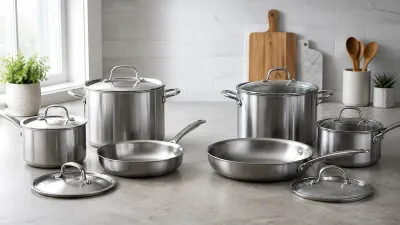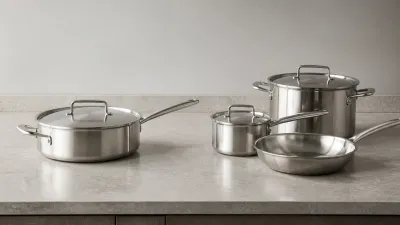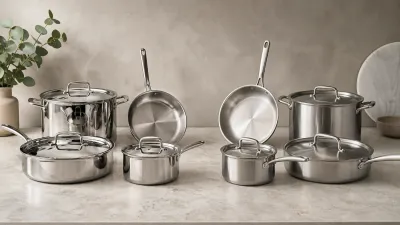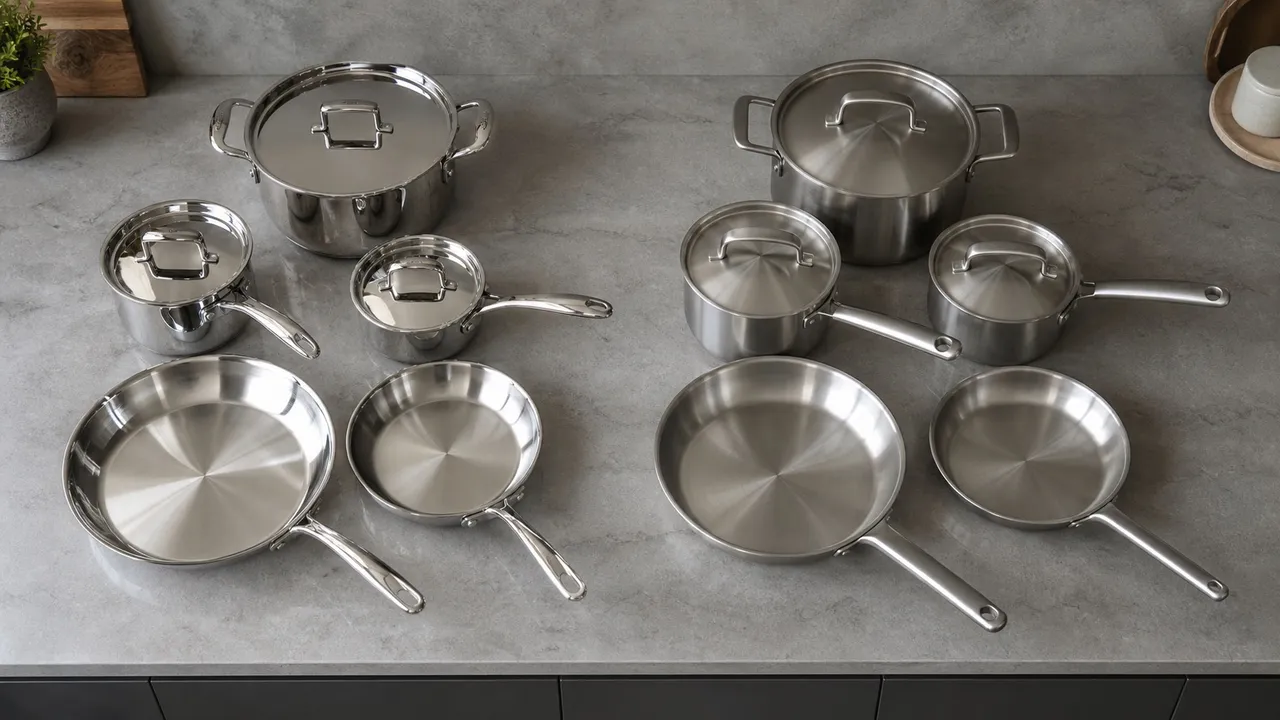
All-Clad D3 is our default choice over Viking 3-Ply. The matched sets use the same basic stainless-steel/aluminum/stainless-steel construction, but D3 has the deeper exact-product review history and All-Clad makes a qualified U.S. manufacturing claim. Viking is the value alternative when its internal markings, vessel mix, handle shape, or current offer fits you better.
The verdict at a glance
| Decision | Viking 3-Ply 10-piece set | All-Clad D3 10-piece set | Winner |
|---|---|---|---|
| Construction | Fully clad three-ply | Fully clad three-ply | Tie |
| Included stockpot | 8 quarts | 8 quarts | Tie |
| Interior markings | Marked saucepans and stockpot | Not listed as a set-wide feature | Viking |
| Current Amazon evidence | 4.7 from 55 reviews | 4.5 from 1,227 reviews | All-Clad for depth |
| Manufacturing statement | Imported | Made in the USA with global components | All-Clad |
| Oven and broiler limit | Up to 600°F | Up to 600°F | Tie |
The exact sets we compared
This comparison is limited to Viking model 40011-9990C, the silver 10-piece set with metal lids, and the current uncoated All-Clad D3 10-piece set. It does not mix in Viking Contemporary, Viking 5-Ply, glass-lid variants, All-Clad D3 Everyday, or nonstick pieces.

Viking 3-Ply Stainless Steel 10-Piece Cookware Set
4.7 out of 5 (55 ratings, as of August 1, 2026)
Viking's imported, fully clad three-ply 10-piece set with metal lids, an 8-quart stockpot, and marked saucepans and stockpot.
- 8- and 10-inch fry pans
- 1.5-quart saucepan, 2.25- and 3.5-quart sauté pans, and 8-quart stockpot
- Induction compatible and oven, grill, and broiler safe to 600°F
Pros
- Measurement markings in the saucepans and stockpot
- Metal lids avoid the lower limit associated with glass
- Rounded handles may suit buyers who dislike All-Clad's groove
Cons
- Only 55 Amazon reviews in the current exact-product snapshot
- Imported rather than made in the United States
Considerations
Choose the exact silver metal-lid set; Viking sells similarly named glass-lid, Contemporary, copper-clad, and five-ply collections with different specifications.
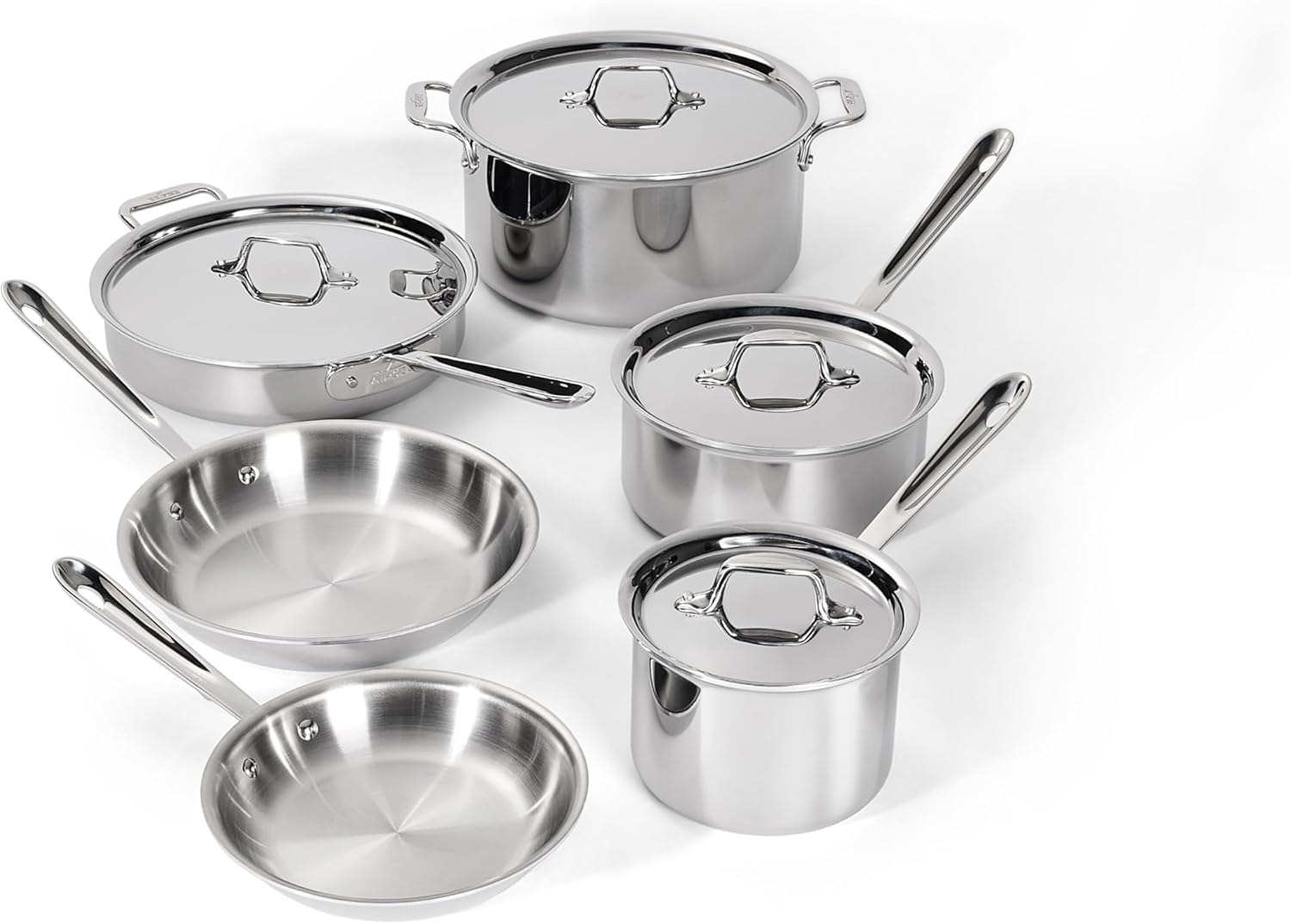
All-Clad D3 Stainless 10-Piece Cookware Set
4.5 out of 5 (1,227 ratings, as of August 1, 2026)
All-Clad's fully bonded D3 set, made in the United States with global components and supplied with stainless steel lids.
- 8- and 10-inch fry pans
- 2-quart saucepan, 3-quart casserole, 3-quart sauté pan, and 8-quart stockpot
- Induction compatible and oven and broiler safe to 600°F
Pros
- Much deeper Amazon review history for the exact set
- Qualified made-in-USA manufacturing statement
- Mature D3 line with exact first-party documentation
Cons
- Grooved long handles do not suit every hand
- No line-wide interior measurement-marking feature
Considerations
The stronger default if you will use the included vessels; lift a D3 pan first if handle comfort is a deciding factor.
How we compared
This is a research-based editorial comparison, not a hands-on or side-by-side test. We matched Viking marketplace model 40011-9990C through its dated exact-ASIN record and matched the current All-Clad D3 set. Viking’s current direct product page labels its metal-lid set 40011-9990SC and lists a 3-quart saucepan, so it is related-line evidence rather than exact-assortment evidence here. The exact-ASIN record supplies 40011-9990C’s model, vessels, 600°F limit, materials, markings, and induction compatibility. Exact Amazon availability, ratings, review counts, titles, and images came from Bright Data snapshots sd_msb18psu9adixxayi and sd_msb0qds92lo5k1x9vs captured August 1, 2026.
We compared construction, actual vessels, lids, markings, handling, induction and oven use, origin language, warranty, retailer evidence, and value. We did not measure heat spread or handle temperature ourselves.
Construction and heat control
Both exact sets bond an aluminum core between stainless layers through the base and sidewalls. Both work on induction. Neither exact manufacturer page gives enough comparable metal-thickness data to declare one set faster or more even from specifications alone.
Viking identifies a 304 stainless cooking surface, aluminum core, and magnetic stainless exterior. All-Clad describes D3 as a stainless cooking surface and exterior around an aluminum core. Those documents establish construction, not an independently measured cooking-performance advantage.
Winner: Tie.
Vessels, lids, and handling
The Viking assortment has 8- and 10-inch fry pans, a 1.5-quart saucepan, 2.25- and 3.5-quart sauté pans, and an 8-quart stockpot; four metal lids complete the count. The matched D3 set has the same fry-pan sizes, a 2-quart saucepan, 3-quart casserole, 3-quart sauté pan, and 8-quart stockpot with four lids.
Viking marks its saucepans and stockpot for liquid measurement. Its handles are rounded, while D3 uses All-Clad’s familiar grooved long handle. Neither shape wins universally, so lift the vessel size you expect to use most.
Winner: Viking for markings; preference for handles and vessel mix.
Origin, warranty, and value
Viking marks the exact set as imported. All-Clad describes the matched D3 set as made in the USA with global components. That is a qualified manufacturing claim, not proof that every layer or component is U.S.-sourced.
Both manufacturers offer limited lifetime coverage under their written terms. That does not cover ordinary wear, misuse, overheating, or thermal shock. Viking can be the better value when its current checkout total is materially lower, but this page does not publish changeable prices.
Winner: All-Clad for qualified U.S. manufacturing; compare current totals for value.
Which should you buy?
Choose All-Clad D3 for the stronger exact-set record and qualified U.S. manufacturing. Choose Viking 3-Ply when its markings, handles, vessel mix, and current value are the better match. Do not buy either merely because the box says ten pieces. Four of those pieces are lids.
Compare D3 with D5 before paying for more layers, Tramontina with All-Clad for another value-versus-premium decision, and our stainless steel cookware set guide for a wider field. Both sets need the same stainless steel cooking technique.
Related guides
Continue with Cuisinart vs Calphalon Stainless Cookware.