Yes, a stainless steel water bottle can release measurable nickel, but that finding is conditional. Nickel can be part of the alloy, while migration is the amount that actually moves into a drink. Those are different questions, and the answer changes with the exact bottle, drink, contact time, temperature, surface condition, and the person drinking from it.
The bottle-specific evidence is also limited. One real-use study tested only one stainless steel bottle alongside bottles made from other materials. It used room-temperature deionized water, not a representative range of brands, alloys, acidic drinks, or hot beverages. Cookware studies add useful context about acidity, heat, time, and new surfaces, but they do not predict the release from your bottle. If you have diagnosed nickel allergy, suspected systemic symptoms, or a clinician-directed restriction, use this article to frame questions for your clinician and the bottle maker, not to diagnose yourself.
Can stainless steel water bottles release nickel?
Yes. The direct bottle research detected nickel among the inorganic elements released into water from reusable bottles, but it did not establish one release rate for stainless steel bottles generally. A bottle can therefore be a possible source of nickel exposure without every stainless bottle, drink, or use pattern producing the same result.
The best bottle-specific study I found was a 2021 experiment on 20 reusable bottles sold in Italy. The researchers tested one stainless steel bottle, 12 aluminum bottles, six plastic bottles, and one silicone bottle, with duplicate units for each type. They rinsed, filled, sampled, emptied, and dried the bottles over four weeks. The test used organics-free deionized water at about room temperature so trace elements could be measured without the minerals already present in tap water. Nickel appeared among the elements detected, and release generally fell after the earliest sampling period.
That study is useful because it used a repeated-use bottle routine rather than only a short laboratory soak. It is not a survey of stainless steel drinkware. It did not test a broad range of stainless grades, acidic beverages, carbonated drinks, hot liquids, damaged interiors, or undisclosed liners. Its results support the possibility of migration under its conditions, not a claim about what every bottle releases. Read the full reusable-bottle study for the materials, timetable, and limitations.
What is the difference between nickel in steel and nickel in a drink?
Alloy composition tells you what the metal contains. Migration testing tells you what a particular liquid picked up under particular conditions. A label such as 18/8, 18/10, 304, or 316 may describe a nickel-containing stainless grade, but it is not a measured migration result and it is not a medical certification.
Common austenitic stainless families include 304 and 316, while stainless steel also includes lower-nickel and nickel-free families. The exact grade, surface finish, heat treatment, welds, and manufacturing quality can vary. Outokumpu’s stainless steel overview identifies 304 and enhanced 316-family austenitic grades while also describing lower-nickel alternatives. A bottle maker’s material statement is more useful than a generic claim that a bottle is simply stainless.
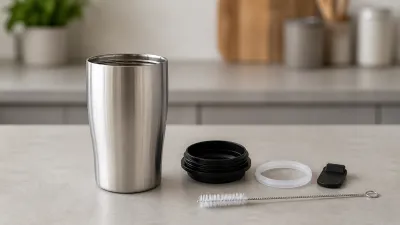
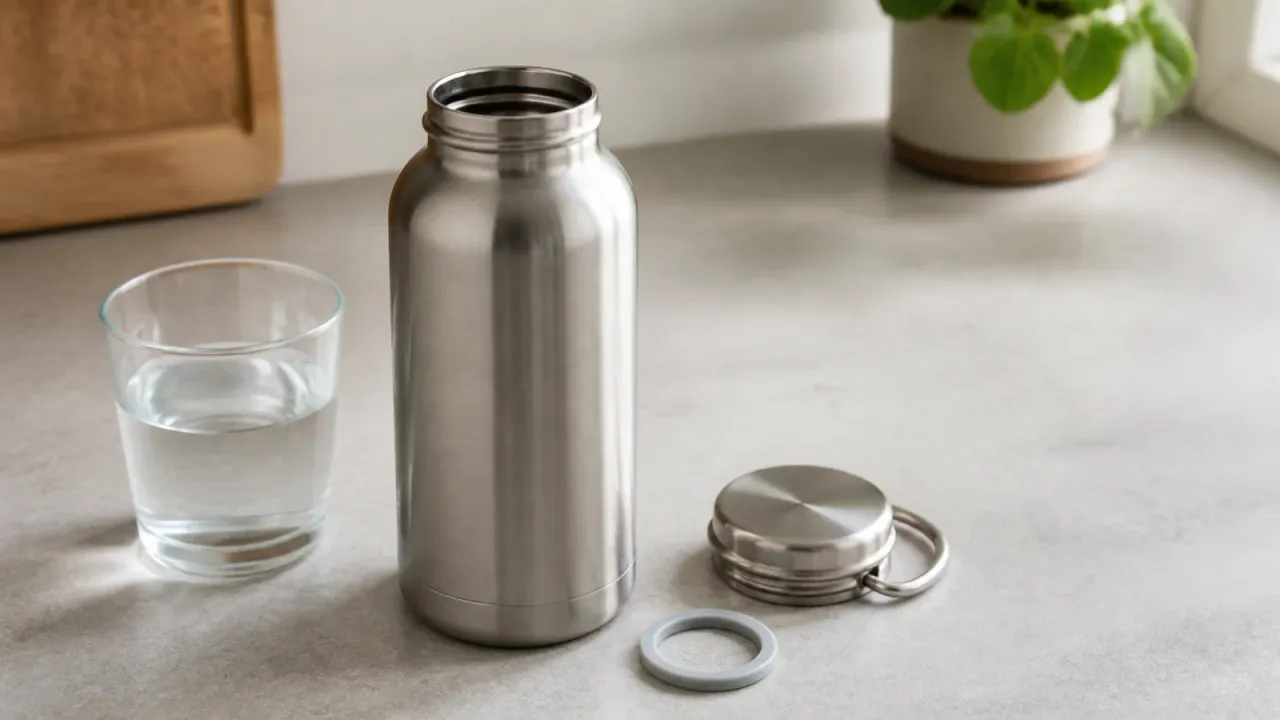
The liquid-contact surface matters most. A vacuum bottle can have stainless inner and outer walls, but its cap, spout, straw, threads, gasket, adhesive, or liner may be made from something else. A colored exterior coating is not automatically the drink-contact surface. The bottle study notes that the composition of inner linings in metallic bottles is often not disclosed, which is why a complete product needs a component-level answer.
The FDA’s food-contact overview explains that food-contact safety reviews consider migration data together with toxicological information for the intended use. That principle is important here: a food-contact claim for one model and use condition does not prove a zero-migration result for every drink or every component.
What did cookware research actually test?
Cookware research shows why acidity, heat, contact time, grade, and use history matter, but it is indirect evidence for a water bottle. A pan holds hot food in a different shape, at a different temperature, for a different time, with a different surface area and cleaning history.
In one peer-reviewed study, researchers cooked tomato sauces with several stainless materials and a saucepan. Nickel and chromium release varied with grade, cooking time, sauce, and cooking cycle. New stainless surfaces produced the largest increases in that setup, and release generally declined over repeated cycles. The PubMed record for that study reports the tested conditions and makes clear that the results came from specific cooking experiments.
Another study tested 18/10 stainless pots with tomato sauce, lemon marmalade, and aqueous solutions at different pH values. Release was higher with unused pots, longer boiling, low pH, or added EDTA, and it differed between manufacturers. The PubMed abstract also says the measured amounts were below the study’s known allergy-triggering thresholds under those experiments, while noting that highly sensitive people can have different individual thresholds.
Those results support a cautious rule: do not transfer a cookware number to a bottle. They do support asking how a bottle was tested, what beverage was used, how long it contacted the surface, and whether the tested object had the same grade and interior as yours. Our guide to nickel migration from stainless cookware covers that separate evidence base in more detail.
Which drinks and conditions can change migration?
No single ingredient, temperature, or storage time guarantees a result. Evidence treats the following as variables that can change migration, so the exact bottle instructions and test conditions matter.
| Condition | What the evidence supports | What it does not prove |
|---|---|---|
| Plain water | The bottle study measured release into deionized water at room temperature and found variable inorganic-element release. | It does not prove that all tap water, filtered water, or every stainless bottle behaves the same way. |
| Acidic or otherwise reactive drinks | Cookware and food-simulant studies found more release under some low-pH or chemically demanding conditions. | They do not provide a universal acidity cutoff or a bottle-specific rate for juice, coffee, sports drinks, or another beverage. |
| Carbonated drinks | Carbonation can change beverage chemistry and pressure, so the maker’s exact beverage approval matters. | A general stainless label does not prove that a bottle or cap is suitable for carbonation. |
| Heat | Heated cookware tests often produced more release than room-temperature tests. | A cookware result does not establish what a particular insulated bottle does with a hot drink. |
| Longer contact | Contact time affected release in cookware experiments, and the bottle study sampled over repeated days. | There is no universal safe number of hours for every bottle and drink. |
| New versus used surface | Several studies measured higher release from new surfaces, followed by lower release in later cycles. | A fixed rinse or use schedule cannot certify zero migration from a new bottle. |
| Scratches, pits, or coating damage | A damaged or corroded drink-contact surface deserves maker review because its construction and cleanability have changed. | A visual mark alone cannot measure nickel migration or diagnose an alloy problem. |
The bottle study itself used deionized water partly because ordinary drinking water contains minerals that vary by source and can obscure trace measurements. That makes its data easier to compare in a laboratory, but less representative of every home water supply. It also means that the study cannot answer the separate question of a bottle holding an acidic or hot beverage.
Does nickel migration mean a health risk?
Not by itself. Health risk depends on the amount that migrates, the chemical form, how much is absorbed, the total exposure from food and water, and whether the person is sensitized. A detected trace is evidence of migration, not proof that a reader will develop symptoms or that a bottle is unsafe for everyone.
The European Food Safety Authority’s nickel assessment says migration from good-quality stainless food-contact materials is likely of little or no relevance compared with nickel naturally present in the diet, while noting that leaching may be more important for poor-quality materials or other nickel-containing alloys. EFSA also describes uncertainty in oral absorption and reports that absorption can differ depending on whether nickel is taken in water while fasting or with food. Those findings are population-level risk-assessment evidence, not a personal exposure calculation.
Nickel allergy is another reason not to make a blanket claim. The German Federal Institute for Risk Assessment says food exposure is generally not a health risk for people with nickel allergy, while acknowledging that isolated symptoms can occur in sensitized people. The American Academy of Dermatology’s nickel guidance focuses on allergic contact dermatitis from exposure and recommends medical evaluation when a rash or recurring symptoms need diagnosis.
Do not use a bottle, a color change, or an online symptom list to diagnose nickel allergy. If you notice a recurring reaction after using a particular bottle, stop using it while you ask a dermatologist, allergist, or other clinician what evaluation is appropriate. Do not start a restrictive diet, take a detox product, or assume that changing bottles will explain every symptom. Seek urgent care for an emergency reaction rather than trying to troubleshoot the metal at home.
How should you evaluate a bottle if nickel matters to you?
Start with the exact product documentation, not a home leach test. Ask the manufacturer to identify the surfaces that touch the drink and the conditions covered by its food-contact or migration testing.
- Record the brand, model, size, lid, and purchase source. The body and the closure may have different material statements.
- Ask which alloy forms the inside wall and mouth, not only the outside shell. Ask whether the liquid touches bare stainless steel, a ceramic or polymer liner, a coating, or another material.
- Ask which parts are wetted during normal use. Include the cap, threads, spout, straw, valve, gasket, and any internal plug.
- Ask what drinks and temperatures the maker permits. A statement for still water does not automatically cover acidic drinks, carbonated drinks, coffee, alcohol, or hot liquids.
- Request the relevant food-contact declaration or migration-test summary when you need a documented answer. Ask what beverage or food simulant, temperature, duration, and surface were tested.
- Follow the maker’s cleaning instructions. Rinse away cleaner, avoid unapproved abrasives or chemicals, and dry the body and removable closure parts fully. Do not use a harsh acid or bleach as an improvised way to remove suspected metal.
- Stop using the bottle if the interior is pitted, flaking, cracked, sharply gouged, or no longer cleanable. Contact the maker about a replacement part or the complete bottle. A surface appearance cannot tell you how much nickel, if any, is migrating.
When you are comparing new bottles, the best stainless steel water bottles guide can help with body, lid, gasket, and care differences. It does not replace a model-specific alloy or medical answer.
Does a liner, coating, lid, or dent change the answer?
Yes. A bottle is a system, and the material that touches the drink can differ from the material that gives the bottle its shape or insulation.
| Part | Why it matters | What to verify |
|---|---|---|
| Inner wall | It may be bare stainless steel or a separate liner. | Exact material, intended drinks, and migration evidence for that surface. |
| Interior coating or finish | A coating can change what touches the drink, and damage can expose an unknown layer. | Whether it is food-contact approved and what the maker says about chips, peeling, or scratches. |
| Mouth and threads | These areas may be a different finish or alloy and receive repeated contact with the drink. | The maker’s material statement for the rim and internal threads. |
| Cap, spout, straw, and valve | These parts can add plastic, silicone, adhesive, or other wetted surfaces. | The complete closure materials and beverage restrictions. |
| Gasket or seal | The gasket may retain drink residue even when the steel body is intact. | Material, cleanability, replacement interval, and whether it can be removed. |
| Dent, pit, or corrosion | Impact or corrosion can change cleanability and expose hidden construction. | Stop-use guidance, warranty limits, and maker assessment for the exact model. |
Current maker pages illustrate why the full product matters. Thermos says its stainless products have no interior coating, while specific Klean Kanteen models describe an all-stainless interior or separate silicone components. Those are model-specific statements, not a rule for every bottle. For a damaged bottle, our guide to whether a dented stainless steel water bottle is safe explains why a photo cannot certify the inner wall, liner, seal, or drinking path.
The broader stainless steel food-storage safety guide makes the same distinction for containers: evaluate the body, lid, gasket, coating, temperature, and intended use together. A food-contact label is useful, but it does not erase the need to follow the exact product instructions.
Frequently asked questions
Does plain water make nickel leaching impossible?
No. The bottle-specific study detected nickel among elements released into water under its controlled conditions. It tested one stainless bottle with deionized water at room temperature, so it cannot prove either zero release or a typical result for every bottle and water source.
Does 18/8 stainless steel mean nickel-free?
No. The label generally signals a chromium and nickel composition, not a nickel-free alloy or a migration rate. Ask the maker which grade forms the liquid-contact surface and request documentation when that distinction matters.
Should someone with a nickel allergy avoid every stainless steel bottle?
There is no universal answer from the bottle label alone. Most people with nickel allergy do not need to assume that every food-contact stainless product will cause a reaction, while a highly sensitive person may need individualized advice. Ask your clinician and the manufacturer about the exact product, beverage, and contact surface.
Can a home test prove that a bottle is safe?
No. A home spot test or a visual inspection cannot replace laboratory migration testing under representative conditions. It also cannot identify the dose a particular person would absorb or the cause of a symptom. Use manufacturer documentation and medical advice for those questions.
What is the practical answer?
Stainless steel water bottles can release nickel in some tests, but the evidence does not support a universal leaching rate or a blanket safety verdict. The strongest bottle-specific study tested one stainless bottle with room-temperature deionized water, while cookware studies show that acidity, heat, time, grade, and new surfaces can change migration in other systems.
For ordinary use, choose a bottle sold for food or drink contact and follow its instructions. If nickel exposure is a medical concern, identify the exact drink-contact alloy, liner, coating, and closure materials, ask the maker for intended-use testing, and discuss your personal risk with a clinician. Treat damage, peeling, pitting, or an unknown interior as a reason to stop and ask the maker rather than trying to prove safety at home.
Sources
- Astolfi et al., Reusable water bottles: Release of inorganic elements, phthalates, and bisphenol A (retrieved 2026-08-22)
- Kamerud, Hobbie, and Anderson, Stainless steel leaches nickel and chromium into foods during cooking (retrieved 2026-08-22)
- Guarneri et al., Release of nickel and chromium in common foods during cooking in 18/10 stainless steel pots (retrieved 2026-08-22)
- EFSA, Update of the risk assessment of nickel in food and drinking water (retrieved 2026-08-22)
- U.S. Food and Drug Administration, Food Packaging and Other Substances that Come in Contact with Food (retrieved 2026-08-22)
- German Federal Institute for Risk Assessment, Allergies: questions and answers (retrieved 2026-08-22)
- American Academy of Dermatology, Nickel allergy guidance (retrieved 2026-08-22)
- Outokumpu, Austenitic stainless steel grades and properties (retrieved 2026-08-22)
- Thermos, Frequently asked questions and Klean Kanteen, 64 oz wide-mouth bottle materials (retrieved 2026-08-22)