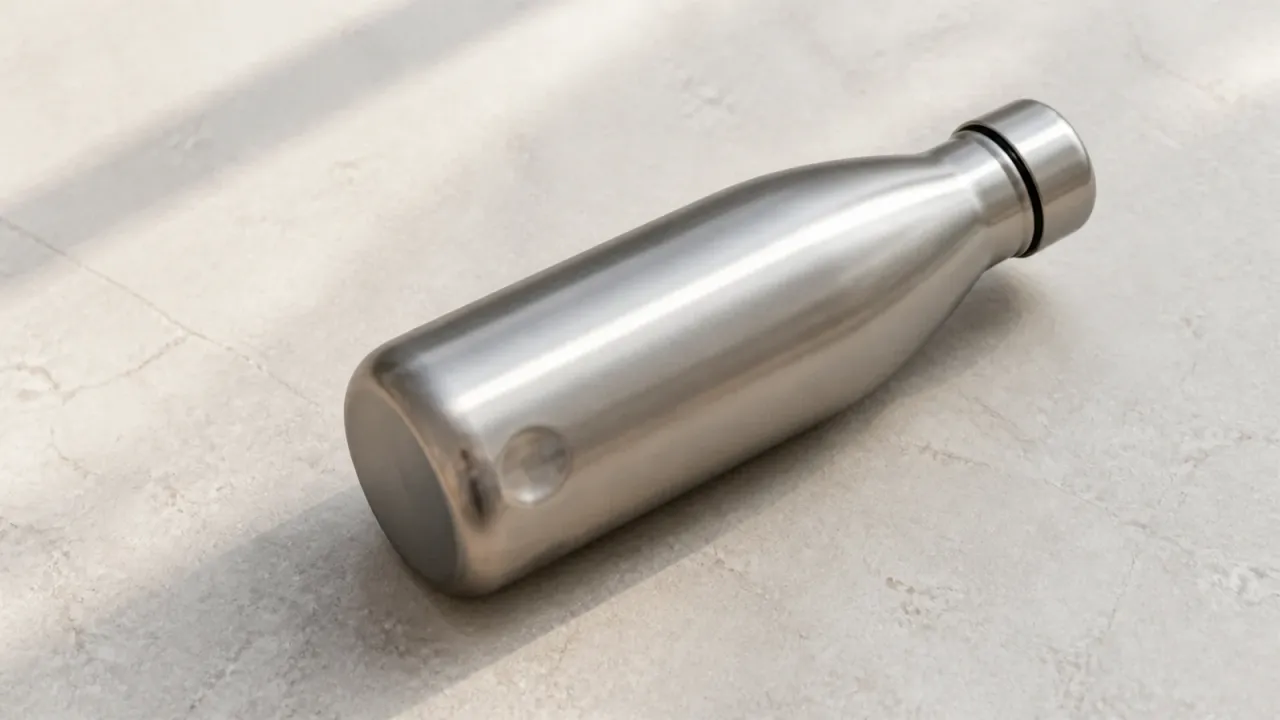
A shallow, smooth dent on an outer wall may be cosmetic, but you cannot call a dented bottle safe from its appearance alone. Stop using it if the dent creates a sharp fold, reaches the inside, cracks or peels a liner or coating, opens a seam, causes a leak, changes an insulated bottle’s behavior, damages the lid or threads, or leaves contamination you cannot remove. Ask the exact maker before reusing the bottle, and use only the beverage and conditions that maker allows.
This is a research-based safety guide, not a hands-on inspection or laboratory test. A photo cannot show an inner-wall breach, hidden liner damage, a weld, a vacuum space, a seal, or contamination inside a closed part. We checked current Owala care and warning guidance, Owala warranty terms, Hydro Flask warranty guidance, and the FDA Food Code 2022 on August 22, 2026.
What does a dent tell you?
A dent tells you that the bottle experienced enough force to deform at least one part of its construction. It does not tell you whether only the outside wall changed shape or whether the inner wall, insulation space, coating, seam, or lid also changed.
A single-wall bottle has one main metal wall. A vacuum-insulated bottle has an inner and outer wall separated by an evacuated space, and some models also have a finish or another layer. The same-looking mark can therefore have different consequences on different bottles. New warmth on the outside during ordinary use, a leak, or a change in temperature retention can justify stopping use, but none of those observations is a universal vacuum test. A new rattle is not proof of failure either. Hydro Flask says a small metal disc can rattle without affecting insulation or structural integrity on its bottles.
The drink-contact surface is the first safety boundary. The FDA model code describes reusable food-contact materials as safe, corrosion-resistant, nonabsorbent, smooth, easy to clean, and resistant to pitting, chipping, scratching, scoring, distortion, and decomposition. It also calls for food-contact surfaces to be free of breaks, open seams, cracks, chips, pits, sharp internal corners, and rough welds. That is a useful condition benchmark, not a household certification or a verdict for an unidentified bottle.
| Area to inspect | What the appearance can and cannot establish | Conservative boundary |
|---|---|---|
| Interior wall | A clean-looking opening does not prove that a hidden inner wall is intact. | Stop if there is a crack, gouge, pit, sharp edge, exposed layer, flaking finish, or a place you cannot clean. |
| Liner or coating, if the model has one | A dent may crack or lift a non-steel layer without exposing it clearly from outside. | Stop when the layer is cracked, peeling, blistered, or unknown. Ask the maker about the exact material. |
| Rim, weld, base, and body seam | A smooth outside panel does not rule out an opened weld or a slow leak. | Stop for a gap, spreading seam, sharp metal, seepage, or a bottle that no longer sits securely. |
| Lid, threads, gasket, spout, and straw | The bottle body can be sound while the closure no longer seals or cleans properly. | Stop if the lid cannot seat, threads skip, the gasket is cut, or the drinking path leaks or remains contaminated. |
| Outer wall and insulation | An outer dent is not a direct food-contact finding, but it can accompany hidden structural or vacuum damage. | Do not infer a leakproof or vacuum guarantee from a visual inspection. Follow the exact maker. |
For broader context on water exposure, deposits, crevices, and damaged surfaces, see our guide to whether stainless steel is waterproof. For food-contact containers, the guide to stainless steel containers and food safety covers the limits of the metal, lid, temperature, and storage conditions.
How should you inspect a dented bottle?
Inspect the bottle empty, clean, dry, and unpressurized. Do not diagnose the condition from a photograph or try to make the dent move before you document it.
- Identify the exact bottle. Record the brand, model, size, lid style, purchase source, and whether it is single-wall or insulated. Find the care and warranty page for that exact model. Owala and Hydro Flask both distinguish normal wear or accidental damage from manufacturing issues, so a generic warranty summary is not enough.
- Look at the outside in angled light. A shallow, broad depression with a smooth transition is different from a tight crease, folded edge, puncture, or raised burr. Do not press hard with a finger or tool to measure depth. Photograph the entire bottle and a close view beside the model markings.
- Inspect the inside and the drinking rim. Use a bright light and look for a crack, gouge, rough patch, pit, flake, loose coating, dark residue, or a new sharp edge. If the dent is near the shoulder, bottom, rim, or mouth, treat the inner-wall condition as unknown rather than assuming the outside shape tells the whole story.
- Check seams and the base. Look around the neck joint, welds, bottom ring, and any visible seam for a gap, wet track, stain that returns after cleaning, or movement. A dry exterior during one brief observation is not a leakproof certification.
- Check the complete closure. With the bottle empty, inspect threads, cap seating, gasket, spout, straw, valve, carry loop, and hinge. Follow the model diagram before removing a gasket. A damaged thread or seal can create leakage, an opening hazard, or a wet crevice even when the metal body looks fine.
- Treat insulation clues as a reason to pause, not a home diagnosis. If an insulated bottle suddenly transfers heat or cold through the wall, develops a hot spot during normal use, or no longer behaves as the maker describes, stop using it and contact the maker. Hydro Flask describes an exact support test for suspected insulation failure, but a boiling-water experiment is not a universal test and can cause burns. Do not invent a pressure or temperature test for another brand.
- Consider the impact and any contamination. If the bottle struck a dirty surface, a chemical, a vehicle floor, or an unknown liquid, cleanability may be the deciding issue. If residue, odor, or a trapped material remains in a crack, seam, gasket channel, or inaccessible lid passage, stop using the bottle instead of escalating to a harsher cleaner.
Which damage means stop using it?
Stop using the bottle and contact the maker or arrange replacement when any of these conditions is present:
- A tight crease, sharp fold, burr, puncture, crack, or edge can catch skin or a cleaning tool.
- The dent reaches the inside, or the inner surface has a pit, gouge, crack, flake, or exposed unknown layer.
- A liner, powder coat, paint, or other finish that can contact the drink is cracked, peeling, blistered, or shedding.
- A weld, rim, base, or body seam has opened, is spreading, or leaks.
- The lid no longer seats, the threads are distorted, the gasket is cut or displaced, or the spout, straw, or valve leaks.
- An insulated bottle has a new unexplained hot spot, unusual heat transfer, or another change that the maker associates with lost insulation. Do not treat a rattle alone as proof of damage.
- The bottle holds an unknown contaminant, has a persistent odor or residue, or contains a crevice that cannot be inspected and cleaned.
- The bottle was used for carbonation and the exact model and closure are not explicitly approved for that use after the impact.
These are stop-use boundaries, not a diagnosis of what happened inside the bottle. The maker may ask for photos, the model number, or the bottle itself before deciding whether a part can be replaced.
When can you keep using a dented bottle?
Continued use is a conditional possibility only when the dent is clearly limited to a smooth exterior wall, the inside and drink-contact surfaces are intact and cleanable, the rim, seams, lid, threads, gasket, and drinking path work normally, no insulation or leak behavior has changed, and the exact maker permits continued use.
Even then, stay within the maker’s ordinary use instructions. For an insulated bottle, that may mean still water or other specifically listed drinks, not carbonation, heat, freezing, or a side-packed carry position. A cosmetic appearance does not establish a pressure rating, leakproof rating, vacuum condition, or indefinite service life. Stop if the dent changes, the bottle leaks, or any red flag appears later.
How should you clean or test it after an impact?
Clean only within the exact bottle and lid instructions. Empty and rinse the bottle, wash the body with the maker-approved soap and brush, and clean approved removable lid parts separately. Let the body, cap, gasket, straw, and valve dry fully before reassembly. Owala says its stainless cup should be hand-washed to preserve its finish and warns against bleach and abrasives; its lid and straw instructions are separate. Those instructions illustrate why a stainless body does not set the care rule for every component.
Do not hammer, bend, squeeze, freeze, heat, drill, sand, or pressurize the bottle to remove the dent or prove that it holds water. A repair attempt can damage an inner wall, liner, seam, coating, or vacuum space and may also void a warranty. Do not use a strong cleaner to compensate for a crack or an inaccessible contaminated crevice. If the maker specifically permits a plain-still-water check, that observation can find an obvious leak, but it cannot certify the closure as leakproof or the insulation as sound.
If the bottle held a chemical, mold-like residue, or an unknown substance, do not assume that one rinse makes it suitable for drinking. Ask the maker whether the body, lid, and seals can be safely replaced or whether the complete bottle should be retired.
Does carbonation change the answer?
Yes. Carbonation raises the importance of the exact body, closure, venting, and use instructions, so do not put sparkling water, soda, beer, or another pressurized drink in a dented bottle unless the manufacturer explicitly approves that exact model and lid.
Owala’s current FAQ says its stainless FreeSip bottles are not for hot, carbonated, or perishable liquids, while it lists different beverage permissions for some tumbler models and warns that pressure can make contents leak or spray. That is a model-specific distinction, not a general stainless-steel rule. Our guide to carbonated drinks in stainless steel bottles explains why a stainless body alone is not a pressure rating.
Do not use a carbonated drink as a pressure test. If the bottle was dented while pressurized, empty it safely according to the maker’s instructions, keep it out of use, and ask the maker about the exact body and closure.
Should you repair a dent yourself?
No. A do-it-yourself dent repair is not a safe substitute for a maker’s assessment. Hammering from outside, pushing from inside, freezing a filled bottle, applying heat, or using compressed air can move the damage into a seam, inner wall, liner, coating, gasket seat, or vacuum space. Owala’s warranty terms say repairs or modifications by someone other than the company void its warranty, and other makers can set different limits.
Document the condition before cleaning or altering anything. Keep the model information and purchase record, then use the maker’s support or warranty route. A replacement lid may solve a closure problem, but it cannot certify a damaged bottle body.
What should you ask the manufacturer?
Send the maker the exact model and size, a description of where the dent is, whether the bottle is insulated, what was inside when it was damaged, and clear photos of the outside, inside, rim, base, seam, and closure. Ask these specific questions:
- Is this body approved for continued use with still, noncarbonated water?
- Does the dent location suggest an insulation, seam, liner, or rim concern for this model?
- Is the coating or liner intended to contact the drink, and how should damage to it be handled?
- Can the lid, gasket, straw, or other closure part be replaced separately?
- Is the condition covered by the maker’s warranty or replacement policy?
Photos can help support staff identify a model or decide what to request next, but they cannot reveal every internal condition. If the maker cannot confirm the bottle’s condition and the damage is more than a smooth cosmetic mark, replacement is the more cautious boundary.
If replacement is the maker’s recommendation, compare the best stainless steel water bottles by construction, lid, and care instructions rather than assuming every stainless bottle has the same limits.
Frequently asked questions
Is every dented stainless steel bottle unsafe?
No. A smooth exterior dent on an otherwise intact bottle may be cosmetic, but appearance alone cannot establish that the inner wall, liner, seam, vacuum, and closure are intact. Use the inspection limits above and follow the exact maker.
Can I use a dented insulated bottle?
Only after the exact maker confirms that the body and closure remain suitable. A dent can be outside the drink-contact surface yet still coincide with lost insulation or a changed seam, and no photograph can rule that out.
Can I put a dented bottle in the dishwasher?
Not to fix or test it. Dishwasher permission applies to a specific model and its parts, not to a damaged bottle. Inspect and contact the maker first, then use only the care method the maker approves.
Can a dented bottle hold carbonated drinks?
Only when the exact bottle and closure are explicitly approved for carbonation and the maker has cleared the damage. A dent is not evidence of pressure safety, and many stainless water bottles are not intended for carbonated drinks at all.