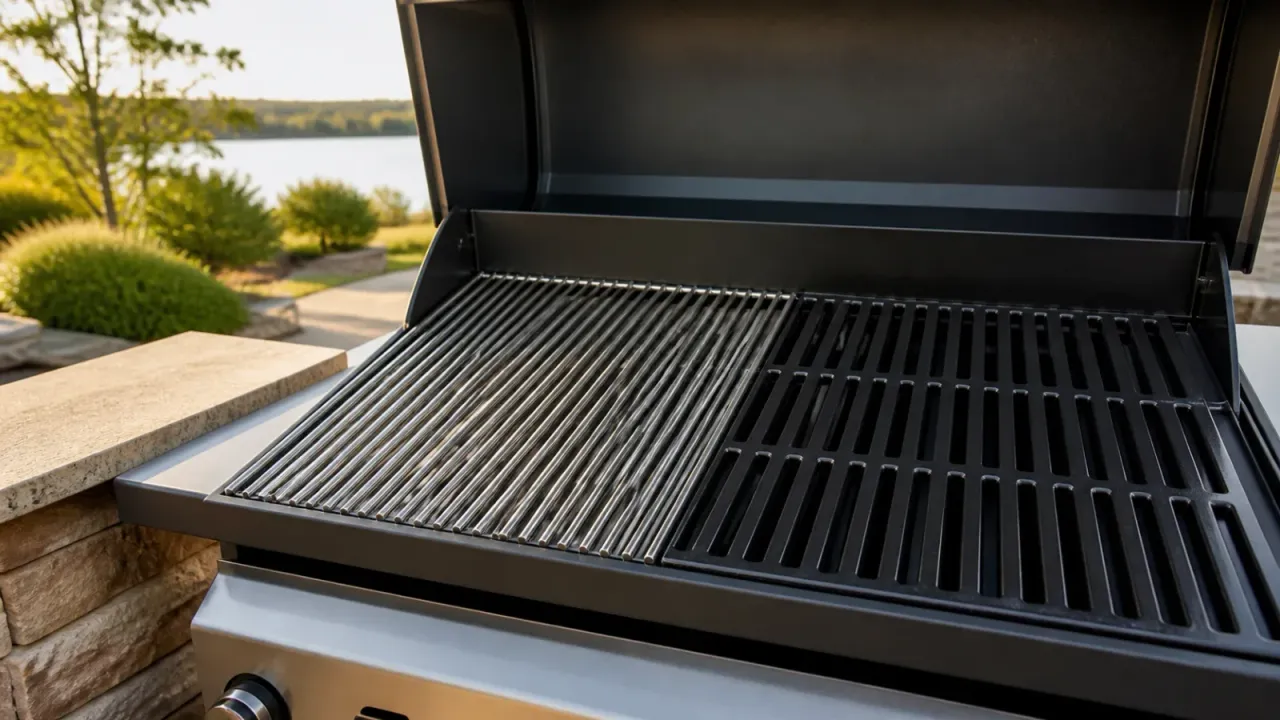
Choose stainless steel grill grates when you want easier cleaning, better resistance to wet storage, and less maintenance between cooks. Choose cast iron when steady stored heat and pronounced sear marks matter more, and you are willing to manage more weight and care. Neither material is the universal winner. The right grate is the one that matches your cooking priorities and fits your grill exactly.
There is one important qualification: cast iron can mean bare cast iron or porcelain-enameled cast iron. The latter does not need the same seasoning routine as bare cast iron. I separate those versions below instead of treating every cast-iron grate as identical.
Stainless steel vs cast iron grill grates at a glance
| Decision | Stainless steel | Cast iron | Better starting point |
|---|---|---|---|
| Heat response | Usually changes temperature more readily, depending on rod size and construction | More thermal mass and steadier heat after preheating | Depends on the cook |
| Sear marks | Can produce strong marks with adequate preheating | Holds heat well as cold food lands on the grate | Cast iron for stored heat |
| Rust and corrosion | More resistant to rust, but not rust-proof | Bare cast iron needs prompt drying and oil; enamel changes the care picture | Stainless steel for damp storage |
| Seasoning | No seasoning routine | Bare cast iron needs seasoning; porcelain enamel does not | Stainless or enameled cast iron |
| Cleaning | Brush and wash according to the grill maker’s guidance | Brush; protect bare seasoning and the enamel on coated grates | Stainless steel for simpler care |
| Weight | Often easier to lift at a similar size | Usually more substantial | Stainless steel |
| Durability | Can last a long time with the right care | Bare iron is repairable; enamel needs protection from damage | Depends on construction and care |
| Replacement fit | Model and dimensions still control the choice | Model and dimensions still control the choice | Exact manufacturer match |
The word “better” hides the choice. A grate that survives damp storage is not automatically the best tool for a cook who values a heavy, heat-stable surface. Start with the way you grill, then confirm the replacement geometry.
Heat response and thermal mass
Grill grate material affects the way the surface stores and gives up heat, but material is not the only variable. Rod diameter, bar spacing, grate area, support frame, burner output, airflow, and the food load all matter. A thin stainless replacement and a heavy stainless replacement will not behave identically. The same is true of cast iron.
For vegetables or other pieces that may fall between the grate bars, compare stainless steel grill baskets by opening size and fit after choosing a sound supporting grate.
Cast iron’s practical advantage is its mass. Once a cast-iron grate is fully preheated, it tends to hold more heat as a cold steak or a full basket of vegetables touches the bars. Weber describes cast iron as retaining heat better and longer than stainless steel in its grate comparison. That stability can help when you want a steady searing surface rather than a quick drop in grate temperature.
Stainless steel grates generally make a more forgiving choice when you change the heat or need the grate to come back to a new setting without waiting as long. That is a tendency, not a guarantee. The finished grate’s construction and your grill’s burner layout can outweigh the metal label. Do not promise faster recovery from a material name alone.
If your grill is prone to uneven burner zones, neither material fixes the underlying layout. Check the manufacturer’s grate design, keep the grate clean enough for good contact, and learn where the hot and cool zones sit before judging the material.
Sear marks and browning
Both materials can make good sear marks. Weber’s grate guidance lists stainless steel, porcelain-enameled cast iron, and porcelain-enameled steel as materials that can produce great marks when used correctly. The grate cannot replace dry food, enough preheating, appropriate spacing, and patience before turning.
Cast iron gets the edge when the grill loses heat as a cold item hits the surface. Its thermal mass can make the transition less dramatic, especially for thick steaks or larger batches. Wider bars and the direction of those bars also influence the pattern on the food.
Stainless steel is not a no-sear material. A stainless grate that is fully preheated and matched to a powerful enough grill can brown meat and vegetables effectively. Its lower maintenance may also make it easier to keep the surface ready for the next cook. If you prefer more pronounced stored heat, cast iron is the more natural fit. If you value easy upkeep and predictable replacement care, stainless is usually the calmer choice.
Rust, corrosion, and damp storage
Stainless steel is more resistant to corrosion than bare cast iron, which matters for grills kept outside or in a humid environment. It still needs reasonable care. Salt, grease, standing water, ash, and harsh chemicals can stain or attack stainless surfaces over time. Stainless does not mean immune to rust or discoloration.
Bare cast iron has a different bargain. Its surface is protected by seasoning, and the metal needs to be dried promptly after cleaning. A missed drying step or a cover that traps moisture can lead to rust. That rust is often repairable, but repair adds work before the next cook.
Porcelain-enameled cast iron changes the exposed surface. The enamel removes the bare-iron seasoning routine and provides a coated cooking surface, but it is still a finish that should be handled according to the grill maker’s instructions. Do not treat an intact enamel surface like an uncoated iron bar, and do not use a chipped or damaged grate without checking the manufacturer’s guidance.
For a grill that spends much of the season outdoors, stainless is the easier choice when you do not want moisture management to be part of the routine. A covered grill and sensible cleaning still matter more than the material label suggests.
Seasoning and surface care
Stainless steel grates do not need a cast-iron-style seasoning layer. Weber’s stainless grate care guidance centers on preheating, brushing with a suitable stainless brush, and using a grate cleaner or scrubber after the grate cools when heavy grease remains. Follow the instructions for your grill and brush type because a damaged brush can leave debris behind.
Bare cast iron needs a maintained layer of seasoned oil. The purpose is to protect the metal and make the surface easier to cook on, not to turn it into factory nonstick. Clean the grate as directed, dry it completely, and restore the light oil layer when the manufacturer’s instructions call for it. A cast-iron grate that is neglected can rust even if it performed well at the last cook.
Porcelain-enameled cast iron does not need the same seasoning work. Weber’s cast-iron care guidance says its porcelain enamel supplies the coated surface without a raw cast-iron seasoning routine. That makes enameled cast iron a useful middle path for cooks who want substantial heat retention without oiling bare iron after every cleaning.
If you want a broader view of stainless cookware maintenance, read our guide to the pros and cons of stainless steel cookware. A grill grate has its own maker instructions, but the same distinction between corrosion resistance and corrosion immunity still applies.
Cleaning after a cook
For stainless steel, the basic routine is usually straightforward: preheat the grate as directed, brush away residue with the specified tool, and use a suitable grill cleaner after the grate cools if grease remains. Do not assume a kitchen pan cleaner, bleach, or an abrasive pad is appropriate for a grill grate. The grill maker’s instructions control.
Bare cast iron asks for more discipline. Avoid leaving it wet, and do not put it through a routine that strips the seasoning unless you are intentionally restoring the surface. Dry it fully and apply the care step recommended by the maker. If you cook sugary sauces or fatty food, cleaning promptly helps either material.
Enamel simplifies the seasoning question but does not make the grate indestructible. Use the brush and cleaner approved for that finish, avoid sudden temperature shocks, and do not scrape aggressively just because the bar feels heavy. The coating is part of the cooking surface.
Our best stainless steel cleaners roundup covers household stainless cleaning products, not a universal license to use every cleaner on a hot or coated grill grate. Check the label and the grill manual before applying one.
Weight and handling
Cast iron is normally the heavier choice at a comparable grate size. That weight can help keep the grate stable and contributes to heat retention, but it also matters when you remove it for cleaning or storage. A cast-iron replacement that is awkward to lift can become a care problem even if its cooking behavior suits you.
Stainless steel is often easier to handle, especially when the grate is a multi-piece set. That does not guarantee a light grate. Frames, crossbars, thick rods, and larger dimensions add mass to either material. Use the manufacturer’s listed dimensions and handling instructions rather than guessing from a product photo.
Weight also affects the practical fit. A grate must sit securely on the supports, clear the lid and warming rack, and leave the correct space around burners and flavorizer bars. A heavier grate that rests unevenly is not an upgrade.
Durability and replacement life
Stainless steel can last for years when it is kept clean, protected from corrosive residue, and not abused with incompatible tools or chemicals. Surface discoloration is not automatically a structural failure. Inspect for severe thinning, cracks, broken welds, and a grate that no longer sits securely.
Bare cast iron is unusually repairable. Surface rust can often be removed and the grate reseasoned. That does not make every old grate safe to keep using. Deep pitting, a broken support, a warped frame, or a grate that no longer fits the grill is a replacement problem, not a seasoning problem.
Porcelain-enameled cast iron can provide long service, but the enamel condition matters. Treat chips, cracks, and loose sections as reasons to stop and consult the maker. The heavy underlying metal does not make a damaged coating irrelevant.
In all three cases, durability depends on the grill environment and the exact part. Covering the grill, keeping vents appropriate for the model, and following the maker’s cleaning schedule may do more for service life than changing materials.
Replacement compatibility matters more than material
Do not buy a grate because a listing says “stainless” or “cast iron” and the dimensions look close. Replacement grates are model-specific parts. Confirm the grill brand, series, control-panel layout, manufacturing range, number of burners, grate sections, support points, and out-of-carton dimensions.
For example, Weber’s stainless-steel 7639 page lists fit across several Spirit and Genesis families, but it does not make the part universal. The porcelain-enameled cast-iron 7522 page lists a different group of Spirit and Genesis models and distinguishes side-mounted controls from front-mounted controls. That kind of detail is the difference between a secure replacement and a grate that rocks, blocks the lid, or leaves a burner exposed.
Measure the usable grate area only after checking the owner’s manual and the maker’s parts catalog. Leave room for the grate frame, not just the cooking rods. If the model number is uncertain, contact the manufacturer before ordering.
Model-specific replacement examples
These are fit examples, not universal recommendations. Confirm your grill model and the current manufacturer parts page before using either option.
Stainless option for selected Weber grills

Weber Stainless-Steel Cooking Grates for Select Spirit Gas Grills
4.8 out of 5 (540 ratings, as of August 21, 2026)
A two-piece stainless-steel grate set for selected Spirit and Genesis gas-grill models, with model-specific fit guidance from Weber.
- Two stainless-steel cooking grates
- Listed dimensions of 17.3 by 11.8 by 0.5 inches
- Fits selected Spirit and Genesis families, subject to the model list
Pros
- No bare-cast-iron seasoning routine
- Official manufacturer page gives a detailed fit list
- Two-piece design can be easier to remove than one large grate
Cons
- Not a universal Spirit or Genesis replacement
- Dimensions and control layout still need to match
- Current availability can change after this capture
Considerations
Best for a confirmed compatible Weber model when low-maintenance stainless care is the priority.
Porcelain-enameled cast-iron option for selected Weber grills

Weber 7522 Porcelain-Enameled Cast-Iron Cooking Grates
4.6 out of 5 (329 ratings, as of August 21, 2026)
A two-piece porcelain-enameled cast-iron grate set for selected Spirit and Genesis gas-grill models, with a separate manufacturer fit list.
- Porcelain-enameled cast-iron cooking surface
- Listed dimensions of 15 by 11.3 by 0.5 inches
- Fits selected Spirit 200, Spirit 500, and Genesis Silver A models
Pros
- Cast-iron mass supports steady heat after preheating
- Porcelain enamel avoids a bare-iron seasoning routine
- Official manufacturer page distinguishes side-mounted controls
Cons
- Does not fit every Spirit control-panel layout
- The enamel surface still needs finish-appropriate care
- The captured listing showed limited seller availability on 2026-08-21
Considerations
Best for a confirmed compatible Weber model when stored heat matters and you want enameled rather than bare cast iron.
The exact retailer records for these examples were captured on August 21, 2026. Ratings, review counts, availability, and seller status can change. The manufacturer pages remain the authority for fit, dimensions, and care.
How we compared
This is a research-based comparison, not a hands-on or side-by-side grill test. I reviewed current grate guidance and replacement-part pages from Weber, then compared the documented material tradeoffs for heat retention, searing, corrosion, seasoning, cleaning, weight, durability, and fit. I did not measure grate temperatures, test sear marks, or install either replacement on a grill.
The comparison is intentionally narrower than a broad cast iron vs stainless steel cookware discussion. It owns grill-grate material decisions and replacement-fit cautions. It does not claim that one material is best for every cookware shape, indoor burner, griddle, or grill model.
Final verdict
Choose stainless steel if your grill lives outdoors, you want the simpler care routine, or you change grates often enough that rust resistance matters. Choose porcelain-enameled cast iron if you want cast-iron heat retention without seasoning bare iron. Choose bare cast iron only when you are comfortable drying, oiling, and repairing the surface as needed.
Before ordering, confirm the exact part number and grill model. A well-fitting stainless grate is a better choice than an ill-fitting cast-iron grate, and the reverse is also true. Material is the final decision, not the first compatibility check.
For a related grill-top cooking surface, see our best stainless steel griddles guide. A griddle changes the cooking surface and airflow differently from replacement grates, so it should not be treated as a drop-in substitute.