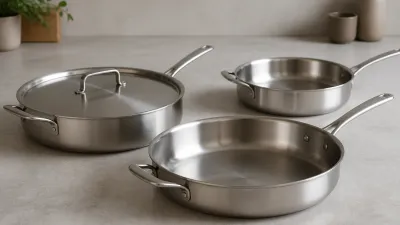
A 12-inch frying pan is the better single-pan size for most households because it gives two to four portions enough room to brown without crowding. Choose a 10-inch pan for one or two portions, lighter handling, or a smaller burner. An 8-inch pan is a specialist for one egg or a very small serving, not the best only skillet.
The advertised diameter is measured across the top rim. Sloped walls make the flat cooking surface smaller, so two pans sold as 12 inches can hold different amounts of food. Check both the cooking-surface diameter and the base diameter before buying.
Frying-pan sizes at a glance
| Nominal size | Best for | Common limitation |
|---|---|---|
| 8 inches | One egg, spices, a small garnish | Too little room for most full meals |
| 10 inches | One or two portions, compact burners | Crowds larger protein or vegetable batches |
| 12 inches | Two to four portions, family meals | Heavier and needs a wider burner |
| 14 inches | Large batches and entertaining | Difficult to heat evenly on many home burners |
Who should choose a 12-inch frying pan?
Choose 12 inches when this will be your main stainless skillet. The extra cooking floor lets moisture escape around chicken pieces, vegetables, mushrooms, or burgers. That spacing helps food brown rather than steam.
A 12-inch pan is also easier to use for a pan sauce because it holds the browned food and the added liquid without an immediate capacity problem. Many models add a helper handle, which becomes valuable when the pan is full.
The downside is loaded weight. Fully clad stainless cookware is heavier than a thin aluminum pan, and a lid adds more. Check the listed empty weight and lift a comparable pan in person if wrist strength is a concern.
Our recommended stainless steel frying pans include published cooking-surface and weight information where manufacturers provide it.
When is a 10-inch pan enough?
A 10-inch frying pan is enough for one or two people cooking modest portions. It suits two eggs, one steak, a pair of fish fillets, or a smaller vegetable batch. The pan is easier to wash, store, and move with one hand.
It also fits compact cooktops better. The base should align reasonably with the active burner or induction zone. A 12-inch rim can hide a much smaller base, but a very wide pan on a small heating zone can still develop a hot center and cooler edge.
Choose 10 inches if you already own a wider sauté pan or griddle for batch cooking. The smaller skillet then fills a distinct role rather than duplicating another large vessel.
Is an 8-inch pan useful?
An 8-inch pan is useful as a second skillet for one egg, toasted spices, a small serving of vegetables, or a garnish prepared beside the main meal. It heats and washes quickly and stores inside some larger pans.
It is usually a poor only frying pan. The flat cooking floor may be closer to six inches once the walls slope inward. Crowding even two portions encourages steaming and makes utensils harder to position.
Sets often include both 8- and 10-inch skillets. Count the 8-inch pan as a convenience piece, not proof that the set covers larger meals. Our stainless steel cookware-set guide evaluates the complete vessel mix.
Should you buy a 14-inch pan?
Buy a 14-inch frying pan only when you routinely cook large batches and have a burner, induction zone, sink, and storage space that fit it. The pan can brown several portions at once, but its outside edge may remain cooler on a normal residential burner.
Handling is the second constraint. A large stainless pan plus food can be awkward even with a helper handle. Two batches in a responsive 12-inch pan may be easier than controlling one oversized load.
For a broad floor with more capacity and straight walls, consider a sauté pan instead of an oversized skillet. The best stainless steel sauté pans cover that shape.
How do you measure the usable cooking surface?
Measure the flat interior from the point where one wall begins to curve upward to the same point on the opposite side. Do not measure across the rim for this number. Manufacturers may call it the cooking-surface diameter or cooking area.
Then measure the exterior base that touches the cooktop. That number helps match the pan to an induction zone or electric element. Follow the cooktop maker’s allowed diameter range because detection and power distribution vary.
The Made In 12-inch stainless frying pan provides a useful example: its published top diameter and cooking-surface diameter differ because of the sloped walls. Other brands use different geometry, so compare exact models rather than assuming one standard ratio.
How should burner size affect your choice?
Match the pan’s base to the burner you use most often. Flames should remain under the base instead of climbing the sidewalls. On induction, the magnetic base must meet the zone’s detection requirements. Our guide explains how stainless steel works on induction cooktops.
A pan can be wider than the visible induction ring when the cooktop maker allows it, but a large mismatch can slow the edge and concentrate energy near the center. Rotating a pan does not fix an undersized heating zone consistently.
What else should you check besides size?
Size cannot rescue an uncomfortable or poorly matched pan. Check:
- Empty weight and loaded handling
- Helper-handle clearance
- Flat cooking-surface diameter
- Base diameter and cooktop compatibility
- Lid inclusion and fit
- Oven and broiler limits for every component
- Cladding coverage and total construction
- Pouring shape and handle comfort
Read what fully clad cookware means before choosing by ply count. A well-proportioned tri-ply pan can be a better fit than a heavier five-ply model.
Frequently asked questions
Is a 10-inch frying pan too small for two people?
No. It is enough for many two-person meals, especially eggs, fish, or smaller cuts. Choose 12 inches when both portions need more space to brown or when vegetables cook in the same pan.
Is a 12-inch pan measured across the base?
Usually not. The nominal size normally describes the top rim. Check the manufacturer’s separate base and cooking-surface dimensions because the sloped walls reduce usable area.
Should your frying pan be larger than the burner?
A modest difference can be acceptable, but a large mismatch produces less even heating. Match the exterior base to the cooktop maker’s supported burner or induction-zone range.