All-Clad D3 is the better choice for most cooks. It has the same fully clad, induction-ready, 600°F oven-safe build as D5, reacts faster when you change the heat, and costs less. Choose D5 if you want steadier heat, larger handles, or a brushed finish that hides fingerprints, and you are willing to pay more for them.
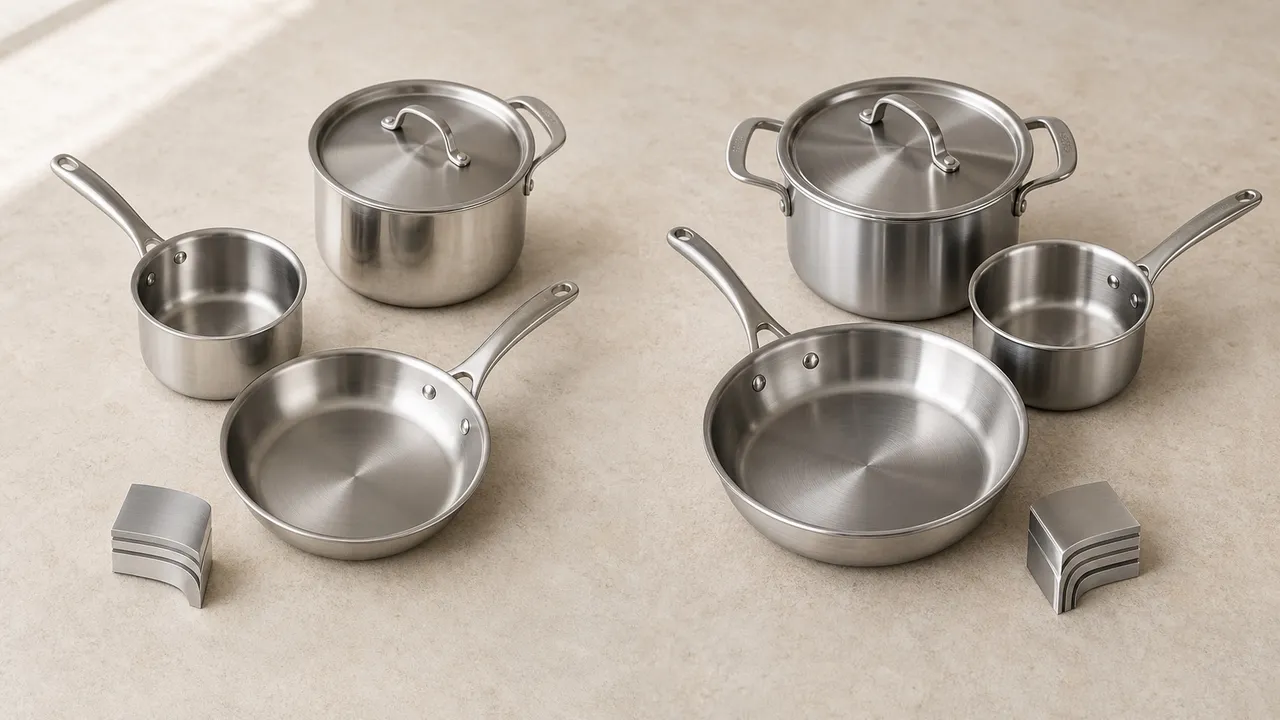
D3 bonds three layers, an aluminum core between two layers of stainless steel. D5 bonds five alternating layers of stainless steel and aluminum, so each D5 pan is heavier and changes temperature more gradually than the same D3 pan.
The verdict at a glance
| Decision | All-Clad D3 | All-Clad D5 | Winner |
|---|---|---|---|
| Bonded construction | Three-ply | Five-ply | Tie for ordinary cooking |
| Core design | Aluminum core | Alternating stainless and aluminum | D5 for thermal moderation |
| Responsiveness | Faster to react | More gradual | D3 |
| Weight per pan | Lighter | Heavier | D3 |
| Price | Lower | Higher | D3 |
| Exterior finish | Polished | Polished or brushed | D5 for choice |
| Handles | Classic long handle | Larger handles, helper handles, and lid handles | Personal preference |
| Induction | Yes | Yes | Tie |
| Oven and broiler limit | Up to 600°F for current uncoated pieces | Up to 600°F for current uncoated pieces | Tie |
| Best fit | Most home cooks | Cooks who want steadier heat, bigger handles, or a brushed finish | D3 |
The exact sets we compared
This page matches the uncoated D3 10-piece set with the uncoated brushed D5 10-piece set, the two sets sold under the listings below. It does not compare D3 Everyday (a separate line All-Clad sells only online), D5 Pro Nonstick, the polished D5 10-piece set, or individual pieces.
Both sets include 8- and 10-inch fry pans, a 3-quart sauté pan, and an 8-quart stockpot. The D3 listing adds 2- and 3-quart saucepans, while the brushed D5 set adds 1.5- and 3-quart saucepans. All-Clad’s own D3 10-piece set swaps the 3-quart saucepan for a 3-quart casserole, and the polished D5 set uses larger 2- and 4-quart saucepans with a 4-quart sauté pan, so check the box contents before you buy.
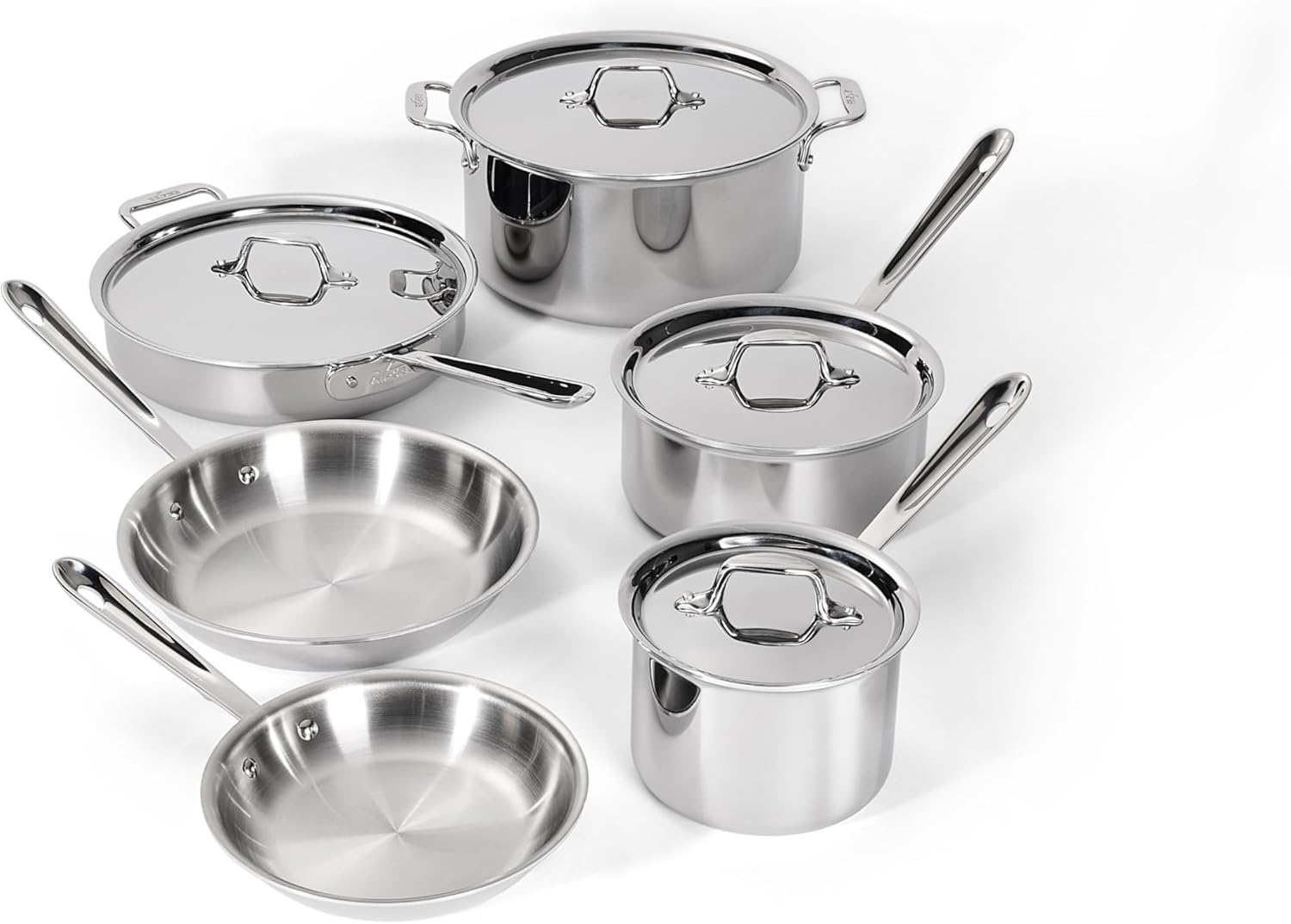
All-Clad D3 Stainless 10-Piece Cookware Set
4.6 out of 5 (1,847 ratings, as of October 20, 2026)
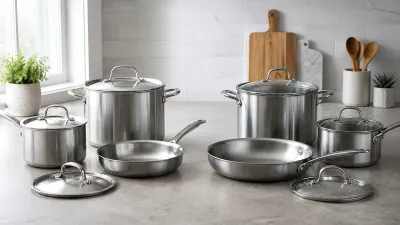
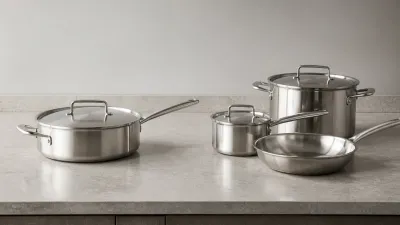
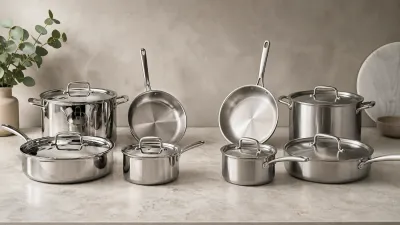
The tri-ply D3 set with six cooking vessels and four stainless steel lids.
- 8- and 10-inch fry pans
- 2- and 3-quart saucepans, 3-quart sauté pan, and 8-quart stockpot
- Induction compatible and oven and broiler safe to 600°F
Pros
- Simpler tri-ply construction responds quickly to burner changes
- Lighter than D5 piece for piece
- Lower entry point than the matched D5 set
Cons
- The grooved long handle does not suit every hand
- Polished exterior shows fingerprints more readily than brushed D5
Considerations
The stronger default when you do not already know that you prefer D5's extra mass, larger handles, and brushed finish.

All-Clad D5 Brushed Stainless 10-Piece Cookware Set
4.6 out of 5 (1,383 ratings, as of October 20, 2026)
The brushed five-ply D5 set with alternating stainless steel and aluminum layers.
- 8- and 10-inch fry pans
- 1.5- and 3-quart saucepans, 3-quart sauté pan, and 8-quart stockpot
- Induction compatible and oven and broiler safe to 600°F
Pros
- Five-ply construction is designed for steadier, more gradual heat
- Brushed exterior that All-Clad says resists fingerprints
- Larger handles and flared pouring edges
Cons
- Heavier than D3 piece for piece
- The 1.5-quart saucepan is smaller than D3's 2-quart
- Extra layers do not automatically improve every cooking task
Considerations
Worth choosing when steadier heat, the handles, or the finish solves a real need. Five layers alone are not a reason to buy it.
How we compared
This is a research-based editorial comparison, not a hands-on or side-by-side test. We matched exact ten-piece sets and checked the current D3 set, brushed D5 set, polished D5 set, and All-Clad’s D3-versus-D5 explanation on October 20, 2026. Exact Amazon set contents, weights, ratings, and review counts were rechecked through Bright Data the same day. The original August 1, 2026 record came from snapshot sd_msb0qds92lo5k1x9vs.
We evaluated construction, actual included vessels, listed weight, handling, finish, cooktop and oven use, care, and value. We did not award a win simply for more layers, and we did not measure heat-up time or temperature spread ourselves.
When the page launched, the July 2–29 Search Console brief had no URL-level history for it. A DataForSEO estimate of 4,400 monthly US searches for “all clad d3 vs d5” helped prioritize the page but did not influence which line won.
Construction: three layers versus five
D3 bonds a stainless cooking surface and magnetic stainless exterior around an aluminum core. D5 uses five bonded layers, alternating stainless steel and aluminum. Both carry conductive material through the base and sidewalls and both use bare stainless cooking surfaces.
Layer count alone does not disclose the thickness or mass of conductive metal. All-Clad describes D5’s inner stainless layer as heat-diffusing and markets the line for its most even, stable heat, while it markets D3 for fast, even heat. In practice, the inner stainless layer slows how quickly heat moves through a D5 pan, so temperature changes feel more gradual. D3 is simpler and generally more responsive when you adjust a burner.
Winner: D3 for direct control; D5 if gradual changes are the goal.
Weight, handles, and finish
Piece for piece, D5 is heavier than D3, and All-Clad says the extra metal is visible at the rim. Set weights blur that difference. Amazon lists the D3 10-piece set at 26 pounds and the brushed D5 10-piece set at 24 pounds, but those are retailer listing weights for sets with different saucepans, not our measurements of matched pans.
D3 uses All-Clad’s long grooved handle, designed for an underhand grip. D5 has larger handles, and All-Clad says its larger helper and lid handles improve grip and control. Handle comfort is personal, so lift the same pan size from each line before buying if you can.
D3 comes with a polished exterior. D5 comes in polished and brushed versions, and All-Clad says the matte brushed finish resists fingerprints. The D5 set compared here is the brushed one.
Winner: D3 for lighter pans; D5 for bigger handles and a choice of finish.
Cooking, induction, and oven use
Both D3 and D5 work on induction, so induction should not decide between them. All-Clad lists both lines as compatible with any stovetop, including induction. Because induction changes power quickly, D3 should follow your adjustments more closely, while D5 smooths them out.
All-Clad rates current uncoated D3 and D5 pieces for oven and broiler use up to 600°F, though lids and specialty pieces should be checked individually.
Neither line is nonstick. Preheat over moderate heat, add oil, and let food brown before turning it. Our guides to preheating stainless steel and preventing sticking apply to both.
Winner: Tie.
Care and warranty
All-Clad lists both sets as hand-wash only. Let either pan cool before washing and avoid chlorine bleach. All-Clad notes that long exposure above 500°F can discolor stainless steel without affecting performance. Its limited lifetime warranty covers defects under its terms, not misuse, overheating, or normal wear.
For bonded residue, follow how to clean stainless steel pans rather than escalating immediately to steel wool.
Which should you buy?
Buy D3 if you want All-Clad’s classic fully clad design at a lower price, with lighter pans that react quickly to the burner. Buy D5 if you have handled it and prefer its heavier feel, larger handles, steadier heat, or brushed finish.
D5 is worth the extra cost only when one of those differences solves a real problem in your kitchen. Five layers alone will not make everyday searing, sautéing, or simmering noticeably better.
If price is pushing you away from both, compare fully clad cookware by total construction rather than badge or layer count. Our best stainless steel cookware sets guide includes less costly options.
Two adjacent decisions isolate different trade-offs: HexClad versus All-Clad compares a ceramic-coated hybrid surface with bare D3 stainless, while Tramontina versus All-Clad compares a value-focused glass-lid tri-ply set with D3.
The comparison of D3 with All-Clad Copper Core isolates the effect of a bonded copper layer. For component-level choices, compare glass and stainless cookware lids.
Related guides
Continue with Cuisinart vs Calphalon Stainless Cookware.