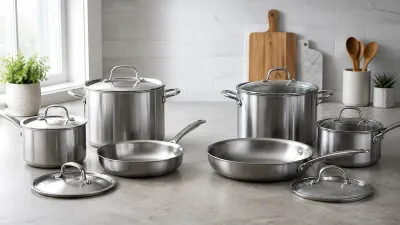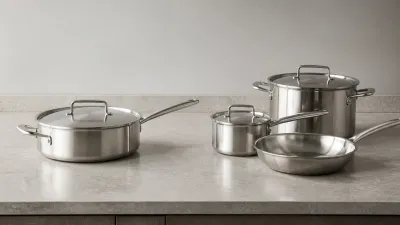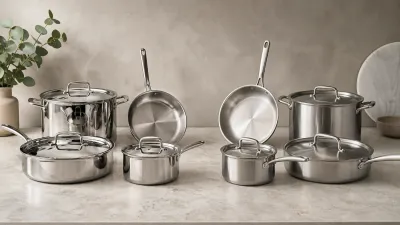
Choose a saucepan for liquid-heavy jobs, smaller portions, and controlled pouring. Choose a sauté pan when you need a broad cooking floor for browning, enough wall height for a sauce, and a helper handle for moving a heavier meal.
The names describe shape, not quality. Both vessels can use the same fully clad stainless construction and both can move from stovetop to oven when their handles and lids permit it. The useful difference is how much flat cooking area, wall height, and evaporation the recipe needs.
Saucepan vs sauté pan at a glance
| Decision | Saucepan | Sauté pan |
|---|---|---|
| Typical shape | Narrow with tall sides | Wide with straight sides |
| Common capacity | 1.5 to 4 quarts | 3 to 6 quarts |
| Best jobs | Sauces, grains, reheating, small soups | Browning, shallow frying, braising, one-pan meals |
| Evaporation | Slower for the same volume | Faster because of the wider surface |
| Handling | One long handle; small models may lack a helper | Long handle plus helper handle on many models |
| Storage | Smaller footprint | Wider and harder to stack |
What is a saucepan best for?
A saucepan is best for liquids and foods that benefit from a smaller surface area. Its tall sides contain simmering sauce, grains, oatmeal, custard, soup, and reheated portions while limiting evaporation. A defined pouring rim is useful when transferring stock or a finished sauce.
The smaller diameter also fits a modest burner. That matters because a flame or heating zone much wider than the base wastes energy and can heat handles or sidewalls unnecessarily. Our stainless steel saucepan recommendations compare practical sizes and construction for this role.
A saucepan is less effective when food needs room to brown. Crowding chicken pieces, mushrooms, or vegetables releases moisture faster than the narrow vessel can evaporate it. The food steams before it develops the surface color a wider pan can produce.
What is a sauté pan best for?
A sauté pan is best for recipes that begin with browning and finish with liquid. Its broad, flat floor holds more food in direct contact with the cooking surface. Straight sides contain splatter and provide capacity for wine, stock, tomato, or cream added after searing.
That combination suits chicken with pan sauce, braised vegetables, shallow frying, risotto, and larger one-pan meals. A lid turns it into a useful braising vessel. Compare current shapes and handles in our best stainless steel sauté-pan guide.
The tradeoff is size and loaded weight. A five-quart sauté pan can become awkward with food and liquid inside. A helper handle is more than a cosmetic feature because it gives the second hand a stable lifting point.
How does shape change cooking?
Shape changes evaporation and food contact. A wider surface exposes more liquid to air, so a sauté pan reduces sauce faster. A narrower saucepan slows that loss and gives a whisk or spoon a deeper pool to work in.
Straight sides distinguish a sauté pan from a frying pan. A frying pan’s sloped walls make tossing and utensil access easier, but reduce capacity at the same outside diameter. If most meals are dry sears rather than sauced dishes, use the stainless steel frying-pan roundup instead.
Construction still matters in both shapes. Fully clad cookware carries its conductive core through the walls, which can help thick sauces near the sides. A sound bonded base can remain practical for water-heavy saucepan work.
Which size should you choose?
A three-quart saucepan is the most versatile single saucepan for one to four people. It handles grains, sauces, reheating, and moderate soup portions without becoming difficult to pour. A smaller 1.5- or 2-quart pan is helpful for one person or small sauce batches, while a four-quart model overlaps with a small pot.
A three- or four-quart sauté pan suits many households. Move to five or six quarts for larger families, batch meals, or recipes that brown several portions before braising. Compare the flat cooking diameter, not only the stated capacity.
Very large liquid batches belong in a stainless steel stockpot. A sauté pan is wide enough that carrying it full of soup is inconvenient, while a saucepan is often too small.
Can one pan replace the other?
A sauté pan can cover many saucepan tasks when pouring precision and compact size do not matter. It can simmer sauce, cook grains, and reheat food. Expect faster evaporation and more cabinet space.
A saucepan cannot replace a sauté pan as easily because its narrow floor limits browning. It can cook the same ingredients in smaller batches, but that changes the workflow and may produce more steaming.
If you are buying only one vessel and cook mostly pasta sauce, grains, soup, or small portions, choose a three-quart saucepan. If you cook proteins with pan sauces or larger one-pan meals, choose a four-quart sauté pan.
What should you verify before buying?
Check the complete product rather than relying on the vessel name:
- Compare the flat cooking diameter and base diameter with your burner.
- Check empty weight and whether a helper handle is included.
- Verify that the lid, handle, and body share the oven limit you need.
- Confirm induction compatibility for the exact model.
- Decide whether a pouring rim, measurement marks, or sealed rim matters.
- Read the manufacturer’s dishwasher and utensil instructions.
Our research is based on current manufacturer specifications, not a side-by-side cooking test. All-Clad’s cookware guidance describes saucepans as liquid-focused vessels and sauté pans as wide, straight-sided pans for browning and one-pan cooking. Exact dimensions still vary by collection.
Frequently asked questions
Is a sauté pan the same as a frying pan?
No. A sauté pan has straight sides and usually includes a lid and helper handle. A frying pan has sloped sides that make turning and tossing food easier, with less capacity at the same outside diameter.
Can you boil pasta in a sauté pan?
You can boil smaller pasta portions if the pan holds enough water and its maker permits the heat level. A saucepan or stockpot is easier to carry and drain because it is narrower and deeper.
Do both pans work in the oven?
They can, but the exact handle, lid, coating, and bonded construction determine the limit. Check the manufacturer’s instructions for the exact model rather than applying one temperature to every stainless pan.
The glass versus stainless lid guide explains how lid material changes visibility and temperature limits. For low-water covered cooking, read what vapor-seal cooking means before assuming any fitted lid creates the same seal.