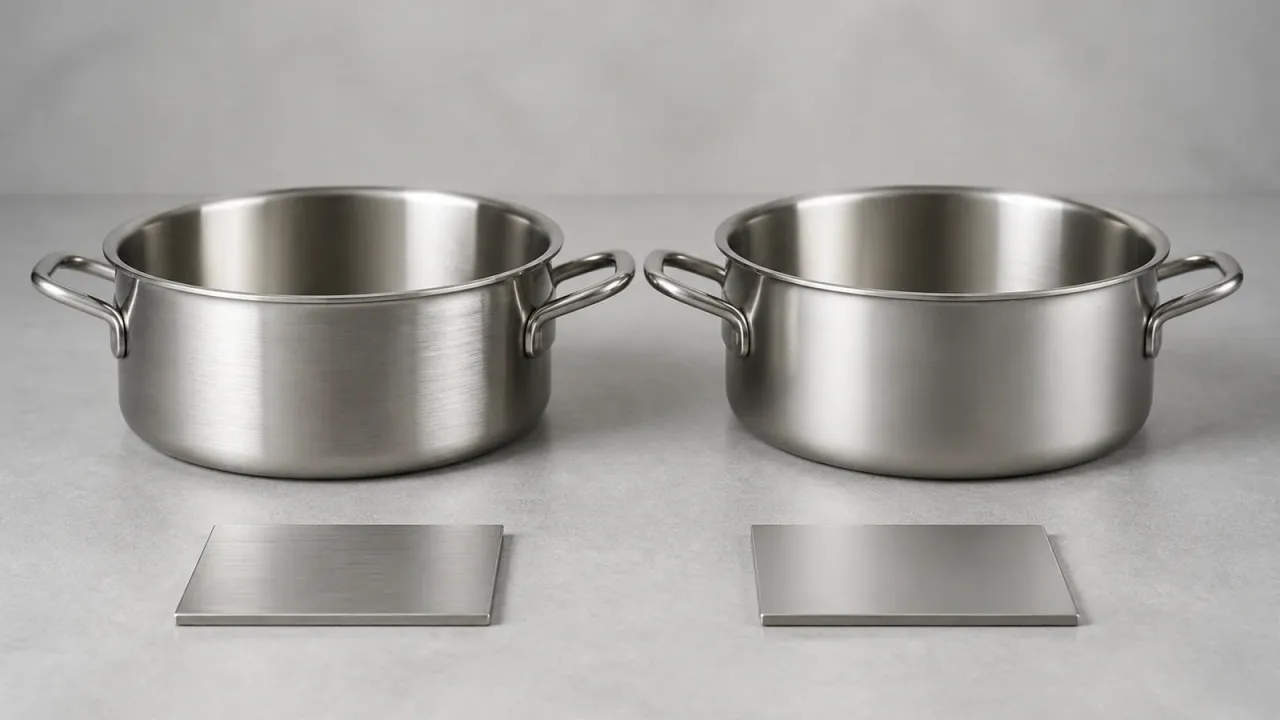
Choose 304 when you want the more familiar nickel-bearing grade and a wider corrosion margin is important. Choose 201 only when the exact maker identifies the alloy, the finished cookware, and the intended use clearly enough for your kitchen environment. Neither grade wins every cookware decision, and a grade name alone does not prove food-contact compliance, durability, induction compatibility, nickel release, or overall quality.
The useful comparison is not “which number is safer?” It is whether the exact finished article has the composition, surface, fabrication, care instructions, and compliance evidence needed for the job. A 201 or 304 label may describe only the cooking surface, while the exterior, base, core, handle, welds, and finish can be different materials or processes.
201 vs 304 stainless steel: what is the practical verdict?
For a general-purpose cooking surface, 304 is the easier default to evaluate because its composition and use are familiar across many cookware and food-equipment specifications. 201 can be a legitimate austenitic stainless choice in suitable environments, but its lower nickel and higher manganese balance, grade variant, fabrication history, and exact surface condition deserve closer verification.
| Decision | 201 stainless steel | 304 stainless steel | What the cookware buyer should verify |
|---|---|---|---|
| Common composition range | About 16 to 18% chromium, 3.5 to 5.5% nickel, and 5.5 to 7.5% manganese in a common 201 table | About 17.5 to 19.5% chromium, 8 to 10.5% nickel, and up to 2% manganese in a common 304 table | The exact standard, UNS grade, product form, and certificate |
| Nickel and manganese balance | Uses more manganese and nitrogen to support an austenitic structure with less nickel | Relies more heavily on nickel to stabilize the austenitic structure | Do not infer performance from nickel percentage alone |
| Corrosion margin | Can be broadly similar to 304 in some ordinary environments, but lower-chromium 200-series variants can have less margin | Generally the more forgiving reference point for many wet, acidic, salty, or cleaning exposures | Food, chloride, temperature, crevices, finish, and care |
| Forming and fabrication | Higher strength and work-hardening rate can change forming and welding behavior | Still process-dependent, with a long history in food and cookware fabrication | Temper, bends, seams, welds, and post-fabrication finish |
| Magnetism | Nominally austenitic, but the finished item may show magnetic pull after forming or from another layer | Also nominally austenitic, with the same cold-work and construction limits | Finished construction, not a hand-magnet result |
| Cooking heat behavior | Grade does not determine heat spreading or response | Grade does not determine heat spreading or response | Core, base, thickness, geometry, burner, and measured evidence |
| Food-contact status | Alloy identity is not finished-article approval | Alloy identity is not finished-article approval | Interior surface, intended use, migration/compliance evidence, and maker instructions |
The ranges in the table are orientation, not a substitute for a material standard. The British Stainless Steel Association composition tables warn that composition ranges differ by standard and product form, and that their tables do not replace the applicable standard. ASTM A240/A240M is a material specification for stainless plate, sheet, and strip. It is not a blanket certification for a finished household pan.
What do 201 and 304 mean in a cookware label?
201 and 304 are alloy designations, not complete descriptions of a pan. A common AISI, ASTM, and UNS-oriented table lists 201 with maximum carbon of 0.15%, chromium of 16.0 to 18.0%, manganese of 5.5 to 7.5%, nickel of 3.5 to 5.5%, and nitrogen up to 0.25%. The same table lists 304 with maximum carbon of 0.07%, chromium of 17.5 to 19.5%, manganese of 2.0%, nickel of 8.0 to 10.5%, and nitrogen of 0.10%.
Those figures describe allowable composition ranges for a named material family. They do not tell you which alloy is on the food-contact surface of a finished pan. They also do not identify whether the pan has an aluminum or copper core, a magnetic exterior, a coating, a separate base, or a welded handle. Some product forms and standards use slightly different limits, and a label can be incomplete or used loosely in a marketplace listing.
The BSSA overview of 201 describes it as a typical manganese-bearing austenitic grade and notes that exact ranges vary between EN and ASTM standards. Read “201 stainless steel” as a starting point for verification, not as a complete bill of materials.
Why does 201 use more manganese and less nickel?
201 belongs to the 200 series, where manganese and often nitrogen help stabilize an austenitic structure while the alloy uses less nickel than a typical 300-series grade. That substitution can change strength, work hardening, corrosion behavior, and how the alloy responds to forming. It is not simply a cheaper version of 304 with identical behavior.
The Nickel Institute’s 200-series comparison explains that 200-series alloys can look and feel like 300-series material while varying widely in chromium and nickel content. It cautions that some lower-chromium 200-series alloys have much lower corrosion resistance and that grade substitution must be matched to the application. That warning matters because “201” is more useful than an unqualified “200 series” label, but still does not reveal every variant or finished-product condition.
The manganese-for-nickel balance also helps explain why the two grades can behave differently during forming. It does not establish a universal price difference at retail. A product’s price includes its thickness, construction, finish, manufacturing, handles, lid, warranty, and seller, not just the cost of alloying elements.
Is 201 or 304 more corrosion-resistant in cookware?
304 is generally the safer material default when the cookware will face repeated moisture, acidic foods, salt, heat, or difficult cleaning conditions and the exact product evidence is otherwise comparable. 201 can perform well in some ordinary kitchen environments, but it has less room for a vague specification, aggressive exposure, poor finishing, or neglected residue. Neither grade is rust-proof.
Corrosion is an environment and surface question. The BSSA corrosion guide describes chloride ions, acidity, temperature, crevices, and tensile or residual stress as contributors to localized corrosion. It also explains that chromium, nickel, molybdenum, and nitrogen can help in different ways. This is why a single percentage or a product photograph cannot predict how a pan will behave after salt dries in a seam or acidic food sits on a damaged surface.
The BSSA’s 201 overview says 201 can have pitting and crevice corrosion resistance similar to 304 while also warning that potential substitution should be considered carefully, especially for forming. That is a bounded comparison, not a promise that every 201 pan matches every 304 pan in every kitchen. A lower-chromium 200-series alloy sold under a vague label should not be treated as equivalent to standard 201.
For corrosion, 304 takes the default decision when the environment is uncertain or the documentation is thin. 201 can remain reasonable when its exact composition, finish, use limits, and care instructions are documented for the intended conditions.
Does 201 form differently from 304?
Yes, the grades can have different strength and work-hardening behavior. The BSSA describes 201 as having higher strength and a higher work-hardening rate than 304, which can produce different forming characteristics. That affects deep drawing, pressed corners, rolled rims, seams, and other operations used to turn sheet into cookware.
Work hardening means that deformation can make the material stronger and harder as it is formed. A maker who understands the grade can select suitable tooling, temper, radii, intermediate annealing, welding practice, and finishing. A careless or poorly controlled process can leave residual stress, distortion, rough seams, or a surface that is more vulnerable to corrosion at a bend or weld.
This is a reason to evaluate the manufacturer and the finished pan, not to declare 201 unusable. It is also a reason not to assume that an alloy name proves fabrication quality. Look for a stable base, smooth food-contact seams, a sound rim, and maker instructions that match the product. If a pan has a lifted seam, sharp exposed edge, crack, or flaking surface, stop using it and ask the maker about the exact item.
304 is often the simpler material for a broad food-equipment specification, but “304” does not erase forming, welding, finish, or maintenance issues. Fabrication quality remains a finished-product question.
Are 201 and 304 magnetic?
Neither grade should be judged by a simple yes-or-no magnet rule. Both are nominally austenitic stainless steels, which are generally nonmagnetic when fully annealed. Forming can transform some austenite to magnetic martensite, and welding or a different layer can change the response in one area of a finished pan.
The BSSA magnetic-permeability guidance explains that cold working, heat treatment, and composition affect magnetic permeability. A pan can therefore show a little pull at a pressed corner or handle attachment even when its cooking surface is an austenitic grade. A stronger response may come from a ferritic stainless exterior or base chosen for induction, not from the interior grade.
Do not use a home magnet test to identify 201 versus 304 or to certify induction performance. A magnet can be a rough clue about one accessible spot, but it cannot reveal the full alloy, the layer arrangement, the condition of the metal, or how evenly the pan will heat. For cooktop compatibility, use the exact manufacturer’s statement for the finished pan.
Does the grade determine cooking performance?
No. 201 versus 304 is primarily a composition and fabrication comparison, not a heat-distribution contest. Stainless steel grade alone does not tell you how quickly a pan heats, how evenly it spreads energy, how well it holds heat, or how it responds to a burner change.
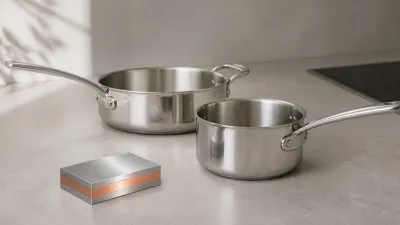
In a clad pan, the cooking surface, conductive core, exterior, and base may all have different jobs. A 304 cooking surface can sit over an aluminum or copper core and a magnetic stainless exterior. A pan marketed as 201 may be single-layer, clad, disc-bottomed, coated, or assembled with several other materials. Thickness, coverage, geometry, burner contact, and mass can dominate the cooking experience.
This comparison therefore cannot award a heat-performance winner. Read the exact construction page and care manual, and do not transfer a maker’s claim from one collection or size to another. If the listing says only “stainless steel cookware,” the grade and layer arrangement remain unknown.
Is 201 or 304 automatically food-safe cookware?
No. An alloy designation is not the same thing as finished-article food-contact compliance. The relevant questions are which surface touches food, what other components can migrate, how the article is finished and maintained, and whether the maker supports the intended use with appropriate documentation.
The FDA’s food-contact guidance explains that the overall regulatory status of a food-contact material depends on each substance that makes up the article, its specifications, and its conditions of use. FDA also lists cookware among food-contact uses for which migration and toxicological information can matter in an intended-use assessment. That does not turn a 201 or 304 label into an FDA approval, and this article does not make a product-specific compliance determination.
The European Commission’s food-contact framework likewise treats kitchenware and tableware as food-contact materials whose safety depends on the article and its intended use. Its Joint Research Centre kitchenware guidance describes test conditions for migration according to material, food contact, time, and temperature. That is why a grade label cannot establish nickel, chromium, manganese, or other release from every finished pan.
When a seller claims “food grade,” ask what exact article, surface, standard, intended food, and test or compliance document the claim covers. If those details are not available, preserve the unknown rather than treating 201 or 304 as a universal safety answer.
Does 304 release less nickel than 201?
The grade name alone cannot answer a finished-article release question. 304 commonly contains more nickel in its nominal composition range than 201, but bulk composition is not a migration result. Release depends on the food-contact surface, finish, passivation, exposure time, temperature, acidity, salt, abrasion, and the test method used.
The same caution applies to claims that 201 is “nickel-free.” Standard 201 contains nickel in the common composition table, and product variants can differ. A maker’s composition certificate or migration report is more useful than a marketing comparison. If nickel exposure is your concern, ask for intended-use evidence for the exact pan instead of inferring it from the grade number.
How should you verify a 201 or 304 cookware product?
Use this checklist before treating a listing as a grade comparison:
- Confirm the exact alloy. Look for the grade, UNS designation, applicable standard, product form, and a maker or mill certificate. “Stainless steel” alone is not enough.
- Identify the food-contact surface. Ask whether the interior is 201, 304, another stainless grade, a coating, or an unknown material. Do not assume the exterior grade is the interior grade.
- Map the construction. Check whether the pan is single-layer, fully clad, base-clad, or assembled with a separate disc, core, lid, or handle. Grade ownership stops at the alloy portion actually documented.
- Inspect fabrication evidence. Look for smooth seams, a stable base, sound welds or rivets, an intact finish, and care instructions for salt, acids, cleaners, heat, and storage.
- Match the environment. Consider acidic or salty foods, long contact, repeated heating, dishwasher or sanitizer exposure, and crevices. Use the maker’s limits rather than assuming either grade tolerates every condition.
- Ask for food-contact documentation. A finished-article statement, migration test, declaration, or letter of guaranty should identify the product and intended conditions. A generic alloy certificate does not replace that evidence.
If the product page cannot answer these questions, the honest conclusion is “grade or compliance unknown.” Do not cut, grind, scratch, apply chemicals, or use a home magnet test as a definitive investigation. Those actions can damage the pan and still will not establish the full composition or food-contact status.
How do 201 and 304 compare with other stainless grades?
This page owns the 201 versus 304 cookware decision. It does not replace comparisons of 304 with 430 or 316, and it does not define “food grade” as a broad category. For the adjacent material questions, see 18/10 versus 18/8 stainless steel cookware, 304 versus 430 stainless steel, 304 versus 316 stainless steel, and what food-grade stainless steel means. Those pages own their separate grade and terminology boundaries.
Which grade should you choose for cookware?
Choose 304 when you want the more familiar general-purpose reference grade, need greater confidence in a wet or acidic environment, or have two otherwise comparable products and one provides clearer 304 construction and food-contact documentation.
Consider 201 when the exact maker documents the grade and finished article, the use environment is appropriate, and the product’s fabrication, care, and food-contact evidence meet your needs. Do not select it solely because a listing uses “stainless steel” or because a magnet responds weakly.
Choose neither on grade alone when the interior material, product standard, construction, or intended-use evidence is missing. A well-documented 201 pan can be easier to evaluate than an unnamed “304” pan, while an unsupported 201 claim should not be treated as equivalent to a certified 304 specification.
How we compared
This is a research-based material comparison, not a hands-on cookware test. The planning identity, search intent, cannibalization boundary, and approved incoming links were checked on August 22, 2026. Alloy composition and technical claims were checked against the BSSA composition and technical pages, ASTM’s A240/A240M scope, Nickel Institute guidance, FDA food-contact guidance, and European Commission and JRC food-contact material guidance.
The comparison covers nominal composition, nickel and manganese substitution, corrosion environment, forming, magnetism, construction layers, and finished-article food-contact evidence. It does not rank products, test migration, measure corrosion, certify a pan, compare prices, prove induction behavior, or claim that either grade universally wins on safety, durability, or performance.