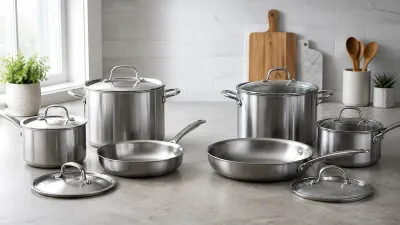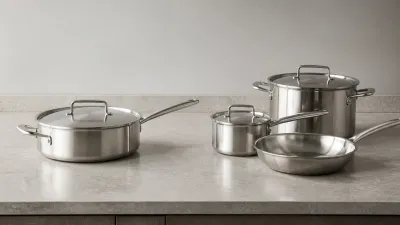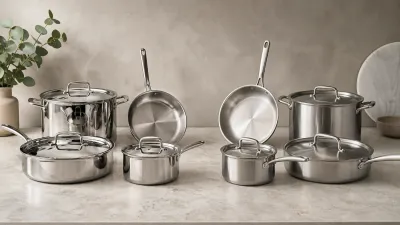
Heritage Steel Eater is the better 10-piece set for cooks who want a 2-quart saucier, a larger 4-quart sauté pan, five-ply construction, and an 800°F stated oven limit. All-Clad D3 is better for buyers who prefer simpler tri-ply cookware, two conventional saucepans, and the brand’s long-established pan layout. Both sets are fully clad, induction-ready, and manufactured in the United States with imported or global materials.
This comparison matches Heritage Steel’s Eater Series 10-piece set with All-Clad’s D3 10-piece set. Heritage Titanium and All-Clad D5 are different five-ply lines. They are outside this matched decision.
Heritage Steel Eater and All-Clad D3 at a glance
| Decision | Heritage Steel Eater 10-piece | All-Clad D3 10-piece | Winner |
|---|---|---|---|
| Construction | Fully clad five-ply | Fully bonded tri-ply | Fit matters more than layer count |
| Cooking surface | 304 stainless steel | Stainless steel | Tie for uncoated cooking |
| Small covered vessel | 2-quart saucier | 2-quart saucepan | Heritage for curved stirring; D3 for straight sides |
| Sauté pan | 4 quarts | 3 quarts | Heritage for capacity |
| Fry pans | 8.5 and 10.5 inches | 8 and 10 inches | Heritage for slightly more area |
| Oven and broiler | 800°F | 600°F | Heritage |
| Induction | Yes | Yes | Tie |
| Manufacture | Clarksville with global materials | USA with global components | Tie, wording differs |
| Warranty | Lifetime warranty | Limited lifetime warranty | Read both terms |

Heritage Steel Eater Series 10-Piece Cookware Set
4.8 out of 5 (121 ratings, as of August 1, 2026)
Heritage Steel's five-ply Eater set, manufactured in Clarksville, Tennessee, with global materials.
- 8.5- and 10.5-inch fry pans
- 2-quart saucier, 3-quart saucepan, 4-quart sauté pan, and 8-quart stockpot
- Induction compatible and oven and broiler safe to 800°F
Pros
- Saucier adds a curved-wall vessel absent from the D3 set
- Larger sauté pan and slightly larger skillets
- Manufacturer names its Clarksville factory and global material qualification
Cons
- Smaller exact-product Amazon review pool than D3
- Larger vessels need more burner and cabinet space
Considerations
Choose it when the exact vessel layout solves a need; five named layers alone do not establish better heat performance.
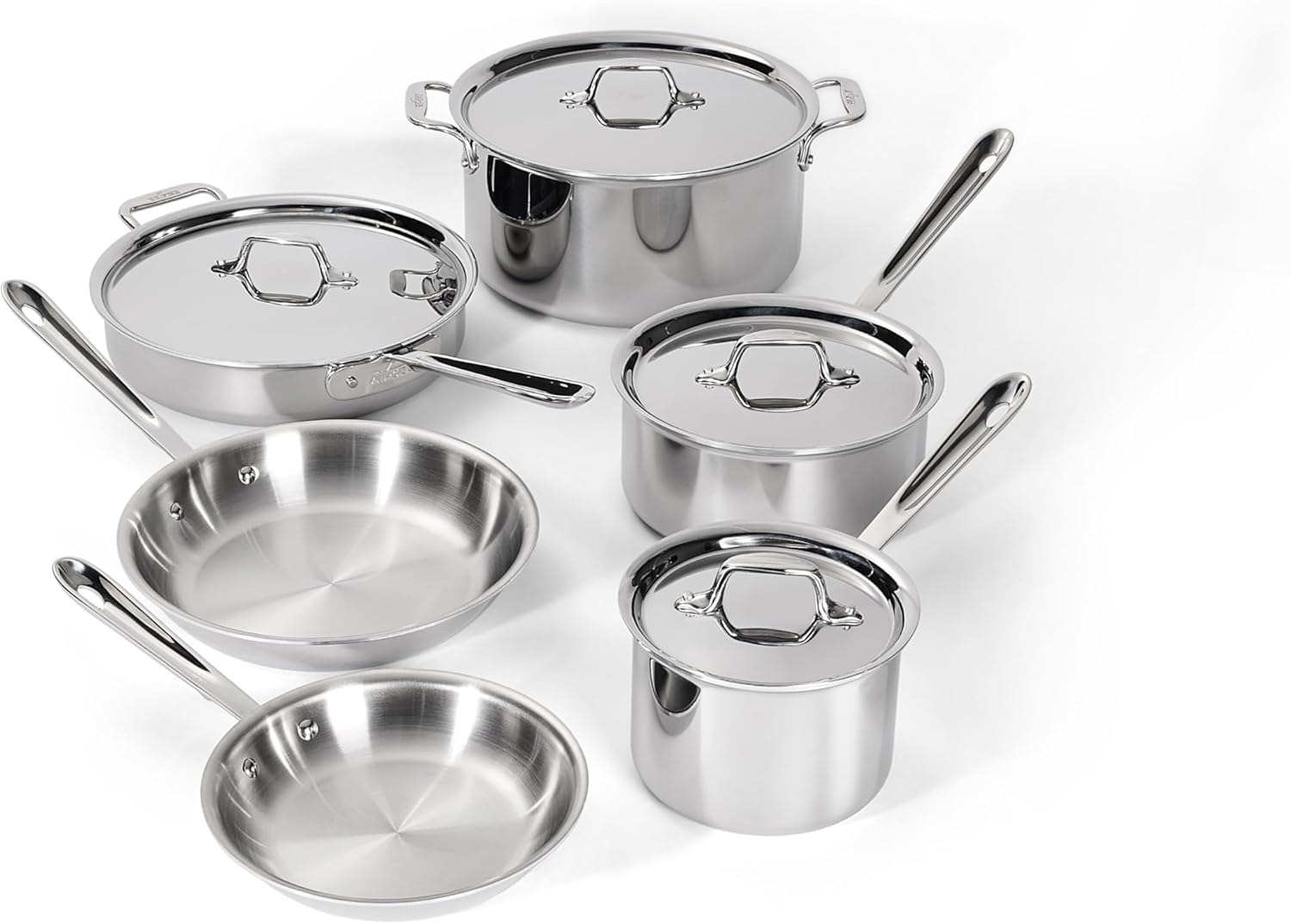
All-Clad D3 Stainless 10-Piece Cookware Set
4.5 out of 5 (1,227 ratings, as of August 1, 2026)
All-Clad's fully bonded tri-ply set with two conventional sauce vessels and qualified US manufacturing.
- 8- and 10-inch fry pans
- 2-quart saucepan, 3-quart casserole, 3-quart sauté pan, and 8-quart stockpot
- Induction compatible and oven and broiler safe to 600°F
Pros
- Deeper exact-set Amazon review history
- Smaller assortment can fit compact burners and storage more easily
- Simpler tri-ply construction without a layer-count premium
Cons
- No saucier in the matched set
- Smaller sauté pan and lower stated oven ceiling
Considerations
Choose it when the traditional vessel mix and smaller dimensions matter more than Heritage's saucier and larger pans.
How we compared
This is a research-based editorial comparison, not a hands-on or side-by-side test. We checked the current Heritage Steel Eater 10-piece set and All-Clad D3 10-piece set on August 1, 2026. The decision uses stated construction, pan sizes, oven limits, cooktop compatibility, care, manufacturing disclosures, and warranty language.
Exact Amazon availability, ratings, review counts, and images came from Bright Data snapshots sd_msb1su48qv9hndd6a and sd_msb0qds92lo5k1x9vs captured the same day. This scheduled page has no URL-level row in the July 2–29 Search Console brief; missing data was not treated as zero performance. The July 25 portfolio retained this lower-volume comparison because it owns a distinct U.S.-made five-ply-versus-tri-ply decision; unavailable keyword volume was not invented.
We did not assume that five layers cook better than three. Neither maker publishes enough directly comparable core thickness and independent test data on these product pages to turn layer count into a heat-performance ranking. Volatile prices are also excluded.
Five-ply versus tri-ply does not decide the winner
Heritage Steel describes Eater cookware as fully clad five-ply. Its 304 stainless cooking surface sits above three aluminum core layers and a magnetic 400-series stainless exterior. All-Clad D3 uses a fully bonded tri-ply body with stainless around an aluminum core.
Both structures extend through the base and sidewalls. That makes either one different from a thin single-layer pan or a pot with conductive metal only under the base. Extra layers can change how a pan is engineered, but the count alone does not disclose aluminum thickness, total mass, responsiveness, or evenness.
If construction is your main concern, compare the exact vessel’s weight and geometry rather than counting layers. Our guides to three-ply versus five-ply cookware and fully clad construction explain why five is not an automatic performance score.
Winner: Tie without matched independent measurements.
Heritage has the more distinctive set layout
Heritage’s box includes 8.5- and 10.5-inch fry pans, a 2-quart saucier with lid, a 3-quart saucepan with lid, a 4-quart sauté pan with lid, and an 8-quart stockpot with lid. All-Clad uses 8- and 10-inch fry pans, 2- and 3-quart saucepans, a 3-quart sauté pan, and an 8-quart stockpot, with lids on the covered vessels.
The saucier is the meaningful split. Its curved transition from base to wall gives a whisk fewer corners to chase when making custard, gravy, or pan sauce. D3 instead supplies two straight-sided saucepans, a familiar shape for boiling, reducing, and reheating.
Heritage also gives the sauté pan another quart of stated capacity and makes both skillets half an inch larger. More capacity helps a household that cooks larger batches, but it also takes more burner and cabinet space.
Winner: Heritage for variety and capacity; All-Clad for two conventional saucepans and a more compact layout.
Heritage publishes the higher oven ceiling
Heritage lists the all-metal Eater set as oven and broiler safe to 800°F. All-Clad rates the D3 set for oven and broiler use to 600°F. Both limits exceed ordinary roasting and baking temperatures, so the practical benefit appears mainly in unusually high-heat finishing.
A higher ceiling is not permission to preheat an empty pan indefinitely. All-Clad specifically warns against leaving empty pans on a hot burner beyond normal preheating. Follow the applicable product instructions, and check any accessory bought separately.
Both sets work on induction. Burner fit still matters because an induction element couples with the magnetic base area, not the marketing name. See our induction compatibility guide before assuming every stainless item behaves alike.
Winner: Heritage for the higher stated limit; tie for induction.
Handles, care, and cleanup require a closer look
Heritage uses hollow stainless handles designed to reduce stovetop heat transfer, while warning that handles can still get hot during extended high-heat cooking. All-Clad uses its classic riveted handle designed for an underhand grip. Both attach handles with interior rivets, so neither gives you the flush, nearly level fasteners found on some competing lines.
Handle comfort is personal and changes when a pan is full. Lift comparable pieces before buying if you can. Turn the pan as if pouring, and make sure your wrist can keep the rim level.
All-Clad’s current D3 product page says hand wash only. Heritage’s page emphasizes its all-metal construction but buyers should follow the exact care sheet supplied with the set rather than infer dishwasher permission from the material alone. For either brand, our stainless cookware cleaning guide starts with the least aggressive method.
Winner: No universal winner.
Manufacturing statements are similar but not identical
Heritage says it manufactures the Eater cookware and lids in Clarksville, Tennessee, from global materials, including clad steel sourced from South Korea. All-Clad describes D3 as made in the USA with global components in its Pennsylvania factory.
Neither statement means every layer, handle, or input originated domestically. Both are qualified manufacturing claims. Our roundup of stainless cookware made in the USA keeps those qualifications visible rather than replacing them with an all-domestic label.
The useful origin difference is factory transparency, not a flag icon. Heritage names Clarksville and one imported clad-metal source. All-Clad names its Pennsylvania factory and global components. Buyers can value either disclosure without pretending it measures cooking performance.
Winner: Tie for US manufacture with imported inputs.
Which cookware should you buy?
Buy Heritage Steel Eater if you will use the saucier, need a 4-quart sauté pan, prefer slightly larger skillets, or genuinely need the stated 800°F ceiling. Those differences justify choosing it more clearly than the five-ply label by itself.
Buy All-Clad D3 if two straight-sided saucepans suit your cooking, smaller vessels fit your burners and storage better, or you want the same tri-ply platform compared in our All-Clad D3 versus D5 guide. The wider stainless cookware-set roundup helps if neither assortment is right. Shoppers weighing a third brand can read how All-Clad D3 compares with Made In.
Count your existing pans before buying either set. A 10-piece box contains six cooking vessels and four lids. Buying the better-shaped assortment is more valuable than duplicating a good stockpot or sauté pan you already own.
Frequently asked questions
Is Heritage Steel better than All-Clad?
Heritage Steel Eater is better when its saucier, 4-quart sauté pan, larger skillets, and 800°F stated limit match your cooking. All-Clad D3 is better when you want two straight-sided saucepans, smaller pans, and simpler tri-ply construction. Neither brand wins without matching the exact collections.
Is Heritage Steel cookware made in the USA?
Heritage Steel says the Eater cookware and lids are manufactured in Clarksville, Tennessee, with global materials. Its current product page says the clad cookware steel comes from South Korea. That supports a qualified US manufacturing claim, not a claim that every material is domestic.
Is Heritage Steel five-ply better than All-Clad tri-ply?
Not by layer count alone. Both sets extend an aluminum core through the vessel, while Heritage divides its core and shell into five named layers. Without matched measurements for core thickness, total mass, heating, and responsiveness, pan sizes and handling are sounder decision points than five versus three.
Related guides
Continue with Heritage Steel vs Made In Cookware: Which Is Better?, Made In vs Hestan Cookware: Which Is Better?, Le Creuset vs All-Clad Stainless Cookware, Demeyere vs Hestan Cookware: Which Is Better?.