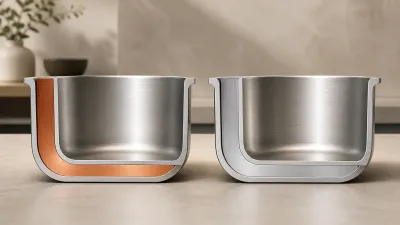
Three-ply cookware is the better default for cooks who value lower weight, quick burner response, and broad choice. Five-ply cookware fits cooks who prefer a steadier-feeling pan and accept more weight, but the extra layers do not prove better performance.
Choose by total construction, weight, and response, not by whichever label has the larger number.
3-ply vs 5-ply cookware at a glance
| Decision | 3-ply cookware | 5-ply cookware | Better fit |
|---|---|---|---|
| Typical structure | Stainless, conductive core, stainless exterior | Five bonded metal layers in a line-specific arrangement | Neither by count alone |
| Handling | Often lighter | Often heavier, but verify the exact pan | 3-ply for easier lifting |
| Heat adjustment | Often quicker-feeling | Often steadier-feeling | Depends on technique |
| Choice | Many brands and price levels | Fewer lines, often positioned as premium | 3-ply for selection |
| Induction | Requires a magnetic exterior | Requires a magnetic exterior | Tie when specified |
| Best use | General-purpose daily cookware | Cooks who want a line’s specific mass and design | Depends on the exact line |
What do three-ply and five-ply mean?
The terms describe counted bonded layers, not a universal material formula. Conventional three-ply stainless cookware places an aluminum core between a stainless cooking surface and stainless exterior. Tramontina documents that structure for its fully clad Signature line.
Five-ply can mean alternating stainless steel and aluminum, as All-Clad specifies for D5, or another combination selected by a different manufacturer. Read the layer diagram for the exact line. Our guide to fully clad cookware explains the separate question of whether those layers reach the rim. For a brand-matched example, see our All-Clad D3 vs D5 comparison.
Which cookware heats more evenly?
Neither ply count wins without comparable measurements. Heat spreading depends strongly on the conductive metal’s material and thickness. A three-ply pan with a substantial aluminum core may spread heat better than a five-ply pan whose counted layers include more stainless steel.
Pan diameter, burner match, flatness, and food load also affect the result. Claims made for one five-ply line do not transfer to every five-ply product, just as one thin three-ply pan does not represent the category.
This category is a tie unless the manufacturer publishes meaningful construction details or independent testing compares equivalent pieces.
Which responds faster to burner changes?
Three-ply often feels more responsive because many three-ply pans are lighter and use a simple aluminum core. Five-ply lines are often designed with more total mass or internal stainless layers, which can slow temperature change and hold heat longer.
That distinction can help or hinder. Quick response is useful for sauces and temperature corrections. More thermal stability can help when a cool steak or a large batch of vegetables hits the pan. Total mass matters more than the layer label, so compare published weights for the same diameter and vessel type.
Three-ply takes this category for cooks who prioritize quick adjustment, subject to the exact pan’s weight.
Which is easier to handle?
Three-ply is usually the easier category to lift, tilt, and wash. The advantage matters more in a large sauté pan or when a saucepan is full. Five-ply is not always heavy, however, and handles, lids, and vessel dimensions can erase a small construction difference.
Check listed product weight rather than assuming. The current Demeyere versus All-Clad comparison illustrates the point: equivalent five-ply and three-ply sauté pans can have very similar published total weights.
Three-ply wins for the best chance of lower weight, not as an absolute rule.
Is five-ply more durable?
Ply count alone does not establish durability. Rim finishing, handle attachment, steel gauge, bonding quality, flatness, and care all affect service life. Both well-made three-ply and five-ply cookware can carry long warranties, and both can warp under severe thermal shock, as the guide to why stainless steel pans warp explains.
Do not pay extra solely for the idea that two counted layers must add years of life. Compare the warranty terms and construction of the exact products.
This category is a tie.
Which works better on induction?
Both can work equally well when the exterior is magnetic, the base remains flat, and its diameter suits the element. Ply count does not determine induction compatibility. Manufacturer instructions for the exact line are the reliable check.
Read our induction compatibility guide before choosing a pan for a cooktop with strict minimum-diameter detection.
This category is a tie when both products are specified for induction.
Should you buy 3-ply or 5-ply cookware?
Buy three-ply if you want a practical all-purpose set, easier handling, and more choices across price levels. It is the safer default when you cannot point to a specific five-ply feature you need.
Buy five-ply if you have compared equivalent pans and prefer the line’s weight, handle, heat behavior, or other documented feature. Buy the construction as a whole, not the number five.
Our best stainless steel cookware sets compare exact sets, while the All-Clad D3 versus Made In Stainless Clad guide applies this decision to current three-ply and five-ply products.