No. Solid stainless steel pots, pans, mugs, bottles, and flatware do not belong in a microwave. Metal can spark inside the oven and damage it, and appliance makers list metal containers among the items to keep out. The narrow exceptions are a metal rack or accessory that the oven maker supplies and tells you how to use, and the rare container whose own maker labels that exact product microwave safe.
If you need to reheat something that lives in stainless steel, move it to a glass or ceramic dish first. The rest of this guide explains what goes wrong, where the exceptions stop, and what to do if metal already went in.
Short answer
Keep stainless steel out of the microwave unless the microwave’s manual allows a specific metal accessory or the container’s maker labels that exact product microwave safe. That rule covers cookware, travel mugs, insulated bottles, lunch boxes, and flatware.
A stainless label does not change this. The grade of steel, a “food-grade” stamp, or a dishwasher-safe symbol says nothing about microwave use. For the wider question of whether the steel itself is safe for food, see is stainless steel cookware safe.
Why metal sparks in a microwave
Metal in the oven can throw sparks, which appliance makers call arcing. JennAir’s support page on arcing says that metal cookware and bakeware, objects with gold or silver trim, skewers, twist ties, and foil liners “should not be used in the microwave oven” because they can cause sparking or arcing. The same page warns that prolonged arcing can damage the oven or the utensil, and that the fix is to remove the offending item and switch to a microwave-safe one. (JennAir, General Arcing and Sparking)
The second problem is quieter. A closed metal pot or mug is a poor way to heat food in a microwave, so the contents may stay cool while the oven runs.
What happens with stainless pots, mugs and bottles
Panasonic’s support page for its commercial microwaves lists metal containers or pans, metal utensils such as forks, spoons, and knives, and containers with metal trim or rims, including stainless steel accents, among the materials not to use. It names microwave-safe glass, microwave-safe ceramic, clearly labeled microwave-safe plastic, and plain paper products as the materials that are safe. (Panasonic, Commercial Microwave Oven has sparks)
That page covers commercial ovens, but the home-oven guidance from JennAir points the same way. Our guide to storing food in stainless containers applies the same caution to lunch boxes and food containers, and our thermos guide says never to microwave a metal bottle.
A few cases deserve a plain note.
- Mugs and bottles are metal containers, which makers list among the items to keep out.
- Pots and pans fall under the metal cookware and bakeware that JennAir says should not be used.
- A few specialty products are built and labeled by their makers for microwave use. Use one only when its own instructions say so for your type of oven.
The stainless steel inside your microwave
Many microwaves have a stainless steel cavity or a stainless door and trim. That is part of the oven’s design, and it is not the same as putting loose metal inside. Follow the manual for cleaning and care, and keep the cavity free of grease and food buildup. JennAir lists soil buildup in the cavity as one cause of arcing, and Panasonic lists grease or carbon buildup and a damaged waveguide cover as non-cookware causes.
If you are shopping for a microwave with a stainless exterior, see our best stainless steel microwaves.
Some ovens also ship with a metal convection rack or crisper pan. JennAir notes these are available on some models, that they must not touch the cavity walls, ceiling, or floor, and that the crisper pan should sit on the turntable. Use them only as your model’s manual describes.
Foil is the other gray area. JennAir says aluminum foil and some metal can be used in its ovens when used properly, and that improper use can cause arcing and damage. The USDA Food Safety and Inspection Service handout on microwave cooking is stricter and says never to use aluminum foil in the microwave oven. (USDA FSIS, Cooking Safely in the Microwave Oven) With those two positions in conflict, skip foil unless your manual explicitly allows it.
What to use instead
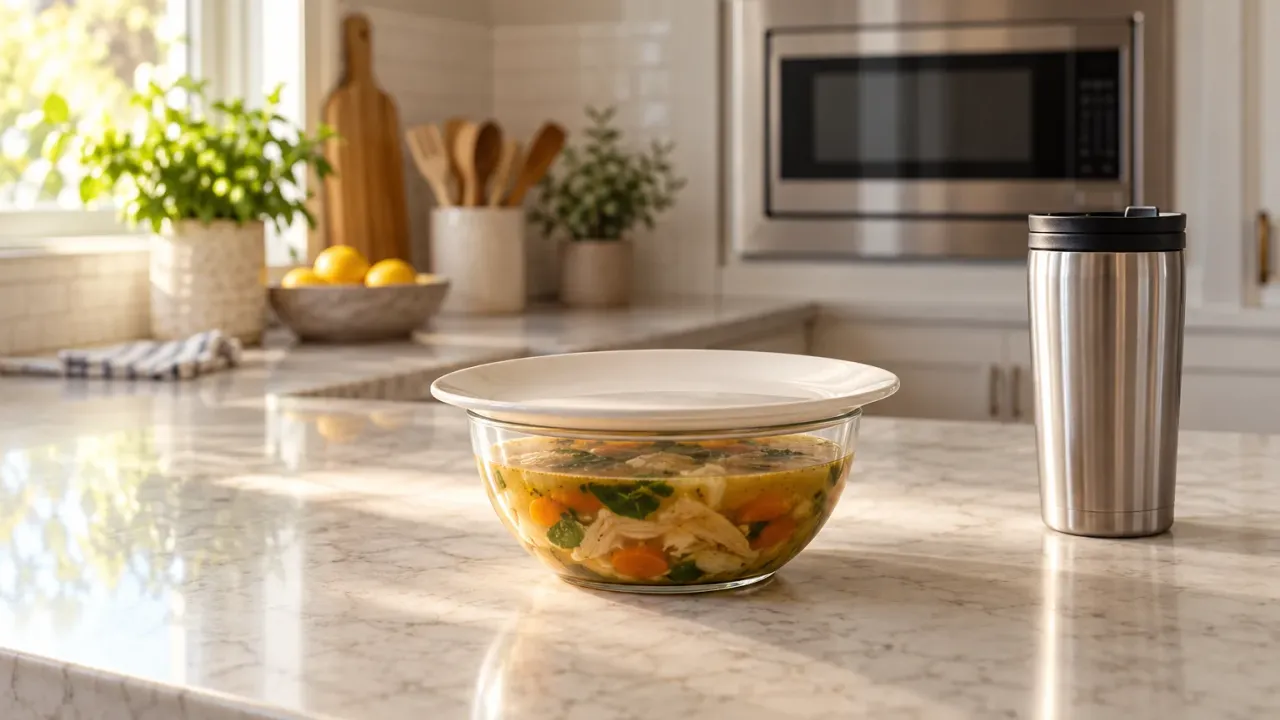
Reheat in a vessel that is labeled microwave-safe.
- Microwave-safe glass or ceramic bowls and plates
- A microwave-safe lid or plate set loosely over the bowl, since FSIS says to cover the dish and vent the lid or wrap
- Microwave-safe plastic wrap, wax paper, parchment paper, and white microwave-safe paper towels, as listed by the FSIS handout, with plastic wrap kept off the food
For a lunch, pack the food in stainless for the trip and move it to a dish at work. If you reheat often, a glass container saves the extra step. Our comparison of glass containers for reheating shows where each material fits, and our roundup of stainless containers for the fridge covers the cold-storage side.
If the pan is for the oven rather than the microwave, the rules differ. See stainless in the oven.
If you already microwaved stainless steel
Stop the oven right away. Panasonic’s corrective steps are to stop the operation immediately if sparking occurs, remove all food and containers, and replace the container with microwave-safe cookware. Let the oven and the item cool before you handle them.
Then look at both for damage. Panasonic says that if sparking continues with an empty cavity or with microwave-safe cookware, the cause is not the container and the unit may have a damaged waveguide cover, buildup, or a component failure. In that case, stop using it and contact the maker’s service line.
Frequently asked questions
Can I microwave a stainless steel travel mug?
No. A travel mug is a metal vessel, and makers list metal containers among the items to keep out of the microwave. Pour the drink into a microwave-safe mug and warm it there.
Is stainless steel flatware safe to microwave for a few seconds?
No. Panasonic lists metal utensils such as forks, spoons, and knives among the items not to use, and JennAir lists metal cookware and skewers as arcing risks. Short run times do not remove the risk, so take the spoon out before you start.
Are microwaves with a stainless steel interior safe?
Yes, when you use the oven as its manual describes. The stainless cavity is part of the oven’s design and is not loose metal in the food space. Keep it clean, follow the manual, and do not add metal that the manual does not allow.
Can I microwave food wrapped in foil?
Avoid it. The FSIS handout says never to use aluminum foil in the microwave. JennAir says some foil use is acceptable when done properly. If your manual does not describe a safe method for your model, use a microwave-safe dish instead.