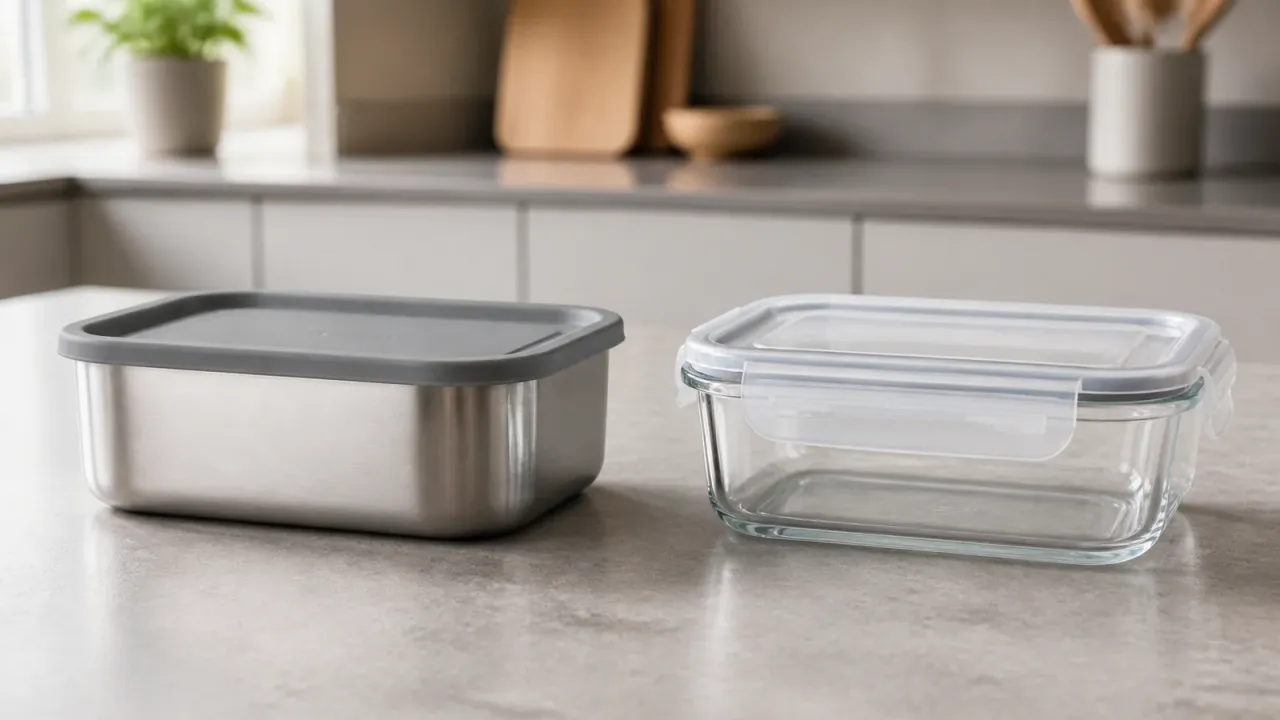
Choose stainless steel when you want an opaque container with a lower breakage concern for lunches, leftovers, or freezer storage and you can live without microwave use. Choose glass when you want to see the food and move the exact vessel from freezer to microwave or a preheated oven under its maker’s instructions. Neither material wins every storage job.
The practical choice is the complete container, not the body material alone. A stainless box may have a silicone lid with a leak-resistant rather than leakproof claim. A glass container may have a plastic lid that cannot go in the oven. Compare the body, lid, seal, appliance limits, condition, and replacement path together.
Stainless steel vs glass food storage containers at a glance
| Decision | Stainless steel | Glass | Better starting point |
|---|---|---|---|
| Visibility | Opaque; you need to open the lid to inspect the food | Clear; contents and fill level are visible | Glass for visual checks |
| Weight and handling | Often lighter at a comparable capacity, but exact weights vary | Usually adds more weight at a comparable capacity | Stainless steel when frequent lifting matters |
| Breakage and damage | Can dent, scratch, or develop a sharp damaged edge | Can chip or break after a drop, impact, or bad temperature change | Match the damage risk you can manage |
| Microwave use | Metal containers are not microwave vessels | Some exact glass lines document microwave use with the lid removed | Glass when reheating in the same vessel matters |
| Oven use | Exact body and lid limits control; the U-Konserve body is listed to 300°F | Exact glass line limits control; Snapware’s current glass guidance lists up to 450°F with the lid removed | Check the exact product |
| Freezer use | The U-Konserve example is maker-listed freezer safe | The Snapware example is maker-listed freezer safe, with temperature-transition precautions | Tie when both exact products allow it |
| Lids and seals | Platinum-grade silicone lid; maker says leak-resistant | BPA-free plastic lid with four locking tabs and a silicone seal | Glass for a stronger published seal claim; test and inspect either |
| Odors and stains | Stainless body is opaque; the lid and seal still need cleaning | Maker says Pyrex glass resists stains and does not absorb food odors or flavors | Glass for visible residue control |
| End of life | Metal body may have a local scrap or recycling route; lid is separate | Whole glass may be accepted locally; broken glass must stay out of recycling bins | Check local rules and separate components |
This table describes the two documented examples below, not every container sold under either material name. Thickness, shape, lid fit, seal design, manufacturing condition, and care instructions can change the result.
Which material is better for everyday storage?
Stainless steel is the easier starting point for a container that will be lifted often, carried to work or school, or stored in a crowded freezer. It does not create the same glass breakage concern when it is knocked against a counter. It can still dent, scratch, or develop a damaged rim, so it is not damage-proof.
Glass is the easier starting point when you want to identify leftovers without opening the lid, reheat in the storage vessel, or check a portion at a glance. Its tradeoff is a heavier and more fragile body. A glass container that is chipped, cracked, or damaged by a sharp impact should not remain in service just because the lid still closes.
If the container will travel in a bag, inspect the closure before comparing the body. A leak-resistant stainless lid may be a good fit for sandwiches and solid leftovers but a poor fit for soup. A glass container with four locking tabs may control liquid better when the seal is clean and aligned, but no lid should be treated as universally leakproof after damage, overfilling, or a mismatched container.
For a stainless-only lineup with different shapes and closure styles, see our best stainless steel food storage containers guide. It covers divided lunch boxes and gasketed containers as product-specific designs rather than treating every stainless box as interchangeable.
How we compared
This is a research-based comparison, not a hands-on or side-by-side test. I used one bounded Bright Data Amazon discovery search, then checked the exact Amazon records for U-Konserve B088VLDMNW and Snapware B086TTGF78 on August 22, 2026. Current maker pages supplied the material, lid, appliance, size, care, and availability context. I did not fill, drop, freeze, microwave, oven-test, carry, dishwasher-test, or measure either container.
The U-Konserve exact record identifies one 25-ounce clear-variant rectangle, a 7.8-ounce listed item weight, a 4.5 rating from 166 reviews, and an in-stock Amazon snapshot. Its current U-Konserve maker page identifies 304 (18/8) stainless steel, platinum-grade silicone, a 25-ounce size, a 7.75 by 5 by 1.75-inch size with the lid on, freezer and dishwasher use, body oven use up to 300°F, and no microwave use. That maker page showed the selected 25-ounce variant unavailable when checked, so its maker availability and the Amazon snapshot must remain separate.
The Snapware exact record identifies five 4-cup glass containers with plastic lids, ten pieces when lids are counted, an 8.3-pound set weight, a 4.6 rating from 3,621 reviews, and an in-stock Amazon snapshot. The current Snapware glass-storage guidance describes Pyrex glass, four-locking-tab lids with silicone seals, freezer, microwave, dishwasher, and oven guidance for the line. It says the glass is oven-safe to 450°F with plastic lids removed. Those maker claims describe the product family; check the package and care sheet for the exact listing before heating it.
Amazon ratings, review counts, sellers, images, and availability are dated records, not quality tests or future-stock guarantees. Product identity, marketplace fields, and maker product-family names can use different identifiers. I preserve those records separately rather than treating a similar product page as the exact ASIN.
Representative products, not a universal winner
These cards make the comparison concrete. They are exact marketplace examples, not hands-on test winners. Do not read a rating as evidence that one material seals, heats, or lasts better in your kitchen.
Stainless steel example
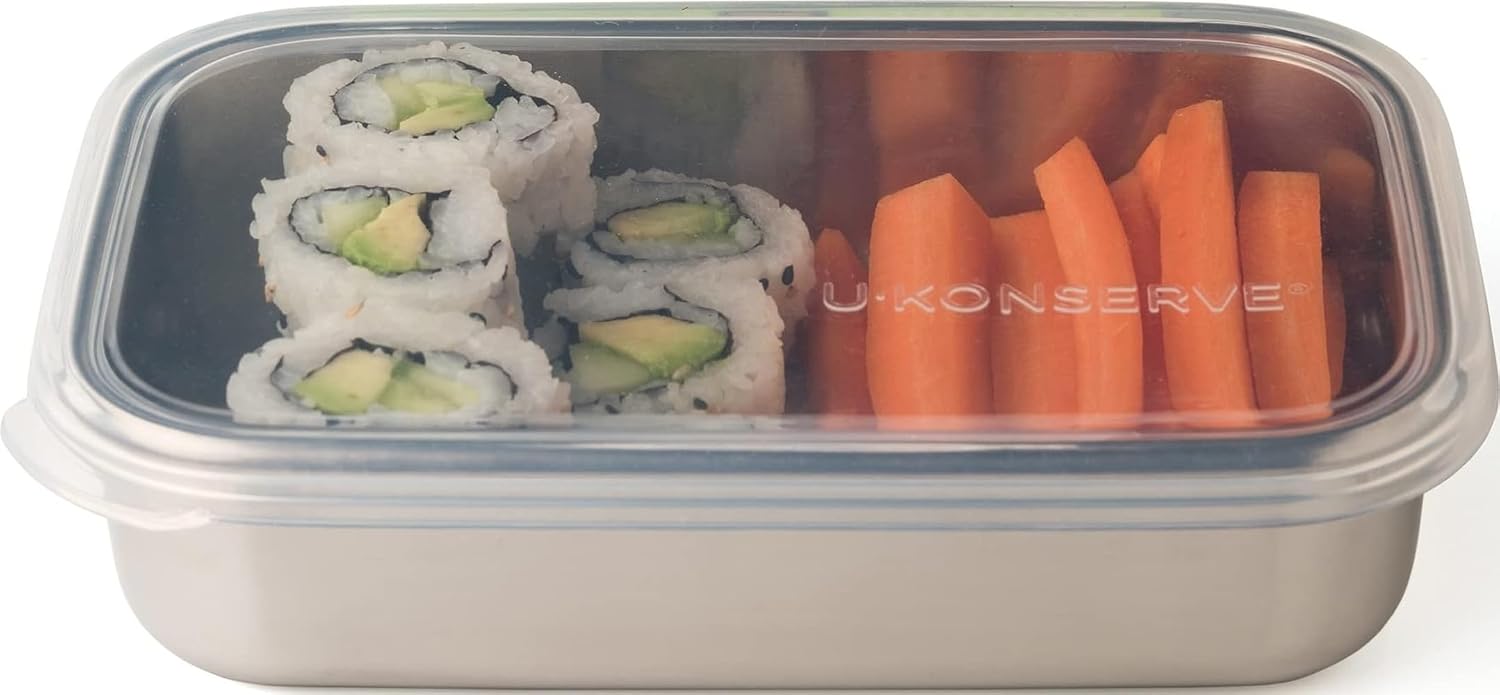
U-Konserve 25 oz Stainless Steel Rectangle Bento Food Container
4.5 out of 5 (166 ratings, as of August 22, 2026)
A 25-ounce stainless steel rectangle with a removable silicone lid and maker-documented freezer, dishwasher, and limited oven use.
Pros
- The opaque metal body avoids the same glass breakage mode during ordinary carrying
- The exact maker page identifies the body and lid materials separately
- The listed 7.8-ounce item weight is useful when checking a specific carry routine
Cons
- The body cannot be used in a microwave
- The maker describes the lid as leak-resistant, not as a universal liquid guarantee
- The maker page showed the selected 25-ounce variant unavailable at the evidence check
Considerations
Check the exact seller, variant, seal condition, and current maker availability before relying on this single-container listing.
Glass example

Snapware Glass Total Solutions 5-Pack, 4-Cup Food Storage Set
4.6 out of 5 (3,621 ratings, as of August 22, 2026)
Five 4-cup Pyrex glass containers with plastic snap-lock lids, giving the exact listing ten pieces and 20 cups of listed capacity.
Pros
- Clear sides make the contents and portion level easy to inspect
- The glass body can be reheated in a microwave when the lid is removed and instructions allow it
- The maker describes the glass as resistant to stains and food odors or flavors
Cons
- The exact listing reports an 8.3-pound set weight, which can matter for transport
- Glass can chip or break after impact or a prohibited temperature transition
- Plastic lids are not oven parts and the locking tabs need separate care
Considerations
Use the exact care instructions, let hot or cold glass follow the maker's temperature-transition rules, and inspect the lid tabs and rim.
Food-contact materials
| Surface | Verified material | Source |
|---|---|---|
| U-Konserve 25-ounce container body | 304 (18/8) stainless steel | U-Konserve rectangle container |
| U-Konserve lid | Platinum-grade silicone | U-Konserve rectangle container |
| Snapware B086TTGF78 container body | Pyrex glass | Snapware glass-storage guidance |
| Snapware lid | BPA-free plastic with four locking tabs and silicone seal | Snapware glass-storage guidance |
These are manufacturer-identified materials for the named components. They are not a blanket food-contact certification for every product sold under a brand, and composition does not by itself prove that every food, temperature, contact time, or damaged condition is acceptable. The FDA’s food types and conditions of use framework shows why the food, temperature, and storage condition matter alongside the substance. Follow the exact product instructions and replace a container or lid that no longer supports a clean, intact food-contact surface.
Weight and breakage
Stainless steel usually has the handling edge for a single portable container, but a fair comparison requires matching capacity and counting the lid. The U-Konserve marketplace record lists 7.8 ounces for one 25-ounce container. The Snapware record lists 8.3 pounds for a five-container set with five lids. Those fields are not a direct unit-to-unit test, so they should guide a measurement check rather than become a universal weight claim.
The more useful difference is how each material fails. Steel can dent or scratch, and a damaged rim can interfere with a lid or create a sharp edge. Glass can chip or break after an impact and can be damaged by abrupt temperature changes. A protective lunch bag may reduce knocks, but it does not make glass unbreakable or a steel box dent-proof.
Winner: stainless steel for a routine that involves frequent lifting and a lower concern about breakage. Glass remains reasonable when the container stays mostly at home and visibility or reheating matters more.
Visibility and portion checks
Glass wins visibility because you can see the food without opening the lid. That helps when you are identifying leftovers, checking a portion, or deciding whether a container still has room for a lid without disturbing the contents. Pyrex’s maker page also describes the glass as resisting stains and not absorbing food odors or flavors, which is useful context for visible storage.
Stainless steel blocks light and hides the contents. That can protect privacy in a lunch bag and may make a dark pantry tidier, but you need a label or an open lid to identify food. The body can be easy to wipe clean, while the silicone lid and its edge still require inspection and drying.
Winner: glass for visibility and at-a-glance meal planning. Stainless steel wins only if seeing the food is less useful than an opaque, light-blocking container.
Microwave, oven, and freezer boundaries
Microwave use is the cleanest dividing line. Do not place the U-Konserve steel body in a microwave. The Snapware glass line documents microwave use for the glass body, but the plastic lid must be removed or vented exactly as instructed. A microwave-safe glass body does not make its lid microwave-safe in every position or cycle.
Oven permissions also belong to the whole setup. U-Konserve lists the body to 300°F and tells users not to put the lid in the oven. Snapware’s current glass-storage guidance lists the Pyrex glass to 450°F and says the plastic lids are not oven-safe. Preheat as directed, keep plastic or silicone parts out when required, and never infer that a freezer label grants permission for a sudden freezer-to-hot-oven transfer.
Both example makers list freezer use. Pyrex’s safety guidance says to let glass reach room temperature before placing it in the freezer, refrigerator, microwave, or preheated oven. Leave headspace for food that expands and follow the exact container and lid directions. Stainless steel avoids glass thermal-shock concerns, but its lid and seal still have their own temperature limits.
Winner: glass for one-vessel microwave or documented oven use. Stainless steel is the simpler choice when the container will stay cold or be transferred to a separate reheating vessel.
Lids, seals, and leak risk
The lid may matter more than the body when a container travels. U-Konserve identifies a flexible platinum-grade silicone lid and calls it leak-resistant. That wording supports ordinary packed food, but it does not promise a leakproof seal for soup, a sideways bag, an overfilled box, or a worn lid. Check the rim, lid edge, and fit before each carry.
Snapware uses a BPA-free plastic lid with four locking tabs and a silicone seal. The maker describes the line as airtight and leak-proof. That is a product claim for the documented lid design, not proof that every used lid will hold liquid after a tab breaks, a gasket collects residue, or a lid is paired with the wrong shape. The exact Amazon record also has a separate lid material field, which is why the glass container should not be described as an all-glass food-contact system.
Neither lid should be closed over food that is still releasing heat unless the maker gives directions for that use. Clean the groove or fixed seal, let the container cool as instructed, and stop using a lid with a failed latch, warped rim, torn seal, or persistent leak.
Winner: Snapware for the stronger published closure specification. U-Konserve may be the better fit when a simpler, plastic-free body-and-silicone-lid system matters more than a liquid-seal claim.
Acidic or salty foods and food contact
A named grade or glass label is only one part of the food-contact decision. The U-Konserve page identifies 304 (18/8) stainless steel for the body and platinum-grade silicone for the lid. The Snapware listing identifies a glass container and plastic lid, while the maker describes Pyrex glass and a silicone-sealed closure. Those component records are more useful than a vague promise that a container is simply food safe.
For tomato, citrus, vinegar, brined, or salty food, use the container for the storage time and temperature the maker allows. Do not store food in steel that is deeply pitted, rusting, sharp, or damaged at a seam. Do not use glass with chips or cracks. A gasket or lid can be the first part to fail even when the body looks clean.
Our guide to whether stainless steel containers are safe for food storage covers refrigeration, cooling, freezer headspace, and damaged surfaces. It also explains why the container does not extend the safe life of a leftover. The material comparison here does not replace food-handling guidance or the product instructions.
Winner: neither universally. Choose the product whose complete food-contact surfaces, care instructions, and storage conditions are documented for the foods you actually keep.
Odors, stains, and cleaning
Glass has the clearer maker statement for stain and odor resistance. You can also see residue on the walls before it dries. The tradeoff is that the lid and silicone seal are separate cleaning surfaces. Wash the lid as directed, leave it open or separated to dry when the design allows it, and inspect the locking tabs.
Stainless steel can hide residue because the body is opaque. Its smooth metal surface does not remove the need to wash the lid, seal, rim, and corners. The U-Konserve example is listed dishwasher safe for the container and lid, but care still includes avoiding the microwave and keeping the lid out of the oven. Do not infer that a different stainless finish or silicone formulation has the same permissions.
Winner: glass for visible cleaning checks and the maker’s published stain and odor statement. Stainless steel is still a practical choice when you prefer an opaque container and will follow the separate lid-care instructions.
Durability and replacement
This comparison does not produce a drop test, dishwasher-cycle count, seal-life estimate, or durability ranking. A marketplace review count cannot answer those questions. Steel, glass, plastic, and silicone each create different replacement decisions.
With stainless steel, inspect dents, sharp edges, scratches that affect cleanability, and a lid that no longer sits flat. With glass, inspect the rim, corners, and base for chips or cracks before every use. With either product, a lid or seal that fails can turn an otherwise usable body into a poor storage system. Check whether the maker sells replacement lids or parts before buying a format that you expect to keep for years.
Winner: depends on the part you are most likely to damage and the replacement path available for the exact line. Stainless steel avoids glass breakage, while glass gives you a body that may be easier to inspect for residue and cracks.
End of life and recycling
Do not make a material choice on a recycling slogan alone. The stainless body and glass body may enter different local collection or scrap channels, while silicone and plastic lids usually need a separate decision. The EPA says acceptance varies by local program, and its recycling guidance says broken glass should not go in a recycling bin. Its recycling FAQ also recommends checking with the local provider and rinsing food residue from accepted materials.
Reuse is usually the first end-of-life option for an intact container. If a lid is lost but the body remains useful, check for a replacement rather than discarding the whole set. If the body is dented, cracked, chipped, or no longer cleanable, stop using it for food and follow local disposal instructions. Separate the body, lid, gasket, and sleeve only when the maker or local program gives you a safe route to do so.
Winner: no universal winner. Stainless steel may have a metal recovery route and glass may have a container-glass route, but local rules decide whether either route exists for your exact item.
Which should you choose?
Choose stainless steel if your priorities are lower breakage concern, opaque storage, easy carrying, and cold storage without microwave use. The U-Konserve 25-ounce example fits that brief, provided its leak-resistant lid and the current availability mismatch are acceptable.
Choose glass if your priorities are visibility, direct microwave use, documented stain and odor resistance, or a container that can move from freezer to reheating under exact instructions. The Snapware five-pack shows that design, but the set is heavier and its glass and locking lids still need careful handling.
If your routine includes both uses, do not force one material to do every job. Keep stainless steel for portable or opaque storage and glass for visible leftovers and reheating. The right choice is the complete product whose body, lid, seal, appliance limits, food-contact materials, care, and replacement path match your routine.
For another material comparison that separates body, closure, and carrying limits, see our stainless steel versus glass water bottles guide. For a food-prep example focused on visibility and breakage, compare stainless steel versus glass mixing bowls.