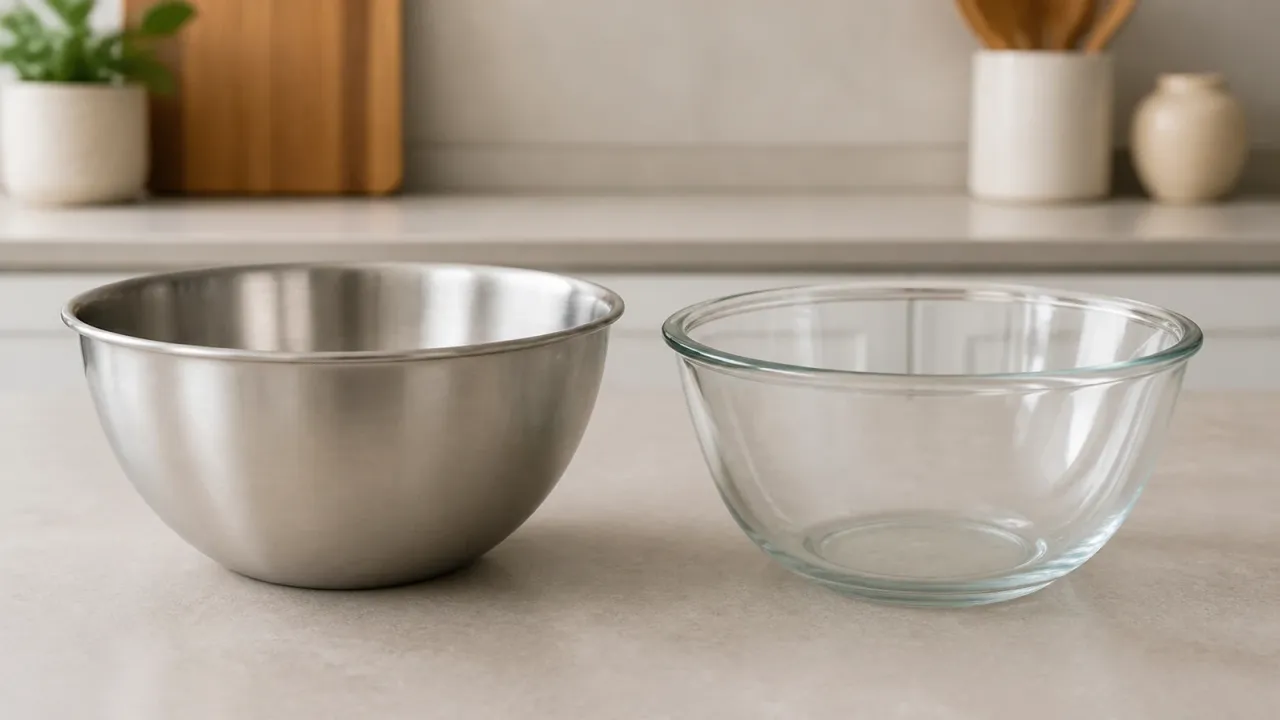
For most kitchens, stainless steel is the better everyday mixing bowl. It is easy to lift, does not carry the same chip or shatter risk as glass, and often stores compactly. Glass is the better fit when you want to see the mixture, use the bowl in a microwave, or serve from the same clear vessel. The choice turns on handling and temperature use more than a blanket material ranking.
If you are choosing one set, start with the work you do most often. Stainless steel favors repeated prep, whisking, and storage. Glass favors visibility, microwave convenience, and presentation. Both materials can be food-contact appropriate when the finished product and its care instructions are clear.
Stainless steel vs glass mixing bowls at a glance
| Decision | Stainless steel | Glass | Better starting point |
|---|---|---|---|
| Visibility | Opaque, so the sides and bottom are hidden | Clear, so layers and consistency are easy to see | Glass for visual control |
| Handling | Usually lighter at a comparable size and does not carry the same chip or shatter risk as glass | Usually heavier and can chip or break if dropped or struck | Stainless steel for frequent lifting |
| Temperature use | Not a microwave vessel; follow the exact bowl maker’s care guidance | Some lines allow microwave or oven use, with line-specific thermal-shock rules | Glass for documented microwave use |
| Whisking | Light bowls may move unless braced with a towel or stable base | Extra weight can help, but a smooth base can still slide | Depends on the bowl and counter |
| Acidic mixtures | Suitable for mixing, but do not assume every set is intended for long-term storage | Suitable for mixing, but avoid sudden temperature changes | Tie for mixing; follow care limits |
| Cleanup | Exact sets may be dishwasher safe | Exact sets may be dishwasher safe | Tie after checking the maker |
| Storage | Nesting and lids vary; some sets include fitted lids | Nesting is common, while lids are less universal | Stainless steel when covered storage matters |
| Long-term handling | Can dent or scratch, but does not break like glass | Resists stains in some lines, but remains breakable | Depends on your storage and handling |
The table is a starting point, not a claim that every bowl in a material behaves the same way. Wall thickness, base shape, finish, included lids, and the manufacturer’s care instructions can change the practical result.
Visibility and handling
Glass wins when you need to watch the mixture. You can see whether flour has settled at the bottom, whether a dressing has emulsified, or how much of a layered preparation remains without lifting the bowl. That is useful for baking and for recipes where the texture changes quickly.
Stainless steel asks you to use a spatula or whisk to check the bottom and sides. The tradeoff is easier handling. A steel bowl is generally less stressful to carry from the counter to the sink because a dropped bowl will not create the same glass breakage hazard. Steel can still dent, deform, or develop scratches, so it is not damage-proof.
The shape matters as much as the material. A broad, low bowl gives a whisk more room but can be awkward to carry when full. A tall bowl contains splashes but may hide flour pockets. Compare the actual diameter, height, and weight when a manufacturer publishes them instead of treating “stainless” or “glass” as a complete specification.
For the rest of a prep station, our guide to the best stainless steel kitchen utensils covers tools that pair with either bowl material. Use a stable work surface and a bowl size that leaves room for the ingredients to move.
Temperature response and microwave use
Glass is the more useful choice when the same vessel needs to go from preparation to a microwave, but the permission belongs to the exact product line. Pyrex’s product page for its three-piece mixing bowl set identifies tempered glass and microwave and dishwasher use. Its safety guidance also tells users to let a dish reach room temperature before placing it into a preheated oven or microwave. Read the Pyrex safety and usage guidance and Pyrex frequently asked questions before heating any glass bowl.
That timing matters because glass can be damaged by abrupt temperature changes. Do not move a cold glass bowl directly onto a hot surface, pour very hot liquid into a chilled bowl, or assume that one Pyrex product’s care rules apply to every glass mixing bowl. The word “oven-safe” also does not mean that a bowl is safe on a stovetop, under a broiler, or through every temperature transition.
Stainless steel is not microwave safe, but a mixing bowl is rarely the only vessel in a recipe. You can mix in steel, transfer a portion to a microwave-safe container, and return it to the bowl. This adds a step, but steel is forgiving for ordinary counter work and does not create a glass thermal-shock decision during mixing.
Neither material should be used on a burner simply because it can hold warm ingredients. Mixing bowls are not interchangeable with saucepans or oven dishes. Follow the exact product instructions, and keep hot ingredients away from a vessel whose manufacturer has not documented that use.
Whisking, mixing, and stability
The best mixing bowl is stable enough that your other hand does not have to pin it down. Glass has a useful amount of weight, which can make it feel planted while you whisk or fold. A steel bowl can be lighter and easier to reposition, but it may slide on a smooth counter when the base is narrow.
A damp kitchen towel under either material can add friction without permanently changing the bowl. A silicone base can help too, but check that it is part of the product design and remains secure during washing. A heavy bowl is not automatically stable if its base is rounded or the counter is wet.
Whisk shape matters. Balloon whisks need room at the bottom and enough width to move through the mixture. A steel bowl makes it easier to hear and feel a whisk against the sides, while a clear glass bowl makes it easier to see unmixed ingredients. Avoid striking glass with a metal whisk or scraper. A compatible silicone or nylon tool reduces the chance of chips and scratches, but the manufacturer’s guidance still controls.
If whisking is a major part of your routine, pair the bowl with the right tool. Our guide to the best stainless steel whisks covers whisk shapes and handling considerations separately from this material decision.
Acidic mixtures, odors, and food contact
Both materials can be appropriate for mixing acidic ingredients when the finished product is made for food contact and cared for as directed. Tomatoes, citrus, vinegar, and cultured dairy do not turn a bowl into a universal storage container. The more important questions are the bowl’s finish, lid material, storage directions, and whether the maker documents refrigerator or freezer use.
The Cuisinart CTG-00-SMB set is identified by Cuisinart as stainless steel, with 1.5-quart, 3-quart, and 5-quart bowls and tight-fitting lids. Its official product page documents refrigerator, freezer, and dishwasher use for that set. Those permissions belong to this product line. They are not a blanket license for every stainless bowl.
Pyrex identifies its three-piece set as tempered glass and describes the bowls as resistant to stains and food odors or flavors. Its official mixing bowl page is the source for that product description. Glass can still retain residue if it is not cleaned well, and the absence of odor absorption does not remove the need to follow heating and temperature-transition warnings.
Cutting surfaces and mixing bowls have different jobs, so do not use a bowl as a substitute for a board or vice versa.
Cleanup, storage, and nesting
Cleanup is close to a tie when both sets are dishwasher safe, but the details still matter. Cuisinart’s exact CTG-00-SMB page documents dishwasher use and includes fitted lids for storage. The Pyrex product page documents dishwasher use and nesting, but the three-piece bowl set does not provide the same included-lid storage system.
Nesting is one of the practical reasons to buy a set instead of three unrelated bowls. Check whether the rims and bases actually nest without binding, and leave room for the largest bowl. A set can nest well while its lids stack poorly. If refrigerator storage is central to your routine, confirm that lids fit securely and that the manufacturer permits the intended storage temperature.
Stainless steel generally tolerates the ordinary knocks of a busy prep area better than glass. It can still scratch when stacked with rough cookware, and a dented rim can affect how a lid fits. Glass may resist stains and odors, but a chip at the rim is a handling concern rather than a cosmetic detail. Inspect the rim and base before using a damaged bowl.
Do not infer dishwasher permission from the material name. Some stainless finishes, silicone bases, printed markings, or lids may have separate instructions. Some glass products have different limits for the bowl, lid, and heating use. Read the product page and care label for the exact set.
Representative product examples
These examples show how the same material decision looks in real sets. They are not hands-on test winners. Product identity, ratings, review counts, and availability below come from dated exact-ASIN marketplace records, while material and care claims are paired with current manufacturer pages.
Stainless steel example

Cuisinart Stainless Steel Mixing Bowl Set with Lids
4.7 out of 5 (6,195 ratings, as of August 21, 2026)
A three-piece stainless steel set with 1.5-quart, 3-quart, and 5-quart bowls plus tight-fitting lids for documented refrigerator, freezer, and dishwasher use.
- 1.5-quart, 3-quart, and 5-quart bowls
- Tight-fitting lids for storage
- Manufacturer-documented refrigerator, freezer, and dishwasher use
Pros
- Opaque steel is easy to handle in a busy prep area
- Included lids make covered storage more practical
- Set sizes cover small, medium, and larger mixing jobs
Cons
- The steel bowls are not microwave vessels
- The material is opaque when you need to inspect the mixture
- Marketplace availability and ratings can change after the capture
Considerations
Best fit for a prep routine that values covered storage, repeated lifting, and a documented stainless set over microwave use.
Glass example

Pyrex Essentials 3-Piece Glass Mixing Bowl Set
4.8 out of 5 (30,655 ratings, as of August 21, 2026)
A three-piece tempered-glass set with 1-quart, 1.5-quart, and 2.5-quart bowls that nest and have manufacturer-documented microwave and dishwasher use.
- 1-quart, 1.5-quart, and 2.5-quart bowls
- Tempered glass construction and nesting sizes
- Manufacturer-documented microwave and dishwasher use with safety limits
Pros
- Clear sides make mixture level and texture easier to inspect
- The sizes nest for compact cabinet storage
- The product page describes resistance to stains and food odors or flavors
Cons
- Glass adds breakage and chip risk during drops or impacts
- The set is heavier to lift at comparable capacity
- Heating and temperature-transition directions must be followed exactly
Considerations
Best fit when visibility and documented microwave flexibility matter more than the lighter handling of stainless steel.
The Cuisinart marketplace record for ASIN B004YZEO9K was captured on August 21, 2026, with a 4.7 rating from 6,195 reviews and an in-stock snapshot. The Pyrex record for ASIN B00LGLHUA0 was captured the same day, with a 4.8 rating from 30,655 reviews and an in-stock snapshot. Ratings and availability can change. The manufacturer pages remain the authority for material, care, and storage permissions.
How we compared
This is a research-based comparison, not a hands-on or side-by-side test. I reviewed the current manufacturer pages for the representative Cuisinart and Pyrex sets, paired those claims with dated exact-ASIN marketplace records, and compared mixing-bowl decisions across visibility, handling, breakage, denting, temperature response, whisking stability, acidic mixtures, cleanup, storage, and nesting. I did not measure bowl temperatures, drop-test either material, or run a dishwasher, microwave, or oven experiment.
The scope is intentionally narrow. This article compares stainless steel and glass mixing bowls. It does not decide between stainless and glass cookware, serving dishes, bakeware, or food-storage containers. For a product-focused view of the stainless category, see our best stainless steel mixing bowls roundup.
Which material should you choose?
Choose stainless steel if you lift the bowl often, want lower breakage concern, prefer covered storage, or do most of your work at the counter. Choose glass if seeing the mixture matters, you want a clear serving vessel, or the exact product line documents microwave use that fits your routine.
If you are undecided, choose the material that removes the most frequent annoyance. A baker who needs to spot flour at the bottom may value glass more than a small weight difference. A cook who moves bowls between counter, sink, and refrigerator may prefer stainless steel’s easier handling. Neither decision eliminates the need to check the exact shape, included lid, base stability, and care instructions.