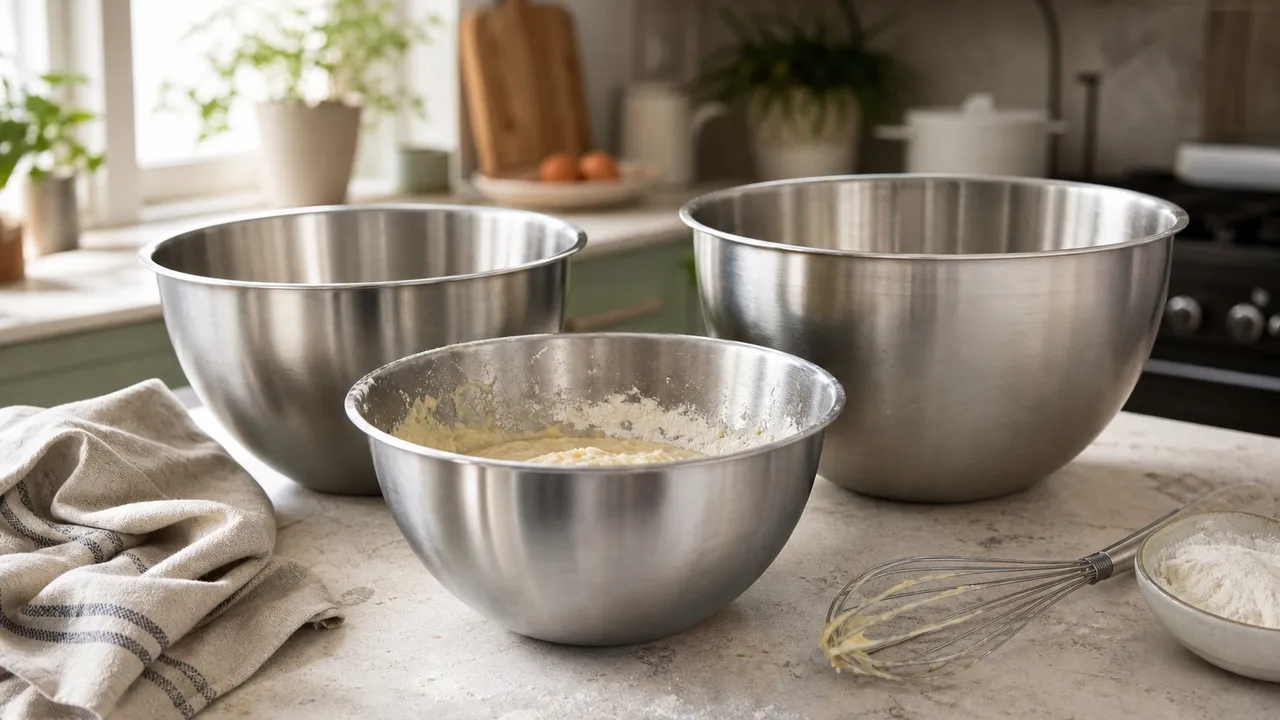
The Cuisinart three-piece set is the best stainless steel mixing bowl set for most kitchens. Its 1.5-, 3-, and 5-quart bowls cover everyday prep, nest compactly, and include fitted lids without adding a silicone base that can trap water.
Choose Viking when you want five useful sizes, lids, and non-slip bases. Priority Chef offers the same five main capacities in a lower-profile set, while FineDine is the simplest choice when you want six plain bowls and no lids.
Our stainless steel mixing bowl picks
| Pick | Best for | Sizes | Lids | Base |
|---|---|---|---|---|
| Cuisinart three-piece set | Most kitchens | 1.5, 3, and 5 qt | Yes | Plain steel |
| Viking ten-piece set | Baking and meal prep | 20 oz, 1.5, 3, 5, and 8 qt | Yes | Silicone |
| Priority Chef five-piece set | Non-slip prep | 1.5, 2, 3, 4, and 5 qt | Yes | Silicone |
| FineDine six-piece set | Simple nesting storage | 0.5, 1, 2, 3, 4, and 5 qt | No | Plain steel |
1. Best overall: Cuisinart Stainless Steel Mixing Bowls with Lids
Cuisinart covers the three capacities most home cooks reach for. The 1.5-quart bowl handles dressings and a few eggs, the 3-quart size suits batters and salads, and the 5-quart bowl leaves room for bread dough or a large batch of vegetables.
The current Cuisinart listing confirms that the bowls nest, include lids, and are dishwasher, freezer, and refrigerator safe. Plain steel bottoms slide more readily than silicone, but they also avoid a bonded base that needs separate drying and inspection.

Cuisinart Stainless Steel Mixing Bowl Set
4.7 out of 5 (6,185 ratings, as of July 26, 2026)
Three nesting stainless steel mixing bowls with fitted lids in practical everyday capacities.
- 1.5-, 3-, and 5-quart bowls
- Three fitted storage lids
- Dishwasher-, freezer-, and refrigerator-safe bowls
Pros
- Useful size progression without tiny specialty bowls
- Plain steel base is simple to inspect and dry
- Lids extend the set to covered prep and storage
Cons
- No non-slip base
- Only three bowl sizes
Considerations
The strongest general-purpose set when compact nesting and straightforward care matter more than a grippy base.
2. Best for baking and meal prep: Viking Ten-Piece Mixing Bowl Set
Viking supplies five bowls and five lids, including an 8-quart bowl that gives dough and large salads room to move. Etched measurements help with rough portioning, while the silicone bases reduce rotation during whisking.
Viking’s current product page lists the 20-ounce, 1.5-, 3-, 5-, and 8-quart capacities. It says the bowls are dishwasher safe but recommends hand washing the lids. The silicone bases are useful on a smooth counter, though each base should be dried fully before the bowls are nested.

Viking Ten-Piece Stainless Steel Mixing Bowl Set
4.6 out of 5 (1,788 ratings, as of July 26, 2026)
Five stainless steel bowls with measurement marks, fitted lids, and silicone non-slip bases.
- Five bowls from 20 ounces to 8 quarts
- Etched measurement markings and fitted lids
- Silicone non-slip bases
Pros
- Largest bowl has room for dough and big batches
- Five capacities reduce the need to wash between prep steps
- Bases resist spinning during vigorous mixing
Cons
- Lids require hand washing
- Silicone bases need careful drying
Considerations
Choose this set when a large bowl and stable bases will be used often enough to justify ten separate pieces.
3. Best non-slip value: Priority Chef Mixing Bowls with Lids
Priority Chef’s five bowls step evenly from 1.5 to 5 quarts. That makes the set practical for staged prep when you need several medium bowls but rarely mix a very large batch. The etched measurements and silicone bases add convenience without changing the stainless food-contact surface.
The manufacturer’s care guidance says to hand wash the lids and place the bowls on the dishwasher’s top rack. The 5-quart ceiling is the main tradeoff: it is sufficient for cake batter and salads, but less roomy for kneading or tossing food without spills.

Priority Chef Five-Piece Mixing Bowls with Lids
4.7 out of 5 (6,186 ratings, as of July 26, 2026)
Five nesting steel bowls with close-spaced capacities, lids, measurements, and non-slip bases.
- 1.5-, 2-, 3-, 4-, and 5-quart bowls
- Etched measurements and fitted lids
- Silicone non-slip bases
Pros
- Even capacity steps suit multi-part recipes
- Bases steady the bowls on smooth counters
- All five bowls include lids
Cons
- No bowl larger than 5 quarts
- Care differs between bowls and lids
Considerations
A practical choice for frequent ingredient prep when medium sizes and counter grip matter more than one extra-large bowl.
4. Best simple six-bowl set: FineDine Stainless Steel Mixing Bowls
FineDine omits lids, measurement markings, and silicone bases. In return, the set gives you six lightweight stainless bowls from 0.5 to 5 quarts that nest into a small cabinet footprint.
The smallest sizes are useful for spice blends, sauces, and mise en place. The wide rolled rims provide a defined grip, but the plain lightweight bowls can move during forceful whisking. Place one on a folded damp towel when you need more stability.
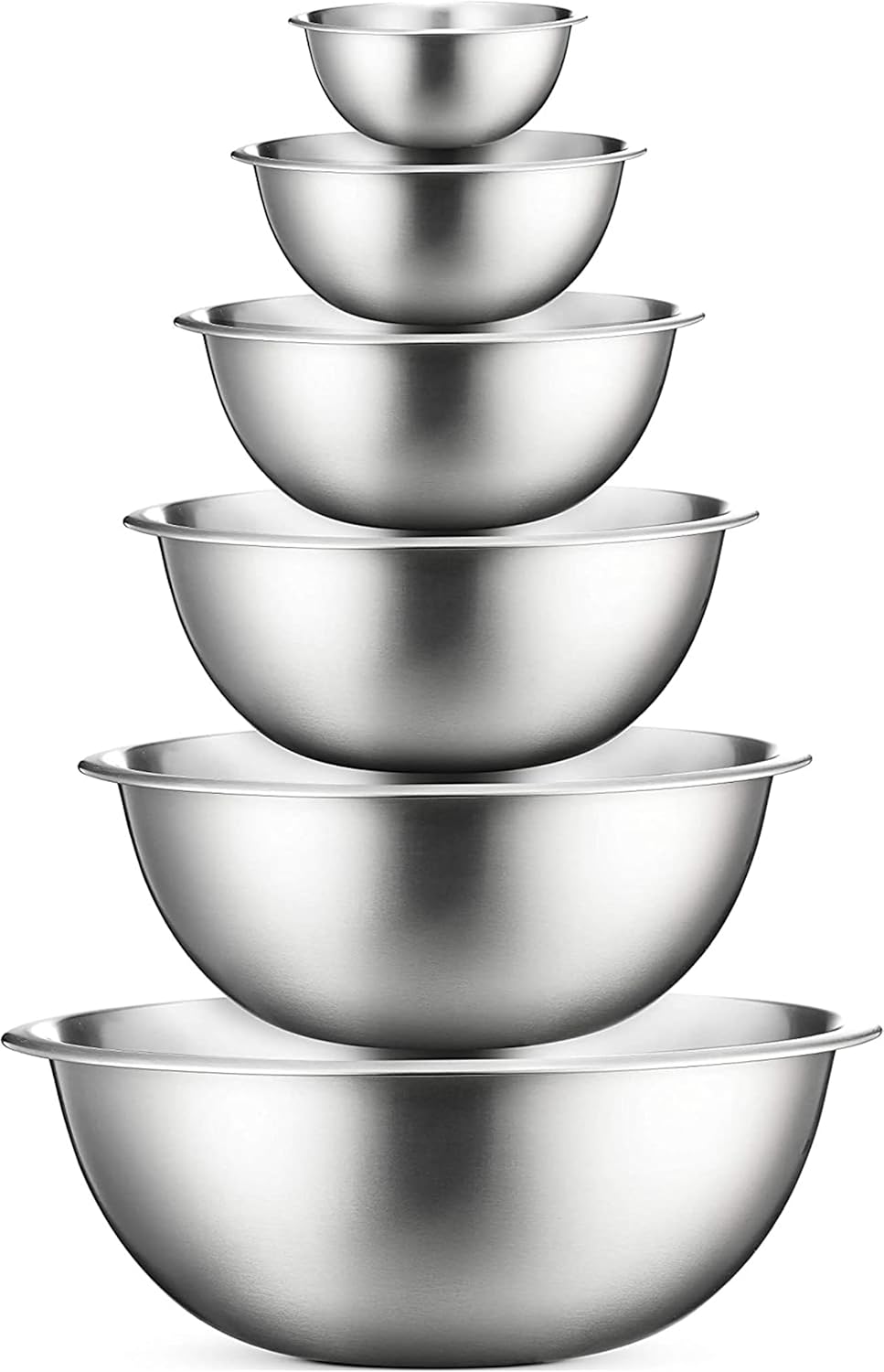
FineDine Six-Piece Stainless Steel Mixing Bowl Set
4.7 out of 5 (42,947 ratings, as of July 26, 2026)
Six plain nesting stainless steel bowls for cooks who do not need lids or silicone bases.
- Six bowls from 0.5 to 5 quarts
- Rolled rims and marked capacities
- Dishwasher- and freezer-safe construction
Pros
- Broad size range includes small prep bowls
- No attached base or lid to maintain
- Nests compactly
Cons
- No lids
- Light bowls may slide while mixing
Considerations
Best when you want a large number of uncomplicated prep bowls and already own separate storage containers.
How we chose
This is an editorial comparison based on current specifications, not a hands-on test with identical recipes in every set. We compared exact Amazon ASINs, manufacturer guidance, capacity progression, food-contact construction, care, and storage. Ratings and review counts came from Bright Data product snapshots captured July 26, 2026.
We favored sets that:
- Use stainless steel for the interior food-contact surface.
- Provide meaningfully different capacities rather than near-duplicates.
- Nest without unstable stacking.
- State separate care requirements for bowls, lids, and bonded bases.
- Have active exact-model listings with substantial owner feedback.
The term stainless steel does not describe a grade, thickness, or manufacturing quality by itself. Our guide to food-grade stainless steel explains what a material label can and cannot establish.
How to choose the right set
Start with the largest bowl
A 5-quart bowl covers most household mixing, but bread dough and large tossed salads benefit from 7 to 8 quarts. Extra space prevents flour and vegetables from escaping over the rim.
If the bowl will receive cooked potatoes from a press, choose a diameter that supports the tool’s rest without crowding the rim. The stainless steel potato ricer guide compares the rest and plate designs that affect that fit.
Decide whether lids replace another container
Fitted lids help with staged prep and refrigerator storage. They are not a reason to store every food in a bowl indefinitely. Follow the site’s guide to storing food in stainless steel for acidic, salty, and long-duration storage decisions.
Treat silicone as a separate component
A silicone base can make whisking easier, but it also creates a seam and may carry different dishwasher guidance. Dry the base before nesting. Choose plain steel when easy inspection and uncomplicated care matter more than grip, and use the stainless steel cleaning guide for residue or water spots.
Do not infer alloy from appearance
An 18/10 marking describes nominal chromium and nickel content, not bowl gauge or durability. The 18/0 versus 18/10 guide explains the corrosion and nickel tradeoff without turning either label into a complete quality score.
Stainless steel mixing bowl questions
Are stainless steel mixing bowls better than glass?
Stainless bowls are lighter and do not shatter, while glass lets you see the mixture and can sometimes go in a microwave. Choose for the task; stainless is especially convenient for lifting, whisking, and compact nesting.
For bread prep, the guide to kneading dough on stainless steel covers clean surfaces, traction, and temperature. For batters and emulsions, compare the best stainless steel whisks by shape and handle.
Can stainless steel mixing bowls go in the dishwasher?
Many can, but lids and silicone bases may have separate instructions. Follow the exact manufacturer’s guidance and avoid trapping water between nested pieces.
Can you use a hand mixer in a stainless steel bowl?
Yes, if the maker allows it. Metal beaters can leave cosmetic marks, so keep them moving and avoid pressing them into the wall. A towel or non-slip base helps steady a plain bowl.
Related guides
Continue with Stainless Steel Zesters, Stainless Steel Bench Scrapers, Stainless Steel vs Glass Mixing Bowls, Stainless Steel Pizza Pans.
Continue with Stainless Steel Muffin Pans, Stainless Steel Citrus Juicers, Stainless Steel Salad Servers, Stainless Steel Bread Boxes.
Continue with Stainless Steel Kitchen Shears, Stainless Steel Pie Pans, Stainless Steel Cake Servers, Stainless Steel Ladles.
Continue with Stainless Steel Cake Pans, Stainless Steel Loaf Pans, Stainless Steel Gravy Boats, Stainless Steel Garlic Presses.
Continue with Stainless Steel Serving Trays, Stainless Steel Tart Pans.
For oven forms and coated surfaces, compare Stainless Steel vs Nonstick Bakeware.