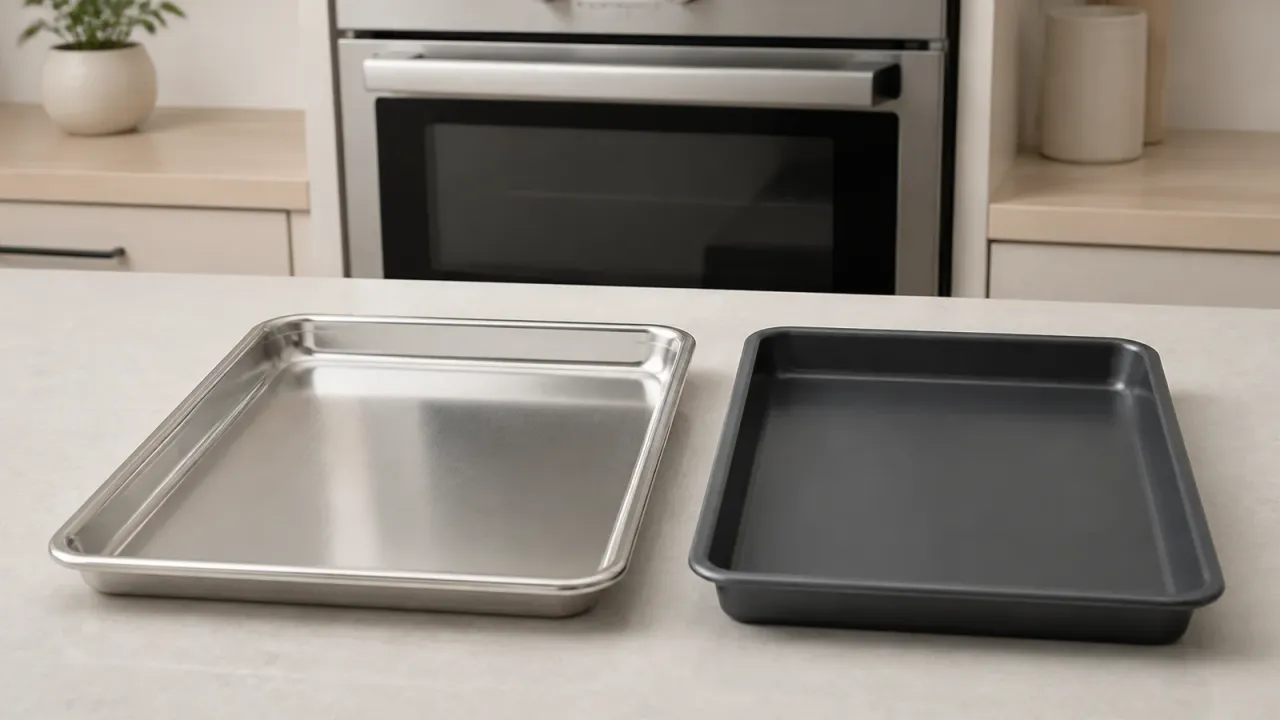
Choose stainless steel bakeware when you want an uncoated food-contact surface, metal-utensil tolerance, and the option to follow a higher maker-stated heat limit. Choose nonstick bakeware when easy release and lighter cleanup matter more, and you can follow the coating’s temperature, utensil, and cleaning limits. Neither surface is a universal winner.
The useful comparison is the same oven job in the same form: a sheet pan against a sheet pan, a cake pan against a cake pan, or a loaf pan against a loaf pan. Base metal, color, construction, recipe, and the exact maker instructions can change the result. This guide covers oven bakeware only, not stovetop pans or general cookware tradeoffs.
Stainless steel vs nonstick bakeware at a glance
| Decision | Stainless steel bakeware | Nonstick bakeware | What to verify |
|---|---|---|---|
| Food-contact surface | Usually bare stainless steel when the maker identifies an uncoated interior | A maker-labeled coating over a base metal; the coating chemistry and base vary | The exact product page and care guide |
| Release | Plan on grease, parchment, or another recipe-approved release method | The coating is designed to reduce sticking, but recipe preparation still matters | Whether the recipe calls for greasing and whether the maker allows spray |
| Color and browning | A bright surface does not tell you the whole thermal story | A dark or light coating can change the visual result, while the base still matters | Pan color, base metal, layers, and recipe |
| Temperature | No universal limit; some stainless models publish high oven and broiler limits | No universal limit; coatings often have a lower maker-stated ceiling | The lowest limit for the exact pan and any insert |
| Utensils | Some makers allow metal utensils on a stainless interior, with sharp edges still excluded | Soft silicone, nylon, or wooden tools are the safer default for a coated surface | The maker’s utensil guidance |
| Cleaning | Cool first, then use the maker’s soap, sponge, and scouring instructions | Hand washing and nonabrasive tools can help preserve the coating | Dishwasher, cleaner, and scrubber guidance |
| Wear question | There is no nonstick layer to preserve on a documented bare surface | Coating wear depends on heat, tools, cleaners, storage, and the exact formulation | Warranty and care instructions, not a universal lifespan |
For a broader stainless bakeware starting point, see the best stainless steel baking sheets guide. It covers sheet-pan construction and size choices; this article explains when a coated surface changes the decision.
What the two labels actually describe
Stainless steel describes a metal used in the bakeware body or food-contact surface. A pan can be single-layer stainless, bonded to an aluminum core, or assembled with other materials. “Stainless” does not identify thickness, layers, color, or a universal oven limit. Confirm that the interior is the surface the maker is describing.
Nonstick describes a surface finish, not one universal base or coating formula. One current maker example uses heavy-gauge aluminized steel under a ceramic-reinforced nonstick coating. Another nonstick pan may use a different base or coating. Keep the composition unknown unless the exact maker identifies it.
The two exact examples used in this guide show why the distinction matters. All-Clad describes its stainless half-sheet as tri-ply stainless steel and aluminum with a polished stainless interior, metal-utensil guidance, and a 600°F oven and broiler limit. Its Pro-Release half-sheet uses heavy-gauge aluminized steel with a ceramic-reinforced nonstick coating, a 450°F oven limit, and soft-utensil guidance. Those are model-specific facts, not universal stainless and nonstick rules.
These cards are reference products for the construction comparison, not hands-on rankings or proof that one brand’s range represents every pan in its category.
Stainless example

All-Clad Stainless Steel Half-Sheet Baking Pan with Cooling Rack
5 out of 5 (41 ratings, as of August 22, 2026)
A documented tri-ply stainless and aluminum half sheet for readers who want an uncoated interior and a published 600°F oven and broiler limit.
Best for: High-heat baking or roasting when the exact maker's uncoated surface and metal-utensil guidance fit the job.
Check price on Amazon- Surface
- Polished stainless-steel interior
- Base
- Tri-ply stainless steel and aluminum
- Oven limit
- 600°F oven and broiler, maker-stated
Why we picked it
- No nonstick layer to preserve on the documented interior
- Maker publishes metal-utensil guidance for the stainless bakeware
- Cooling rack adds a separate oven and cooling function
Watch-outs
- Release still needs the recipe's grease or lining method
- The exact pan and rack dimensions must fit the oven and storage space
Considerations
Treat the rating as a dated marketplace snapshot. Verify the current package, dimensions, care, and heat limit before buying.
Nonstick example

All-Clad Pro-Release Nonstick Bakeware Half Sheet Pan
4.2 out of 5 (112 ratings, as of August 22, 2026)
A documented aluminized-steel half sheet with a ceramic-reinforced nonstick coating for readers who put release and cleanup ahead of a higher heat ceiling.
Best for: Cookies, cakes, and other moderate-temperature bakes when soft utensils and coating care are acceptable.
Check price on Amazon- Surface
- Ceramic-reinforced nonstick coating
- Base
- Heavy-gauge aluminized steel
- Oven limit
- 450°F oven, maker-stated
Why we picked it
- Maker describes easy release and a lighter color intended to reduce overbrowning
- Soft silicone, nylon, or wooden tools are specified for the surface
- The half-sheet form covers common cookie and pastry jobs
Watch-outs
- The published oven limit is lower than the stainless example
- Hand washing and nonabrasive care are recommended to preserve the coating
Considerations
Treat the rating as a dated marketplace snapshot. Confirm the coating, dimensions, care, and current oven limit for the exact listing.
Release preparation is the first practical split
Bare stainless steel is not nonstick. For cookies, cakes, loaf breads, or roasted foods, use the grease, parchment, flour, or other release method that the recipe and pan instructions allow. A polished interior can feel smooth, but shine is not a release guarantee. Let a bake set before trying to lift it, and match the release method to the shape.
Nonstick can reduce the work needed to release a cake, cookie, or muffin, but it does not cancel every preparation instruction. All-Clad’s Pro-Release care page says to follow recipe greasing directions and avoid cooking spray because it can damage that coating. A different maker may give different directions. Read the exact manual before assuming that oil, spray, parchment, or a silicone liner is allowed.
For sticky batters and delicate edges, nonstick is the simpler first choice when its temperature and care rules fit. For a pan that will also handle high-heat roasting or repeated metal-tool contact, a documented uncoated stainless surface gives you a wider set of permitted techniques, provided you accept the extra release preparation.
Color, base metal, and browning are separate questions
A stainless-versus-nonstick label does not predict browning by itself. King Arthur Baking’s pan comparison found that aluminum and aluminum-steel combinations are more conductive than stainless steel alone, and that a dark pan can heat and brown differently from a light pan. A nonstick pan may therefore be dark or light and may use steel, aluminum, or a layered base. A stainless pan may be single-layer or bonded to a conductive core.
Compare like with like when you change a pan. Keep the form, size, rack position, recipe, and oven setting stable, then check the maker’s advice. A dark coated cake pan may produce a different edge color from a bright stainless pan, but that does not prove that all nonstick pans brown faster or all stainless pans brown slower. The exact color and construction remain part of the evidence.
The best stainless steel cooling racks guide is useful when a sheet-pan setup includes a rack. Treat the rack as a separate component with its own material and heat limit instead of assuming that the pan’s rating covers it.
Same task, different form
Sheet pans and cookie sheets
Choose stainless when the sheet will see high-heat roasting, a documented broiler limit, or regular contact with metal tools. Choose nonstick when cookie release and fast cleanup are the main priorities and the recipe stays under the exact coating limit. For either surface, confirm the usable interior dimensions, rim, rack fit, and color.
Uncoated stainless can need more release work for cookies. A nonstick sheet can make the first lift easier, but its coating needs softer tools and gentler cleaning. The best stainless steel cookie cutters guide covers cutters, which are a separate choice from the sheet surface.
Cake pans
Nonstick is a practical choice when a clean release from a round or square cake pan matters most. Stainless can work when you are willing to grease and line the pan and follow the recipe’s cooling and release steps. Do not transfer one brand’s coating temperature or release promise to another cake pan.
Light and dark interiors can change edge color and timing. If a recipe names a particular pan color or material, preserve that instruction before swapping surfaces.
Loaf pans
For quick breads and enriched loaves, nonstick may reduce the effort at the corners and side walls. Stainless remains a reasonable choice when the loaf is lined or the maker documents a release routine that suits the recipe. Measure the inside length and width, not just the advertised nominal size, because loaf geometry changes how batter fills the pan.
Muffin pans
Nonstick can simplify release around individual cups, but the cup coating still needs soft tools and the maker’s cleaning routine. Liners may change release and browning, so use them only when the recipe permits. Stainless muffin pans need a deliberate grease or liner plan, especially for sugary or sticky batters.
Pie pans
For pie plates, compare the interior color, rim, depth, and the recipe’s browning expectation. A light nonstick surface may behave differently from a shiny stainless pan, while a dark coating may deepen edge color. There is no universal material winner for every crust. Follow the exact pan and recipe guidance, then use a liner or release method that does not conflict with the maker’s instructions.
Roasting pans
Stainless is often the more flexible choice when the exact pan supports high oven heat, a rack, and the tools you need for an oven-only roast. Nonstick can make cleanup and release easier for moderate-temperature roasting, but verify the coating limit and whether the rack or lid has a separate rating. Do not assume that an oven rating on one component approves the whole assembly.
This article stops at oven bakeware. For stovetop surface choices, searing, or the broader cookware comparison, use stainless steel vs nonstick cookware, which owns that separate decision.
Care, utensil limits, and coating wear
Stainless steel care
Let a hot stainless pan cool before washing. All-Clad advises warm water, dish soap, and a sponge, with a warm soak and gentle nylon pad for harder residue. It also warns that putting hot bakeware under cold water can cause warping. Other makers may allow different cleaners or dishwasher use, so the exact care guide controls.
Metal utensils may be acceptable on a documented stainless interior, but sharp edges can still scratch or gouge a surface. A stainless finish can discolor or spot without becoming a different material. Avoid turning one maker’s cleaning recommendation into a universal dishwasher or abrasive rule.
Nonstick care
Nonstick surfaces need more limits around tools and cleaning. The All-Clad Pro-Release instructions specify silicone, nylon, or wooden utensils, hand washing with soap and a sponge, and no abrasive cleaners or scouring pads. The same page says to avoid cooking spray for that coating. These are model-specific instructions, but they illustrate the care tradeoff that comes with a coated surface.
High heat, metal tools, aggressive scrubbing, and careless stacking can shorten the useful life of a coating. The exact formulation, application, warranty, and care history determine how long a pan lasts. This article does not assign a universal lifespan or claim that every worn coating fails at the same point.
Use the maker’s temperature limit
There is no universal bakeware temperature limit for either material. As a current manufacturer example, All-Clad lists its stainless bakeware at 600°F for oven and broiler use, while its Pro-Release nonstick bakeware is oven safe to 450°F. The same brand has other collections and accessories with different instructions.
Check the pan, rack, liner, lid, and any silicone or plastic part separately. The lowest applicable limit controls the assembled job. If the product page does not publish a number, preserve that unknown instead of borrowing a rating from another model.
The same component check applies to countertop ovens; our stainless-body and stainless-interior air-fryer guide leaves basket material and coating status unverified when the maker does not publish them.
Who should choose stainless steel bakeware?
Stainless is the better fit when you:
- want a documented bare food-contact surface with no nonstick layer to maintain;
- bake or roast at temperatures near the limit of a coated model;
- use metal tools and want the maker to permit them;
- can grease, line, or otherwise prepare the pan for release;
- prefer to evaluate a pan by its body, layers, dimensions, and care instructions.
Stainless is less convenient when your main goal is effortless release from delicate or sticky bakes. A bare surface also does not guarantee even browning, because thickness, core, color, geometry, and oven position still matter.
For a broader lineup of stainless sheet forms, see the best stainless steel baking sheets guide and check the exact construction and heat limit for each pick.
Who should choose nonstick bakeware?
Nonstick is the better fit when you:
- put easy release and quick cleanup ahead of maximum heat flexibility;
- mostly bake at temperatures below the exact maker-stated limit;
- are comfortable using silicone, nylon, or wooden tools;
- can hand wash, protect, and store the coating as directed;
- want a cake, loaf, muffin, or cookie form that does not need as much release work.
Nonstick is less convenient when you use a broiler, regularly exceed a moderate oven limit, need metal utensils, or want a surface that does not depend on coating care. Do not infer coating chemistry, toxicity, or expected lifespan from the word nonstick alone.
How we compared
This is a research-based comparison, not a hands-on or side-by-side bake test. We checked the approved DataForSEO bakeware opportunity and its oven-only ownership boundary, then reviewed current All-Clad manufacturer pages, current exact-ASIN marketplace snapshots, King Arthur Baking’s pan-conductivity discussion, and the Cookware Manufacturers Association guide on August 22, 2026.
The comparison covers release preparation, base metal versus food-contact coating, color and browning, utensils, cleaning, coating wear, oven forms, and maker-specific temperature limits. We did not measure heat distribution, run a bake trial, test migration, identify an undisclosed coating formula, assign a toxicity verdict, compare prices, or claim a universal performance winner. Product ratings are dated marketplace snapshots, not test results.
Sources
The following sources were accessed on August 22, 2026. Manufacturer pages support exact construction, care, and temperature claims. Marketplace pages support the dated ASIN and rating snapshots only.
- All-Clad Stainless Steel Bakeware half-sheet pan, tri-ply construction, stainless interior, utensil guidance, care, and 600°F oven and broiler limit.
- All-Clad Pro-Release Nonstick Bakeware half-sheet pan, aluminized-steel base, ceramic-reinforced coating, soft-utensil guidance, care, and 450°F oven limit.
- All-Clad bakeware care and use, collection-specific temperature, cleaning, and utensil instructions.
- King Arthur Baking, baking trials and pan conductivity, discussion of stainless, aluminum-steel construction, and pan color.
- Cookware Manufacturers Association guide, institutional bakeware and cookware material guidance.
- Amazon snapshot for All-Clad stainless half-sheet ASIN B0GGJJQNDM, dated rating and product identity record.
- Amazon snapshot for All-Clad Pro-Release nonstick half-sheet ASIN B07WNK85GC, dated rating and product identity record.