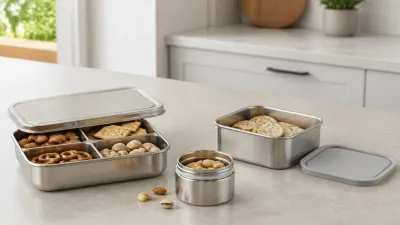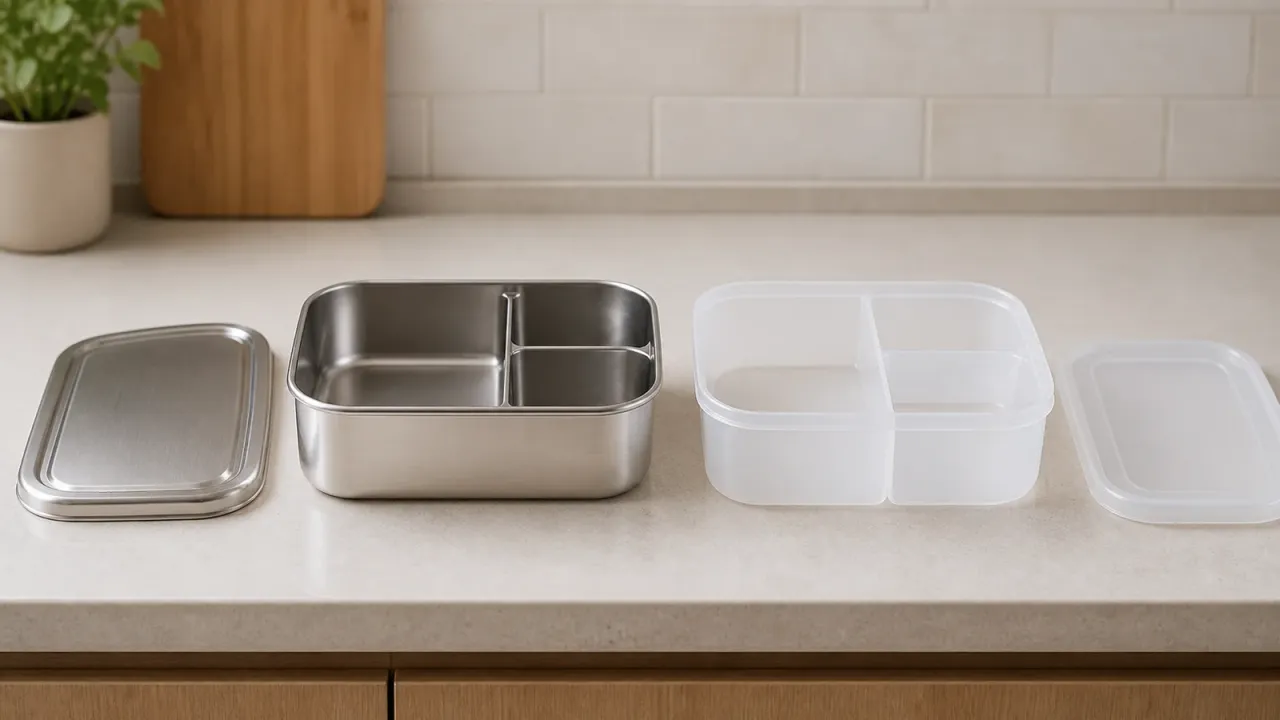
Stainless steel is the better starting point when you want a rigid lunch box that is less likely to hold food odors and you can reheat food somewhere else. Plastic is the better fit when a lighter carry, a removable tray, or documented microwave and freezer use matters more. Neither material wins every lunch routine, and neither material alone proves that a finished lunch box is safer.
For a broad look at stainless containers, see our guide to the best stainless steel food storage containers. This comparison stays narrower: school and work portability, leak management, compartments, insulation, food-contact parts, weight, and cleaning.
Quick comparison
| Decision | Stainless steel | Plastic | Better starting point |
|---|---|---|---|
| Carry weight | The representative box weighs 1.6 lb | The representative box weighs 1 lb 6 oz | Plastic for a lighter bag |
| Leak management | Rigid tray and silicone components can make a strong seal, but the maker still calls it leak-resistant | Leak-proof claims depend on the lid, tray, divider, and outer-shell alignment | Check the exact closure and care rules |
| Compartments | Three fixed tray compartments, with an optional removable silicone container | Three compartments, with a removable divider that can make a larger space | Plastic for more layout flexibility |
| Insulation | Neither representative box is documented as insulated | Neither representative box is documented as insulated | Use a separate insulated bag and cold sources |
| Food-contact parts | Maker identifies 18/8 stainless and silicone parts | Maker describes food-safe, BPA-free materials but does not name every resin or elastomer | Stainless when documented component scope matters |
| Cleaning | Top-rack dishwasher safe, with handwashing recommended to preserve the seal | Tray is top-rack dishwasher safe; outer shell should be hand washed | Depends on whether you will hand wash the shell |
| Reheating | Not a microwave vessel | Maker documents microwave use for the removable tray | Plastic when reheating in the same product matters |
The table describes the two representative products below, not every lunch box sold under either material label. A lid, gasket, latch, divider, or coating can change the result. Read the exact maker instructions before packing a wet meal or reheating food.
Portability and weight
Weight matters more for a child walking to school or a commuter carrying a laptop, bottle, and lunch than it does for a short drive. The Bentgo Kids Stainless Steel Lunch Box lists a 1.6 lb product weight and a 5-cup capacity on its current manufacturer product page. The Bentgo Pop Lunch Box lists 1 lb 6 oz and 5 cups on its current manufacturer product page. That is a small difference on paper, but it is noticeable alongside an ice pack and a full drink bottle.
Plastic is the easier default when the lunch box will be carried a long distance or packed into a soft school bag. The exact product still matters. A thick plastic shell, metal hinge, or large lid can weigh more than a slim plastic tray, while a compact stainless box can weigh less than a large multi-part plastic system. Compare the maker’s stated weight and outside dimensions rather than assuming that all plastic is light or all stainless is heavy.
Stainless steel earns its place when rigidity matters. A steel tray is less likely to flex when a sandwich or fruit is packed tightly, and the opaque walls hide scuffs better than clear or translucent plastic. It can still dent, and a dented rim may stop the lid from sealing correctly. A plastic box can flex without denting, but a cracked shell or damaged hinge is a reason to retire it.
For the rest of a portable drink setup, our guide to the best stainless steel water bottles covers bottle weight, caps, and carry considerations separately. Do not choose a lunch-box material in isolation if the full bag is already heavy.
Leak management and compartments
Leak performance belongs to the entire closure system. The relevant parts include the tray, lid, seal or gasket, divider, latch, and the contact between them. Stainless steel does not automatically make a box leakproof, and a plastic box does not automatically leak. A bent rim, overfilled compartment, damp gasket, or misaligned lid can defeat either design.
The Bentgo Kids stainless model has three compartments and an optional removable silicone container. Bentgo describes an airtight seal and leak-resistant compartments, while its product specifications identify the tray as 18/8 stainless steel, the lid as 18/8 stainless steel and silicone, and the removable container as silicone. The maker recommends handwashing to preserve the seal even though the box is top-rack dishwasher safe. Those details are on the Bentgo Kids stainless product page, and they are more useful than the word “stainless” by itself.
The Bentgo Pop plastic model has three compartments and a removable divider. Bentgo describes a leak-proof design, an airtight seal, and an easy-open locking clip. Its maker page documents a top-rack-dishwasher-safe removable tray, microwave and freezer use for that tray, and handwashing for the outer shell. The page describes the materials as FDA-approved, food-safe, and free of BPA, vinyl, lead, and PVC, but it does not identify a particular resin for each tray, lid, divider, seal, or latch. I do not infer polypropylene, Tritan, or silicone where the maker does not name it. Check the Bentgo Pop product page for the current component and care instructions.
For wet foods, test the exact box at home with water before relying on it in a work bag. That is a practical precaution, not a claim that this article tested either model. Pack sauces in a sealed insert when the maker limits the claim to leak resistance, keep the rim clean, and close each latch evenly. A compartment system can separate foods without making a whole box safe for liquids.
Compartments also have a sizing tradeoff. Fixed compartments make a predictable sandwich-and-snack layout but can waste space around a large item. A removable divider gives plastic more layout flexibility, while the stainless model’s optional silicone container adds a fourth place for a small portion. Neither design makes food colder; portion separation and temperature control are separate jobs.
Insulation and lunch safety
Neither representative Bentgo lunch box is described by its maker as insulated. A stainless wall is not a thermos wall, and a plastic shell is not a cold pack. For perishable food, the USDA guidance for keeping bag lunches safe recommends an insulated soft-sided bag with at least two cold sources. Use an insulated container for hot food and follow the food’s safe temperature guidance; do not treat a regular lunch box as temperature control.
This distinction is especially important for school and office lunches. A leak-resistant compartment can keep yogurt away from crackers, but it cannot replace a cold source. A stainless lunch box can feel cool when first packed and still warm into an unsafe range. A plastic lunch box can go into a freezer when the maker permits that use, but freezing the empty tray does not keep a full bag cold all morning.
If hot soup or a hot meal is central to your routine, compare the lunch box with a separate insulated vessel. Our guide to the best stainless steel thermoses covers that job. The lunch box decision here is about packing and carrying compartments, not about insulation.
Food-contact materials
| Surface | Verified material | Source |
|---|---|---|
| Bentgo Kids container and tray | 18/8 stainless steel with separately identified silicone parts | Bentgo manufacturer product page |
| Bentgo Pop tray and divider | BPA-free plastic; exact resin is not disclosed | Bentgo manufacturer product page |
Food-contact review starts with the surfaces that routinely touch food. For the stainless representative, Bentgo identifies the tray as 18/8 stainless steel, the lid as 18/8 stainless steel and silicone, and the removable container as silicone. The maker describes the box as food-grade 18/8 stainless steel and silicone. The product page does not turn the external latches or hinges into food-contact surfaces, so I do not use the stainless label to make a claim about those parts.
For the plastic representative, Bentgo’s current page uses the terms FDA-approved, food-safe, BPA-free, and free of vinyl, lead, and PVC. Those are product claims for the listed model, not universal proof that every plastic lunch box is free of every chemical of concern. The page does not disclose the resin or elastomer for every food-contact part. That means the plastic tray, removable divider, lid, seal, and closure cannot be given a more specific chemistry label here without evidence.
The same caution applies to stainless steel. A stainless tray can have silicone seals, plastic clips, coatings, or a separate insert. A food-contact statement for one component does not transfer automatically to a different lid or replacement part. If component traceability is your priority, choose the model whose maker identifies the parts that contact food, read the care instructions, and replace a cracked or damaged component.
Our explainer on whether stainless steel containers are safe for food storage discusses grades, contact surfaces, and the limits of broad safety language. “BPA-free,” “food-safe,” “silicone,” “plastic,” and “stainless” are useful starting descriptions, not universal health rankings. The finished product and its intended use control the practical decision.
Cleaning and daily care
The easiest lunch box to clean is the one you can open fully and dry completely. Removable trays and dividers expose the corners where crumbs and dressing collect. A gasket that stays damp can develop odor even when the tray itself is easy to wash. Open the parts after washing and let them dry before reassembly.
Bentgo lists the stainless model as top-rack dishwasher safe but recommends handwashing to preserve the leak-resistant seal and latches. That is a meaningful tradeoff for a busy family: the box can go in the dishwasher, but the maker’s preferred care takes more time. Smooth rolled edges also reduce places for food to lodge, but they do not eliminate the need to inspect the rim and seal.
Bentgo lists the Pop’s removable tray as top-rack dishwasher safe and recommends handwashing the outer shell. The removable divider can simplify cleanup, while the shell and closure still need attention. Bentgo’s FAQ and care guidance says to handwash when possible, avoid closing the box while damp, and align the lid before latching. A latch that is forced against a misaligned lid can fail even if the material remains intact.
Plastic may be more convenient when the tray must be microwaved or frozen, but microwave permission applies to the documented tray, not necessarily the lid, divider, shell, or seal. Stainless steel should not go in a microwave. Transfer food to a microwave-safe dish, let it cool as directed, then repack it if needed. Do not infer heating permission from a material name or from another model in the same product family.
Representative products
These product cards are evidence examples, not hands-on test winners. Amazon records were captured on August 21, 2026. Ratings, review counts, sellers, and availability can change. Material, component, leak, and care claims are paired with the current manufacturer pages linked in the surrounding sections.
Stainless steel example

Bentgo Kids Stainless Steel Lunch Box
3.8 out of 5 (2,729 ratings, as of August 21, 2026)
A three-compartment stainless lunch box with an optional silicone container, a 5-cup capacity, and maker-documented leak-resistant and care guidance.
- 18/8 stainless steel tray and lid with silicone components identified by the maker
- Three compartments plus an optional removable silicone container
- Top-rack dishwasher safe, with handwashing recommended to preserve the seal
Pros
- Rigid tray and clearly scoped food-contact materials
- Opaque stainless interior is less likely to show food stains
- Five-cup capacity fits a substantial school or work lunch
Cons
- Heavier than the representative plastic model
- Not a microwave vessel or documented insulated container
- The maker recommends handwashing even though top-rack dishwasher use is allowed
Considerations
Best fit when rigid compartments, documented stainless and silicone food-contact parts, and odor-resistant daily packing matter more than the lightest carry.
Plastic example

Bentgo Pop Leak-Proof Bento-Style Lunch Box
4.5 out of 5 (4,025 ratings, as of August 21, 2026)
A five-cup bento-style lunch box with three compartments, a removable divider, and maker-documented tray microwave, freezer, and dishwasher use.
- Three compartments with a removable divider
- Maker describes FDA-approved, food-safe materials without naming every resin or elastomer
- Removable tray is documented as microwave, freezer, and top-rack dishwasher safe
Pros
- Lighter carry at the same stated five-cup capacity
- Removable divider gives more layout flexibility
- Tray heating and freezer permissions fit meal-prep routines
Cons
- Outer shell should be hand washed
- The maker does not identify the specific material of every food-contact component
- A maker-page variant was backordered while the exact Amazon color record was in stock
Considerations
Best fit when lower carry weight, a flexible divider, and documented tray reheating matter more than a fully named food-contact material scope.
The exact Amazon record for B08FF69BV3 listed Bentgo Direct as the seller, a 3.8 rating from 2,729 reviews, and an in-stock snapshot. The exact Amazon record for B0B3CPQKZX listed Bentgo Direct as the seller, a 4.5 rating from 4,025 reviews, and an in-stock snapshot. Bentgo’s current Pop page showed the selected Bright Coral and Teal variant as backordered, while the Amazon Periwinkle and Pink record was in stock. That is an availability and color-variant conflict, not a reason to merge the two records. See the Bentgo Kids stainless product page and Bentgo Pop product page for current maker specifications.
How we compared
This is a research-based comparison, not a hands-on or side-by-side test. I used Bright Data Amazon discovery and exact-ASIN product records captured on August 21, 2026, then checked the current manufacturer pages for model, component, material, leak, insulation, and care evidence. The comparison covers school and work portability, weight, compartments, leak management, insulation, food-contact surfaces, reheating limits, and cleaning. I did not open, fill, drop, heat, freeze, microwave, dishwasher-test, or carry either product.
The product records preserve the marketplace model and ASIN separately from the maker’s product-family name. I did not include LunchBots Medium Trio ASIN B00IHMNSV6 because the exact Amazon title and the maker’s Large Trio page did not align, and the maker page was marked sold out while a third-party marketplace offer remained available. I also rejected marketplace-only stainless and plastic candidates when a current maker page did not identify the food-contact parts, care, and leak design well enough for this comparison.
The evidence has limits. Amazon ratings, review counts, sellers, and availability are dated snapshots. Bentgo’s Pop page does not name the resin or elastomer for every tray, lid, divider, seal, or latch. “Food-safe,” BPA-free, silicone, plastic, and stainless descriptions are not universal proof of health superiority. Product design and care can matter as much as the base material, and no statement here is a substitute for the current product instructions.
Which lunch box should you choose?
Choose stainless steel when you want a rigid, opaque box with a maker-identified 18/8 tray and silicone components, and you can keep food cold or hot with a separate insulated system. Accept the extra weight and the need to transfer food for microwave use. The Bentgo Kids stainless model is the stronger fit for that decision.
Choose plastic when a lighter bag, a removable divider, and documented tray microwave or freezer use remove more daily friction. Confirm which parts may be heated, washed, and frozen, and do not fill a leak-resistant box with liquid unless the exact closure is designed for it. The Bentgo Pop model is the stronger fit for that decision, with the maker’s component-material disclosure remaining less specific.
If the lunch includes perishable foods, buy the temperature-control system separately from the box. If the lunch is mostly dry food and the child or commuter carries it a long way, weight and closure alignment may matter more than the material name. The best choice is the product whose complete design and care instructions match the way you actually pack, carry, clean, and reheat lunch.