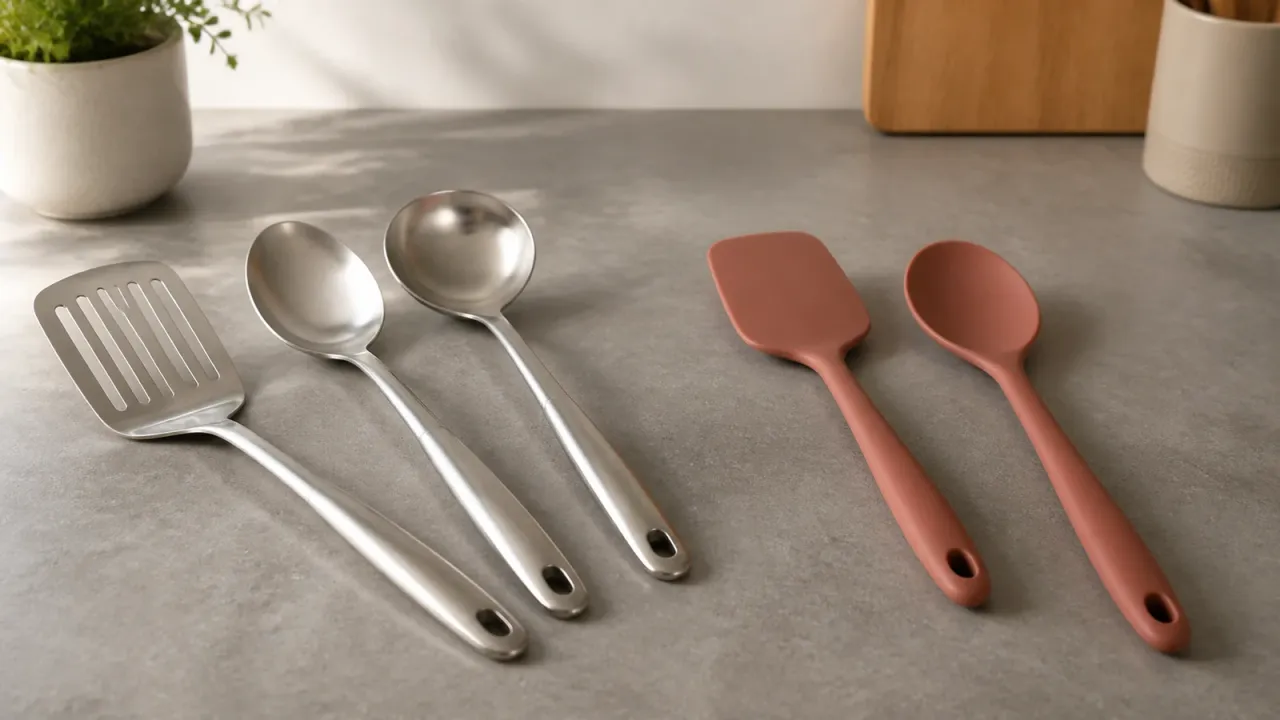
Stainless steel is the better fit for firm control on uncoated cookware, while silicone is the better fit for coated surfaces that need a nonscoring tool. Neither material wins every job: the utensil’s exact construction, cookware surface, care instructions, and model-specific heat limit still decide the choice.
This is a material comparison, not a product ranking or a hands-on test. For specific stainless sets, see our best stainless steel kitchen utensils; this page explains when the material itself is the useful deciding factor.
| Decision | Stainless steel | Silicone | Who benefits |
|---|---|---|---|
| Cookware surface | Suits many uncoated metal surfaces when the cookware maker allows metal tools | A nonscoring option for coated surfaces when the maker permits it | Silicone for nonstick or delicate finishes; stainless for durable uncoated surfaces |
| Food-contact evidence | Alloy, finish, joints, and intended use still need checking | Formulation, reinforcement, finish, and intended use still need checking | The buyer who can verify the exact maker documentation |
| Heat | The tool body may not be the limiting part; handle, joint, and finish are model-specific | The maker must publish a limit for the exact tool and construction | Neither by material label alone |
| Stiffness and control | Usually the firmer choice for turning, lifting, or scraping on suitable surfaces | Flexible and cushioned, useful for folding or sweeping a surface | Stainless for force; silicone for flexibility and surface protection |
| Cleaning and wear | Smooth one-piece forms can be easy to inspect, but seams and edges still matter | Many current tools are dishwasher-safe, but joins and damage remain model-specific | The design that stays smooth, intact, and easy to clean |
Which material fits your cookware?
Start with the surface, not the utensil color. Stainless steel is a practical match for many uncoated stainless, cast-iron, and other durable cooking surfaces, provided the cookware maker allows metal tools. It gives a firm edge for turning or lifting and does not flex around the food in the same way as a soft head.
Silicone is the more coating-friendly material choice for a coated pan when the cookware maker calls for nonscoring or nonscratching tools. The 2022 FDA Food Code gives the same surface principle for coated kitchenware in food-service guidance: multiuse cookware with a nonstick coating should be used with nonscoring or nonscratching utensils and cleaning aids. That is a compatibility rule, not a blanket claim that silicone is always safe or that metal always damages every surface.
Manufacturer instructions can be more specific than a general material rule. All-Clad’s product support says its tool and utensil materials are safe on its bonded stainless steel collections, while metal tools can leave superficial markings. For its nonstick collections, it recommends nylon, plastic, or wood tools to avoid scratching or chipping the coating. Follow the instructions for the actual pan, because a stainless exterior does not prove that the cooking surface is uncoated.
If your kitchen has both coated and uncoated cookware, owning both materials is often the simplest answer. Keep stainless tools for the surfaces that permit them and silicone tools for the pans that need a nonscoring edge. The ceramic vs stainless steel cookware comparison covers why the cooking surface changes the utensil decision.
How do the food-contact materials compare?
“Food-grade” is not a complete comparison. The FDA explains that a food-contact substance can be part of cookware, food-preparation equipment, or a preparation surface. Its safety assessment considers the intended use, migration into food, and toxicological information. The finished utensil can also combine several substances: a silicone head may have a stainless reinforcement or handle, and a stainless tool may have a coating, weld, rivet, or grip.
The FDA’s regulatory-status guidance says the overall status of a food-contact material depends on each individual substance that is reasonably expected to migrate, its authorization, and its conditions of use. That is why an alloy number or a “food-safe silicone” phrase should not be treated as a complete evaluation of a finished utensil.
For a buyer, verify four things on the exact product page or care guide:
- The working surface material is named, not just the handle or outer sleeve.
- The maker identifies the tool as intended for food contact and states the relevant use conditions.
- The edges, seams, rivets, grips, or reinforcement are finished so they can be cleaned and do not shed or expose a damaged layer.
- The care instructions match the way you will wash, heat, and store the utensil.
If a listing only says “stainless handle” or “silicone grip,” leave the material of the food-contact head unconfirmed. A color, photograph, or marketplace title is not evidence of the alloy, silicone formulation, or coating.
Do stainless steel or silicone have higher heat limits?
There is no universal heat limit for either material as a kitchen utensil. The limiting part may be the handle, adhesive, joint, coating, reinforcement, or shape rather than the visible working surface. Oven, broiler, stovetop, direct-flame, and dishwasher permissions also describe different exposures.
The FDA’s food-contact conditions table includes cooking above 250°F as one condition used when evaluating a food-contact substance. That table helps explain why intended use matters; it is not a temperature rating for a stainless or silicone utensil.
Current maker pages show the same model-specific pattern. All-Clad’s silicone tool collection describes its tools as heat-resistant and gentle on nonstick cookware, then gives a 450°F limit for the tools while noting that some products are rated to 450°F or 500°F depending on the product. It also lists dishwasher care for that collection. Those statements support the named tools and their construction, not every silicone utensil.
An all-stainless utensil may have no polymer head, but that does not make every part of it suitable for every heat source. A hollow handle, hanging loop, welded joint, or decorative finish can change the maker’s instructions. A silicone head may be designed for high-heat cooking yet still have a lower-rated handle, reinforcement, or use condition. Read the complete model guide before using a utensil in an oven, under a broiler, or over direct flame, and do not transfer a rating from a similar-looking tool.
Which material gives better stiffness and control?
Stainless steel generally benefits tasks that need a firm edge or resistance to bending. A turner can slide under food, a spoon can lift a heavier portion, and a scraper can apply more direct force when the cookware surface permits metal. Thickness, shape, a rolled edge, and the handle-to-head joint still matter, so a thin or flexible stainless tool is not interchangeable with a thick one.
Silicone benefits tasks that need flex and contact with a curved surface. A flexible spatula can sweep a bowl, fold a batter, or follow the corner of a pan without presenting a hard metal edge. All-Clad describes its silicone tools as combining flexibility and strength and says its heads are firm yet flexible. That is maker guidance for its line, not a promise that every silicone head has the same resistance to bending.
Choose based on the motion you make most often. If you lift, turn, or scrape on uncoated cookware, stainless steel’s stiffness can make the motion more direct. If you fold, spread, or work around a coated surface, silicone’s flex and softer contact can be more useful. In either case, the blade geometry and handle balance may matter more than the material name.
Which material is easier to clean and maintain?
The best utensil is the one that remains smooth, intact, and easy to inspect after cleaning. The Food Code’s multiuse-utensil criteria call for a safe, durable, corrosion-resistant, nonabsorbent material with a smooth, easily cleanable surface that resists pitting, chipping, crazing, scratching, scoring, distortion, and decomposition. This is model food-service guidance, but it gives a useful checklist for a home utensil as well.
One-piece stainless forms can be straightforward to rinse and inspect. They can still have folded edges, welds, rivets, hanging loops, or handle transitions that need attention. Pitting, a rough edge, or corrosion can make a surface harder to clean even when the tool is still recognizable as stainless steel.
Silicone heads are often molded as a continuous piece, but not every tool is one-piece. A stainless reinforcement, glued or fitted handle, seam, texture, or narrow joint can create a cleaning point. All-Clad lists its silicone tools as dishwasher-safe, but a different maker or a different silicone construction may have different care instructions. Dishwasher compatibility is a product claim, not a material default.
Wash according to the exact maker’s instructions, clear food from seams and hanging holes, and dry the utensil before storing it. Do not mix cleaners or improvise chemical treatments. If a product’s care page is missing, treat dishwasher, soaking, oven, and sanitizing permissions as unknown rather than filling the gap with a general rule.
What damage means it is time to replace a utensil?
Inspect the working surface and the handle connection, not just the color. A stainless tool may need replacement when it has a burr that can cut or scratch, a bent edge that no longer sits correctly, deep pitting, active corrosion, a crack, a loose joint, or a finish that is lifting. A superficial mark on an uncoated pan is not the same thing as a sharp damaged utensil edge.
For silicone, look for cuts, tears, a split edge, exposed reinforcement, separation from the handle, severe deformation, or a surface that has become tacky or difficult to clean. Discoloration alone does not identify the cause or prove a safety problem, but discoloration accompanied by melting, cracking, or a changed texture is a reason to stop using the tool until the maker advises you.
Replace either material when damage compromises cleanability, food contact, or control. Do not trim a damaged silicone head, file a metal burr into a new shape, glue a split, or continue using a loose handle because the utensil still appears functional. Keep the model number and photographs if you need a warranty or replacement decision. The scratched stainless steel pan safety guide explains why surface condition and the exact coating matter more than a simple material label.
Which should you choose for your kitchen?
Choose stainless steel when:
- Your main cookware is uncoated and its maker permits metal tools.
- You want a firm edge for turning, lifting, or scraping.
- You prefer a surface that is easy to inspect for residue, burrs, and corrosion.
- The exact tool documents its food-contact construction and care limits.
Choose silicone when:
- You use nonstick, ceramic-coated, or other cookware that requires nonscoring tools.
- You want a flexible head for bowls, curved pans, folding, or spreading.
- The exact tool documents its heat limit, dishwasher status, and food-contact construction.
- The head and handle remain intact without exposed reinforcement or difficult-to-clean gaps.
Choose a pair of tools when your cookware is mixed. A silicone turner can protect a coated skillet while a stainless spoon or ladle handles a stockpot that allows metal. This is a use-case decision, not a universal safety ranking.
If the listing leaves the working-surface material, intended use, temperature limit, or care instructions unclear, keep that uncertainty in the decision. Do not infer a food-contact claim from “stainless look,” a silicone-colored finish, a product photograph, or a seller’s generic title.
Are stainless steel or silicone utensils safer?
Neither label is a universal safety winner. A suitable utensil is one whose food-contact materials and intended use are documented, whose surface is compatible with the cookware, and whose condition allows it to be cleaned and used as designed. A damaged stainless edge can be a problem; so can a cut silicone head or a failed handle joint.
The FDA Food Code says food-contact surfaces and utensils should be clean to sight and touch, and the FDA’s food-contact framework focuses on the individual substances, migration, and conditions of use. Those principles support a verification habit rather than a material slogan. Check the exact maker documentation and replace a utensil when its condition no longer supports cleanability or control.
For more material context, compare the best stainless steel whisks separately. Wire geometry and handle construction make a whisk a different decision from a turner or spatula, even when both are stainless steel.
How we compared
This is a research-based material comparison, not a hands-on or side-by-side test. The approved planning research and review package were checked August 20, 2026. I checked current FDA food-contact guidance, the 2022 FDA Food Code, and current All-Clad support and silicone-tool pages to compare intended use, cookware compatibility, heat limits, stiffness, cleaning, damage signs, and replacement questions.
The comparison does not rank individual products, make a universal heat claim, or declare stainless steel or silicone categorically safer. Product construction, alloy or silicone formulation, handle design, reinforcement, finish, and maker instructions can vary by model. The page also does not test cooking performance, temperature, dishwasher cycles, coating wear, migration, or repairability. Product selection belongs in the separate utensil roundup, where exact listings and current availability can be checked.
Recheck the maker’s current care page before buying or using a particular utensil. If the product page does not document the material, food-contact use, cookware compatibility, or heat and dishwasher limits that matter to you, treat those details as unknown.