Yes. Stainless steel cookware can go on a gas stove when the complete pan is intended for stovetop use, sits securely on the grate, and the maker permits gas cooking. The stainless body is usually not the limiting factor. Burner fit, flame placement, base condition, handles, lids, coatings, and the manufacturer’s instructions matter more.
Do not treat the word “stainless” as a universal gas-stove rating. Two pans can have different bases, handle materials, coatings, and heat limits. If the instructions for your exact pan do not list gas use, ask the maker before relying on it over an open burner.
Is stainless steel cookware compatible with a gas stove?
Stainless steel cookware is compatible with a gas stove when its design and instructions allow stovetop use. A gas burner heats the pan with a controlled open flame, so the practical question is whether the assembled pan can sit flat and whether every part can tolerate the way that flame reaches it.
Some cookware makers list gas compatibility for particular collections or models. For example, Tramontina’s stainless steel saucepan guidance recommends a burner no larger than the pan and says the flame should stay below the pan’s bottom. That is useful model-maker guidance, not permission for every stainless pan.
Gas use also does not answer other cooktop questions. A pan that works over gas may or may not work on induction, depending on its base. The separate stainless steel and induction cooktops guide explains why those two compatibility questions should not be combined.
How should you match a gas burner to a stainless pan?
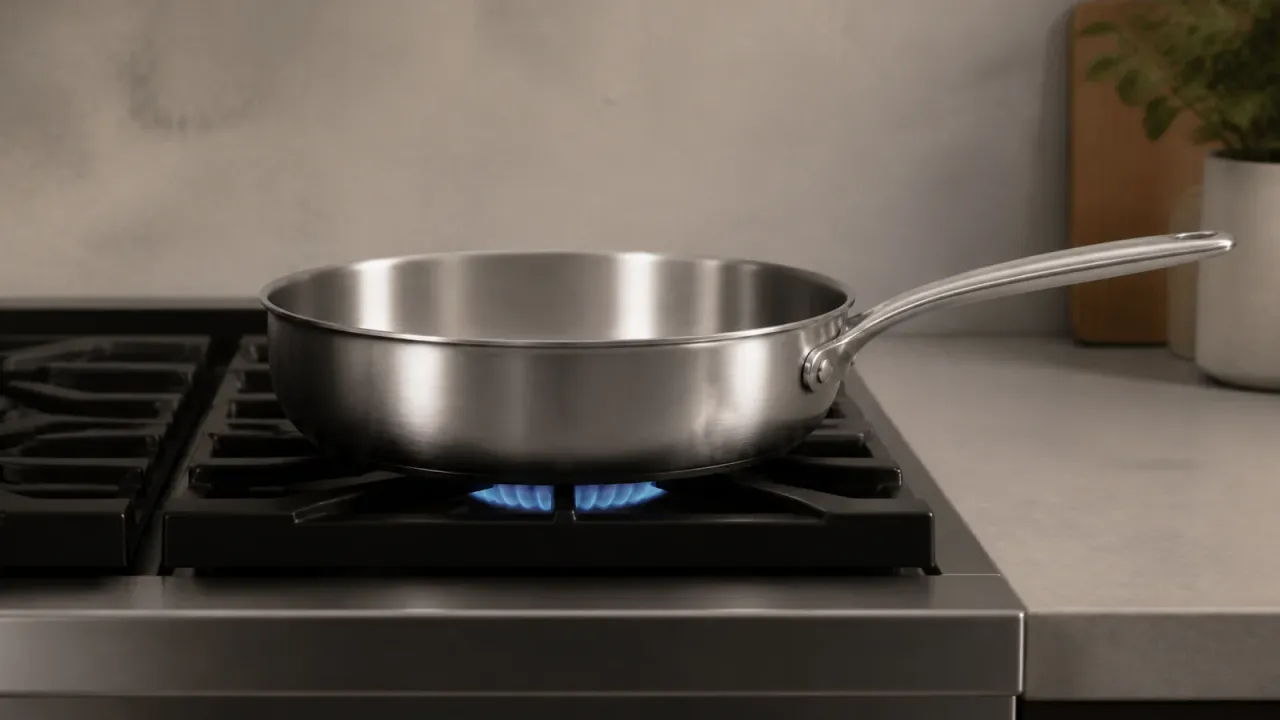
Choose a burner that supports the pan’s base without sending flame up its sides. Center the pan on the grate, and use a burner that is an appropriate size for the cooking surface. The Whirlpool gas cooktop control guide says to use cookware sized for the burner, center it over the burner, and keep the flame from extending beyond the cookware. GE gives the same core instruction: the flame should match the cookware and should not climb the sides.
This does three useful things:
- It puts heat under the cooking surface instead of around the sidewall.
- It reduces direct heat on the handle and nearby surfaces.
- It helps the pan remain balanced on the grate rather than being pushed or heated unevenly.
The pan should sit level without rocking, tipping, or sliding when empty. A warped base can make a pan unstable even if the stainless steel itself is still intact. Do not compensate for a poor fit by turning the flame higher.
A round-bottom wok needs its own support check, so compare the flat- and round-bottom stainless steel wok options before using one on gas.
Should you preheat stainless cookware gradually on gas?
Yes. Gradual preheating is a sensible default for stainless cookware on a gas stove. Start with a moderate flame or the setting the maker recommends, let the pan warm evenly, and increase heat only when the recipe and the pan’s instructions call for it. Avoid putting an empty pan over a strong flame for longer than necessary.
All-Clad’s stainless cookware care guidance recommends low to moderate preheating and says high heat is for boiling. It also warns that leaving an empty pan on a hot burner can cause damage. Tramontina similarly recommends low heat for its stainless pans because the base distributes heat efficiently.
These are technique and care recommendations, not a universal knob setting or a promise that every pan heats the same way. A thin pan, a clad pan, and a pan with a coated interior can respond differently. Follow the exact instructions for the collection you own.
Can a gas flame warp or discolor stainless steel cookware?
It can. Excessive or uneven heat may produce a brown, blue, or rainbow-colored heat tint, while severe heating or rapid cooling can affect the pan’s shape. A heat tint may be cosmetic, but a base that rocks, a loose handle, a leaking seam, or separated layers is a reason to stop using the pan until the maker evaluates it.
All-Clad notes that extended high heat can change the color of stainless steel without necessarily changing its cooking performance. The same care guide warns against putting a hot pan under cold water because sudden cooling can cause warping. Those points describe cookware care and heat behavior; they do not establish a universal temperature limit or a gas-stove approval for another brand.
Let a hot pan cool according to the maker’s care instructions before washing it. Do not deliberately shock it with cold water to speed cleanup, and check the base on a flat surface if you suspect it has changed shape.
What should you check on the handle, lid, and coating?
Check the whole assembled pan, not just the stainless cooking surface. A gas flame that is correctly positioned under the base can still send heat toward a handle, lid, or other component if the pan is small for the burner or the flame is too high.
Before cooking, check these parts:
- Handle: Confirm the material and attachment are approved for stovetop use. Keep the handle out of the flame and away from adjacent burners, and assume it can become hot. All-Clad’s customer-service guidance specifically warns that gas ranges can send heat from the vessel’s sides toward the handle and recommends using a mitt when needed.
- Lid and knob: Use a lid only within the exact model’s instructions. Glass, plastic, silicone, and metal parts can have different limits from the pan body.
- Coating: A stainless exterior does not make a nonstick interior suitable for a stronger flame. Follow the coating instructions and do not use the exterior material as a substitute for a heat rating.
- Base: Reject a pan that rocks, has a separated base, or cannot sit securely on the grate.
For the separate question of oven use, see can stainless steel go in the oven. An oven rating does not by itself decide how a pan, handle, or lid should be used over a gas flame.
How do you use stainless steel cookware on a gas stove?
Use this sequence as a practical check, then give the maker’s instructions priority:
- Read the exact pan, lid, and handle instructions. Confirm that gas stovetop use is included and note any limits for coatings or removable parts.
- Inspect the pan. Make sure the base is flat, the handle is secure, and there are no cracks, separated layers, or damaged fittings.
- Set the pan in the center of the grate before adjusting the burner. It should sit stable without touching a neighboring burner or hanging over an unstable edge.
- Match the burner to the base. Adjust the flame so it heats the bottom without climbing the sidewall or reaching the handle. The GE flame-size guidance explains that flame beyond the pan wastes heat and heats the handles.
- Preheat gradually and avoid prolonged empty heating. Add food or cooking liquid when the pan and recipe call for it, and use the lowest effective heat that follows the maker’s directions.
- Stay near the stove while the burner is on. Use a dry mitt when a handle is hot, and keep towels, packaging, and other flammable items away from the flame.
- Vent the room while cooking. The U.S. Environmental Protection Agency’s cooking guidance recommends using a range hood whenever you cook, preferably one that exhausts outdoors. If you do not have an outdoor-vented hood, use another safe ventilation option recommended for your home.
- Turn the burner off when cooking is finished, then let the pan cool before washing. Follow the maker’s cleaning instructions instead of putting a very hot pan under cold water.
This routine cannot make an unapproved pan suitable for gas. If the manufacturer does not identify the pan’s intended cooktops or the handle and coating limits, choose cookware with clearer instructions.
Why does ventilation matter when cooking on gas?
Ventilation is about the gas appliance and cooking process, not a special property of stainless steel. A range hood can capture cooking particles and combustion products. The EPA recommends turning it on whenever you cook and venting outdoors when possible. It also suggests using back burners when practical because they are closer to the hood’s capture area.
Keep the burner properly adjusted according to the appliance instructions. A persistent abnormal flame color or an appliance problem belongs with the range maker or a qualified service professional, not a cookware workaround. Never use an indoor gas stove as a room heater.
Frequently asked questions
Can any stainless steel pan go on a gas stove?
No. The stainless material alone does not establish compatibility. Check the exact pan’s intended cooktops, base condition, handle, lid, coating, and the maker’s limits before use.
Why does stainless steel turn brown on a gas stove?
High or uneven heat can create a heat tint on stainless steel. It may be cosmetic, but overheating can also damage a pan or change the shape of its base. Let it cool naturally and follow the maker’s approved cleaning method. Stop using it if it rocks, leaks, or has damaged fittings.
Can the handle of a stainless pan be over the gas flame?
The flame should stay beneath the pan’s base, not climb toward the handle. Position the handle as the cooktop and cookware instructions direct, keep it away from the burner, and use a dry mitt if it becomes hot. Do not assume a stainless handle stays cool just because its material is stainless.
Does gas compatibility mean the pan is induction compatible?
No. Gas and induction use different heating methods. For induction, check the pan’s magnetic base and the maker’s instructions in the guide to stainless steel cookware for induction.
For a broader look at how construction affects stainless cookware, see the pros and cons of stainless steel cookware guide.
Sources and access dates
- Whirlpool gas cooktop control guide, burner sizing, centering, grates, flame placement, and empty-cookware guidance, accessed August 21, 2026.
- GE Appliances proper flame sizes on gas ranges, matching flame size to cookware and avoiding flame up the sides, accessed August 21, 2026.
- All-Clad use and care, gradual preheating, empty-pan, discoloration, and cooling guidance for its stainless cookware, accessed August 21, 2026.
- All-Clad customer service, collection-specific heat guidance and gas-range handle warnings, accessed August 21, 2026.
- Tramontina stainless saucepan care, burner sizing, low-heat, and flame-placement guidance, accessed August 21, 2026.
- U.S. Environmental Protection Agency cooking ventilation guidance, range-hood and ventilation recommendations, accessed August 21, 2026.