Yes, stainless steel cookware can work on a smooth glass-top stove when the cooktop is a radiant electric or glass-ceramic model, the pan has a clean, dry, flat, smooth base, and the maker permits that use. Stainless steel alone is not a universal compatibility rating. Pan shape, base condition, size, construction, weight, residue, and the exact cooktop manual still matter.
Radiant glass cooktops heat with elements beneath the ceramic glass. They do not require a magnetic pan. Induction cooktops also have glass surfaces, but they heat through a magnetic field and need cookware with a suitable magnetic base. Do not use an induction magnet test as the answer to a radiant-glass question.
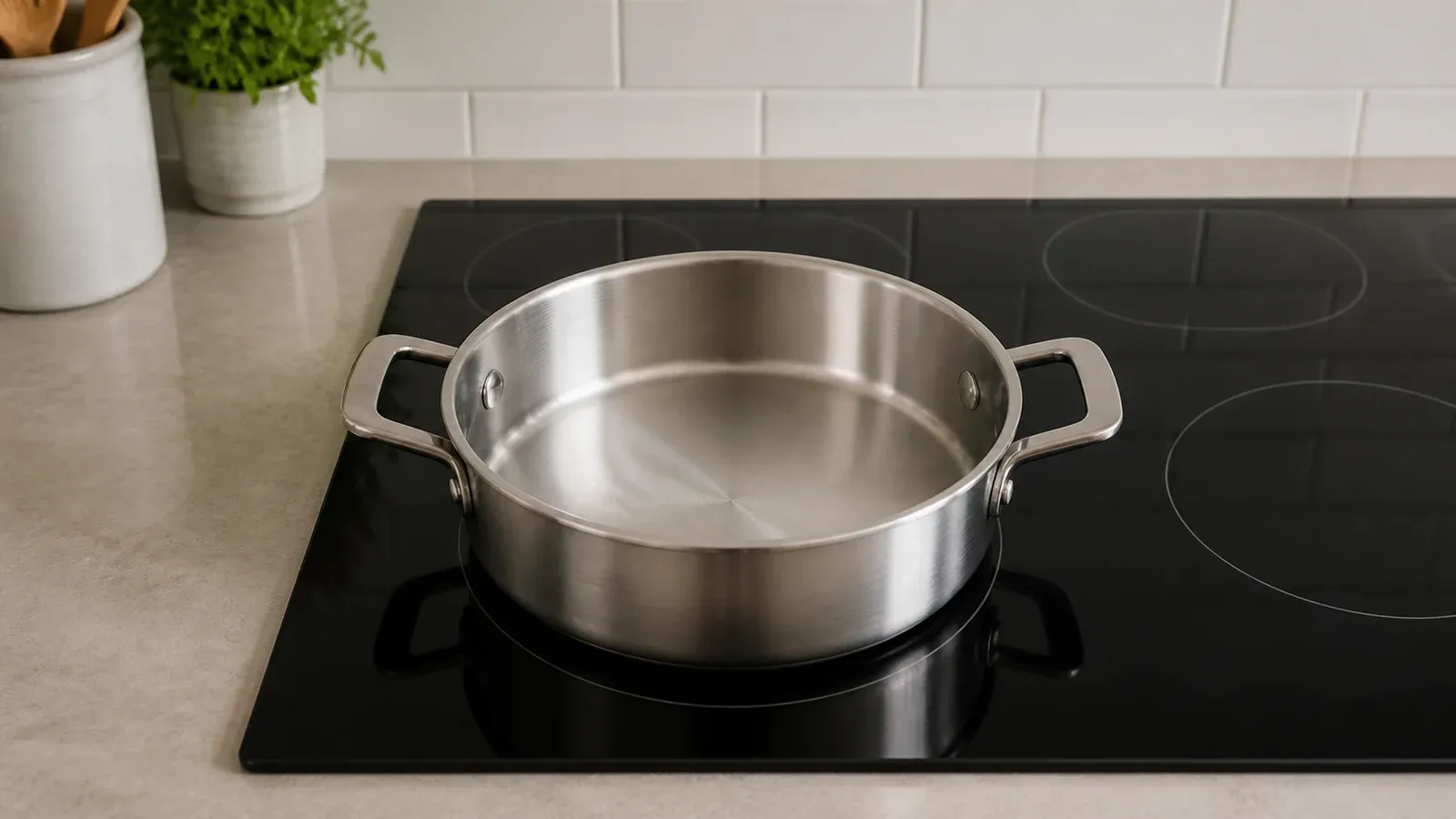
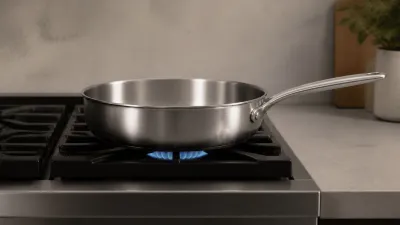
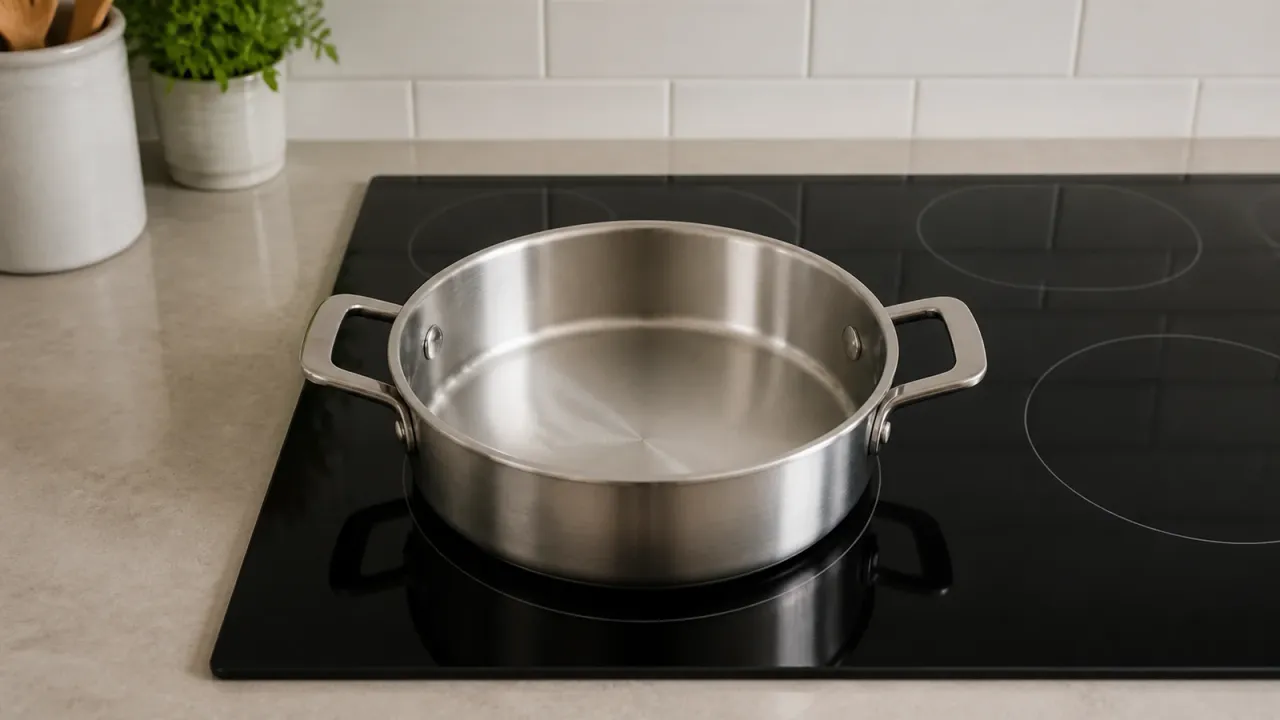
Illustration only: the pan and cooktop are generic visual cues. This image does not verify a real cookware base, glass composition, hidden heating element, weight limit, or maker approval.
If the cooktop is induction, use our guide to stainless steel on induction cooktops instead. For a purchase decision, the stainless steel cookware for induction roundup checks complete models rather than treating every stainless pan as equivalent.
| Check before use | Why it matters | What to verify |
|---|---|---|
| Cooktop type | Radiant glass and induction use different heating methods | The controls, manual, and model name identify a radiant, electric, or induction surface |
| Pan base | A flat, smooth base makes better contact and is less likely to mark the glass | No rocking, burrs, baked-on grit, ridges, or severe warping |
| Size and position | The element and pan need suitable contact and centering | Follow the cooktop’s marked-zone and overhang limits |
| Handling | Sliding can scratch or leave metal marks | Lift and place the pan instead of dragging it |
| Condition | Residue and water can bake onto the surface | Keep both the glass and pan bottom clean and dry |
| Limits | Weight, canning, heat, and hot-lid rules vary | Follow the exact cooktop and cookware manuals |
Can stainless steel cookware work on a glass top stove?
Stainless steel is generally a suitable material for a radiant smooth glass cooktop, but only as part of a complete pan-and-cooktop match. GE’s radiant smooth glass cookware guidance recommends stainless steel and says a sandwich-clad bottom can combine stainless durability and stability with aluminum or copper heat distribution. The same guidance still assumes an appropriate base and does not approve every stainless pan for every model.
The useful question is not “Is the pan stainless?” It is “Does this complete pan have the base, size, condition, and maker instructions this radiant surface requires?” A stainless pan with a warped bottom or rough particle trapped under it can be a poor match even though the alloy itself is acceptable. A pan with a smooth, flat base can work even when its construction includes aluminum or another conductive layer.
Read the cookware instructions before first use, especially when the pan has a bonded disc, nonstick coating, decorative exterior, glass lid, helper handle, or unusual shape. The stainless steel frying pan guide explains why the body material does not settle the limits of a complete pan.
For an unusual stir-fry shape, the stainless steel wok guide separates flat-bottom models from a round-bottom option that needs compatible support.
Is a glass top stove the same as induction?
No. A radiant glass-top stove passes heat from an electric element beneath the glass into the pan, while induction creates a changing magnetic field that heats a compatible pan base. The shared glass surface is the source of much of the confusion, not evidence that the two cooktops accept cookware in the same way.
For radiant glass, a magnet is not the compatibility test. Flatness, smoothness, size, cleanliness, and the manual are more relevant. For induction, the base must contain enough magnetic material for the appliance to detect and heat it. A stainless pan can therefore work on radiant glass but fail on induction, or work on both when it has a magnetic exterior or bonded base.
Do not infer radiant performance from an induction label, and do not infer induction compatibility from a pan’s ability to heat on an electric glass surface. The induction compatibility guide covers magnetism, detection areas, and residual heat as a separate question.
What should the pan base be like?
The base should be flat, smooth, clean, and dry enough to make broad contact with the glass without rocking. A stainless label does not guarantee any of those conditions.
Look for these problems while the pan is cool:
- a base that rocks on a flat counter;
- rounded, ribbed, dented, or sharply concave or convex areas;
- burrs, rough welds, or a damaged disc edge;
- burnt food, salt, sand, or other grit stuck to the bottom;
- water droplets or cleaner residue that can heat and leave deposits;
- a separated or visibly distorted bonded base.
Whirlpool’s ceramic-glass maintenance guidance says flat-bottomed cookware supports heat conduction and warns that rounded, warped, ribbed, or dented bottoms can produce uneven heating and poor results. It also tells users to make sure pan bottoms are clean and dry before use because residue and water can leave deposits when heated.
Do not smooth a rough pan base with sandpaper or a metal tool unless the cookware maker supplies a repair method. Altering a bonded base can expose another layer, change stability, or void a warranty. Replace or ask the maker about a pan that no longer sits securely.
How do you check a pan for flatness?
Check the cool, clean base with a straight edge before putting the pan on the cooktop. Turn the pan upside down and place a ruler across several directions. The edge should touch the base evenly; a small maker-allowed concavity is different from a rocking or visibly warped pan.
GE’s flatness check uses a ruler and says a very slight concave center may be acceptable. It also describes a boiling-water observation for cooking performance, but that is a maker’s diagnostic example, not a required test for every household or a universal proof of safe glass contact. Start with the non-heating ruler check and follow the cooktop manual.
If the pan rocks, has a gap large enough to change contact, or shows a sudden shape change, do not try to flatten it yourself. A base that is technically stainless can still be unsuitable for a smooth radiant surface.
How should you place and move the pan?
Place the pan gently in the center of the marked cooking zone, then lift it straight up when you need to reposition it. Do not drag or rotate a loaded stainless pan across the glass.
Sliding can scratch the ceramic glass, transfer metal marks, and pull grit beneath the base. Samsung’s cookware guidance tells users never to slide a pot across an electric or induction cooktop and to pick it up and place it instead. All-Clad gives the same handling warning in its current cookware care guidance, but neither statement makes every cooktop scratch-proof.
Keep handles turned as the cooktop manual directs and leave enough room to lift the pan without striking a neighboring vessel. Do not use a pan as a trivet, cutting board, or storage surface. Do not place a loose mat, foil, paper, or improvised spacer beneath it unless the cooktop maker explicitly approves that accessory.
Does pan size and weight matter on glass?
Yes, but the acceptable range is model-specific rather than a universal stainless-steel rule. The pan’s flat cooking base should suit the marked element, and the complete load should stay within any limit the cooktop or cookware maker publishes.
GE recommends medium- or heavy-weight cookware for performance on its radiant smooth glass cooktops and says flat bottoms are essential for heat transfer. It also warns that older, used, or thinner pans may lose flatness and that non-flat pans can crack the glass. Treat this as GE guidance for its cooktop family, not a universal minimum weight or a promise that heavier is always safer.
Check the exact manual before using an oversized skillet, stockpot, canner, griddle, or water-filled vessel. Some models specify minimum and maximum pan diameters, allowable overhang, or separate canning instructions. A pan that you can technically place on the glass may still be too large, too heavy to lift safely, or outside the appliance’s approved use.
Do not estimate a safe load from the pan’s stainless grade, ply count, or empty weight. The cookware, food or liquid, lid, and handling method all affect the actual load. If the manual does not state a limit, preserve that unknown and ask the cooktop maker before using an unusually heavy vessel.
What residue or damage should you check before cooking?
Inspect and clean both surfaces before turning on the element. A clean, dry glass surface and a clean, dry pan bottom reduce the chance that food, salt, water, or metal residue will bake into a mark.
Common clues include:
- a gray or silver streak that may be transferred metal rather than a crack;
- a chalky or cloudy spot that may be cooked-on residue or mineral deposit;
- stuck sugar, syrup, or another sugary spill that can pit glass if it cools in place;
- a rough pan bottom that can scratch even when the glass itself is marketed as scratch resistant;
- a crack, chip, raised edge, or deep gouge that is not routine residue.
Follow the cooktop manual for cleaning products and scraper use. Whirlpool says sugary spills should be addressed promptly with the surface still somewhat warm and warns that cooled sugar can adhere and create pitting or permanent marks. Samsung’s electric cooktop care guidance says to turn the cooktop off and let it cool before cleaning routine spills, while treating sugar and chocolate spills as an urgent exception because they can adhere quickly.
Do not confuse a removable metal mark with a scratch, and do not use an abrasive pad or an unapproved scraper simply because a pan left a streak. The cooktop manual controls the tool, cleaner, temperature, and timing for that surface.
How should you manage heat and thermal shock?
Use only the heat settings and preheating sequence specified by the exact cookware and cooktop makers. Radiant elements cycle on and off as they regulate temperature, so the visible cycling or a slower response than induction is not by itself a compatibility failure.
Do not leave an empty pan heating longer or hotter than the cookware instructions permit. Stainless cookware with a conductive core can respond differently from a thin single-layer pan, and a coated interior can have stricter limits than a bare stainless surface. For construction context, see what fully clad cookware means, but do not treat cladding as a heat rating.
Thermal shock rules also belong to the specific maker. Whirlpool warns that leaving a hot lid on ceramic glass can allow trapped air to form as the cooktop cools and can break the glass when the lid is removed. All-Clad warns that placing a hot pan under cold water can warp that cookware. These are useful exact-maker cautions, not a universal temperature threshold for every pan, lid, or cooktop.
Let the pan and surface cool according to their manuals before cleaning or moving a hot lid. Do not pour cold water onto a hot cooktop or deliberately shock a hot pan to accelerate cleanup.
What does the cooktop manual control?
The cooktop manual controls the details that a material name cannot answer. Check it for the approved cookware materials, minimum and maximum base diameter, overhang, canning or oversized-vessel rules, surface-cleaning method, residual-heat warnings, and what to do after a crack or spill.
The cookware manual separately controls the pan’s intended cooktops, coating limits, lid and handle rules, empty-pan warnings, thermal-shock advice, and whether a bonded base or disc is approved for glass. When the two sets of instructions differ, pause and ask the relevant maker rather than choosing the more permissive rule.
No visual inspection can verify a hidden heating element, load rating, bonded-layer condition, or manufacturer approval. Keep the model numbers and care guides available when a pan is unusually large, heavy, warped, coated, or unfamiliar.
What should you do if the glass shows marks?
Turn the element off, let the surface reach the temperature the manual specifies for cleaning, and identify the mark before applying anything stronger. A removable food or metal deposit calls for the cooktop’s approved cleaner and tool; a crack, chip, pit, or deep scratch calls for service guidance.
Do not keep cooking over a crack or use a pan to cover a damaged area. Do not assume a mark is harmless because it looks cosmetic, and do not assume a polished pan base is scratch-proof. Photograph the cooktop and pan base, record the model numbers, and contact the cooktop maker when the source of the mark is unclear.
If the pan’s base is rough, warped, separated, or shedding material, stop using it on the glass until the cookware maker evaluates it. Cleaning cannot repair a distorted base or restore a cracked ceramic surface.
When should you stop using the pan or cooktop?
Stop and ask the maker or a qualified service professional when the pan rocks, its bonded base separates, the cooktop cracks or chips, a control behaves abnormally, or a spill has caused pitting or a permanent mark.
Also pause when you cannot identify whether the appliance is radiant or induction, when the manual gives no answer for a heavy or oversized vessel, or when a coating, lid, handle, or accessory has a separate unknown limit. Do not solve an evidence gap by increasing heat, adding a spacer, dragging the pan, or copying an instruction from a different model.
Frequently asked questions
Can I use an 18/10 stainless steel pan on a glass top stove?
Usually, the stainless grade is not the deciding issue on a radiant glass cooktop. Check that the pan’s base is flat, smooth, clean, and maker-approved for that surface. An 18/10 label does not establish induction compatibility, base flatness, or a cooktop load limit.
Can fully clad stainless cookware work on a radiant glass cooktop?
Yes, it can when the complete pan has a flat, smooth base and the makers permit the use. Fully clad describes layers through the walls and base, not a universal glass-cooktop rating. A disc-bottom or single-layer pan can also work when its base and instructions meet the cooktop’s requirements.
Does stainless steel scratch a glass cooktop?
Stainless steel is not automatically scratch-causing, but a rough or dirty base, trapped grit, or sliding can scratch or mark ceramic glass. Keep both surfaces clean and dry, lift rather than drag the pan, and follow the exact cooktop guidance. “Scratch resistant” is not “scratch proof.”
Can I slide a stainless steel pan across the cooktop?
No. Lift and place it instead. Sliding can drag grit across the surface and can leave scratches or metal marks, even when the pan and cooktop are otherwise compatible.
Can I use a heavy stainless steel stockpot or canner?
Only when the exact cooktop and cookware instructions allow that vessel, size, and load. Some makers publish separate advice for medium or heavy cookware, overhang, or canning, but there is no universal safe weight for every glass-top stove. Ask the cooktop maker when the manual is silent.
Sources and access dates
- GE Appliances, Electric Range cookware for a radiant smooth glass cooktop, stainless recommendations, sandwich-clad bases, and medium or heavy cookware guidance, accessed August 22, 2026.
- GE Appliances, steps to check cookware for best performance, ruler flatness check and non-flat-pan cautions, accessed August 22, 2026.
- Whirlpool, maintenance of ceramic glass, flat bases, clean and dry bottoms, sliding, residue, and hot-lid warnings, accessed August 22, 2026.
- Samsung, cooktop cookware breakdown, electric-cooktop lifting guidance and stainless-versus-induction distinction, accessed August 22, 2026.
- Samsung, clean and care for an electric cooktop, dry cookware bottoms, spill handling, and cool-surface cleaning guidance, accessed August 22, 2026.
- All-Clad, current use and care, no-sliding and cookware-specific thermal-shock cautions, accessed August 22, 2026.