Yes, stainless steel can go in the freezer. Food-grade stainless handles freezer temperatures without cracking or warping, and a container, pan, or ice cube tray made of it is a normal thing to store food in. The limits come from the contents and from what you do next, because the cold itself does not harm the steel.
Two cases need care. Do not freeze liquid in a filled or sealed insulated bottle, because the liquid expands and can damage the bottle. And do not move a frozen pan straight to a hot burner. The sections below cover both, plus how to pack food for the freezer.
This is a research-based safety guide, not a freezer test. It draws on the bottle makers’ own care pages and on what the site’s other guides already establish.
Is stainless steel safe in the freezer?
Stainless steel is safe in the freezer as a material. A home freezer holds food at 0°F, and 18/8 stainless steel stays tough at that temperature. It does not turn brittle in a home freezer.
What varies is the product. A lid, gasket, handle, coating, or vacuum layer can have its own limits, so the question is really about the exact item. Our guide to fridge and general container safety covers lids, seals, and instructions in detail, and this page stays on the freezer.
Which stainless steel items can go in the freezer?
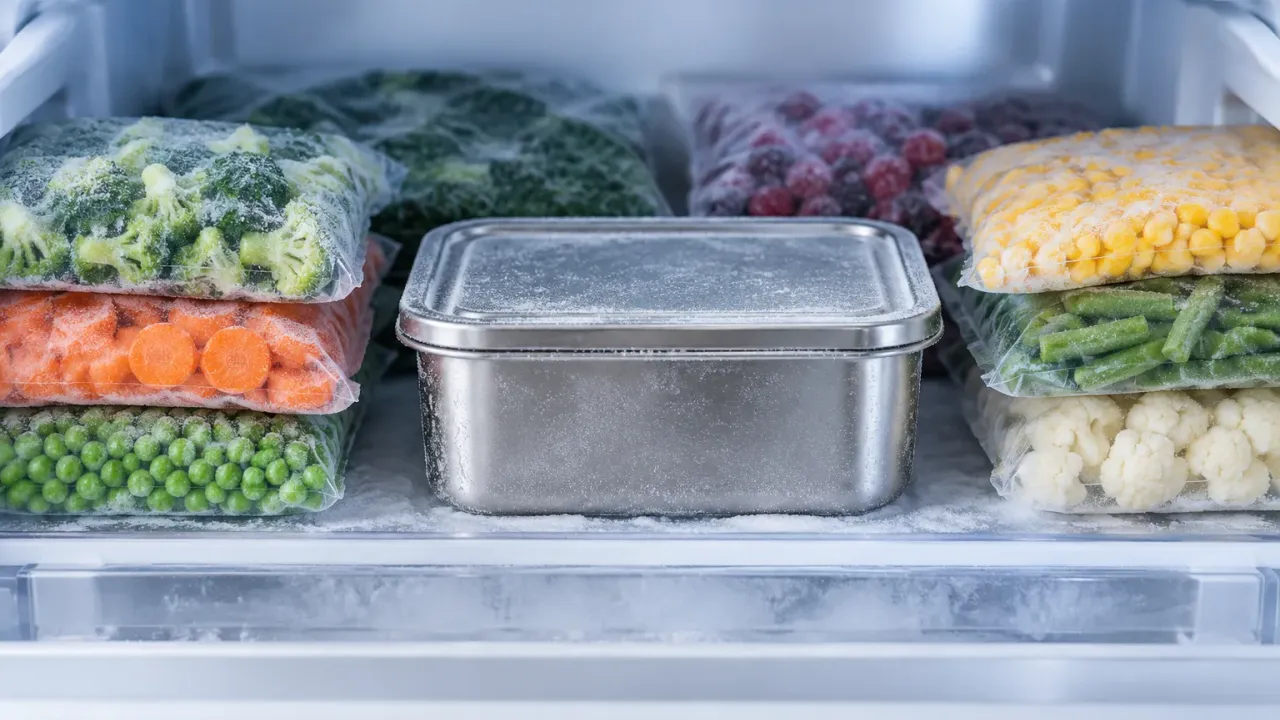
Solid single-wall stainless steel food containers, pots, pans, and ice cube trays are fine, as long as the lid and any non-steel parts are rated for freezer use too. Insulated bottles, tumblers, and food jars are the exception, covered in the next section.
- Food containers are fine when the maker approves both the body and the lid for the freezer.
- Pots and pans can hold leftovers, but see the thermal shock section before you reheat.
- Ice cube trays are made for the freezer. Leave room at the top of each cell, because water expands as it freezes.
- Single-wall bottles need the maker’s instructions first, then room for expansion.
Can you freeze liquids in a stainless steel bottle or tumbler?
Usually not, and never to the top. Water expands as it freezes, and a sealed or insulated stainless steel bottle gives that expansion nowhere to go. Maker advice varies, and it is worth reading for your exact bottle.
- Stanley’s FAQ answers the question flatly. It says its products are not freezer-safe and that “expanding liquids can damage your product.”
- YETI’s FAQ for its Rambler Bowls says it does not recommend freezing them, similar to its insulated Rambler products, because loss of vacuum may occur.
- Owala says its stainless steel bottles are technically freezer safe, and it suggests a few ice cubes in the bottle instead.
That gap is useful. A vacuum-insulated bottle is built to keep the outside temperature away from the drink, so freezing it works against the design. If you want a colder drink, add ice. If the bottle is a dented or damaged one, our guide to dented stainless steel bottles lists freezing a filled bottle among the repair attempts to avoid.
Carbonation raises a separate pressure problem. Our guide to bottle limits for fizzy drinks covers it.
Can frozen stainless steel crack or warp from thermal shock?
Cold alone does not crack stainless steel. The risk is a fast swing between cold and hot, which makes one part of a pan expand or shrink faster than another. That uneven movement is what warps pan bases.
Do not take a frozen pan and put it on a hot burner or into a hot oven, and do not run hot water over a frozen vessel to free the contents. Let it warm up first. If it holds food, thaw the food in the fridge, because perishable food should not thaw on the counter. Our guide on why stainless steel pans warp cites All-Clad and Calphalon on sudden temperature changes.
How should you pack food in stainless steel for the freezer?
Leave headspace, use a freezer-rated lid, and label the container. Water-rich foods such as soup and stew expand as they freeze, so fill them below the rim. A rigid container packed to the top can push its lid up or distort a seal.
- Cool hot food before it goes into the freezer.
- Fill to the maker’s headspace line, or leave roughly an inch below the rim for liquids.
- Seal with a lid the maker rates for the freezer.
- Label the contents and date, since steel is opaque and you cannot see inside.
- Thaw in the fridge or in cold water in a leak-proof package, and do not thaw perishable food on the counter.
USDA’s freezing and food safety guidance covers safe temperatures and thawing for the food itself. It does not address stainless steel, so follow the container maker for the steel.
Is stainless steel better than glass or plastic for freezing?
Stainless steel is the sturdiest of the three because it does not shatter if you drop it. Glass lets you see the contents, and plastic is light. For a side-by-side look at the tradeoffs, see our comparison of glass versus stainless.
If you want containers built for the job, our roundup of the best food storage containers lists options with their lid and material details.
Frequently asked questions
Can you put a stainless steel water bottle in the freezer?
Check your bottle’s maker first. Stanley and YETI advise against it for their insulated products, and Owala says its bottles are technically freezer safe but suggests ice cubes instead. If you do freeze a single-wall bottle, leave room at the top so the liquid can expand.
Can you put a stainless steel pot in the freezer?
Yes. A bare stainless steel pot or pan handles freezer temperatures. Check that any plastic handle, glass lid, or silicone part is also freezer-rated, and let the pot thaw before it meets a hot burner.
Does freezing food in stainless steel change the taste?
Not by itself. Food-grade stainless steel is a stable material, and any flavor change in the freezer more often comes from air exposure and long storage. Seal the container well and use the food within its recommended time.
Sources
- Stanley 1913, frequently asked questions (checked 2026-10-23)
- YETI, frequently asked questions, Rambler Bowls (checked 2026-10-23)
- Owala, frequently asked questions (checked 2026-10-23)
- USDA FSIS, freezing and food safety