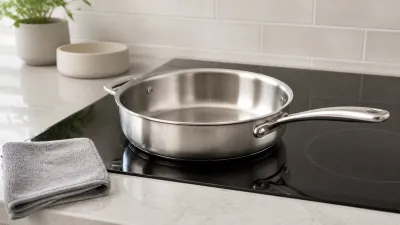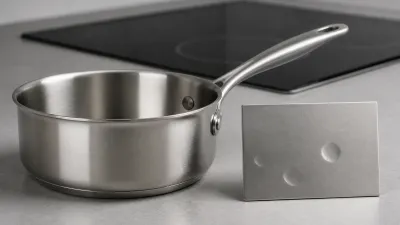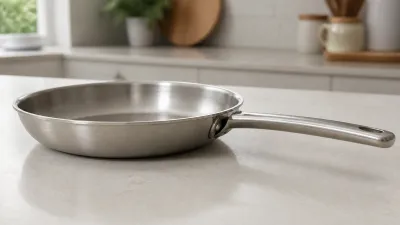
A stainless steel pan warps when one part of it heats or cools much faster than the rest, so the metal expands or shrinks unevenly and the base bows out of shape. The usual triggers are high heat on a burner smaller than the base, heating the pan empty, and cold water hitting a hot pan. Do not hammer, press, or heat a warped pan flat, because a home repair can cost you the maker’s help.
A slight manufacturing contour is not always damage. Test the cool, clean pan on a verified flat surface and compare it with the maker’s specifications before deciding that it has warped.
What causes a stainless steel pan to warp?
Cookware changes size slightly as it heats. A thick, evenly heated base manages that movement better than a thin base exposed to a concentrated hot spot. Distortion can occur when the temperature difference overwhelms the pan’s construction.
The usual triggers are:
- high heat concentrated beneath one part of the base
- prolonged empty heating
- a small burner under a wide pan
- cold water added to a very hot empty pan
- impact from dropping the cookware
- repeated use on a heat source the manufacturer excludes
All-Clad’s product support guidance says high heat, the wrong heat source, and sudden temperature changes can produce an uneven base. Calphalon’s stainless cookware guidance likewise warns that putting a hot pan in cold water can cause thermal shock and warping.
How can you tell whether a pan is warped?
Let the pan cool, clean its bottom, and place it on a known-flat counter or cooktop that is turned off. Press lightly near the rim without touching the handle. Rocking, spinning, or a visible gap can indicate distortion. Check for debris beneath the pan and confirm that the cooktop itself is level.
Uneven oil pooling during cooking can be another clue, but oil also moves with a sloped range or a pan whose base was intentionally made slightly concave. Ask the manufacturer if the shape is uncertain.
The central stainless steel pan cleaning guide treats a rocking base or separated layer as structural rather than a cleaning problem. Cleaning the exterior bottom can rule out burnt residue that prevents a pan from sitting flat.
Can you safely flatten a warped stainless steel pan?
Do not attempt a home flattening repair. Hammering, pressing, reheating, or rapidly cooling a bonded pan can weaken handles, alter the base further, separate layers, or create an unstable cooking surface. It can also affect a warranty claim.
Photograph the cool pan on a flat surface. Record the brand, cookware line, model or size, purchase date, and heat source. Contact the manufacturer before modifying it. A maker can decide whether the shape is expected, repairable, covered, or due for replacement.
The All-Clad cookware warranty excludes damage from thermal shock and from unauthorized modification or repair. It also excludes warping or metal separation caused by high heat or by heating the pan empty. That is why you should document the condition before anyone touches the pan. Terms vary by brand and cookware line.
You will find advice online to tap a warm pan flat with a rubber mallet. That advice comes mostly from thin pans and baking sheets. A clad pan is several metals bonded together, and All-Clad’s support page sends owners of an uneven pan to customer service rather than describing a home fix.
When should you replace a warped pan?
Stop using the pan if it rocks enough to be unstable, does not make reliable contact with an electric or induction surface, has separated bonded layers, leaks, or has a loose handle that cannot be safely secured. An unstable pan can move while hot, and poor contact can make heating less predictable. On induction, a warped base can also keep the zone from detecting the pan, which the guide to stainless steel on induction cooktops covers.
A slight change that the manufacturer confirms as safe may remain usable on some ranges. Follow that product-specific answer. If replacing it, the stainless steel frying pan guide explains how base construction, weight, and handle control affect daily use. Review stainless steel cookware safety separately from appearance concerns.
Which stainless steel pans resist warping?
Pans with a thick, flat base and a bonded aluminum or copper core resist warping best, because the core spreads heat before one spot runs far hotter than the rest. All-Clad’s support page says base bonding protects against warping and that fully bonded, rim-to-rim construction adds stability across the whole pan. Demeyere’s Industry 5 frying pan page says its flat-base design keeps the pan from warping when heated. That is a maker’s claim, not an independent test.
Construction labels only go so far. A fully clad pan and a disc-bottom pan can both stay flat when the base is thick and sized to the burner, as the disc bottom vs fully clad comparison explains. Extra layers do not prove a pan is tougher either, and the 3-ply vs 5-ply comparison notes that both can warp under severe thermal shock. No construction makes cold water in a scorching pan safe.
How do you prevent warping?
Match the burner to the pan base, use moderate heat unless the maker directs otherwise, and do not leave an empty pan unattended. Let cookware cool naturally before washing. Do not pour cold liquid into a scorching empty pan or move it directly from a burner to cold water.
Respect the limits for the exact cookware line in the guide to using stainless steel in the oven. Oven-safe temperatures depend on handles, lids, coatings, and construction, not only on the stainless steel body.
Clean brown residue rather than mistaking it for deformation. The guide to why a stainless steel pan turns brown distinguishes surface color from a changed shape. After the pan cools and dries, store stainless steel pans with stable support so stacked weight does not rest on handles or lids.
Frequently asked questions
Do stainless steel pans warp easily?
Not under normal use. Warping usually follows a specific event, such as an empty pan left on high heat or a hot pan plunged into cold water. All-Clad recommends low to medium heat for most cooking and keeps high heat for boiling.
Is it normal for a new stainless steel pan to rock?
Treat it as a question for the maker, not something to live with. All-Clad tells owners not to use a pan whose base is uneven at purchase and to contact customer service. Rule out residue and an uneven counter first.
Does stainless steel thickness prevent all warping?
No. A thicker or well-bonded base can resist distortion, but no construction makes misuse harmless. Heat control, burner size, cooling, and the maker’s instructions still matter.
Can a dishwasher warp a stainless steel pan?
Dishwasher permission varies by cookware line. The larger thermal-shock risk is a very hot pan meeting cold water. Let the pan cool and check whether the exact stainless steel pan is dishwasher safe.
Is a spinning pan always warped?
Not always. Food or residue under the base, an uneven surface, or an intentional base contour can affect the test. Clean and dry the pan, test a second known-flat surface, and ask the manufacturer when the result remains unclear.
Related guides
Continue with Use Stainless Steel Cookware on a Grill?, Use Stainless Steel Cookware on a Campfire?, Use Stainless Steel Cookware With a Separating Base?, How Long Does Stainless Steel Cookware Last?.
Continue with Use a Stainless Steel Pan With a Loose Handle?, Pitting in Stainless Steel Cookware?, Stainless Steel Pans Scratch Glass Cooktops?.