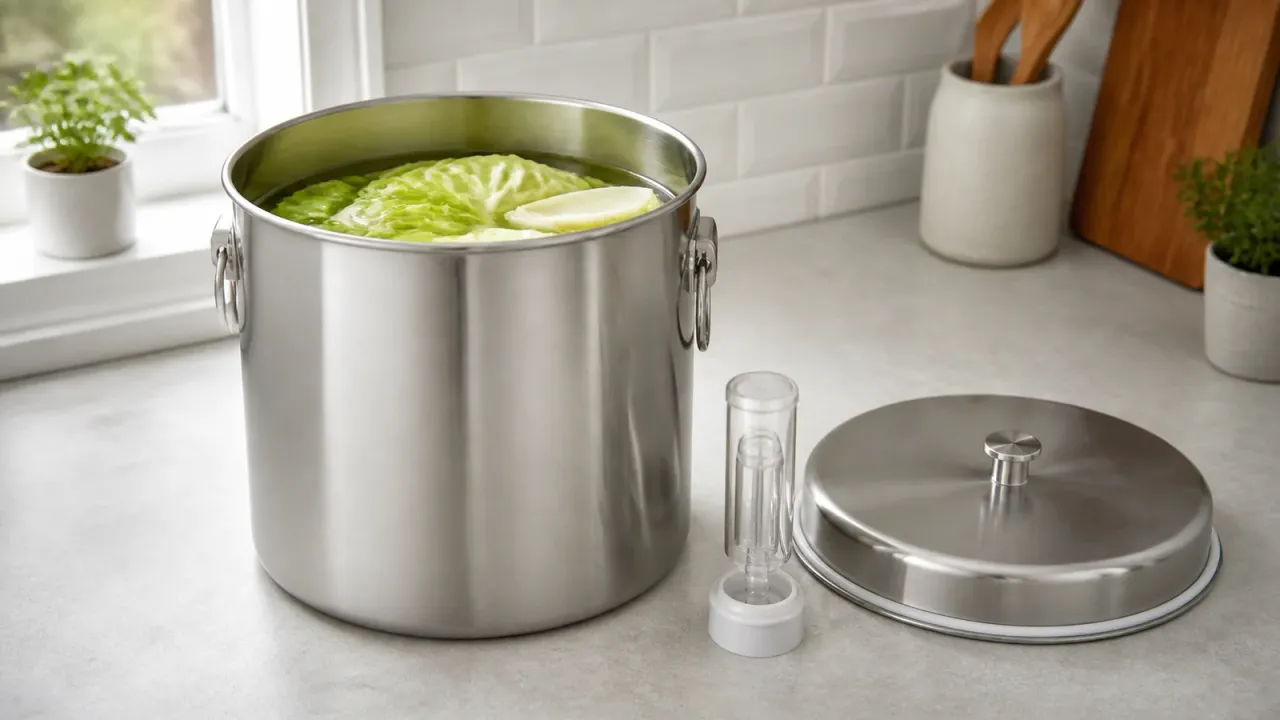
Yes, stainless steel can suit some food fermentation, but a documented vessel and a tested process must agree on the food, brine, acidity, temperature, gas release, and storage. A shiny metal container is not automatically a fermentation vessel. For home-fermented vegetables, the University of Minnesota Extension specifically advises avoiding metal because the lactic acid produced by the bacteria can react with it. The National Center for Home Food Preservation instead describes stoneware, food-grade plastic, and glass for its home guidance.
That leaves a narrow, useful distinction. Some purpose-built stainless brewing fermenters document an alloy, sanitary welds, a removable lid, and an airlock or blow-off connection. Those details support a decision about that finished product and its stated brewing use. They do not make an unidentified household vessel suitable for a vegetable brine, and they do not replace a tested recipe or food-safety process. Read our explanation of food-grade stainless steel for why the finished article matters more than a grade number alone.
This is a vessel and material check, not a fermentation recipe. Use a current tested recipe from NCHFP or your local extension service for the food, salt, pH, temperature, fermentation time, and storage steps.
Can you use stainless steel for food fermentation?
You can use stainless steel only when the exact vessel is documented for the food-contact conditions and the recipe or process is validated for the food being fermented. The safe answer changes with the type of fermentation, the alloy and finish, the welds and fittings, the acidity and chloride exposure, and whether gas can escape.
| Situation | What supports a conditional yes | What remains unknown |
|---|---|---|
| Purpose-built stainless fermenter | The maker identifies the food-contact material, finish, fittings, cleaning method, and intended fermentation use | Whether those limits match a vegetable brine, culture, temperature, and contact duration |
| Commercial brewing vessel | The product documentation specifies sanitary construction, an airlock or blow-off path, and any pressure rating | Whether beer-equipment instructions apply to a different food or fermentation method |
| Generic stainless bowl, bucket, or canister | A traceable maker specification for the complete article and its food-contact use | Alloy, weld quality, coatings, gasket material, corrosion resistance, and venting |
| Home lacto-fermented vegetables | A tested recipe and a vessel that the recipe or extension guidance supports | Whether substituting stainless changes the process or increases metal exposure |
The FDA Food Code is a useful performance benchmark, even though it is a model code for food-service settings rather than a household certification. It calls for food-contact materials that are safe, durable, corrosion-resistant, nonabsorbent, smooth, cleanable, and resistant to pitting, scratching, and similar damage. Those are checks on the finished surface and its use, not a blanket approval of every stainless item.
Which stainless vessel is actually suitable?
The most defensible candidate is a purpose-built vessel whose maker identifies the complete food-contact system and tells you how to use it. Check these details before choosing it:
- Look for the exact alloy or a clear food-contact specification for the interior, not just “stainless” in a product title. A 304 label can describe a useful material while leaving the finish, welds, lid, gasket, and use limits undocumented.
- Confirm that the interior is smooth and intact, with no pits, cracks, sharp crevices, open seams, or rough welds. FDA guidance specifically calls for smooth welds and joints that are accessible for cleaning and inspection.
- Identify the lid, gasket, airlock, valve, tubing, sealant, and any coating. The stainless body does not establish the safety or temperature limit of those parts.
- Ask the maker whether the vessel is intended for the food, acid, salt or chloride exposure, temperature, cleaning chemicals, and length of contact in your recipe. If the documentation is silent, treat the condition as unknown.
- Confirm the vessel’s specified venting method. A standard lid, an airlock, and a pressure-rated lid are different systems with different limits.
Do not borrow a pressure or cleaning practice from another model. For example, Spike describes its Flex as a 304 stainless fermenter with sanitary welded ports and an airlock option, while its separate pressure-fermentation guidance warns that a blocked exit can allow dangerous pressure to build. That is product-specific evidence, not permission to seal a household container. Likewise, stainless steel food storage guidance addresses storage and handling, not the changing chemistry and gas production of fermentation.
What should you inspect before adding food?
Inspect the vessel, lid, fittings, and seals when they are clean and dry, before the food and brine make inspection harder. A practical inspection is:
- Read the maker’s instructions. Confirm the exact model, intended food or beverage, cleaning products, temperature limits, and whether the lid is vented or pressure-rated.
- Check the food-contact path. Trace every surface the food, brine, foam, or condensate can touch. Do not stop at the outside wall.
- Look at welds and crevices. A weld should be smooth and cleanable. A deep seam, trapped residue, pinhole, rough repair, or inaccessible fitting is a reason to stop and ask the maker.
- Check the closure. A gasket should be intact and seated. The airlock or blow-off path should be clean, unobstructed, and the one specified for that vessel.
- Confirm the recipe’s controls. Use the process’s tested ingredients, salt instruction, pH checks, temperature range, headspace, and storage direction. Do not replace those controls with an appearance check.
If you cannot identify the alloy, finish, weld quality, or nonmetal components, choose the container named in the tested recipe instead. “Food-grade” is useful only when it describes the complete article and intended use.
How do salt, acid, and chloride affect stainless steel?
Salt and acid are not automatic proof that stainless steel is either safe or unsafe. They are exposure conditions that have to match the alloy, surface, temperature, contact time, and care instructions.
The British Stainless Steel Association explains that pitting and crevice corrosion occur most readily in aqueous chloride solutions, and that acidic conditions and higher temperatures promote those forms of attack. It also notes that concentrated salt and vinegar mixtures can pit stainless surfaces over time. A fermented brine can therefore be a more demanding service condition than a brief contact with a neutral food.
Use the maker’s limits rather than guessing from a common grade. A better alloy or a polished finish may improve resistance, but neither one creates a universal permission for every brine. Pay particular attention to:
- Long or repeated contact with salty liquid
- Acidification as fermentation progresses
- Warm or temperature-controlled processes
- Residue trapped beneath a gasket, clamp, valve, or weld
- Scratches, iron contamination, pits, or corrosion that interrupt the passive surface
- Chlorine or hypochlorite cleaners, which can stain and pit stainless steel
Never mix cleaners, and do not introduce an unknown acid, bleach, or concentrated sanitizer into a fermentation vessel. If the maker does not document the brine and cleaning conditions, use a recipe-supported glass, food-grade plastic, or ceramic vessel rather than improvising a corrosion test with food.
What should the lid or airlock do?
The lid should follow the tested process and the vessel maker’s design, while allowing the fermentation gas to be managed safely. “Airtight,” “airlocked,” and “pressure-rated” are not interchangeable claims.
For home vegetable fermentation, extension guidance keeps the produce under brine and describes a properly fitting cover or airlock system. Follow the recipe’s cover method and headspace instead of copying a generic jar trick. If the recipe uses an airlock, use the specified airlock and keep its path clear.
Do not clamp shut or seal an ordinary stainless container because fermentation produces carbon dioxide. Only a vessel explicitly designed and rated for pressure, with the manufacturer’s required pressure-relief hardware and operating instructions, can be considered for that use. A lid that looks tight is not evidence that the body, gasket, fittings, or relief path can safely contain pressure.
If a container is bulging, hissing, leaking, or otherwise showing unexpected pressure, do not stand over it, remove a fitting, or improvise a release. Keep people away and follow the exact maker or local food-safety guidance. An unknown or damaged pressure vessel is not a home experiment.
How should you clean and dry the vessel?
Clean the complete vessel before and after use with the maker’s approved method, then rinse and dry every part that can contact food. NCHFP’s home guidance says to wash the fermentation container and its parts in hot sudsy water and rinse them well with very hot water before use. FDA’s model code similarly emphasizes surfaces that can be reached, cleaned, and inspected.
Use this sequence unless the maker specifies a different compatible method:
- Remove the lid, gasket, airlock, valves, weights, and other detachable parts.
- Wash food residue with the approved cleaner and a non-scratching tool. Do not use steel wool or a harsh abrasive that can score the surface.
- Rinse until no cleaner remains, taking care around threads, welds, seals, and airlock channels.
- Sanitize only with a product and dilution the maker or tested recipe supports. Never mix cleaners or sanitizers.
- Drain and air-dry the vessel and components completely before reassembly or storage.
- Inspect again for pits, pinholes, rough welds, staining that will not clean away, damaged gaskets, or trapped residue.
Chloride-containing bleach and some other disinfectants can damage stainless steel. If the care manual does not name a sanitizer, ask the maker or use the tested recipe’s sanitation direction. Do not “restore” a pitted food-contact surface with an improvised acid or abrasive treatment.
When should you stop using the vessel or batch?
Stop and seek qualified food-preservation guidance when the vessel, process, or ferment no longer matches the documented conditions. Replace or repair through the maker when you find:
- Pits, pinholes, cracks, open seams, sharp crevices, flaking coatings, or rough welds
- A gasket, airlock, valve, or fitting that is cracked, swollen, blocked, or no longer cleanable
- Corrosion or an unexplained metallic residue after a brine or cleaning cycle
- A vessel whose alloy, contact surface, or pressure rating cannot be verified
- Unexpected pressure, leakage, or a lid that is hard to open because of pressure
For the food itself, follow the tested recipe’s pH, temperature, time, submersion, and storage checks. Do not taste a batch to decide whether an unexplained process is safe. Visible mold, an offensive or unexpected odor, sliminess, contamination, or a failed process check is a reason to stop and consult current extension guidance rather than trying to rescue the batch.
Is stainless steel better than glass or food-grade plastic?
There is no universal winner. For home-fermented vegetables, the recipe and extension guidance are the deciding evidence: NCHFP describes glass and food-grade plastic as substitutes for stone crocks, while UMN Extension advises avoiding metal for lactic-acid fermentation. Glass, food-grade plastic, and ceramic may be the simpler choice when a tested recipe names them.
Purpose-built stainless equipment can offer a durable, cleanable vessel and controlled fittings, but it adds questions about grade, weld finish, seals, brine compatibility, and pressure. That can be worthwhile for a documented brewing process or a food process whose maker has specifically qualified the vessel. It is not a reason to replace the container in a tested home recipe with an unknown stainless bucket.
Frequently asked questions
Can I ferment sauerkraut in a stainless steel container?
Do not assume you can substitute a generic stainless container for the vessel in a tested sauerkraut recipe. UMN Extension advises avoiding metal for lactic-acid vegetable fermentation, and NCHFP’s home guidance centers stoneware, glass, and food-grade plastic. Use the recipe’s named container unless the stainless maker and a qualified extension source support the exact substitution.
Can I ferment acidic or salty foods in stainless steel?
Only when the complete vessel is documented for that food and exposure. Chloride, acid, temperature, contact time, crevices, and surface damage can change corrosion risk, so a 304 or 316 label alone is not enough. Ask for the exact maker limit or choose the tested recipe’s supported container.
Can I seal a stainless steel fermenter?
Only if it is a pressure-rated fermenter used with the specified relief path and instructions. An ordinary lid should not be treated as pressure equipment. For non-pressure fermentation, use the recipe’s airlock, blow-off, or cover method and keep the gas path clear.
Is stainless steel better than glass for fermentation?
Not as a blanket rule. Stainless can be a good material in a purpose-built, documented fermenter, while glass or food-grade plastic may be the better-supported choice for a particular home recipe. If your question is about serving finished beer or wine rather than fermenting food in the vessel, see our guides to drinking beer from stainless steel and stainless steel’s effect on wine taste.
Sources
- National Center for Home Food Preservation, Suitable Containers, Covers, and Weights for Fermenting Food (retrieved 2026-08-22)
- University of Minnesota Extension, Preserving Food at Home: Fermentation (retrieved 2026-08-22)
- U.S. Food and Drug Administration, Food Code 2022 (retrieved 2026-08-22)
- British Stainless Steel Association, Selection of Stainless Steels for the Food Processing Industries (retrieved 2026-08-22)
- British Stainless Steel Association, Cleaning Methods for Stainless Steel (retrieved 2026-08-22)
- Spike Brewing, Flex Stainless Steel Fermenter (retrieved 2026-08-22)
- Spike Brewing, Pressure Fermentation Safety Guidance (retrieved 2026-08-22)