Sometimes, but not as a blanket rule. 201 stainless steel can suit a defined food-contact use when the finished article, surface condition, fabrication, and instructions match the food, temperature, contact time, cleaning, and local requirements. A “201” label alone does not prove that every tray, pan, or container is safe, and it does not prove that one is unsafe.
What is 201 stainless steel?
201 is an austenitic chromium-manganese stainless steel grade, commonly identified as AISI 201 or UNS S20100. An official 201 material specification lists the following composition ranges by weight:
| Element | 201/S20100 range | What the label tells you |
|---|---|---|
| Chromium | 16.0%–18.0% | The alloy contains chromium that supports stainless behavior |
| Manganese | 5.5%–7.5% | The grade belongs to the chromium-manganese family |
| Nickel | 3.5%–5.5% | Nickel is present, though the range is lower than in many 300-series grades |
| Nitrogen | 0.25% maximum | A specified chemistry limit, not a finished-product safety result |
The ATI 201 HP material data identifies the product as UNS S20100 and gives these composition limits. The World Stainless technical paper on austenitic chromium-manganese steels also lists the 201 band and explains that 200-series grades were developed as lower-nickel alternatives to familiar chromium-nickel grades.
Composition helps a materials engineer select an alloy. It does not tell you which surface touches food, how that surface was fabricated, whether the product has other food-contact components, or whether the item was made for the use you have in mind.
Does a 201 grade alone prove food-contact safety?
No. Food-contact suitability is a finished-article and intended-use question, not a grade-number shortcut.
The European Union’s Regulation (EC) No 1935/2004 requires food-contact materials and articles to be made so they do not transfer constituents to food in amounts that could endanger health, unacceptably change the food, or harm its taste or smell under normal or foreseeable use. That is a performance and use framework, not a universal approval of every alloy marked 201.
The FDA Food Code 2022 likewise describes food-contact surfaces in terms of safety, corrosion resistance, durability, cleanability, and resistance to pitting, chipping, scratching, and similar damage under normal use. The Food Code is a model for retail and food-service jurisdictions, not a certificate attached to a consumer product.
The FDA’s guidance for bulk juice transport gives a narrower example. It names stainless AISI 200 and 300 series with at least 16% chromium and a No. 3 finish or higher for certain food-contact equipment and containers, along with smooth, cleanable, nonabsorbent, corrosion-resistant surfaces. That example shows how a 200-series material can appear in a defined food-contact specification. It does not approve every 201 item for every food, temperature, or cleaning process.
When can 201 be suitable for food contact?
201 can be a reasonable choice when the maker has matched the grade and finished surface to the intended food-contact conditions and can document that choice. Look for evidence that:
- The maker identifies every routine food-contact surface, including the body, lid, liner, welds, fasteners, coatings, seals, and gaskets.
- The surface is smooth, continuous, inspectable, and free of open seams, deep pits, sharp crevices, or rough welds that can trap food or cleaning residue.
- The product documentation states the intended foods, temperature range, contact duration, and cleaning or sanitizing limits.
- A material certificate or food-contact compliance statement applies to the exact finished product and the jurisdiction where it will be used.
- The item is maintained and used within the maker’s instructions.
If a listing only says “201 stainless” without identifying the food-contact surface or intended use, compliance is unverified. That missing evidence is not proof that the article is unsafe, but it is also not a reason to assume it is food safe.
Why do corrosion and surface condition change the answer?
Corrosion resistance and surface condition determine how well a 201 article continues to perform in its actual environment. The World Stainless paper on austenitic chromium-manganese stainless steels notes that some 200-series grades can have less margin against general or localized corrosion than the more highly alloyed grades they were designed to replace.
That matters when a surface faces salty or acidic food, heat, long contact times, stagnant moisture, aggressive cleaning, or chloride-containing chemicals. A sound surface can maintain its passive protection, while contamination, heat tint, abrasion, pitting, crevices, or a poorly finished joint can make cleaning and corrosion control harder. The grade name cannot describe those finished conditions.
Fabrication is part of the safety question. Welds and joints should be smooth and accessible for inspection. Pickling and passivation can remove contamination and support formation of a continuous passive film, but a treatment name is not a substitute for a finished-product compliance statement. World Stainless’ surface-treatment guidance explains what these treatments do and why surface contamination can contribute to corrosion.
Set aside an item with a food-contact surface that is deeply pitted, flaking, separating, or visibly corroded until the maker or a qualified materials professional evaluates it. Do not turn a visual inspection into a universal safe or unsafe verdict for every 201 product.
What does testing say about 201 metal release?
A controlled study found that the tested 201 samples released metals below the cited limits under its protocol, but that result does not certify every product sold as 201.
In the KTH Royal Institute of Technology food-contact test report, grade 201 samples with a 2D surface finish were exposed to citric acid food simulant at pH 2.4. The protocol used two hours at 70°C, followed by longer periods at 40°C. The report says the measured releases of iron, chromium, nickel, and manganese from the tested 201 samples were below the cited specific release limits after the exposure period.
That is useful evidence about those prepared samples and conditions. It does not cover every retail lot, surface finish, weld, coating, fastener, cleaning chemical, food, temperature, or age-related defect. The report was commissioned by Team Stainless and is a technical study, not a product approval for an unnamed article.
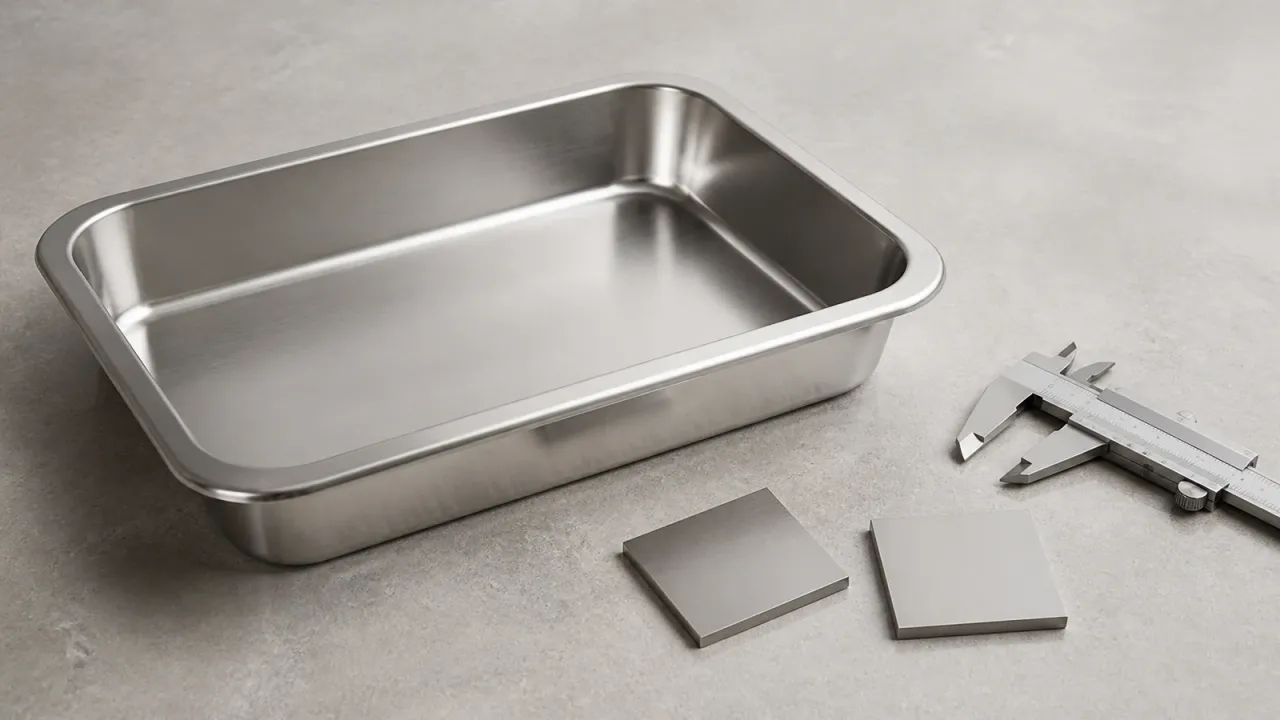
Migration testing and composition testing answer different questions. A composition table identifies the alloy’s ingredients. A migration test measures what leaves a specified surface into a food or simulant under specified time and temperature conditions. A product maker must connect those results to the complete article and its intended use.
How should you evaluate a 201 item before using it?
Start with the exact item’s food-contact surfaces and maker’s instructions, then check the finished condition and environment.
- Identify what actually touches the food. Do not rely on the stainless exterior if the contact surface is a liner, coating, insert, gasket, or another alloy.
- Request the exact grade, product specification, intended-use statement, and food-contact compliance documentation from the maker or supplier.
- Match the item to the food and service conditions, including acidity, salt, temperature, contact time, storage, dishwasher cycles, and cleaning chemicals.
- Inspect seams, welds, edges, and the contact surface for pits, open joints, rough areas, peeling, or corrosion. Follow the maker’s care instructions.
- Treat magnet tests, shine, color, and marketplace wording as poor substitutes for a material certificate or finished-product documentation.
If the maker cannot identify the food-contact surface or provide use limits when those details matter, choose a traceable product with clearer documentation. For commercial, institutional, or regulated work, use the applicable sanitation standard and procurement requirements rather than a household guess.
Is 201 suitable for cookware?
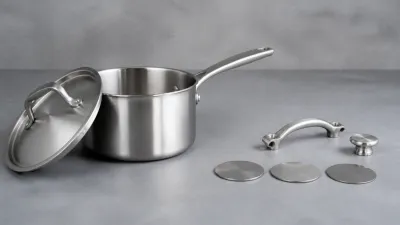
It may be, but cookware safety still turns on the finished pan and its instructions, not only the steel number. A pan can combine a cooking surface with a separate base, fasteners, rivets, handle, lid, coating, or seal. Each part may have a different material and temperature limit.
For cookware labels, our guide to 18/10 versus 18/8 stainless steel cookware explains why a surface-alloy label does not predict the whole pan’s construction or performance. If you are comparing broad grade families, see the 304 versus 430 stainless steel comparison and 304 versus 316 stainless steel guide. Those pages cover different comparison decisions; this article is limited to qualifying a 201 food-contact use.
The broader food-grade stainless steel explanation covers why grade, fabrication, surface finish, components, and intended use must be considered together. A 201 cookware label can be one useful specification, but it is not the complete safety record.
Frequently asked questions
Is 201 stainless steel the same as 304?
No. Standard 201 is a lower-nickel chromium-manganese grade with its own composition range. The two grade names describe different alloy specifications, and neither name alone proves that a finished food-contact article meets every intended-use requirement.
Does 201 stainless steel contain nickel?
Yes. The standard 201/S20100 range includes 3.5%–5.5% nickel, although the exact product should be verified from its material documentation. A product marketed as 201 should not be treated as nickel-free based on the grade number alone.
Can a 201 stainless steel pan be food safe?
It can be suitable when the exact pan is made for food contact, its surfaces and other components are documented, its finish is intact, and it is used within the maker’s limits. If those facts are missing, the correct conclusion is that compliance is unverified, not that every 201 pan is safe or unsafe.
Sources
- ATI, 201 HP Austenitic Stainless Steel, UNS S20100 (retrieved 2026-08-21)
- World Stainless, Austenitic Chromium-Manganese Stainless Steels (retrieved 2026-08-21)
- U.S. Food and Drug Administration, 2022 Food Code (retrieved 2026-08-21)
- U.S. Food and Drug Administration, Guidance for Bulk Transport of Juice Concentrates and Certain Shelf-Stable Juices (retrieved 2026-08-21)
- European Union, Regulation (EC) No 1935/2004 (retrieved 2026-08-21)
- KTH Royal Institute of Technology, Compliance Tests of Stainless Steel as a Food Contact Material (retrieved 2026-08-21)
- World Stainless, Surface Treatment (retrieved 2026-08-21)