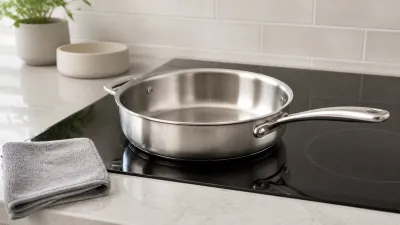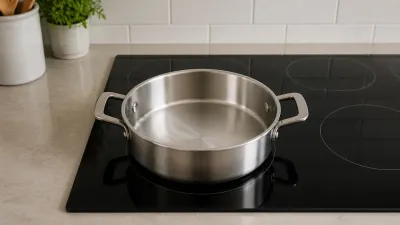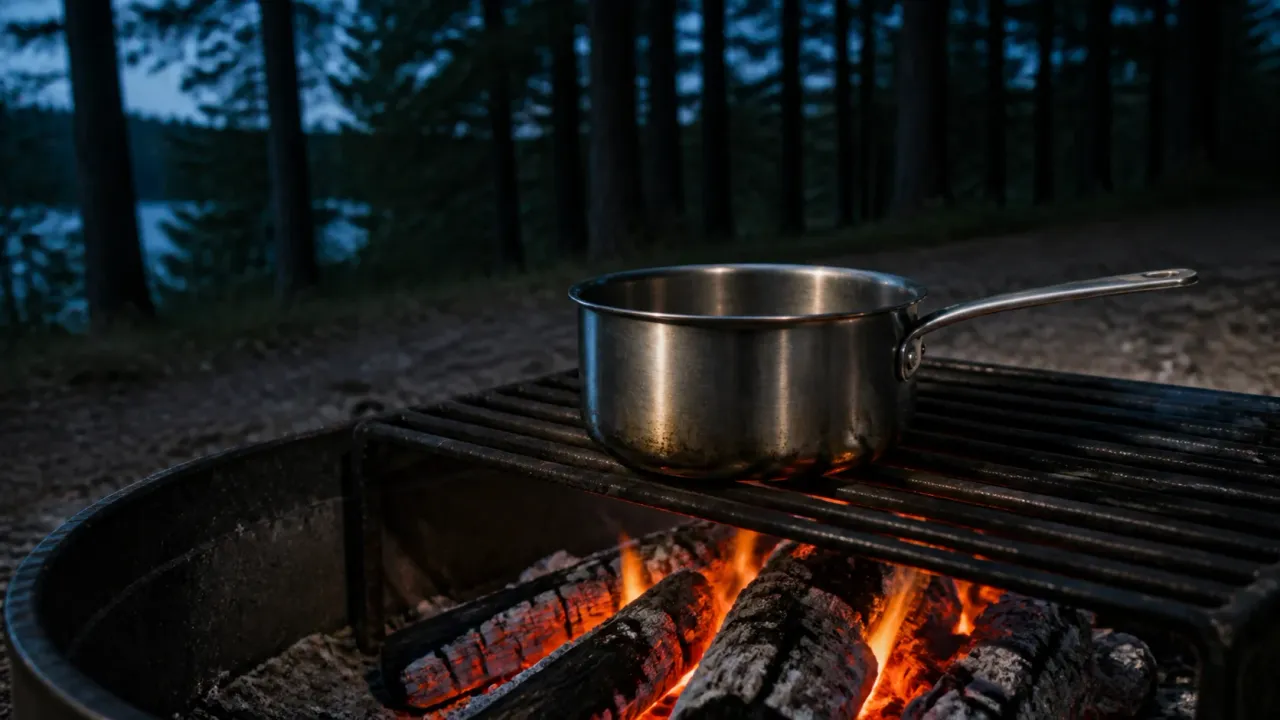
Yes, but only with a suitable piece of stainless steel cookware, a permitted fire, and a stable grate over a small bed of coals. Stainless steel is not an open-flame rating. A pan that is oven-safe can still have a handle, lid, coating, or base that the manufacturer excludes from direct flame.
Read the instructions for the exact model before taking it outside. If they do not mention open-flame or outdoor use, use a purpose-built camp pot or a portable stove instead. This guide covers a wood campfire in an approved fire ring or fire pan, not a kitchen oven or a controlled grill.
What stainless steel cookware can go over a campfire?
Cookware is a reasonable candidate only when the complete assembled piece is cleared for the heat source, not merely because its cooking surface is stainless steel. Look for a bare or otherwise documented food-contact surface, a sound base, and handles and lids whose materials and limits are known.
Before the fire is lit, check these points:
- The manufacturer permits open flame, outdoor cooking, or an equivalent use for that model.
- The pan sits flat and securely on the grate or support you will use.
- No plastic, wood, silicone, detachable grip, or other heat-sensitive part will face the flame.
- The handle attachment, rivets, base, and lid are intact, with no wobble, separation, cracks, or loose hardware.
- The pan is large enough to sit inside the support without tipping when it contains food or water.
A bonded aluminum core does not automatically rule out campfire use. It does mean that the whole construction and the manufacturer’s instructions matter. The same check applies to an inexpensive single-layer pot and a heavy fully clad pan. The material label alone cannot supply an outdoor temperature limit.
Why can a campfire damage a stainless steel pan?
Uneven heating and sudden cooling are the main risks. A campfire moves heat around with flames, glowing coals, wind, and shifting fuel, so the base can see a much sharper temperature difference than it would on a properly sized burner.
Uneven heat can distort the base
A pan can warp when one part of its base gets much hotter than another, when it is heated empty for too long, or when it rests on an unsuitable support. T-fal’s cookware care guidance links high heat or the wrong heat source with a wobbly, distorted base. Keep the fire small, let the wood settle into coals, and center the pan on a firm grate rather than balancing it on burning logs.
Do not let flames climb the sides of the pan or lick a long handle. A flame that reaches the handle or lid is a sign to move the cookware or reduce the fire, not to keep cooking until the food catches up.
Sudden cooling can warp metal
Do not carry a hot pan from the fire and plunge it into a stream, cooler, snow, or cold wash water. All-Clad’s care instructions warn that hot cookware under cold water can warp the base, and T-fal gives the same thermal-shock warning. Set the pan on a stable heat-safe surface and let it cool before washing.
The same rule applies if rain starts or the pan tips into a wet area. A cool-down period protects the pan and gives you time to handle hot metal without rushing.
Heat can overwork handles and coatings
Heat-sensitive components can fail before the stainless body does. T-fal says an overheated detachable handle can break and cause a pan to fall, and that direct flame can deform silicone or crack a glass lid. A loose handle also turns a manageable pot into a burn and spill hazard.
Do not infer a campfire rating from an oven number. An oven surrounds a pan with relatively even heat, while a fire can expose one edge, handle, or lid seal to direct flame. If the maker lists only a stovetop or oven limit, treat open-flame use as unconfirmed.
How should you set up a stainless pan over coals?
Set up the fire first, then put the pan over a small, stable bed of coals inside an approved site. Keep water and a shovel or trowel close, and keep one responsible person watching the fire the whole time.
- Check the local land manager’s rules and current fire restrictions. The National Park Service campfire guidance notes that even a generally permitted campfire may be prohibited during a burn ban or dangerous conditions.
- Use an existing fire ring, an approved fire pan, or another site the land manager allows. Leave plenty of clearance from dry grass, leaves, overhanging branches, and other fuel.
- Keep the fire modest and allow the wood to burn down before cooking. Use a grate or purpose-built support that cannot rock, roll, or tip when the pan is loaded.
- Center the pan over coals, not directly on unstable logs. Keep the handle away from the flame and orient it where people will not brush against it.
- Stay with the fire and make small heat adjustments by moving the grate or pan only with suitable gloves or tools. Never leave a pan or campfire unattended.
The cooking surface may darken with soot. That is expected on a wood fire, but soot can transfer to hands, food containers, and clothing. Keep the lid on only when its material and seal are approved for the heat, and wipe or wash the cooled pan according to its care instructions.
Which pans and parts should stay out of a campfire?
Leave any pan out when you cannot verify the limits of its coating, handle, lid, or structure. The following table gives a conservative stop list.
| Part or condition | Do not use it over a campfire when | Why it matters |
|---|---|---|
| Nonstick or ceramic coating | The exact maker’s instructions do not allow open flame or outdoor use | High heat can damage or discolor a coating, and an oven limit does not establish a direct-flame limit |
| Plastic, wood, silicone, or detachable handle | The part can face flame or its rating is unknown | Heat can deform, loosen, or break the handle and make the pan fall |
| Glass lid or silicone seal | The exact lid is not approved for direct flame | Direct flame can crack glass or deform a silicone edge |
| Loose handle, wobbly base, or separating layers | The pan is already unstable or structurally damaged | A loaded pan can tip, leak, or drop while hot |
| Unknown alloy or mixed construction | You cannot find model-specific use and care instructions | A stainless exterior does not identify every food-contact or heat-sensitive part |
For a coated pan, the default should be no. All-Clad’s current care guide says its stainless cookware with nonstick coating should stay below its stated oven limit, avoid the broiler, and use low or medium heat. T-fal likewise warns that high heat can damage a nonstick coating. Those instructions do not authorize an open fire.
The same caution applies to stainless pans with a colorful exterior, painted markings, an encapsulated base, or a decorative finish. Do not guess which layer is exposed to the flame. Ask the maker for a model-specific answer or choose a plain camp vessel designed for that job.
How should you cool and clean the pan after cooking?
Move the cookware away from the fire with a secure grip, place it on a stable nonflammable surface, and let it cool naturally before cleaning or packing it. Do not set a hot pan on a plastic table, dry vegetation, or a surface that could scorch.
Once it is cool enough to handle, inspect the base and handle. A new wobble, rocking base, separated layer, cracked lid, or loose handle is a reason to stop using the pan until the manufacturer assesses it. Our guide to why stainless steel pans warp explains how to test a cool pan without trying to hammer it flat.
Rinse or wash away ash and food residue with the cleaner and tools the manufacturer allows. T-fal advises against steel wool, steel brushes, and scratchy cleaners on polished stainless surfaces. Do not scrub a hot pan, and do not trade a soot mark for a damaged finish by reaching for an abrasive pad. Our guide to the pros and cons of stainless steel cookware puts visible heat tint and cleanup effort in the larger ownership picture.
How do you leave the campfire safely?
Put out the fire before you pack the cookware, and stay until the coals are cool to the touch. Cooking is finished only when the fire is extinguished, not when the food is off the grate.
The NPS campfire safety sequence is simple:
- Drown the embers, coals, and sticks with water until they are wet.
- Stir the remains, add more water, and stir again.
- Continue until no material is warm to the back of your hand. Never bury hot coals because they can smolder and reignite.
Follow the land manager’s local procedure when it differs. The NPS allows soil or sand when water is unavailable, while Leave No Trace’s campfire guidance recommends water, established fire rings or fire pans, small fires, local firewood, and cool ash cleanup. In backcountry areas, cool ashes may need to be scattered away from camp or packed out, and a mound or pan site may need its soil replaced.
Pack out food scraps, foil, plastic, and other litter. Do not burn packaging to make cleanup easier. If you cannot keep the fire small, keep it attended, or put it completely out, skip the campfire and cook on a portable stove.
When should you choose a camp stove instead?
Choose a camp stove when the cookware maker is silent about open flame, the fire is restricted, the weather is windy or unusually dry, the pan has a coating or heat-sensitive handle, or you need predictable heat. A stove also makes more sense when you are cooking in a place without a stable grate or enough water for a complete extinguishing cycle.
Stainless steel cookware safety guidance covers food-contact and condition questions that still matter outside. It does not turn a kitchen pan into camping equipment. If the exact product cannot pass the fire, support, component, and cool-down checks above, use a purpose-built outdoor pot or a lightweight stove instead.
Frequently asked questions
Can I use a stainless steel frying pan over a campfire?
Only when the manufacturer clears that exact pan for open flame or outdoor use and you can support it securely over coals. A shallow skillet with an exposed handle is easy to tip or overheat, so use a stove or purpose-built camp pan when the instructions are unclear.
Will a campfire warp stainless steel cookware?
It can. Uneven heating, prolonged empty heating, an unstable support, and rapid cooling can all distort a base. Let the pan cool naturally, then test it on a flat surface. Stop using it if it rocks, leaks, or has a loose handle or separating layer.
Can I use nonstick or ceramic-coated cookware on a campfire?
Do not assume that you can. Use a coated pan over a fire only when the exact manufacturer instructions expressly allow open flame or outdoor cooking. An oven-safe temperature, a broiler rating, or a stainless exterior is not enough evidence for direct flame.
Can I use a glass lid or silicone handle over a campfire?
Only with an explicit model-specific open-flame rating. Otherwise leave the lid or heat-sensitive handle at home. Direct flame can deform silicone, crack glass, or damage a detachable handle even when the pan body is stainless steel.
Is campfire soot a sign that stainless steel cookware is unsafe?
Not by itself. Soot usually means the exterior was exposed to wood smoke or flame, but inspect the pan after it cools. A warped base, deep pitting, a damaged coating, a cracked lid, or a loose handle is a reason to stop using it and ask the manufacturer.
Which sources support this guidance?
This is research-based guidance, not a hands-on test of a particular pan, fire, or cooking setup. Fire rules and cookware limits vary by location and model, so the local land manager and the exact product manual take priority.
- National Park Service, Campfire Safety, last updated April 28, 2025, accessed August 21, 2026.
- Leave No Trace Center, Principle 5: Minimize Campfire Impacts, accessed August 21, 2026.
- T-fal, Care & Use, accessed August 21, 2026.
- All-Clad, Use and Care Guide, accessed August 21, 2026.