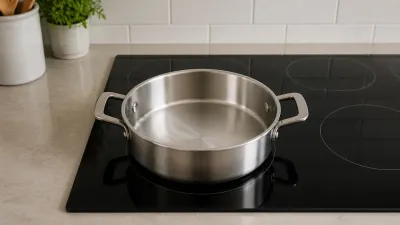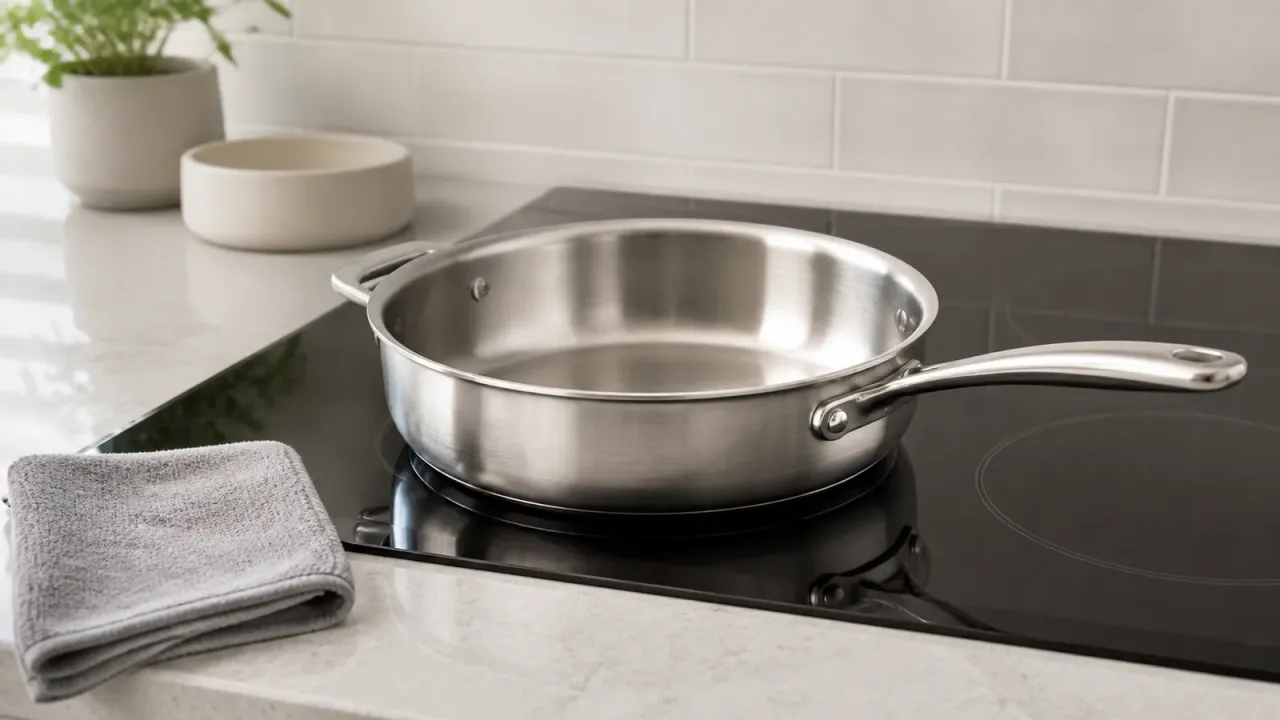
Usually, no. Stainless steel itself is not the deciding factor: a smooth, clean, flat pan base placed gently is the lower-risk setup, while trapped grit, burrs, roughness, sliding, impact, and heat damage can mark or scratch glass-ceramic surfaces. Check your cooktop manual because radiant electric and induction models can have different cookware and cleaning instructions.
This is a safety and care guide, not a test of one pan, cooktop, burner setting, or load. The current guidance from GE Appliances, Whirlpool, and Bosch agrees on the key prevention steps: keep the surface and pan base clean, avoid rough bottoms, and lift cookware instead of sliding it.
Can stainless steel pans scratch glass cooktops?
Yes, a stainless steel pan can scratch a glass-ceramic cooktop when its base is rough or dirty, or when it is dragged across the surface. A pan with an intact smooth base does not become scratch-proof because it is stainless steel, and a cooktop described as scratch-resistant is not necessarily scratch-proof.
GE says its ceramic glass cooktops are scratch-resistant but not scratch-proof. Its guidance says pan bottoms should be smooth and flat, rough cookware should be avoided, and cookware should not be slid across the surface. Whirlpool likewise says to use flat-bottomed cookware, keep the bottoms clean and dry, and avoid sliding cookware or bakeware. These are care rules for the appliance and the exact model, not a universal guarantee for every stainless pan or every glass cooktop.
Stainless steel can also leave a metal mark that looks like a scratch. A mark may be removable residue or transfer, while a groove, pit, crack, or rough edge is a different problem. Do not diagnose the surface by color alone. Clean and inspect it after the cooktop and pan have cooled, following the appliance maker’s cleaner instructions.
What causes scratches or marks under a stainless steel pan?
The usual causes are a rough pan base, trapped particles, dragging, impact, or a heat-related deposit, rather than the word “stainless” on the pan label.
Rough burrs, nicks, and warped bases
A burr is a raised sharp edge or rough spot on the base. Nicks, gouges, ribbing, flaking material, and a warped or dented base can also create hard contact points. GE specifically tells owners to check pan bottoms for nicks, gouges, or rough areas because those imperfections can scratch the cooktop. Whirlpool warns that rounded, warped, ribbed, or dented bottoms can cause problems on ceramic glass surfaces.
Do not run a damaged pan back and forth to “test” it. If a clean, cool base still feels rough or catches on a cloth, set it aside and check the pan maker’s care or replacement guidance.
Salt, sugar, sand, and other grit
Small particles trapped between the pan and glass can act like abrasives when the pan moves. GE names coarse particles such as salt, ground pepper, and rosemary as possible sources of scratches. A current Bosch induction manual also warns about salt, sugar, and grains of sand on a glass-ceramic surface.
Inspect both surfaces before placing the pan down. Wipe away loose grit with a soft, clean cloth rather than moving the pan over it. Keep seasoning, dry food, and cleaning residue off the cooktop, and do not use the cooktop as a work surface or storage shelf.
Sliding, spinning, and dragging
Sliding is a controllable risk, so lift the pan before moving it. Even a smooth stainless base can leave metal transfer or abrasion if it is dragged across grit or a rough patch. Spinning a pan to check whether it is flat creates the same movement you are trying to avoid and can add marks.
Use a flat surface and a gentle visual inspection instead of sliding the cookware on the glass. If you must reposition a heavy pan, support it securely and set it down in the new position rather than pivoting it across the cooktop.
Impact, weight, and the cooktop frame
A pan’s stainless material does not tell you a universal safe load for a glass cooktop. The appliance manual controls cookware size, overhang, placement, and any warnings about heavy items. Whirlpool warns that dropping a heavy or hard object can crack ceramic glass, and Bosch warns against letting hard or pointed objects fall on the surface.
Treat impact as different from ordinary pan weight. Do not drop a pan, set it down hard, place a heavy object on the cooktop for storage, or rest hot cookware on the control panel or frame. If the pan rocks or its base has separated, do not keep using it on glass while you wait for the cookware maker’s answer.
Overheating, melted material, and sugar
High heat does not turn a stainless pan into a safe scratch tool. It can create separate surface damage when sugar, plastic, foil, or a metal residue bonds to the glass. Whirlpool says sugary spills can adhere, pit the surface, and leave permanent marks if they cool. GE says melted plastic or a pitted or indented surface may require replacement and service, and it cautions that an overheated copper-bottom pan can leave permanent discoloration.
Follow the exact cooktop manual for a hot spill. Some makers give specific instructions for a scraper while the surface is warm, with an oven mitt and a specified angle. Do not pour cold water over a hot cooktop, scrape at random angles, polish with a metal tool, or improvise a repair method that your manual does not authorize.
How should you inspect a stainless steel pan before using it?
Inspect the cool, clean pan base and the cool, clean cooktop separately, then place the pan down without sliding it.
- Turn the controls off and let the cooktop and pan cool enough to handle safely. Move the pan by lifting it, not dragging it. If the pan is too heavy or awkward to lift securely, follow the appliance and cookware manuals rather than improvising a move.
- Clean loose food, salt, sand, and cleaner residue from the cooktop with the method approved for that model. Use a soft cloth and the labeled ceramic-glass cleaner or mild method the maker specifies. Do not use steel wool, abrasive powder, metal scouring pads, or harsh chemicals unless the exact manual explicitly allows them.
- Wash the pan base according to the cookware maker’s instructions, then dry it. Look at the base in angled light for a burr, sharp edge, stuck food, flaking coating, exposed core, dent, or separation. A stainless exterior does not prove that a bonded base or any coating is intact.
- Check flatness on a separate known-flat surface. Whirlpool’s ceramic-glass guidance suggests placing a straight edge across the cookware base and rotating the ruler; no visible gap or light should appear between the straight edge and the base. This is a simple screening check, not a manufacturer tolerance measurement.
- Set the pan gently on the correct cooking zone. If the base rocks, catches, leaves a persistent rough track, or has a visible defect, do not use it on the glass until the cookware maker assesses it. Record the model and photograph the pan and cooktop before altering either one.
The guide to why stainless steel pans warp covers a separate cool-pan stability check. A warped base can be a cookware problem even when the glass surface is clean and undamaged.
How should you place and move a pan on a glass cooktop?
Place the pan on a clean cooking zone by lifting it into position, and lift it again whenever you need to move it. Do not slide, spin, or rock the pan across the glass to center it.
Match the pan to the cooking zone and the model manual. GE notes that stainless steel is highly recommended for radiant smooth glass cooktops and that a sandwich-clad bottom can combine stainless steel with an aluminum or copper heat-conducting layer. That recommendation concerns cookware suitability and heat transfer; it does not excuse a rough base or prove that the pan is induction-compatible.
For induction, stainless steel must have a suitable ferromagnetic base for the exact appliance. The magnetic and electrical compatibility question is separate from scratch prevention. The stainless steel and induction cooktop guide explains that a stainless label alone does not identify the magnetic construction.
Keep handles and nearby objects from creating a collision path. Do not use the cooktop as a landing area for lids, jars, utensils, or appliances. If a hot lid is set on the glass, trapped air as it cools can create a break risk on some models, according to Whirlpool. Follow your manual for where hot cookware and lids may rest.
How can you tell a metal mark from a scratch?
Treat a gray or silver streak as uncertain until approved cleaning shows whether it is surface transfer, residue, or a scratch. Do not scrape aggressively just because a mark looks metallic.
GE says some marks that look like scratches can be removed by cleaning, while its cookware guidance notes that copper or aluminum residue can appear as scratches. Bosch also lists pan abrasion and metal marks as a separate type of glass-ceramic damage. Those examples show why appearance alone is not enough to identify a groove.
After the surface is cool, follow the exact cooktop maker’s cleaning sequence. A safe general boundary is to use an approved ceramic-glass cleaner and a soft cloth, then dry and inspect in angled light. If the maker’s manual authorizes a cooktop scraper for the residue, follow its specified blade, angle, and temperature instructions. If it does not, do not substitute a razor blade, abrasive pad, metal sponge, sandpaper, polishing compound, or power tool.
If the line changes or disappears with approved cleaning, it may have been residue or metal transfer. If a groove remains, catches light as a physical edge, or is accompanied by a pit or crack, treat it as surface damage and contact the appliance maker. Do not promise that home polishing can remove a true scratch. Bosch says scratches on its electric and induction cooktops cannot be fixed, and GE says deep scratches are not removable.
When should you stop using a pan or cooktop?
Stop using the cooktop and arrange service when the glass is cracked or pitted, and stop using a pan on that surface when its base is rough, unstable, separated, or otherwise damaged.
GE’s current cracked-glass guidance says a cracked or pitted ceramic glass cooktop needs service and recommends not using the cooktop until it is repaired. Bosch’s current support guidance directs owners with a cracked electric or induction cooktop to an authorized servicer, and model manuals may instruct you to switch the appliance off at the breaker because a broken surface can create an electric-shock risk.
Stop and seek model-specific advice when:
- a crack, chip, deep pit, or sharp glass edge is visible;
- a line remains after approved cleaning and you cannot tell whether it is a scratch or a fracture;
- the cooktop has pitting or a melted substance bonded to the surface;
- the pan base has a burr, gouge, exposed core, separated layer, loose disk, or sharp edge;
- the pan rocks, spins, or fails the maker’s flatness check;
- the pan or cooktop has been struck, dropped, or overheated beyond its instructions.
Do not use a cracked cooktop while waiting for a cleaner, a polish, a replacement pan, or a service appointment. Do not hammer, sand, grind, flatten, or re-bond a damaged pan base at home. Those changes can hide the original defect and create a new instability or sharp edge.
Does induction change the scratch risk?
Induction changes how the pan is heated, but it does not make the glass surface immune to rough bases, grit, sliding, impact, or heat-related damage.
Whirlpool’s ceramic-glass maintenance guidance is written for induction cooktops and still says not to slide cookware, to use flat-bottomed cookware, and to keep pan bottoms clean and dry. Bosch gives similar rough-base, salt, sugar, and sand warnings for glass-ceramic induction surfaces. A pan that works magnetically can still be a poor choice if its base is rough, warped, dirty, or damaged.
Do not transfer an induction rule to a radiant model or a radiant rule to an induction model without checking the manual. Use the cooktop manufacturer’s model instructions for cookware size, zone placement, cleaning products, hot-lid handling, and service. The stainless steel cookware guide for glass-top stoves covers the broader compatibility question; this page is about preventing pan-base and surface damage.
Frequently asked questions
Can I slide a stainless steel pan a little to center it?
Lift it instead. Even a small slide can move grit under the base or transfer metal to the glass, and the major appliance makers advise against sliding cookware across ceramic glass.
Are black or silver streaks always scratches?
No. They may be residue or metal transfer, but a color change does not rule out a physical scratch. Let the surface cool, use only the exact maker-approved cleaning method, and reassess the clean dry glass in angled light.
Can a warped stainless steel pan scratch a glass cooktop?
A warped, rocking, dented, or rough base should not be used on the glass until the cookware maker assesses it. The pan may have poor contact or hard points, and testing it by spinning or dragging it can add damage.
Is stainless steel safe for every glass cooktop?
No. Stainless steel may be recommended for some radiant cooktops, while induction requires a suitable magnetic base. Exact size, base flatness, overhang, cleaning, and heat rules come from the cooktop and cookware manuals.
Can I polish a scratch out of the glass?
Do not polish, sand, or scrape a suspected scratch unless the exact appliance maker gives a specific approved method for that condition. Cleaning may remove transfer or residue, but a true scratch or crack may remain and can require service.
Which maker guidance supports this advice?
The prevention and stop-use boundaries here come from current manufacturer support and manual guidance reviewed on August 22, 2026. The pages are model and brand specific, so use your own cooktop manual when it differs.
- GE Appliances, Scratches on Glass Cooktop covers rough and flat pan bottoms, trapped coarse particles, no sliding, and marks that may be removable by cleaning.
- GE Appliances, Cookware Used on a Radiant Smooth Glass Cooktop discusses stainless steel, flat bottoms, residue, burrs, cast iron, and heat-related discoloration.
- GE Appliances, Glass Cooktop Cracked sets a service and no-use boundary for cracked or pitted surfaces.
- Whirlpool, Maintenance of Ceramic Glass covers lifting instead of sliding, flatness, clean and dry pan bottoms, grit, impact, hot lids, and sugar spills.
- Bosch, Scratches on an Induction or Electric Cooktop distinguishes scratches from removable cleaning work and warns against rough bases and metal sponges.
These sources do not establish one universal weight limit, scratch threshold, cleaner, repair method, or cookware rule for every glass cooktop. The exact appliance manual and cookware instructions control.