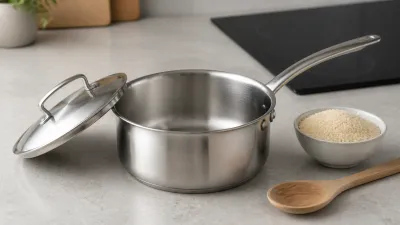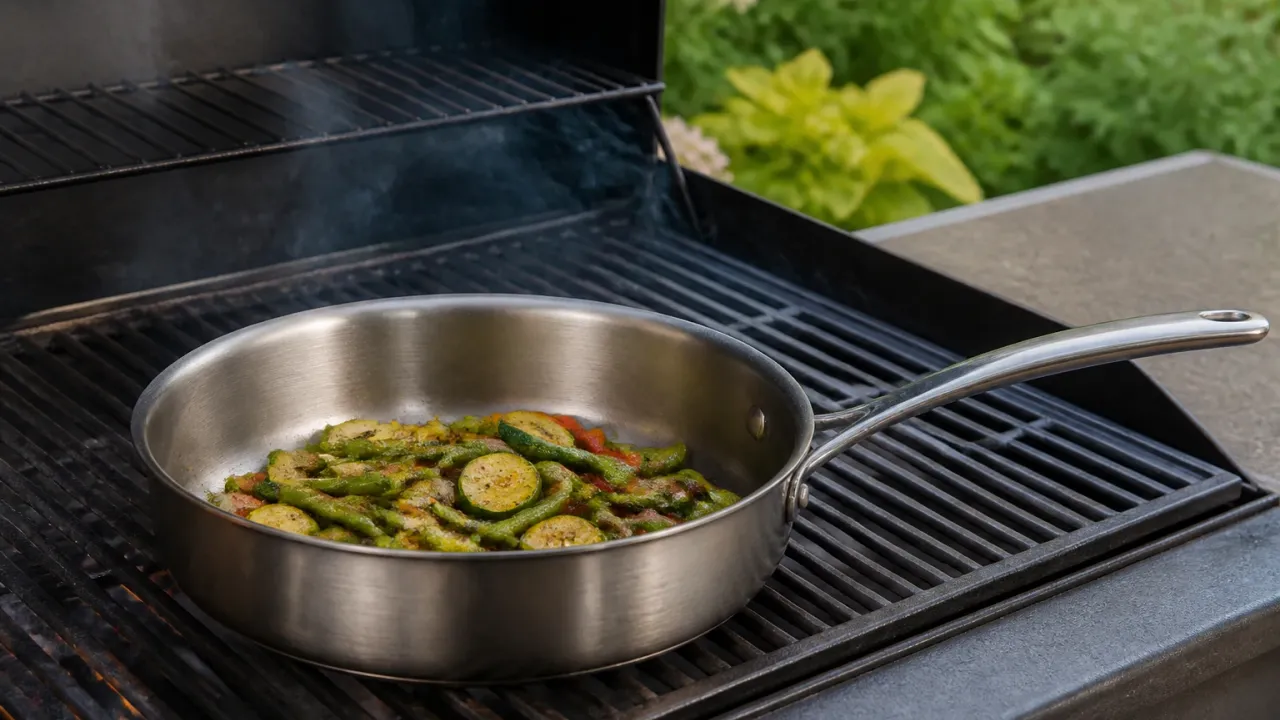
Yes, you can use stainless steel cookware on a grill, but the complete pan has to be heat-rated and stable on the grate. Start with indirect heat, keep the handle away from the hottest zone, and follow the exact cookware and grill instructions. Weber’s stainless steel Deluxe Grilling Pan is made for specified gas and charcoal grills, which shows why fit and hardware matter as much as the steel itself.
This advice assumes a manufactured gas, charcoal, or pellet grill with a stable grate. It does not cover setting a pan in a campfire or directly on loose coals.
What makes grill use different from oven use?
A grill adds open flame, hot grates, grease flare-ups, smoke, wind, and uneven heat zones that an oven does not. A pan that is oven-safe or broiler-safe is not automatically approved for a grill. The All-Clad use-and-care guide lists its stainless cookware as oven and broiler safe up to 600°F, but that is a collection-specific oven limit. Its customer-service guidance warns that handles become hot during extended cooking and recommends mitts. Neither page establishes outdoor-grill approval for a household pan.
Use an oven rating as one piece of information about the assembled cookware. It does not answer whether the exact pan can sit over a burner or coals, whether the handle can clear the lid, or whether the grill supports its weight. The grill manufacturer’s instructions control the appliance, and the cookware manufacturer’s instructions control the pan.
Which stainless cookware is suitable for a grill?
A good candidate is a bare stainless pan with a stable flat base and no part whose heat limit is unknown. The maker’s instructions still have to approve the complete piece.
- Check the body, handle, lid, knob, coating, and any removable grip as separate parts of the assembly.
- Prefer a metal handle, but treat it as hot. Stainless steel conducts heat, and a handle that feels cool on the stovetop can heat up beside a grill flame.
- Treat a stainless exterior as irrelevant if the interior has a nonstick coating. Health Canada’s cookware guidance warns against high heat with nonstick cookware, so follow the exact coating and cookware limits rather than assuming a stainless exterior makes it grill-safe.
- Confirm that the pan sits flat on the grate without rocking, tipping, snagging the lid, or touching a burner or loose coal.
- Reject a pan with a loose handle, cracked lid, separated layers, a leaking seam, or a base that rocks.
The word “stainless” describes a material, not a universal grill rating. Two pans from the same brand can have different handles, coatings, lids, and temperature limits.
Should you use direct or indirect grill heat?
Indirect heat is the better default for stainless cookware because it gives the pan a steadier environment and leaves more room to respond to smoke or a flare-up. Put the pan over the cooler side of the grill, close the lid if the pan and grill allow it, and let the hot air do most of the work.
Direct heat can work for a short, controlled cook when the exact cookware instructions permit it and the pan remains on a stable grate. Keep the pan above the grate, not in the flame or on loose charcoal. A visible flame licking up the sides is a reason to move the pan to the indirect zone or lower the heat.
Use a purpose-built grill pan when possible. Its handles, footprint, and grate fit are designed for that appliance. A household saucepan or skillet may still work, but it has to pass the same checks before it goes outside.
For loose vegetables or smaller pieces that need a contained surface, compare stainless steel grill baskets by opening size, footprint, and closed-lid clearance.
| Grill setup | Practical choice | Main concern |
|---|---|---|
| Pan on a stable grate over indirect heat | Best starting point | Heat still builds in the handle and lid |
| Pan on a stable grate over one gas burner or a coal zone | Use only with exact maker approval | Hot spots and flare-ups |
| Pan over visible flames or loose coals | Avoid | Unstable support and concentrated heat |
| Pan with plastic, wood, or unknown silicone parts | Avoid unless the exact rating permits it | The lowest-rated component can fail first |
| Glass lid with no grill or temperature rating | Leave it off | Thermal shock and a lower heat limit |
How do you use stainless cookware on a grill safely?
Set up the grill and the heat zones before the pan goes on. The steps below keep the pan stable and make a flare-up easier to spot.
- Inspect the grill, grate, fuel lines, and drip area. The U.S. Consumer Product Safety Commission’s grill guidance says to use grills outdoors, inspect gas hoses, keep the grill away from combustible surfaces, and never leave a hot grill unattended.
- Clean grease from the grate and drip area. The U.S. Fire Administration’s grilling flyer warns that leftover grease can start a fire, so do not put a dirty pan over a dirty grill and assume the pan will contain the problem.
- Preheat the grill with the pan off it, then establish an indirect zone. Avoid heating an empty household pan at the grill’s maximum setting. All-Clad’s stainless cookware guidance reserves high heat for boiling and warns that an empty pan left on heat can be damaged. That is general cookware-care guidance, not outdoor-grill approval.
- Put the pan flat on the grate and add food before the pan sits empty for a long time. Keep the pan’s rim below the lid only if the lid can close without touching the handle or cookware.
- Stay beside the grill. Use long-handled tools and dry grill mitts, and keep sleeves, towels, and packaging away from the hot surface. The USFA burn-prevention guidance recommends dry mitts and long-handled barbecue tools for outdoor cooking.
- Move the pan to a heat-safe surface before removing the food. Let it cool before washing. Do not put a hot pan under cold water, because sudden cooling can warp the base.
If oil or fat starts to smoke, move the pan away from the hottest zone if you can do so without reaching through flames. If a fire grows, keep people back and follow the grill’s emergency instructions. Never pour water onto burning grease, and do not carry a burning pan.
What should you do with the handle and lid?
Treat the handle and lid as hot, separate pieces of cookware that need their own ratings. The All-Clad cookware FAQ warns that its handles become hot during extended cooking and recommends oven gloves or mitts. That handling warning does not approve outdoor-grill use.
Metal handles are usually the simplest choice, but they still need a mitt. Plastic, wood, silicone, and removable grips need model-specific limits. Remove a grip only when its instructions say to remove it; otherwise, the handle assembly may not be safe or stable.
Lids need the same care. A lid can sit closer to the grill’s hot air and flames than the pan base. In one All-Clad collection, stainless lids are rated to 600°F for the oven while glass lids are rated to 350°F. Those oven figures are examples, not universal grill permission. For outdoor use, the exact manufacturer must approve the lid; if you cannot find a suitable rating, leave it off.
Can grill heat warp or discolor stainless cookware?
Yes, severe heat or rapid cooling can discolor or warp stainless cookware, although a heat tint by itself is usually a cosmetic change. In its oven and cookware-care guidance, the All-Clad care guide says extended exposure above 500°F can change the color of stainless without affecting performance and warns against putting a hot pan under cold water. Those are care and oven observations, not a grill rating.
Let the pan cool naturally, then check the base on a flat surface. Stop using it if it rocks, leaks, has a loose handle, shows separated bonded layers, or has a cracked lid. Our guide to why stainless steel pans warp explains how to separate a cosmetic mark from structural damage.
Grill soot and cooked-on grease also need their own cleanup plan. Do not scrape a hot pan over the grate or shock it with a hose. Cool it first, then follow the cookware maker’s cleaning instructions.
Frequently asked questions
Can any stainless steel pan go on a grill?
No. Stainless steel alone does not establish a grill rating. Check the assembled pan, handle, lid, coating, base, and the grill’s support before use. If the instructions are missing, choose cookware sold for grilling or leave the pan indoors.
Can you use stainless steel cookware on a gas grill?
Yes, when the exact pan is approved for the heat and sits securely on the grate. Gas flames can heat the sidewalls and handle directly, so indirect heat and a dry grill mitt are the sensible starting points.
Can you put a stainless steel pan directly on grill grates?
Yes, a pan can sit on grill grates when it fits flat, cannot tip, and the cookware maker permits the use. Do not set it in the firebox, on loose coals, or where flames can climb around the handle.
Can you use a glass lid on a grill?
Only when the exact lid has a suitable heat rating and the cookware maker permits that use. A glass lid can have a lower limit than the pan, and rapid temperature changes add a breakage risk. With no model-specific rating, leave it off.
Sources and access dates
- Weber Deluxe Grilling Pan, stainless steel grill pan specifications, accessed August 21, 2026.
- All-Clad Use and Care, stainless cookware heat and cooling guidance, not outdoor-grill approval, accessed August 21, 2026.
- All-Clad Customer Service, handle, lid, and oven/broiler collection-limit guidance, not outdoor-grill approval, accessed August 21, 2026.
- Health Canada cookware guidance, manufacturer-intended-use and high-heat nonstick guidance, accessed August 21, 2026.
- U.S. Consumer Product Safety Commission grill safety, outdoor grill, inspection, cleaning, and supervision guidance, accessed August 21, 2026.
- U.S. Fire Administration grilling fire safety, grease and outdoor fire-safety guidance, accessed August 21, 2026.
- U.S. Fire Administration burn prevention, dry mitt and long-handled-tool guidance, accessed August 21, 2026.
The related pros and cons of stainless steel cookware guide explains why construction and heat control matter beyond the grill. For a pan-specific discussion of heat control and limits, see stainless steel frying pans for home cooks and using stainless steel cookware in the oven.