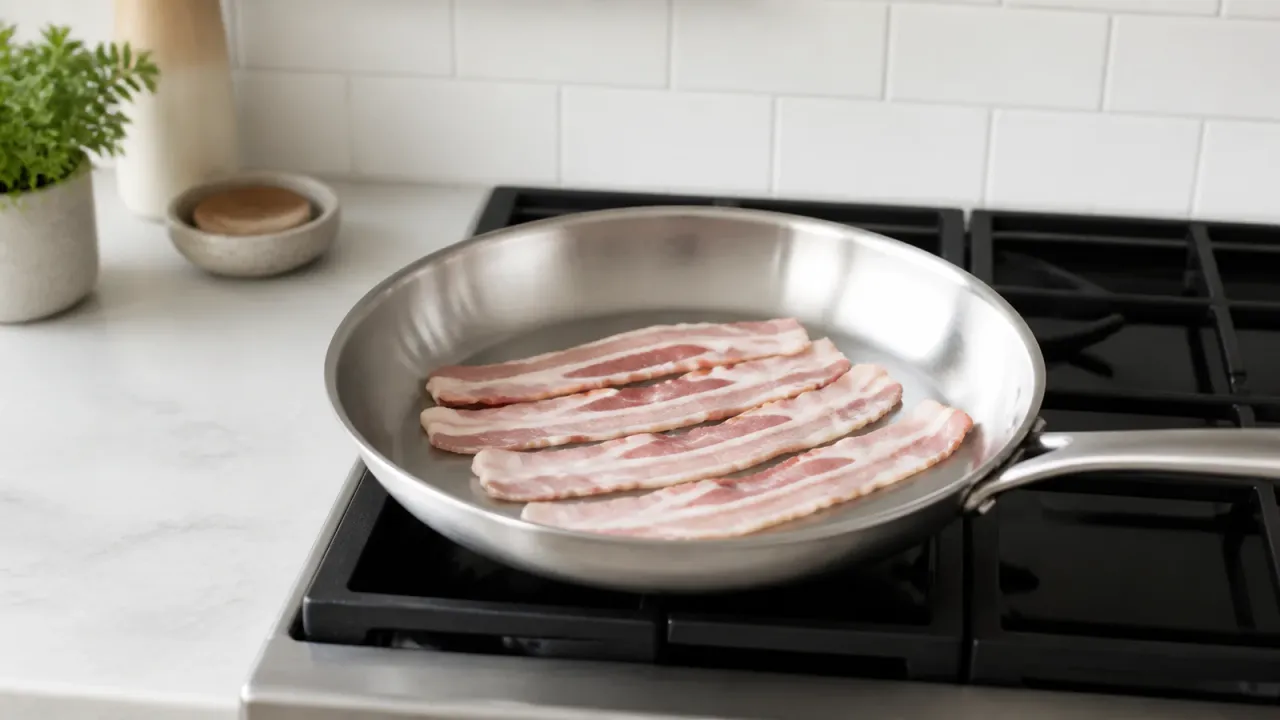
To cook bacon in a stainless steel pan, a cold start is a useful default for ordinary strips: put the bacon in a clean, cool pan, heat it gradually, and adjust the burner as the fat renders. A gently preheated pan can also work, but it gives you less room for error because the bacon begins sizzling as soon as it lands. In either method, the pan material does not make raw bacon safe by itself. Follow the package directions, cook raw bacon completely, and do not use browning or crispness alone as proof of safe doneness.
The practical goal is to let the fat render without scorching the lean portions or crowding the pan. Heat, thickness, cure, quantity, and the pan’s construction all change the result, so a burner number or universal cooking time would be misleading.
What is the safest default way to cook bacon in stainless steel?
For standard strips of raw pork bacon, use a clean stainless steel skillet, arrange the bacon in a single layer, and begin with the pan cool. Bring the pan up gradually over controlled heat, turning the strips as their shape and browning require. Move the finished bacon to a lined plate or rack, then handle the hot fat only after the pan has cooled enough for the transfer you plan to make.
This is a technique recommendation, not a government-approved bacon schedule. The USDA’s bacon and food-safety guidance says pork bacon without another descriptor is raw and must be cooked before eating. It also notes that skillet time varies with the bacon’s thickness, the heat, and how crisp you want it. Treat those variables as reasons to watch the pan, not as permission to rely on appearance alone.
How should you prepare the bacon and pan?
Start by reading the package. “Pork bacon” without a ready-to-eat instruction is raw; cured does not necessarily mean cooked. Uncured or “no nitrates or nitrites added” bacon can still be raw. Canadian bacon, turkey bacon, plant-based strips, and precooked bacon can have different handling and cooking instructions, so do not transfer one product’s routine to another.
Keep raw bacon refrigerated at 40°F or below until you are ready to cook. USDA guidance says to use refrigerated bacon within seven days or freeze it at 0°F. Thaw it in the refrigerator, cold water, or a microwave rather than on the counter. Bacon thawed in cold water or a microwave should be cooked immediately; USDA also says bacon can be cooked from frozen, although frozen slices are harder to separate and arrange evenly.
Do not rinse raw bacon. The USDA washing-food guidance says washing meat does not make it safer and can spread bacteria around the sink and nearby surfaces. Patting bacon dry is not required for ordinary strips, and handling it more than necessary can spread raw juices. Wash your hands and clean any surface that contacted the raw product.
Use a clean, stable stainless steel skillet that gives the slices room to lie mostly flat. Bacon does not usually need added oil because it supplies its own cooking fat. Very lean products may behave differently, but adding a large amount of oil works against the point of rendering and increases the amount of hot fat to manage. Do not begin with a pan that has burnt-on oil or loose carbon. If residue is already present, clean it before cooking; the residue can make sticking and scorching harder to interpret.
Why is a cold start useful for bacon?
A cold start gives the fat time to soften and render as the steel warms. That gradual transition can reduce the abrupt sticking and aggressive sizzle that happen when cold slices hit a very hot, dry surface. It is especially convenient when the strips overlap slightly at first and need to be separated as they relax, although a truly single layer is still the target.
Place the bacon in the cool pan before turning on the burner. Use low or moderate heat as a starting technique, then adjust from what you see and hear. The fat should become liquid and the pan should sizzle steadily, not smoke continuously. If lean areas darken quickly while the fat is still mostly solid, the pan is heating too aggressively. Lift it from the burner briefly or reduce the heat, taking care not to splash the fat.
The words “low” and “moderate” are intentionally approximate. Burner outputs, pan thickness, strip thickness, and the quantity of bacon are not standardized. A setting that works for one cooktop may scorch another pan. The stainless steel sticking guide explains the broader relationship between preheating, fat, moisture, crowding, and release without turning those cues into a fixed bacon timer.
How should you manage rendering, turning, and crowding?
Watch the fat and the texture rather than a stopwatch. As rendering proceeds, liquid fat collects in the pan, the lean bands become firmer, and the edges begin to brown. Those are useful technique cues. They are not a food-safety measurement, and they do not prove that every part of a thick or folded strip has reached a safe state.
Turn the strips when the underside has enough structure to move without tearing, or when one side is browning much faster than the other. There is no universal turning interval. Use tongs or a thin spatula, keep the movement controlled, and avoid repeatedly lifting a slice that is still firmly attached. A little resistance can mean the surface has not finished browning; excessive heat can also weld residue to the pan, so lower the heat before scraping.
Cook in batches if the slices fill the pan. Crowding traps moisture, slows rendering, and makes it harder to distinguish liquid fat from water released during cooking. It also makes turning awkward and raises the chance that one strip will be undercooked while another burns. Keep the first batch warm on a lined plate or rack while the remaining bacon cooks, but do not leave raw or partly cooked bacon at room temperature while waiting.
If you start with frozen bacon, separate pieces as soon as they loosen and keep the pan orderly. A frozen clump can steam in its center while its outside edges brown. Follow the package directions and cook it completely rather than treating the outside color as a doneness test.
Can you use a preheated pan instead?
Yes, but a gently preheated stainless steel pan is less forgiving. It can be useful when the slices are dry, separated, and you want immediate contact with a warm surface. Heat the clean pan gradually, add the bacon before the surface or fat begins smoking, and be prepared for faster sizzling, sticking, and splatter than with a cold start.
Do not preheat an empty skillet to an extreme temperature and then add bacon. Stainless steel can tolerate high heat better than many coatings, but the bacon fat and the food itself can scorch, and a very hot pan produces more hazardous splatter. If the pan smokes, move it off the burner and let it cool before continuing. Never leave the cooking pan unattended.
The cold-start and warm-pan approaches are not competing safety certifications. The cold start is the easier default for gradual rendering; a warm start is a technique choice that calls for closer heat control. Your exact pan maker’s care guidance still controls, especially if the pan has a bonded base, a coating, a non-steel handle, or a lid with separate heat limits.
How do you know bacon is cooked safely?
Cook raw bacon completely before removing it from the heat. The USDA notes that measuring the temperature of thin bacon is difficult and that cured bacon can remain pink because of curing agents. That means color is not a reliable standalone test in either direction: pink does not automatically mean raw, and brown or crisp edges do not automatically prove safe handling.
Use the package instructions and the product’s physical condition as your guide, while recognizing that crispness is a texture preference rather than a validated temperature. The general USDA safe-temperature chart lists temperatures for categories such as pork chops and roasts; it is not a universal bacon temperature to insert into a thin strip. Do not invent a bacon number or judge doneness from appearance alone.
Do not partially cook bacon, refrigerate it, and plan to finish it later. USDA’s bacon guidance says to cook it completely before removing it from the heat. Refrigerate leftovers promptly in a shallow container and use them within the current food-safety guidance. FoodSafety.gov’s storage chart lists bacon for one week in a refrigerator at 40°F or below and one month in the freezer as a quality guideline; follow any shorter package instruction.
What should you do with splatter and hot bacon fat?
Keep your face and hands away from the pan and lower the heat if the fat is spattering aggressively. A splatter screen may reduce droplets if its size, handle, and use are compatible with the exact pan and cooktop. A lid can trap steam and change the texture, so use one only when the recipe and maker directions support it. Do not seal a pan while trying to force a crisping step, and do not carry a pan of uncovered hot fat across a crowded kitchen.
When the bacon is done, use tongs to transfer it. Turn off the burner and let the pan and fat cool enough for a controlled transfer. If you save the fat, pour or strain it into a heat-safe container according to your own food-storage practice. If you discard it, use a container or absorbent solid waste method that follows local guidance. Never pour bacon grease down the sink, and never add water to hot fat. Both can create plumbing or burn hazards.
Do not try to wipe a hot pan with a wet towel. Keep the pan on a stable, heat-resistant surface while it cools, and keep children and pets away from it. If a grease fire starts, do not move the pan or use water. Turn off the heat only if you can do so without reaching through the fire, and follow local emergency guidance.
How do you cool and clean the stainless steel pan?
Let the pan cool before adding water. A sudden temperature change can warp cookware, and water hitting hot bacon fat can splatter. Once the pan is cool enough to handle, remove loose fat with a paper towel or scraper that the maker permits, then wash with warm water, dish soap, and a non-scratch sponge. Dry the pan fully before storing it.
If a thin film remains, a warm soapy soak is usually a gentler first step than aggressive scraping. Do not use steel wool, harsh chlorine products, or a chemical mixture that the maker does not permit. Follow the exact cookware instructions if the handle, rivets, finish, or dishwasher rating differs from ordinary bare stainless steel.
For dark, baked-on bacon residue, use the separate guide on how to clean a burnt stainless steel pan. For a sticky layer of polymerized oil, see how to remove burnt oil from stainless steel. Those are cleanup problems, not reasons to heat an empty pan until residue burns away.
What changes for uncured, precooked, or non-pork bacon?
“Uncured” describes a labeling and curing distinction, not a promise that the product is ready to eat. Treat uncured pork bacon as raw unless the package says otherwise. Precooked bacon may only need reheating, but its package can specify a microwave, oven, or skillet method and a required storage window. Turkey, beef, plant-based, and Canadian bacon differ in fat, moisture, thickness, and handling, so use their exact instructions rather than assuming the rendering cues for pork strips apply.
If the product is shelf-stable until opened, follow that label. If it is refrigerated, keep it cold. If a package says ready to eat, do not turn that into a raw-meat cooking schedule. When a label is unclear, contact the manufacturer or choose a product with clear preparation instructions instead of guessing.
Frequently asked questions
Should you add oil to a stainless steel pan for bacon?
Usually not for ordinary pork bacon, because it renders fat as it heats. Very lean products may need a different approach. Adding oil is not a way to correct excessive heat or crowding, and it creates more hot fat to handle.
Should you rinse bacon before cooking it?
No. USDA advises against washing raw meat because rinsing does not make it safer and can spread bacteria. Keep the bacon cold, handle it briefly, and clean surfaces that contacted raw juices.
Can you cook bacon from frozen?
USDA says bacon can be cooked from frozen, but separating frozen slices is difficult. Arrange pieces as they loosen, avoid a dense clump, and cook completely according to the package directions.
Can you partially cook bacon ahead?
Do not partially cook bacon and refrigerate it to finish later. Cook it completely first, then refrigerate the cooked bacon promptly and follow current storage guidance.
Why does bacon stick to stainless steel?
Cold protein, moisture, a crowded pan, and trying to turn the bacon before it has formed a browned surface can all contribute. A gradual cold start, enough open space, and controlled heat can make release easier, but no stainless technique guarantees zero sticking.
Is a stainless steel pan better than another pan for bacon?
Not universally. Stainless steel works when you want an uncoated surface and can manage rendering and cleanup. A different pan may be more convenient for your recipe, but the product’s instructions and the bacon’s handling directions still control. For a broader look at the pan itself, see this stainless steel frying-pan guide.
Cooking bacon well in stainless steel is mostly a heat-and-space exercise: begin gradually, give the strips room, adjust from the rendering cues, and separate cooking texture from food-safety evidence. Finish the raw product completely, handle hot fat cautiously, and let the pan cool before cleaning.