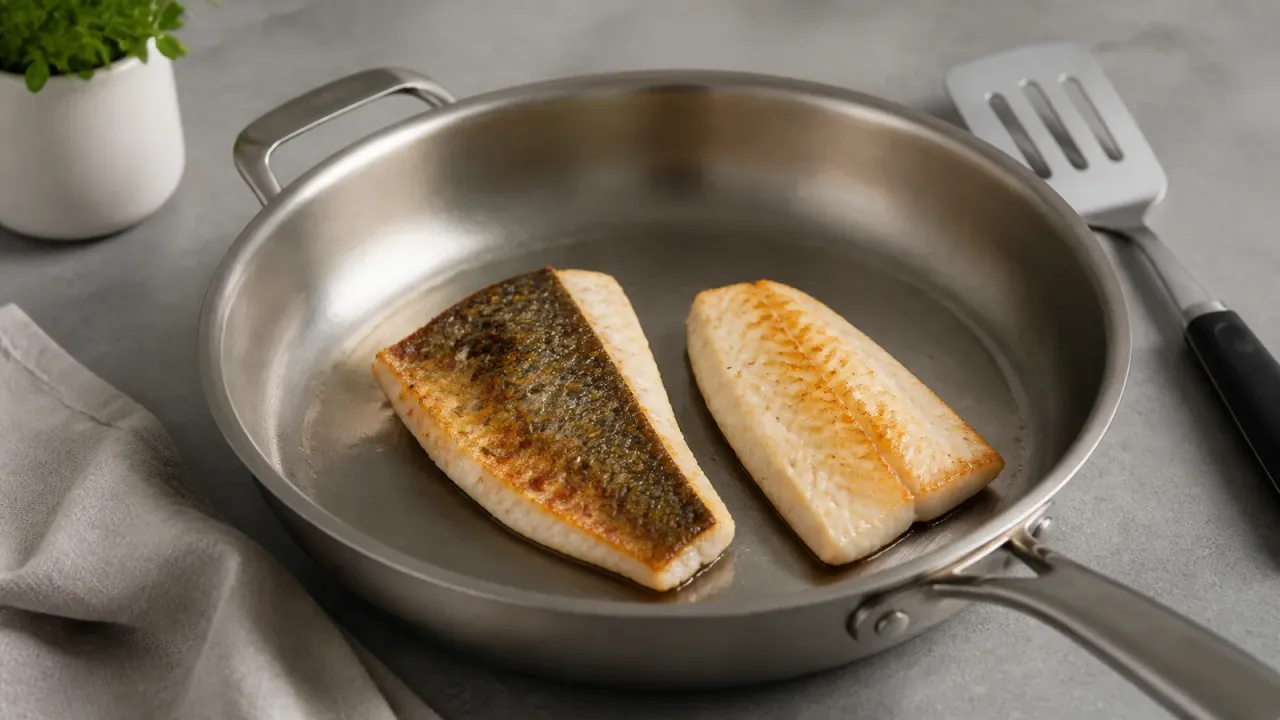
To cook fish in a stainless steel pan without sticking, dry the fillet, warm a clean pan over moderate heat, add enough oil to make a thin film, place the fish gently, and wait for natural release before turning. Use a food thermometer and cook finfish to 145°F for the safety decision; a browned surface alone is not a safe endpoint.
This method does not use a universal burner setting or timer. Fish species, skin, thickness, starting temperature, pan construction, and burner behavior all change the result. The goal is controlled heat and patient release, followed by a measured doneness check and careful raw-fish cleanup.
For the broader version of the sticking method, read how to keep stainless steel pans from sticking. How to know when a stainless steel pan is ready explains why a water-bead test is optional rather than a universal target. If you are still choosing a pan, see stainless steel frying pans as a reliable choice for home cooks.
What is the safest short method for cooking fish in stainless steel?
The safest short method is to keep the fish chilled until preparation, pat it dry, preheat a clean pan gradually, add a thin film of oil, cook without forcing the first release, turn with a broad thin spatula, and verify 145°F in the thickest part before removing it from the heat.
- Keep the fish refrigerated until you are ready to prepare it. Set out a clean plate, cutting board, spatula, thermometer, and paper towels so the raw fish does not sit out while you search for tools.
- Pat the fish dry on all sides, especially the skin if it has one. Discard the used towels and wash your hands after handling the raw fish.
- Start with a clean, dry stainless steel pan. Warm it over low to moderate heat according to the pan maker’s instructions; do not chase a single temperature or minute count.
- Add enough cooking oil to cover the cooking area in a thin, continuous film. The oil should move easily and shimmer without smoking.
- Lower the fish into the pan gently, using the skin side first when that is the recipe’s intended browning surface. Leave it in place until the contact side has formed enough crust to release with a gentle lift.
- Turn with a broad, thin spatula only when the fish releases without force. Cook the second side with the heat adjusted to the fillet’s thickness and the pan’s behavior.
- Measure the thickest portion or center of the fish with a clean food thermometer. USDA’s safe minimum temperature chart lists 145°F for fish and shellfish.
- Move cooked fish to a clean serving plate, then wash the raw-fish tools, board, counter, and thermometer probe before using them for ready-to-eat food.
How should you prepare the fish before it touches the pan?
Prepare the fish by keeping it cold until cooking, patting its surface dry, and checking for bones or loose scales without rinsing raw fish around the sink. Surface moisture cools the pan and can make oil spit; it does not make a fillet safer to eat.
Use a clean plate for the raw fillets and a separate clean plate for cooked fish. Do not return cooked fish to the plate that held it raw. If you season the fish, do so just before cooking so salt and seasonings do not draw moisture onto the surface while the pan waits.
Do not leave a fillet on the counter simply to make it “room temperature.” That phrase is not a safety standard, and it is unnecessary for this technique. The FDA’s seafood safety guidance says to keep seafood properly chilled and gives specific steps for preventing raw seafood from spreading bacteria to ready-to-eat food.
How does skin-on fish differ from skinless fish?
Skin-on fish needs especially dry skin and stable contact, while skinless fish needs a gentle turner and a cautious release check because its exposed flesh can tear more easily.
How should you cook skin-on fish?
Dry the skin thoroughly, add the fish skin-side down when crisping the skin is the goal, and keep the fillet flat long enough for the skin to firm against the pan. A broad spatula can hold down a curling edge briefly, but do not press hard enough to squeeze the fillet or force it against the metal.
The skin may cling at first. That is a cue to wait, not to scrape aggressively. If the skin darkens rapidly while the center remains raw, reduce the heat and continue more gently. There is no universal skin-crisping time because skin thickness, fillet thickness, pan mass, and burner output differ.
How should you cook skinless fish?
Dry the flesh, use a thin continuous oil film, and place the fish on the pan with enough room to turn it. Wait until the underside has developed a browned surface before testing with a thin spatula. Slide under the fillet from the side and turn it in one controlled motion rather than repeatedly lifting it.
Skinless fish can release well in stainless steel, but the pan cannot create a nonstick coating. If a fillet tears under light spatula pressure, stop pulling, check whether the heat is too high, and give the surface more time to form a crust. If it is browning too quickly, lower the heat rather than trying to rescue it with extra oil.
How should you preheat a stainless steel pan for fish?
Preheat the clean, dry pan gradually over low to moderate heat, then use the oil’s movement and sound rather than a universal water test or stopwatch.
All-Clad’s current stainless cookware guidance recommends low or medium heat for one to two minutes as a product-specific starting point and says to add oil after preheating. Its care and use guidance describes a preheated pan, oil that moves across the surface, and a steady sizzle when food is added. Those are useful cues, not a promise that every stainless pan or burner will be ready at the same time.
If you use a few drops of water to check the dry surface, let every drop evaporate before adding oil. Never add water to hot oil. Skip the water test when your recipe uses a lower-temperature fat or when it would encourage you to keep heating an empty pan. A pan that is smoking is too hot for the oil and the fish; remove it from heat and let it return to a controlled range.
How much oil should you use for fish?
Use enough oil to make a thin, unbroken film under the fillet, then adjust for the pan’s size and the fish’s surface rather than measuring a universal volume.
Tilt the pan before the oil smokes so the cooking area is coated. Oil that moves freely and gives a faint shimmer is a more useful cue than a fixed amount. The fish should meet a steady sizzle, not a violent crackle. If it spits aggressively as soon as it enters, lower the heat and keep your face and hands away from the pan’s path.
Choose a cooking fat that suits the recipe and the heat you intend to use. Do not heat any oil until it smokes, and do not pour water into a smoking or burning pan. If oil has scorched, move the pan off the heat, let it cool, and clean it before trying again rather than adding more fish to a damaged surface.
When should you turn fish that is sticking?
Turn fish when it releases with gentle pressure after the contact side has browned; do not use force, a fixed timer, or a scraping motion as the release test.
Freshly placed fish can adhere to stainless steel while its surface is wet and unset. As the contact side cooks, a crust can separate more readily. Slide a thin spatula under one edge. If the fillet resists strongly or the surface tears, wait and reassess the heat rather than pulling it free.
The goal is not to leave the fish untouched regardless of what is happening. If the oil is smoking, the edges are burning, or the pan is getting dangerously hot, move the pan off the burner and reduce the heat. A delayed release is a cooking cue, not permission to ignore scorching or unsafe handling.
How do thickness and species change the method?
Thickness and species change heat exposure and timing, so use a measured center temperature instead of a universal cooking time or burner setting.
- Thin fillets heat quickly and can be difficult to probe from above without overshooting the center. Insert a thermometer probe horizontally from the side toward the thickest center section when the fillet allows it.
- Thick fillets need more time for heat to reach the center. Lower the heat if the outside browns long before the center is ready, and use the thermometer early enough to guide the remaining cooking.
- Skin, fat content, moisture, and the shape of the cut change how the fish contacts the pan. A skin-on salmon portion and a thin skinless white-fish fillet should not be treated as identical jobs.
- Frozen or partially frozen fish can cook unevenly. Thaw it safely according to the FDA’s seafood guidance and dry the surface again before it goes into the pan.
These differences are why this guide does not prescribe a universal two-minute-per-side rule. The pan, burner, fish, and starting state determine how quickly the surface browns and the center heats.
How do you check fish for safe doneness?
Check fish with a clean food thermometer in the thickest portion or center and verify 145°F before removing it from the heat source.
The USDA food thermometer guidance says to place the thermometer in the thickest portion or center of fish. For a thin fillet, insert the probe from the side far enough to reach the center rather than measuring only the browned top. Keep the probe away from the pan, bones, and the cooking surface, because those can distort the reading.
USDA’s safety chart lists 145°F for fish and shellfish. FDA also provides visual cues such as flesh becoming opaque and separating easily with a fork, but those cues vary with species, cut, lighting, and preference. Use them to judge texture, not as a substitute for a thermometer when a measured safety decision is possible. Color, browning, and easy release do not prove that the center is safe.
Wash the thermometer probe with hot, soapy water after checking raw fish and before using it on cooked food or another dish. If the thermometer is not designed to remain in food while cooking, remove the pan or fish from heat before inserting it and follow the instrument maker’s instructions.
What does carryover cooking change?
Carryover cooking is too variable to serve as a guessed safety margin for a fish fillet, so do not remove fish early and assume it will reach 145°F after resting.
A thick piece, a thin piece, a hot pan, a cool plate, and different species can retain and transfer heat differently. The USDA chart specifies the fish temperature before removing food from the heat source. This guide therefore does not prescribe a “pull at” temperature, a resting time, or a universal carryover adjustment. If texture is your concern, use a thermometer and adjust the burner or pan setup on the next attempt rather than applying an untested offset.
How do you prevent splatter and cross-contamination?
Prevent splatter by drying the fish and controlling the oil, and prevent cross-contamination by separating raw fish, cooked fish, and the tools and surfaces that touch them.
The FDA advises washing hands for at least 20 seconds after handling raw food and washing cutting boards, dishes, utensils, and counters with soap and hot water between raw seafood and ready-to-eat food. Its seafood guidance also recommends keeping raw and cooked seafood physically separate.
Use these habits around the pan:
- Pat the fish dry immediately before cooking and keep the pan’s exterior and handle dry.
- Place fish gently from close to the pan rather than dropping it into hot oil.
- Keep the pan handle turned away from the edge and keep a clear path around the cooktop.
- Use a clean spatula for the cooked side; do not put it back on the raw-fish plate without washing it.
- Transfer cooked fish to a clean plate, not the plate that held it raw.
- Wash the thermometer probe between raw and cooked checks.
If oil spits or smokes, lower the heat and step back. Never use water on hot oil.
How should you clean the pan after fish?
Clean the pan after it has cooled naturally by using warm, soapy water and a nonabrasive sponge or the exact maker-approved method.
Do not pour cold water into a very hot pan or submerge it immediately; sudden temperature changes can damage or warp cookware. Once the pan is safe to handle, loosen residue with warm soapy water. If browned fish or oil remains, soak rather than attacking the surface with an unapproved abrasive. The All-Clad care guidance recommends cooling cookware before washing and using warm water and soap for stainless steel.
Clean the spatula, thermometer, raw-fish board, counter, and any plate that contacted the raw fish. A clean pan does not make a contaminated cutting board safe, and cooking the fish does not clean the tools used before it.
When is another pan better for fish?
Another pan is better when your priority is effortless release with very little fat, when the exact stainless pan is damaged or unstable, or when the recipe requires a surface or oven setup your stainless pan maker does not approve.
Stainless steel can reward a dry surface, controlled heat, and patient release, but it is not a universal nonstick substitute. A sound nonstick pan may be more forgiving for very delicate fillets, while a stainless pan is useful when browning and a pan sauce matter. For the broader material tradeoff, see stainless steel frying pans as a reliable choice for home cooks.
The same release logic applies to other delicate proteins, but the safety endpoint changes. See how to cook eggs in stainless steel without sticking for an egg-specific method rather than copying fish timing or doneness cues.
Frequently asked questions
Why does fish skin stick to stainless steel?
Fish skin commonly sticks when it is wet, the pan or oil is not ready, or the fillet is moved before a crust forms. Dry the skin, use a thin oil film, and test for gentle release instead of pulling.
Should you start fish in a cold stainless steel pan?
Use the exact recipe and cookware guidance, but this method starts with a gradually warmed pan and oil added before the fish. A cold-pan method changes the release and browning conditions, so it should not be treated as an interchangeable universal rule.
Can you cook fish from frozen in stainless steel?
You can cook only when the recipe and fish product instructions support it, but partially frozen fish can cook unevenly. Thaw safely when the recipe calls for thawing, pat the surface dry, and use the thermometer rather than a time estimate.
Is opaque fish safe without a thermometer?
Opaque flesh and easy separation are useful texture cues, but they are not as reliable as measuring the center. Use a food thermometer and verify 145°F whenever possible; do not make appearance alone the safety endpoint.
What is the bottom line?
Dry the fish, warm the stainless pan gradually, coat it with a thin film of oil, and wait for a gentle release before turning. Separate skin-on and skinless handling, adjust for thickness and species, do not rely on universal times or carryover, and verify 145°F in the thickest portion before serving. Then clean the pan, thermometer, board, spatula, and other surfaces that touched raw fish.