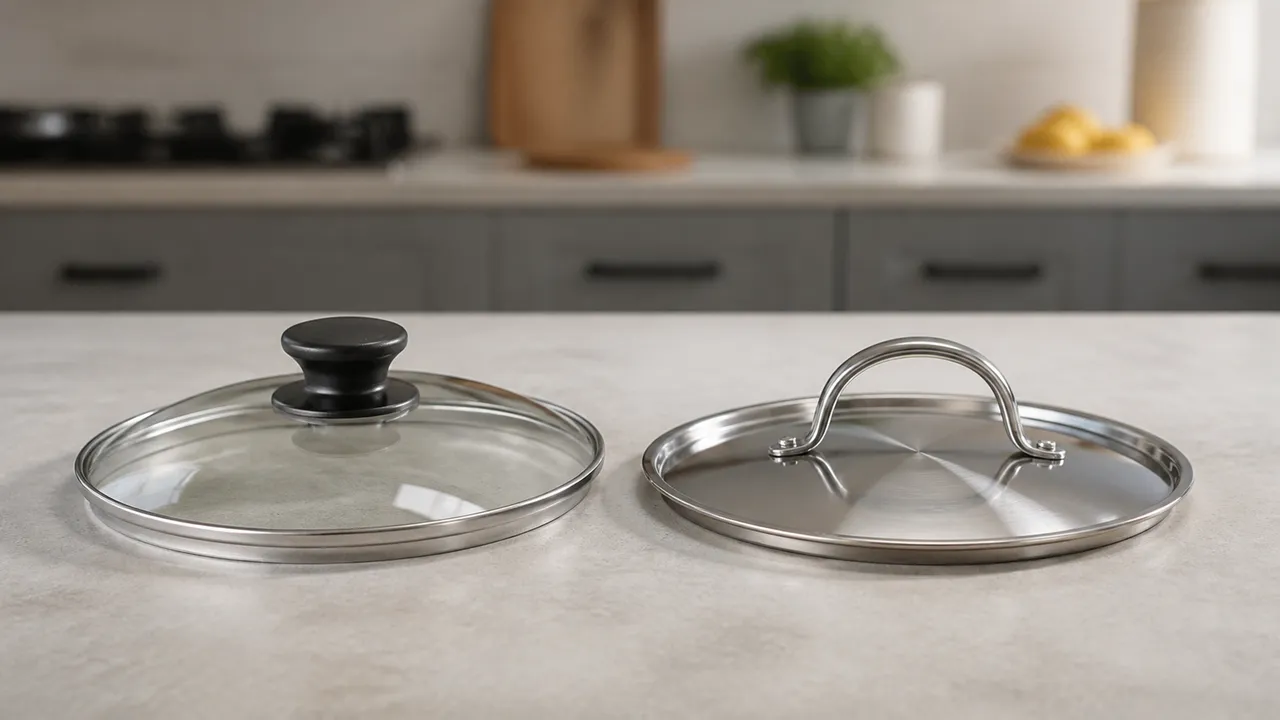
A glass cookware lid is best when seeing the food helps you cook, while a stainless steel lid is better when impact resistance and simple construction matter more. Neither material is automatically the better lid. Fit, handle design, venting, and the exact manufacturer’s heat limits can matter more than the material itself.
This is a material and use comparison, not a product test. Specifications differ by lid, so check the instructions supplied with your cookware before putting any lid in an oven or near a broiler.
Glass and stainless lids at a glance
| Question | Glass lid | Stainless steel lid |
|---|---|---|
| Can you see the food? | Yes, until condensation obscures it | No |
| Impact resistance | Can chip or break if dropped or struck | Usually tolerates ordinary knocks better |
| Weight | Often feels heavier because of thick glass and a metal rim | Varies with gauge and handle design |
| Heat limits | Depends on glass, rim, handle, and maker instructions | Depends on handle, fasteners, and maker instructions |
| Condensation | Visible and easy to monitor | Present but hidden |
| Cleaning | The rim and vent can trap residue | Seams and handle joints still need attention |
The table describes common design tendencies, not guarantees. A heavy stainless lid can weigh more than a compact glass one, and a metal lid with a heat-sensitive handle may have a lower oven limit than expected.
When a glass lid is useful
Glass is helpful when a visual check can prevent unnecessary lid lifting. You can watch a simmer, see foam rising in a stockpot, or check whether vegetables are still moving in the steam. Keeping the lid in place reduces the heat and moisture lost each time you open the pot.
Visibility has limits. Condensation often fogs the underside, especially at the start of cooking. A vented glass lid lets some vapor escape, but that changes how quickly liquid reduces. A closed lid may retain more moisture, yet it can rattle if boiling becomes too vigorous.
If you prefer clear covers, compare stainless steel cookware sets with glass lids by which vessels receive lids, documented vents, and the separate heat limit for each lid.
Glass also requires careful handling. A chipped edge, loose rim, deep scratch, or impact can justify replacement. Avoid sudden temperature changes unless the maker explicitly permits them. Do not assume a glass lid is broiler-safe or place it directly on a hot burner.
When a stainless steel lid is useful
Stainless steel is the practical choice when you want a lid that is not vulnerable to glass breakage. It suits crowded storage, frequent handling, and cooking where you do not need to watch the surface continuously. A domed metal lid may also provide clearance above a roast or a mound of greens.
The tradeoff is that you must lift it to inspect the food. That is rarely a problem for a long braise, but it can be inconvenient when milk, starch foam, or a rapid boil needs close attention. A polished lid also shows fingerprints, water spots, and fine scratches, although those marks are usually cosmetic.
If you are choosing a whole pan rather than only a lid, start with the pan’s shape and purpose. Our guide to saucepans and sauté pans explains how wall height and cooking surface change the job.
Fit matters more than a matching appearance
A useful lid sits securely on the rim without rocking excessively. It does not have to create an airtight seal, but a large gap lets vapor escape and makes the lid less effective. A lid that is too small can fall inward; one that balances only on the outer edge can slide when the pan moves.
Measure the pan where the lid actually seats, not across the widest part of the handles or rolled rim. Nominal pan sizes are not a universal lid standard. Even two pans sold with the same diameter can have different rim profiles.
Replacement lids need extra scrutiny. Check diameter, rim shape, handle clearance, venting, and the maker’s compatibility list. For larger covered vessels, our stainless steel stockpot guide shows why capacity alone does not establish fit.
Oven use depends on every component
The lid material alone does not determine the safe temperature. A lid can include a glass panel, stainless rim, silicone seal, knob, fastener, and adhesive, each with its own limit. The lowest-rated component governs use.
Use the temperature stated for the exact lid, not a limit remembered from a different item in the cookware line. Broilers are a separate question because intense radiant heat can strike the lid and handle directly. If the instructions are silent, do not infer broiler compatibility.
Fully metal does not mean unlimited heat. Stainless handles can become hot, hollow parts can trap water, and coatings or decorative finishes may have restrictions. Use dry protection and keep handles positioned away from direct flame.
Cleaning and inspection
Let the lid cool before washing it. Clean around the rim, vent, fastener, and handle base, where grease and starch can collect. Avoid abrasive tools on printed markings or coated handles. Dry seams so retained water does not drip into storage.
Inspect a glass lid for chips, cracks, a loose rim, or a moving handle. Inspect a stainless lid for sharp deformation, a loose handle, or separated seams. Tighten hardware only as the manufacturer directs; overtightening a knob against glass can add stress.
Cookware sets often mix lid materials and sizes, so make a fit inventory before buying. Our cookware set guide explains the difference between a useful piece count and duplicated parts.
For two specific metal-lid sets, the Viking versus All-Clad cookware comparison lists the matching vessels, lids, and separate use limits. Its Viking pick is a different set from the brand’s glass-lid Artisan line.
Which lid should you choose?
Choose glass if you regularly cook foods that benefit from visual monitoring and you are comfortable handling and storing it carefully. Choose stainless steel if you prioritize resistance to everyday knocks, lighter-looking construction, and do not mind lifting the lid to check progress.
In either case, prioritize a stable fit, a handle you can grip safely, clear heat instructions, and available replacement parts. Those details have more practical value than choosing a material by reputation alone.