Not by itself. Stainless steel is a relatively slow heat conductor compared with aluminum, but a stainless cookware piece can still cook well when its core, thickness, shape, and cooktop fit are designed as a system. The stainless layer usually supplies the durable cooking surface while a more conductive aluminum or copper layer moves heat through the vessel.
This is a research-based material explainer, not a hands-on heat-map test or a universal ranking of cookware. The exact alloy, layer thickness, bonding, burner size, and food load can change the result.
Does stainless steel conduct heat well for cookware?
Stainless steel conducts heat less readily than aluminum, so a thick stainless-only pan can develop a larger temperature difference between the area over the burner and the rest of the cooking surface. That does not make stainless cookware unusable. It explains why many stainless pans add a conductive core or base.
The National Institute of Standards and Technology’s thermophysical properties table lists these reference values for comparing the materials:
| Material reference | Thermal conductivity | Specific heat capacity | Density |
|---|---|---|---|
| Aluminum | 215 W/(m·K) | 910 J/(kg·K) | 2,700 kg/m³ |
| AISI 304 stainless steel | 16 W/(m·K) | 480 J/(kg·K) | 7,920 kg/m³ |
These are reference material properties, not a specification for every alloy or finished pan. Stainless steel is a family of alloys, and a cookware body may combine a food-contact stainless grade with a different exterior grade and a concealed core. Use an exact maker diagram or data sheet when construction matters.
What do conductivity, heat capacity, and responsiveness mean?
Thermal conductivity describes how readily heat moves through a material, while heat capacity describes how much energy is needed to raise a given mass by one degree. They answer different questions, so conductivity alone cannot predict how quickly a whole pan responds.
Thermal diffusivity combines conductivity with density and heat capacity. NIST describes the relationship as α = k / (ρ cₚ), where k is conductivity, ρ is density, and cₚ is specific heat capacity. A material can conduct heat well yet respond differently from another material because its density and heat capacity differ.
For cookware, thermal mass is also important. A thick or heavy vessel contains more material to heat and can hold more energy after the burner is reduced. That steadiness can help with searing or simmering, but it can also make a pan slower to change temperature. A thin pan may respond quickly yet show hot spots if its conductive layer is too small or the burner does not match its base.
That is why “fast heating,” “even heating,” and “responsive” should be treated as separate claims. They describe a complete construction, not the stainless label alone.
Why do stainless steel pans use aluminum or copper cores?
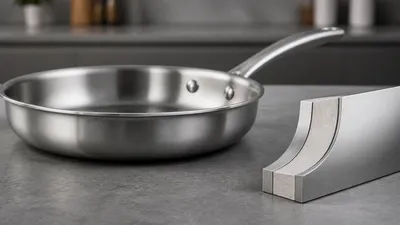
Stainless steel pans use aluminum or copper cores to combine a durable cooking surface with faster lateral heat movement. The core carries heat away from the hottest region over the burner, while the stainless layers provide the working surface and structural protection.
All-Clad’s current D3 construction description identifies an 18/10 stainless interior, an aluminum core, and a polished stainless exterior bonded through the vessel. Its current Copper Core description uses alternating aluminum layers and a copper center as an example of a more responsive bonded construction. Those are manufacturer descriptions of particular lines, not proof that every clad pan produces the same temperature map.
Our guide to why stainless steel pans have aluminum cores explains the same division of labor and why an aluminum core is normally not the food-contact surface in intact clad cookware. A product’s alloy label, layer count, and marketing name are incomplete without the cross-section and core coverage.
Does a thicker stainless pan heat more evenly?
Thickness can help, but it does not guarantee even heating. More conductive material can spread heat across a wider area, and more total mass can buffer temperature changes. A thick layer of stainless alone may still move heat slowly, while a thinner pan with a well-sized aluminum core may spread burner energy more effectively.
The useful questions are where the thickness sits and what it is made of. A pan can have a thick disc only under the floor, a fully clad wall, or several bonded layers with different roles. Core thickness, bonding quality, pan diameter, base flatness, burner size, and the distance between the heat source and the food all matter.
Do not assume that a five-ply label beats every three-ply pan. Additional layers can change heat diffusion, thermal mass, stiffness, and responsiveness, but layer count does not disclose the thickness or conductivity of each layer. Compare like-sized vessels and the exact construction rather than counting plies.
What is the difference between fully clad and disc-base cookware?
Fully clad cookware carries its bonded layers through the base and up the sidewalls, while disc-base cookware attaches a conductive plate mainly to the bottom of a stainless vessel. Both can work well, but they move heat through different parts of the pan.
Fully clad walls can matter when food or a sauce contacts the sides, when a broad sauté surface needs more even heat, or when a reduction climbs the vessel. A disc base can be efficient for stockpots and saucepans used mainly for liquid, because the base receives most of the burner energy and the liquid circulates heat within the pot.
Neither design is automatically superior. A well-sized disc may outperform a poorly matched fully clad pan, while a fully clad saucepan can reduce the cooler sidewall band that matters for thick sauces. The fully clad cookware guide shows why cladding coverage matters more than a large ply number.
The aluminum versus stainless steel cookware comparison keeps the same distinction in view: bare aluminum, anodized aluminum, and aluminum sealed inside stainless cladding are different constructions with different surface and heat behavior.
Does stainless steel work on induction?
Only when the cookware has a suitable ferromagnetic base or exterior. Induction compatibility is a magnetism question, not a simple measure of thermal conductivity.
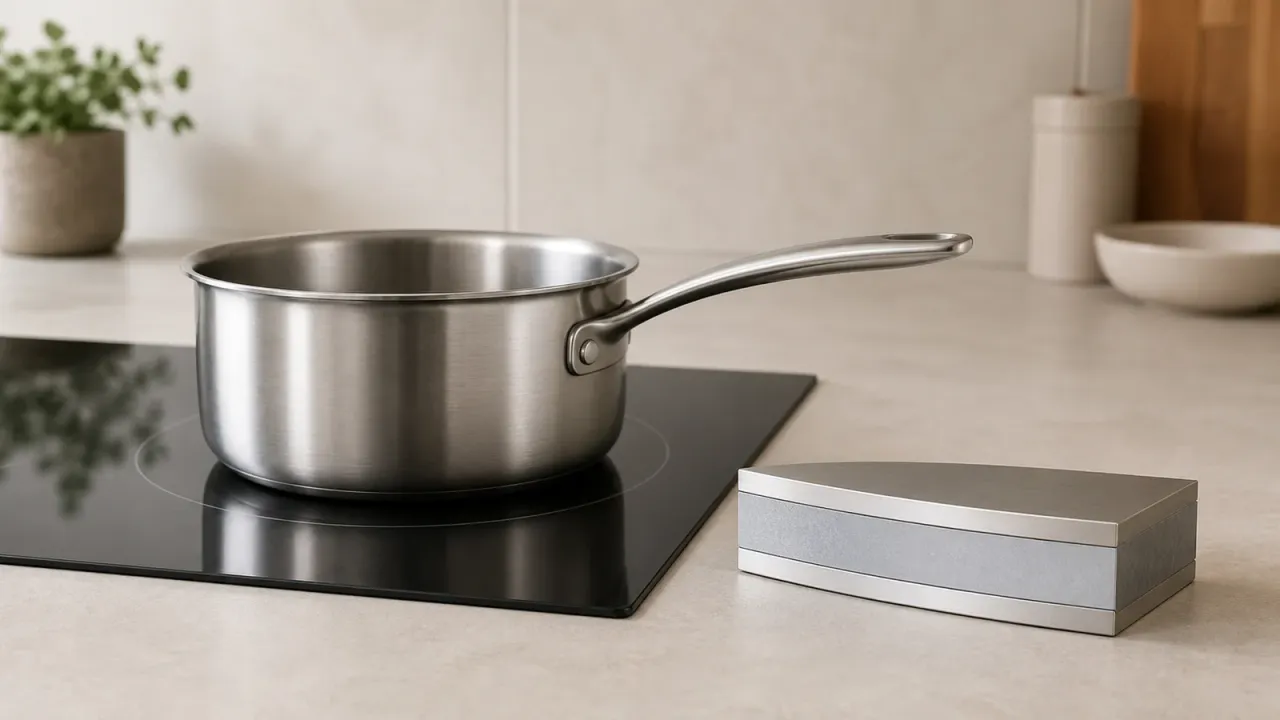
The U.S. Department of Energy’s induction explanation says induction transfers currents directly into compatible cookware, and a flat-bottomed pot or pan that attracts a magnet can work on an induction cooktop. ENERGY STAR likewise advises checking the cookware with a magnet. A stainless pan can therefore be induction-ready, nonmagnetic, or induction-ready only through a particular base layer.
Check the exact product’s induction statement, place a magnet against the base, and make sure the flat base suits the cooking zone. A magnet test can show whether the base is attracted, but it does not reveal the core thickness, heat distribution, or total thermal mass. Do not infer that an induction-compatible pan is automatically more conductive or more even than another pan.
What does stainless steel’s heat behavior mean when cooking?
It means that construction and heat control matter more than the word “stainless.” A conductive core can spread energy across the base and, in a fully clad pan, into the walls. A heavy vessel may then hold that heat after the burner changes, while a lighter vessel may react sooner but show stronger hot spots.
Use the burner size and pan base as a pair. A broad pan over a small heat source can leave its perimeter cooler even when the center is hot. A small pan over an oversized burner can concentrate energy near the center or send heat around the sides. Center the vessel, keep the base flat on the cooktop, and follow the maker’s heat guidance rather than relying on a universal setting.
If a recipe needs a quick adjustment, a highly conductive core may feel more responsive than stainless alone. If a recipe benefits from stable heat, a heavier construction may feel steadier. Those are tendencies, not guarantees. Food quantity, moisture, lid use, pan contact, burner control, and stirring can overwhelm a material comparison.
Stainless steel also remains a surface choice. Its food-contact properties, coating status, and condition are separate from its thermal conductivity. A pan with a sound stainless interior can have a conductive aluminum or copper core underneath without making that core the cooking surface.
How should you compare stainless cookware construction?
Read the exact construction description before treating a stainless pan as fast, even, responsive, or induction-ready. Check these details:
- Food-contact alloy and surface. Confirm what touches food and whether the interior is bare stainless, coated, or otherwise finished. A generic stainless label does not identify every alloy or surface.
- Core material. Look for aluminum, copper, graphite, or another documented core, and record whether the maker gives its thickness or layer order.
- Coverage. Determine whether the conductive layer reaches the sidewalls or remains in a disc under the base.
- Mass and thickness. Compare the same vessel size. More mass may improve stability while slowing changes, and a larger ply count does not tell you the mass by itself.
- Base and cooktop fit. Check flatness, base diameter, induction magnetism, and the maker’s gas, electric, or induction instructions.
- Evidence boundary. Treat manufacturer claims about speed or evenness as claims about that model. Do not turn them into a universal ranking without comparable measurements.
For a broader buying context, our stainless steel cookware set guide compares construction, vessel mix, weight, and cooktop compatibility without treating five-ply as an automatic upgrade.
Frequently asked questions
Is stainless steel a bad cookware material because it conducts heat slowly?
No. Stainless steel is a useful cooking surface, and a conductive core can address much of its slower heat movement. A sound pan still needs an appropriate size, heat source, and technique.
Is aluminum always better than stainless steel for heat?
No. Aluminum has higher reference conductivity, but a bare aluminum pan, a thick cast-aluminum pan, and an aluminum core inside stainless cookware are not equivalent. Surface, thickness, mass, care, and cooktop compatibility change the choice.
Does five-ply cookware always heat better than three-ply cookware?
No. Ply count tells you how many layers the maker counts, not their thickness, order, mass, or purpose. Compare the complete construction and the vessel size.
Will fully clad cookware eliminate hot spots?
No. Full cladding can help move heat through the sidewalls, but burner size, pan diameter, base contact, core design, and heat control can still produce uneven temperatures.
Does an induction-ready stainless pan conduct heat better?
Not necessarily. Induction readiness means the base or exterior responds to a magnetic field. It does not disclose the pan’s thermal conductivity, heat capacity, or distribution.
What is the quickest way to tell how a stainless pan will cook?
Start with the maker’s cross-section, core and base description, weight, dimensions, and cooktop instructions. Those facts are more useful than the word “stainless” or a ply count alone, and a photograph cannot show the full thermal behavior.
What does this article not test?
It does not provide hands-on temperature mapping, burner-by-burner testing, a universal performance ranking, or a promise that one construction will prevent every hot spot. The NIST material values establish a comparison baseline, while manufacturer pages document particular constructions and induction claims. Your exact pan and cooktop remain the controlling evidence.