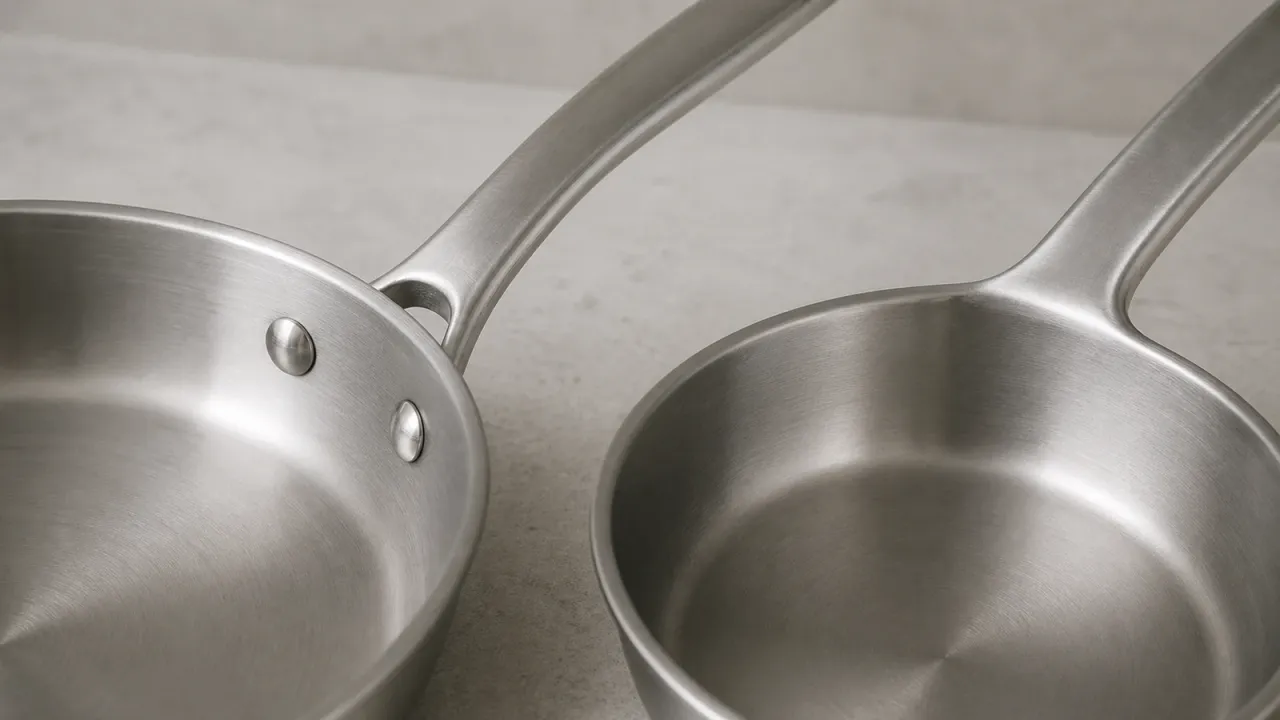
Riveted handles are easier to verify because the fasteners remain visible, while a documented welded handle can be the cleaner choice to wipe down. Neither attachment wins by label alone. Joint design, materials, load, heat, and maker support decide what you can reasonably expect.
This is a construction comparison, not a product ranking. The image above is illustrative only: a smooth interior or a photo with no visible rivets does not prove that a handle is welded, cast, integral, or detachable.
If you are comparing the handle with the rest of the pan, start with what fully clad cookware means, then see 3-ply vs 5-ply cookware, disc-bottom vs fully clad cookware, and why stainless steel pans have aluminum cores. Those pages cover the vessel’s layers and heat path. This page covers the handle attachment and the evidence a buyer can check.
The short answer
| Decision | Riveted handle | Welded handle | What to verify |
|---|---|---|---|
| Joint | A mechanical fastener passes through aligned holes and is formed to hold the parts together | Metal parts are joined at the specified weld area; the maker should name the process or attachment | Exact maker wording for the model or line |
| Cleaning access | Rivet heads and nearby edges can collect residue | A smooth interior can remove one type of snag point | Interior geometry and care instructions, not a product photo |
| Attachment strength | Depends on rivet, sheet, spacing, geometry, and loads | Depends on joint geometry, materials, process, heat input, and inspection | A test or specification that matches the actual pan, if published |
| Heat behavior | The handle shape and material still control heat transfer | The handle shape and material still control heat transfer | Full-pan oven, broiler, stovetop, and care guidance |
| Failure signs | Loose or spinning heads, movement, gaps, or handle play | Cracks, separation, or a changing gap at the joint | Photos, model number, purchase record, and maker support |
| Repair conversation | A maker may discuss rivet or handle service, but access does not authorize owner repair | A maker may require inspection, replacement, or a warranty claim | The exact warranty and repair route |
For most buyers, choose the construction the maker documents clearly. Choose rivets when visible fasteners and a mechanically inspectable joint matter more than a smooth interior. Choose a welded handle when the exact maker documents the weld and the pan’s surface, heat limits, and support terms fit your use. If the listing gives only a smooth photo, leave the attachment unconfirmed.
What riveted and welded mean
A riveted handle is a mechanically fastened joint. The handle and pan are prepared with aligned holes, and a rivet is formed so it stays in place. The NASA Fastener Design Manual treats rivets as engineered fasteners whose size, material, spacing, and loading matter. Cookware makers use their own specifications. Made In’s handle explanation describes its Stainless Clad handles as using two industrial-strength stainless steel rivets, while Heritage Steel’s manufacturing page says its handles are aligned and riveted by hand.
A welded handle is joined at a weld, but the useful buyer question is more specific: what exact process and joint does the maker document for this model? Vollrath’s handle design guide lists welded handles separately from stainless rivets. A current Demeyere Atlantis product page identifies the handle fixing as welded. That is the kind of exact language that supports the label.
Flush rivets are still rivets. For example, All-Clad’s current HA1 Ceramic page describes flush exterior rivets. A flush head may change the surface you clean or the way pans stack, but it does not turn a mechanical fastener into a weld.
The same caution applies to other construction words. Detachable means the maker has documented a removable handle system. Cast or integral means the maker has documented how the handle and vessel were formed. Do not use those labels as synonyms for welded, and do not use a rivet-free image to choose among them.
For a matched pan comparison, see Demeyere Industry 5 versus All-Clad D3, which separates welded and riveted handle designs from care and oven limits. For a flush-rivet alternative, Hestan ProBond versus All-Clad D3 compares the handle and rim details alongside the set contents.
Which construction fits your priorities?
Choose riveted handles when:
- You want visible attachment points that can be checked for movement, damage, or a gap.
- The maker identifies the rivet material or count and publishes care guidance for the exact line.
- You do not mind wiping around the heads and the inside of the handle joint.
Choose welded handles when:
- You want a smooth interior and the maker documents welded attachment for the exact model or line.
- The current product page supplies the complete pan’s heat, care, and warranty limits.
- You are comfortable asking the maker how a failed joint is inspected or supported rather than assuming it can be repaired at home.
Choose neither label from a photograph alone when:
- The listing says only “seamless,” “rivetless,” or “stay cool.” Those words describe an appearance or design goal, not necessarily the joining process.
- A marketplace title and the maker page disagree.
- The model number, handle attachment, or material changes between sizes in the same collection.
Attachment strength depends on the whole joint
The right question is not whether rivets or welds are stronger in the abstract. It is whether the actual handle joint has enough capacity for its materials, geometry, assembly, and expected loads over time.
The NASA fastener guidance discusses fastener selection, joint loading, fatigue, and the possibility that failure occurs in either the fastener or the joined material. A separate NASA technical document on joints and fasteners describes riveted and welded joints as different engineering choices with their own design details. The American Welding Society’s guidance on weld cracking also shows why a weld assessment concerns the weld and the base metal, not just the smoothness of the finished surface.
That gives a practical evidence rule: do not turn the construction label into a universal stronger, safer, or longer-lasting claim. A well-designed riveted joint can have a different failure path from a welded joint, but a cookware buyer normally does not have the load, material, process, or inspection data needed to rank every joint. A manufacturer’s exact attachment statement tells you what was specified. It does not replace a test of your particular pan.
The same limit applies to handle movement. A loose rivet is evidence of a fastener or joint problem. A cracked weld is evidence of a possible weld or base-metal problem. Neither tells you that every riveted or welded handle in that product family will behave the same way.
Joint cleanability is a surface question
Rivet heads create local edges and recesses. Food, grease, or cleaner residue can collect around them, especially when the area is not wiped after cooking. Made In makes that point in its own comparison, while also describing the maintenance as manageable with regular cleaning. That is useful evidence about a recurring cleaning task, not a universal hygiene ranking.
A welded or otherwise smooth interior can remove one kind of snag point. Vollrath’s handle guide describes rivetless and welded designs as ways to create a smoother surface. Demeyere also describes its welded stainless handles and surface treatment on the exact product page. Those maker statements support a line-specific cleanability discussion.
Still, smooth does not mean proven welded. A flush rivet, a covered fastener, a formed handle, or another construction can look similar in a product photo. The interior corner, the handle-to-wall transition, and the care instructions matter more than the absence of a visible dot. If the maker does not name the process, call the surface smooth or rivet-free in your notes, not welded.
Heat behavior comes from the handle design
Attachment method does not provide a handle-temperature rating. Handle length, hollow or solid construction, metal type, coatings or sleeves, burner size, pan geometry, lid use, and oven guidance all affect the result. A long hollow stainless handle may behave differently from a short solid handle even when both are riveted. Two welded handles can also differ.
Manufacturer pages show why the heat claim belongs to the exact line. All-Clad’s D3 8-inch pan page pairs double-riveted stainless handles with a 600°F oven and broiler limit. Made In’s Stainless Clad pan page identifies stainless steel rivets and publishes an 800°F oven statement. Those are product-level permissions, not riveted-handle defaults.
The same principle applies to welded cookware. A maker may describe a hollow stainless handle as designed to slow heat transfer, or may publish a stay-cool feature. Read that as design guidance for the exact line, not as permission to touch a handle after every oven or high-heat setup. Follow the current instructions for the complete pan, lid, helper handle, and any sleeve.
Do not use induction compatibility as an oven rating. Do not borrow an oven limit from a similar-looking pan. Do not add a broiler, burner, or detachable-part claim that the current source does not cover.
Failure signs need separate labels
| What you notice | What it may indicate | What it does not establish |
|---|---|---|
| A rivet head moves, spins, rises, or leaves a visible gap; the handle has new play | A loose fastener, loss of clamping, or movement at the riveted joint | That the pan body is warped or that every rivet in the line is failing |
| A hairline line, open gap, or separation appears along a documented weld | A possible weld discontinuity, crack, or separation at the joint | That a dark mark or normal seam is a crack |
| The handle is bent, the rim is distorted, the wall is dented, or the base no longer sits flat | Handle or vessel deformation from impact, loading, or thermal stress | That the attachment process caused the deformation |
| Blue, purple, rainbow, brown, or other surface discoloration appears | Cosmetic heat tint, residue, or a surface-care issue | A loose rivet, a cracked weld, or a structural failure |
If a handle is visibly loose or cracked, contact the maker before using that pan for a loaded setup. Keep the exact model or SKU, purchase record, dated photos, and a short description of what changed. Do not drill, re-rivet, grind, weld, or bend a structural cookware handle yourself. A repair that changes the joint can affect fit, food-contact boundaries, heat behavior, and warranty review.
Warranty and repair implications
Warranty language follows the product line, not the handle category. Made In’s current cookware warranty specifically lists handle or rivet failures under normal home use for Stainless Clad and Carbon Steel, while its exclusions cover cosmetic wear and misuse. That gives a buyer a clear claim path for those exact lines. It does not make every riveted handle repairable or every weld unsupported.
All-Clad’s limited lifetime warranty is also a product warranty with its own terms. Vollrath’s warranty policy illustrates why commercial cookware support can have different periods and exclusions from a consumer lifetime warranty. Read the current policy that matches the model, seller, and purchase channel.
For a riveted pan, visible access to the fastener does not authorize tightening or replacement. For a welded pan, a smooth joint does not tell you whether the maker repairs, replaces, or inspects it. Ask the maker what evidence it needs, whether the remedy is a replacement or repair, and whether a third-party repair changes coverage. Keep the answer with the receipt.
What to verify before buying
- Find the exact model or SKU on the current manufacturer page. A collection name is not enough when handles or materials vary by size.
- Look for direct attachment wording such as riveted, double-riveted, flush exterior rivets, spot-welded, or welded. Treat “rivetless” and “seamless” as incomplete until the joining process is stated.
- Check the surface and handle transition that you will clean. A product photo can show a shape, but it cannot prove the manufacturing process.
- Read the complete heat and care instructions. Confirm the pan, handle, lid, helper handle, and any coating or sleeve are covered by the same permission.
- Read the warranty for the exact line. Look for handle, rivet, weld, structural, replacement, repair, receipt, seller, and normal-use language.
- Save the source page, model number, order record, and a photo of the attachment. Documentation is more useful than a marketplace adjective if you need support later.
How we compared
This is a research-based construction comparison, not a hands-on or side-by-side test. The planning research package and exact-query review were captured August 20, 2026. For this draft, I checked current manufacturer pages from Made In, All-Clad, Heritage Steel, Vollrath, and Demeyere, then used NASA fastener guidance and American Welding Society material to keep the strength and failure discussion evidence-limited.
The comparison covers attachment wording, visible joint and cleaning implications, design-dependent heat behavior, failure signs, warranty and repair questions, and buyer-verifiable documentation. It does not rank cookware brands, infer construction from smooth photos, or treat flush rivets as welds. The page stays separate from the welded-handle product roundup, which selects exact products that pass a maker-evidence gate. This page explains how to interpret the construction evidence before choosing a pan.
I did not perform cooking, load, temperature, oven, broiler, balance, cleaning-cycle, or repair testing. No universal stronger, safer, cooler, more hygienic, easier, or more repairable claim is made. Recheck the current maker page and warranty before buying because handle wording, instructions, and support terms can change.