Fully clad cookware is the better general-purpose choice for frying pans, sauté pans, and saucepans because its conductive core continues into the walls. Disc-bottom cookware is the practical value choice for stockpots and boiling-focused vessels, where a thick, well-fitted base can do the important work for less.
The decision depends on where the conductive metal sits, how wide it is, and what the vessel needs to cook.
Disc bottom vs fully clad cookware at a glance
| Decision | Disc bottom | Fully clad | Better fit |
|---|---|---|---|
| Conductive material | Concentrated under the base | Extends from base into sidewalls | Fully clad for wall heating |
| Typical value | Often less costly | Often positioned higher | Disc bottom |
| Weight distribution | Mass concentrated low | Metal distributed across vessel | Task dependent |
| Frying and reducing | Edge transition can matter | More continuous heat path | Fully clad |
| Boiling and stock | Strong fit with a broad, thick disc | Works, but may add cost without equal benefit | Disc bottom for value |
| Induction | Works with a suitable magnetic base | Works with a suitable magnetic exterior | Tie when specified |
What is disc-bottom cookware?
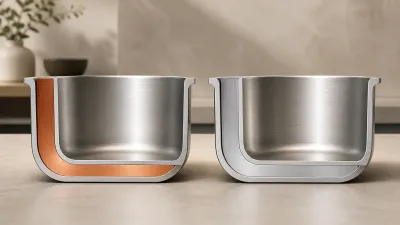
Disc-bottom cookware has a conductive plate bonded or impact-bonded to the bottom of a stainless steel vessel. The plate commonly contains aluminum and may include a magnetic stainless layer for induction. The walls remain primarily stainless steel rather than carrying the same core to the rim.
Cuisinart’s current Professional Series saucepan uses what the company calls a high-impact bonded base. Tramontina also distinguishes tri-ply base from tri-ply clad, describing one as base-focused and the other as extending bonded layers through the walls.
What is fully clad cookware?
Fully clad cookware bonds its layers across the whole body, normally from base to rim. The core can therefore move heat beyond the cooking floor and into the sidewalls. Our fully clad cookware guide covers core metals, coverage, weight, and the limits of ply labels.
Full cladding does not guarantee a thick core or good burner fit. It tells you where the layers extend, not how much conductive metal the pan contains.
Which heats more evenly?
Fully clad construction has the advantage across the whole vessel because the conductive core continues through the wall. That can reduce the abrupt temperature change where a base-only disc ends, especially if the disc is narrower than the cooking floor.
A broad, thick disc can still distribute burner heat very well across the base. For foods sitting mainly on the floor, actual disc diameter and thickness matter more than the category name. Neither design fixes an undersized burner. An undersized burner is also a common reason stainless steel pans warp.
Fully clad wins for continuous base-to-wall heating. A well-made disc can tie it across the central base for many tasks.
Which is better for saucepans and sauté pans?
Fully clad is generally better for sauces, reductions, braises, and crowded sautéing. Food and liquid contact the walls, evaporation happens across a wide surface, and the pan may move between active browning and gentle simmering.
That does not make every clad saucepan better than every bonded-base saucepan. Check weight, diameter, core details, and handle comfort among the best stainless steel saucepans. Still, full cladding is the stronger default for a multipurpose saucepan or sauté pan.
Fully clad takes this category.
Which is better for stockpots?
Disc-bottom construction often makes sense for a stockpot. Water and thin liquids circulate heat, tall walls add substantial material, and the vessel may be heavy before it is filled. Concentrating conductive metal under the burner can control cost and keep some weight out of the walls.
Look for a disc that reaches close to the edge of the flat base. A small inset disc can create a hotter center and cooler perimeter. Our recommended stainless steel stockpots include both fully clad and bonded-base options because capacity and use change the answer.
Disc bottom wins on value for boiling and stock. Fully clad remains useful for thick stews that spend more time against the walls.
Which responds faster and holds heat better?
Coverage alone cannot answer that question. Response and retention depend on total mass, core material, and core thickness. A heavy bonded disc can change temperature more slowly than a light clad body. A substantial fully clad pan can also retain more heat than a thin base-only design.
Compare equivalent vessel weights and construction details. Do not translate “fully clad” into “fast” or “disc bottom” into “slow.”
This category is a tie without product-level data.
Does either construction work better on induction?
Both designs can work on induction. A disc-bottom pot needs a magnetic outer plate, while a fully clad pan needs a magnetic exterior layer. Base flatness and diameter also affect whether the cooktop detects the vessel and transfers energy effectively.
Our guide to stainless steel on induction cooktops explains why a magnet test is useful but not a complete performance test.
This category is a tie when each exact product is rated for induction.
Should you buy disc-bottom or fully clad cookware?
Choose fully clad for a frying pan, sauté pan, saucier, or all-purpose saucepan when you want one continuous heat path into the walls. It is also the simpler default for a cookware set that must handle many techniques.
Choose disc-bottom for a stockpot, pasta pot, or budget-focused saucepan when the disc is broad, the base is flat, and most cooking happens over liquid. Inspect the underside or manufacturer diagram to see where the disc ends.
If you are replacing several pieces, the best stainless steel cookware sets show why one construction need not win every vessel in the kitchen.