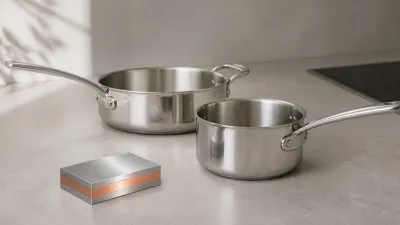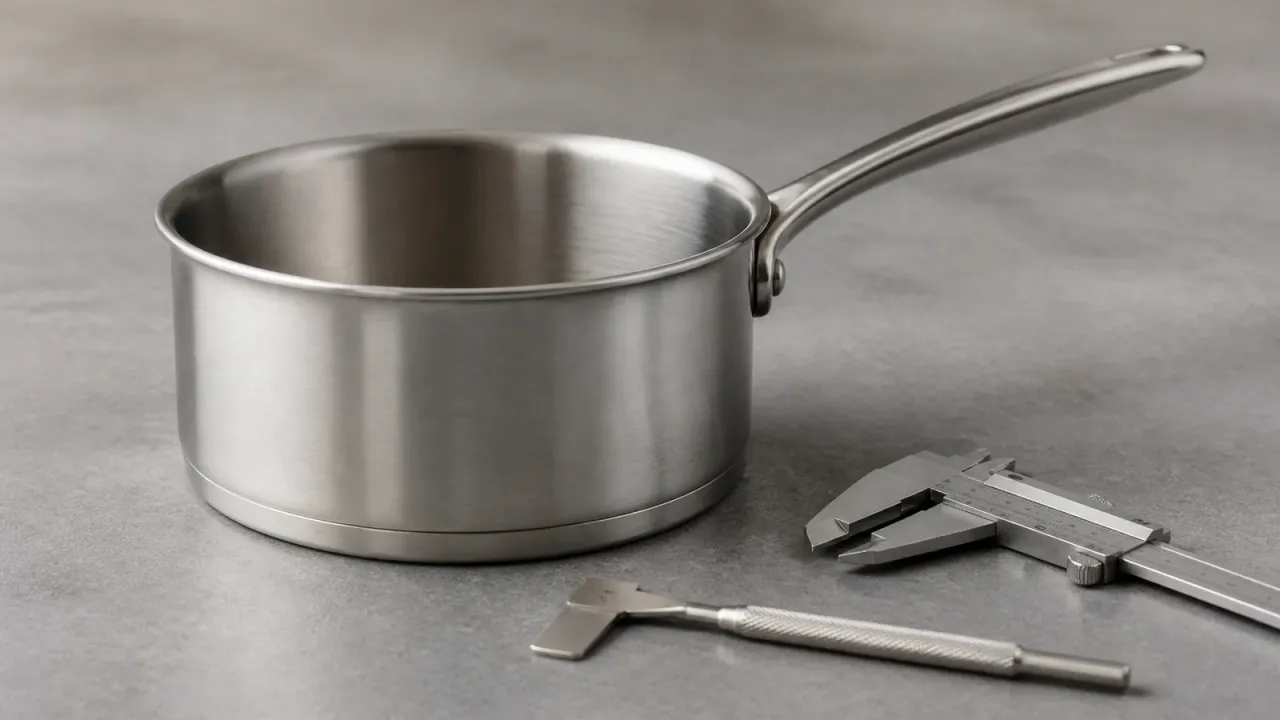
“Stainless steel cookware thickness gauge” is not one measurement. A gauge number may describe sheet stock under a named standard, while a millimeter claim may describe the total wall, one clad layer, or a base assembly. A simple caliper can measure an accessible outside-to-inside distance, but it cannot reveal the thickness of hidden layers in a finished clad pan.
Start by asking what was measured, which material and standard apply, and which part of the exact pan the number describes. The U.S. Code standard gauge for sheet and plate iron and steel and ASTM A480/A480M for flat-rolled stainless and heat-resisting steel are examples of scoped standards, not universal specifications for a finished pot. If a listing does not answer those questions, keep the thickness or gauge unknown.
What does a cookware thickness or gauge claim mean?
A cookware thickness claim has meaning only when it names the measurand, such as sheet stock, total wall, a core layer, or the base. “Gauge” can refer to a numbered sheet-metal system, but it is not a complete description of a pan’s construction.
| Claim or term | What it may describe | What it does not establish |
|---|---|---|
| Sheet-metal gauge | A nominal number in a stated material and gauge standard for sheet or plate stock | The thickness of every part of a finished pan |
| Total wall thickness | The outside-to-inside distance at a particular wall, rim, or cross-section | The thickness of any individual stainless or aluminum layer |
| Clad layer or core thickness | One bonded stainless, aluminum, copper, or other layer | The total wall or base thickness |
| Base or disc thickness | A complete base stack, an attached disc, or one conductive layer, depending on the maker’s wording | Whether that number reaches into the sidewalls |
| Gauge tool or thickness gauge | An instrument used to compare or measure a dimension | The cookware’s material, layer arrangement, or cooking performance |
The word “gauge” is therefore an invitation to read the fine print, not a shortcut to a conversion table. The applicable material, standard, unit system, tolerance, and location on the piece all matter. A manufacturer may use a gauge term for sheet stock, a millimeter value for the complete body, or no numeric thickness at all.
The distinction is also why a cookware label can be accurate without telling you everything you want to know. “5-ply” counts bonded layers, but it does not state their thickness or the thickness of the complete vessel. The guide to fully clad cookware explains why coverage and core details remain separate questions.
Is a gauge number the same as millimeters?
No. Millimeters are a direct length unit, while gauge is a number whose meaning comes from a particular table or standard. Do not convert a bare gauge number to millimeters unless the listing identifies the relevant material and gauge system.
The U.S. Code publishes a standard gauge for sheet and plate iron and steel. ASTM A480/A480M, meanwhile, covers general requirements for flat-rolled stainless and heat-resisting steel plate, sheet, and strip and says its inch-pound and SI values are to be used as separate systems. Those scopes do not turn a gauge number on a cookware listing into a universal finished-pan thickness.
When a maker gives a direct millimeter value, record exactly what the page calls that value. Do not silently relabel a body measurement as a stainless skin measurement, or a base measurement as a conductive-core measurement. When the maker gives only “heavy gauge” or “thick gauge,” there may be no numeric thickness to verify.
How should you measure an exposed cookware rim?
You can make a useful local check of an exposed, straight section with a clean caliper, but treat the result as a measurement of that spot rather than a certified specification for the whole pan. NIST’s Engineering Metrology Toolbox treats uncertainty, accuracy, and precision as parts of a measurement process, and its Gauge Block Handbook documents controlled contact, temperature, repeatability, and calibration for precision dimensional work.
For a cautious household check:
- Identify the dimension before touching the pan. Decide whether you want the exposed rim, a straight wall section, the rolled edge, or the outside of a base. If the product page does not identify the claimed dimension, do not use your reading to fill in that gap.
- Measure only when the cookware is cool, clean, dry, and stable. Residue, heat, a soft coating, or a curved surface can change the contact and the reading.
- Zero the caliper and check that its jaws close cleanly. Use the outside jaws across the accessible metal edge. A caliper’s displayed resolution is not the same as its accuracy or measurement uncertainty.
- Use light, repeatable contact. Do not squeeze a thin wall, force the jaws into a rolled rim, or flex the pan to make the tool touch two surfaces.
- Take several readings at separate points and write down the range, tool resolution, location, and temperature condition. A spread in readings is evidence that geometry or technique limits the result.
- Report the result narrowly, such as “local rim measurement at the front edge,” rather than “this pan is 2 mm” or “this pan is 18 gauge.”
This process cannot establish a manufacturer’s tolerance or prove that a pan meets a material standard. It is a non-destructive observation of an accessible surface. Do not cut, drill, grind, sand, pry, peel, or remove a rim or base to chase a hidden measurement.
Can a caliper measure clad layers or an encapsulated base?
No. A caliper measures the outside envelope that its jaws can reach; it cannot separate a hidden aluminum core from the stainless skins in an intact clad wall.
At an open or plainly exposed layered edge, the tool may span the combined thickness of the visible stack. That is still a total local dimension. A rolled rim, folded edge, weld, reinforcing band, or finished lip can make that local dimension different from the straight wall below it.
An encapsulated or disc base has the same limit. Measuring from the underside to the cooking surface may estimate the complete base package at that location, if both surfaces are accessible and the geometry permits a straight measurement. It does not tell you how much of that package is stainless steel, aluminum, copper, adhesive-free bonding material, or another component. A flush base may expose no edge at all.
If you need the core or layer thickness, use the exact manufacturer’s construction diagram or specification when one exists. If the maker identifies only the layer count or says “aluminum core,” the individual layer dimension remains unknown. Do not infer it from a caliper reading, the pan’s weight, a magnet test, or the number of plies. Our 3-ply versus 5-ply cookware comparison keeps layer count separate from thickness, mass, and material arrangement.
What do current cookware makers actually disclose?
Current maker pages show why the component and measurement label belong beside every thickness number. These examples are disclosures from particular lines, not a ranking or a universal target.
| Maker disclosure | What the wording tells you | What remains limited or unknown |
|---|---|---|
| Made In’s Stainless Clad FAQs state that its frying pans are 2.7 mm thick and the rest of the collection is 2.3 mm thick. The same page identifies an 18/10 stainless cooking surface and 430 stainless bottoms. | The maker publishes different body thickness figures for different pieces and names some surface materials. | The page does not give a layer-by-layer thickness for each pan, so do not rewrite 2.7 mm as the stainless skin or the aluminum core. |
| DEMEYERE’s technology guide calls 2.3 mm the overall thickness of its 7-layer wok material, 3 to 3.3 mm for several pan types, and 4.8 mm for Proline frying pans. It separately describes a Resto capsule base as 4 mm thick with a 3 mm aluminum core. | The maker distinguishes overall 7-layer material from a complete capsule base and from the aluminum core inside that base. | The figures are line- and vessel-specific. They do not establish a universal ideal thickness or transfer to another model. |
Those pages also illustrate why a number should stay attached to its exact line, vessel, and component. A pan can have one figure for its body, another for its base, and no published value for each individual clad layer. The absence of a number is not evidence that the layer is thin or thick.
Does thicker cookware cook better?
No. Thickness alone does not establish faster heating, more even cooking, durability, or a better result. Heat behavior also depends on material conductivity, layer arrangement, total mass, vessel diameter, base geometry, burner match, and how the pan is used.
A thicker component may add mass or change how quickly a pan responds, but that is a construction effect to verify for the exact model, not a performance conclusion from a number alone. A base-only disc and a fully clad wall can have similar measurements at one spot while putting conductive material in different places. Our disc-bottom versus fully clad cookware guide covers that placement distinction.
Use thickness as one piece of evidence. Pair it with the exact construction description, weight for the same vessel size, base or wall coverage, cooktop compatibility, and maker instructions. If those details are missing, the honest answer is that the performance implication is unknown.
What should you ask before trusting a thickness claim?
Ask the maker or seller these questions before comparing a gauge or millimeter number:
- What exact model and vessel does the number describe?
- Is it sheet-metal gauge, total wall thickness, one layer, a core, a base disc, or the complete base stack?
- Which material and gauge standard apply, and are the units inch-based or metric?
- Where was it measured: rim, straight sidewall, cooking floor, underside, or another location?
- Does the number include a coating, rolled rim, reinforcing piece, lid, or base cap?
- Is a tolerance, range, or measurement date provided?
- Is there a construction diagram that separates the stainless skins, conductive core, and any base layers?
If the answer stops at “heavy gauge,” “professional thickness,” or a ply count, keep the numeric thickness and individual layer dimensions unknown. For a broader construction explanation, see why stainless steel pans have aluminum cores, which separates the stainless working surfaces from the concealed conductive core.
Frequently asked questions
Can I measure a hidden aluminum core with a caliper?
No. A caliper can measure an accessible outside-to-inside envelope, but it cannot identify the thickness of an enclosed aluminum core or separate it from the stainless layers. Use an exact maker diagram or leave the layer thickness unknown.
Is an 18-gauge pan always thicker than a 20-gauge pan?
Do not compare the numbers without the named material and gauge standard. A gauge number is not a universal unit, and a cookware listing may use the term without identifying what part was measured. Direct millimeters with a stated component are easier to compare, but they still describe only the component named by the maker.
What is the ideal stainless steel cookware thickness?
There is no universal ideal thickness. The useful choice depends on the vessel, cooking job, mass, conductive material, layer placement, burner or cooktop, and handling needs. A thicker number by itself is not a buying verdict.
Does 5-ply cookware have a known thickness?
No. Five-ply identifies a counted layer arrangement, not a standard total thickness or a fixed core thickness. Read the exact line’s construction and any direct measurement instead.
Sources and method
Research and source checks completed August 22, 2026. This is a research-based metrology and cookware-construction explainer, not a hands-on measurement, destructive examination, or cooking-performance test. It uses guidance from NIST Technical Note 1297 and the NIST Gauge Block Handbook, the scoped U.S. Code standard gauge, and ASTM A480/A480M-25b. Current maker disclosures are linked for Made In and DEMEYERE. No universal gauge conversion, ideal thickness, hidden-layer measurement, destructive procedure, price, product ranking, or unsupported performance claim is included.