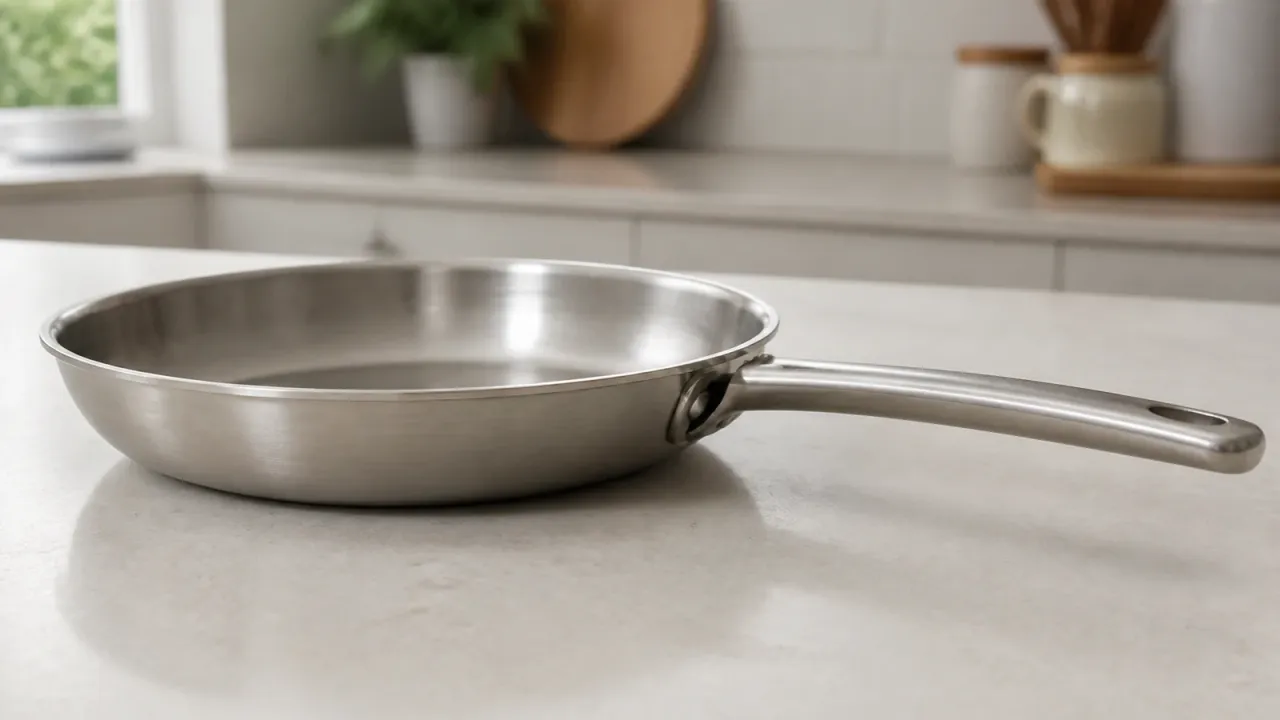
Do not cook with or carry a loaded stainless steel pan if its handle is loose. Set it on a cool, stable surface, let it cool if needed without lifting it by the handle, and identify the attachment before contacting the maker.
A screw-fastened handle may be reasonable to retighten only when the exact maker’s manual says to do so. A loose rivet, weld, cracked handle, bent pan wall, separating joint, or unknown attachment is a stop-use and service or replacement question. Stainless steel in the pan body does not make an unstable handle safe.
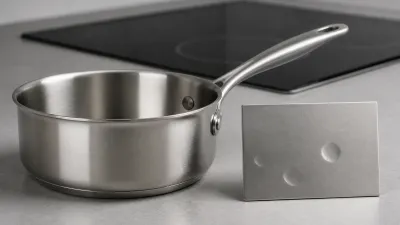
This guide covers the handle attachment, not every cookware safety question. For context on a distorted pan body, see why stainless steel pans warp. What fully clad cookware means explains the pan’s layers, while is stainless steel cookware safe covers food-contact and surface questions. The broader pros and cons of stainless steel cookware discusses material tradeoffs rather than handle repair.
Can you use a stainless steel pan with a loose handle?
No. Treat a loose handle as a reason to stop cooking and stop carrying the pan while it is loaded or hot. A handle that shifts can change the pan’s balance or separate from the vessel when you least expect it. You cannot establish the joint’s load capacity by holding the pan, lifting it over a sink, or giving it a test on the stove.
This is a conservative use decision, not a claim that every loose handle will detach. The U.S. Consumer Product Safety Commission recently recalled a stainless sauté pan after reporting that a screw cap connecting the pan to its handle could detach or eject when heated, creating impact and burn hazards. The recall is a product-specific example, but it shows why a loose handle deserves the maker’s instructions and remedy rather than a home heat test. Follow the CPSC notice if your pan matches a recalled product.
What should you do before inspecting the handle?
Make the pan safe to leave alone before you try to identify the joint:
- If the pan is on a counter or cooktop, set it down without using the loose handle. Do not carry a loaded or hot pan by the handle, and do not ask someone else to do so.
- If it is hot, keep hands away from the handle and let the pan cool in place. Do not pour cold water over a hot pan or move it to a different surface just to inspect it.
- Once the pan is cool and empty, keep it stable on a counter. Look without twisting, flexing, hanging weight from, or heating the handle.
- Record the brand, collection, size, model or SKU, and purchase information. Take clear photos of the joint from several sides without using the pan as a test object.
- Find the current manual and warranty page for that exact model. A similar pan from the same brand can use a different handle, fastener, latch, or repair policy.
The goal is identification, not a home structural assessment. A photograph can document a gap or missing part for customer service, but it cannot show the strength of a hidden thread, rivet, weld, or internal bracket.
The no-heat check is observational only: once the empty pan is cool and resting on the counter, note any movement or gap that is already visible. Do not intentionally wobble, flex, twist, lift, or load the handle to provoke a failure. If the maker’s support team gives you a specific no-load inspection method, follow that method instead of inventing one.
How can you identify the handle attachment?
Look for the construction the maker documents, while keeping the pan out of service. Common possibilities include:
- A screw, bolt, nut, or cap that is visibly intended to be turned. Some makers publish a limited tightening instruction for a specific line. That permission does not transfer to another model.
- One or more formed rivet heads. A riveted handle is a mechanical joint, not an owner-serviceable screw just because a round head is visible. A moving, raised, spinning, or missing rivet is a reason to contact the maker.
- A continuous welded or otherwise joined area with no ordinary user fastener. A gap, crack, metal separation, or change in the joint needs maker review or replacement. Do not treat a smooth appearance as proof of a particular welding process.
- A detachable handle or latch. The latch, release, and pan receiver are a separate system. Use only the maker’s instructions for that handle and pan combination.
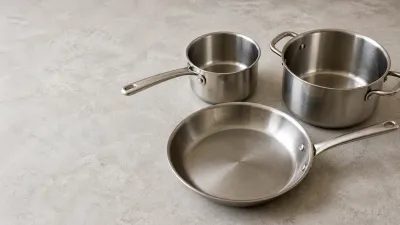
- A helper or side handle attached near the rim. It may carry part of a loaded pan’s weight, so it is not a cosmetic accessory to ignore.
Do not infer a rivet, weld, screw, or hidden bracket from a product photo. Made In’s explanation of riveted and welded handles shows why those are different attachment descriptions, but its construction language does not authorize a repair on another pan. If the manual and the physical pan do not match, stop and ask the maker which model-specific instructions apply.
When is tightening a handle acceptable?
Tightening is acceptable only when the exact maker’s manual explicitly permits the owner to tighten that fastener. For example, T-fal’s care guidance explains that heating and cooling can loosen some handles and directs owners to use an appropriate screwdriver without over-tightening. That is a model-family instruction, not a universal rule for stainless pans.
If the current manual gives that permission, follow its complete procedure and limits:
- Confirm the model and attachment in the manual before touching the fastener.
- Work only with a cool, empty, stable pan. Do not tighten a handle over a burner or while wearing a glove to handle a hot pan.
- Use only the screwdriver, fastener, washer, or replacement part the maker specifies. Do not substitute a hardware-store screw or add adhesive.
- Apply only the amount of tightening the maker describes. Do not invent a torque value, use a power driver, or force a screw that binds, spins, strips, or will not seat.
- Stop if you see a crack, gap, bent metal, missing washer, damaged thread, heat-damaged sleeve, or movement that remains after the permitted adjustment. Ask the maker for the approved next step.
Do not put the pan on the stove, add food, fill it with water, lift it by the adjusted handle, or create another load to prove that the repair worked. The manufacturer’s instruction and support response control what happens next.
When is the handle a service or replacement problem?
Treat the pan as out of service when the attachment is riveted, welded, cracked, deformed, separating, or unknown, or when the maker’s manual does not authorize owner tightening. The FDA Food Code is written for food establishments rather than household certification, but its good-repair benchmark is useful: food equipment components such as fasteners should remain intact, tight, and adjusted to the manufacturer’s specifications. See 4-501.11 in the FDA Food Code.
Contact the maker before using the pan if you notice any of these signs:
- The handle moves, rotates, rocks, or sits at a new angle relative to the pan.
- A rivet head rises, spins, is missing, or leaves a visible gap.
- A weld or surrounding metal has a crack, open seam, or new separation.
- The pan wall, rim, or attachment area is bent, dented, or distorted.
- A screw cap, washer, or other attachment part is missing, loose, stripped, or ejecting.
- A handle sleeve, latch, or insulating part shows heat damage, melting, splitting, or a fit that no longer closes securely.
- The joint keeps loosening, or the model and attachment cannot be identified.
Do not drill, peen, re-rivet, weld, grind, glue, clamp, zip-tie, or improvise a replacement handle. These changes can alter the joint, damage the pan, introduce an unsuitable material near food or heat, and affect warranty review. A visible fastener is not permission to repair a structural cookware joint yourself.
What about a lid knob or helper handle?
A lid knob or lid handle is a separate attachment from the pan’s primary handle. A loose lid handle can make the lid difficult to lift or control and can expose you to hot steam or spilled food. Keep the lid out of use until the exact lid manual authorizes a simple adjustment or the maker supplies a replacement. Do not use the pan handle instructions for a lid.
A helper handle can be just as important when a pan is full. If it moves, separates, or has a loose rivet or weld, do not carry the loaded pan by the main handle and helper handle together. Ask the maker whether the pan should be repaired, replaced, or returned.
Detachable handles have their own latch and receiver limits. T-fal warns that an overheated or damaged detachable handle can break, allowing a pan to fall and cause a burn, and directs owners to stop using and replace a damaged handle. Read the current T-fal care and use guidance for the relevant system rather than assuming that a click means the attachment is secure.
How should you contact the maker or use the warranty?
Use the maker’s customer-service or warranty channel for the exact pan, not a generic cookware forum or a replacement-part listing. Send or have ready:
- the brand, line, size, model number, and SKU;
- the purchase date, seller, receipt, or order number;
- photos of the cool, empty pan and the joint from more than one angle;
- a short description of when the movement or gap appeared; and
- whether the pan was used according to the manual, without claiming a repair or heat test you did not perform.
Ask the maker whether the attachment is intended to be owner-tightened, whether an approved fastener or handle exists, and whether the remedy is inspection, repair, replacement, recall action, or disposal. Keep the pan until the maker tells you what to do. Do not mail it or discard it before a warranty or recall representative provides instructions, unless it presents an immediate hazard that cannot be isolated safely.
Warranty terms vary by line and can distinguish manufacturing defects, normal wear, misuse, unauthorized repair, and damage from heat or impact. For example, Made In’s cookware warranty describes product-specific repair or replacement terms and asks for order and product information. All-Clad’s cookware warranty also has its own coverage and repair conditions. Treat those pages as examples of why the exact model’s current policy matters, not as a promise that every loose handle is covered.
Can you tell if a handle is unsafe from a photo?
No. A photo may show a gap, missing cap, crack, or misalignment, but it cannot establish the condition of hidden threads, the remaining rivet material, weld quality, internal support, or the load the joint can carry. Do not use an image to approve a pan for cooking or to diagnose the attachment.
Use photos to help the maker identify the model and choose the correct support path. If the maker asks for more information, describe the movement and attachment without trying to reproduce the failure with heat, water, food, or a hanging load.
When should you replace the pan instead of repair it?
Replacement is the practical path when the maker says the handle or attachment is not repairable, approved parts are unavailable, the body is cracked or badly deformed, the joint has failed repeatedly, or the pan is subject to a recall remedy. It is also reasonable to replace an unknown pan when you cannot establish its model, attachment, or support path and cannot keep it isolated from use.
Do not make a replacement decision from the stainless label alone. A sound pan body can still have a failed handle, and a handle that looks simple can contain a joint the owner cannot safely service. Follow the maker’s written remedy and keep the old pan out of cooking service while the question is unresolved.
Frequently asked questions
Can I tighten a screw-on pan handle?
Only if the exact manual says the owner may do so. Use the specified tool and method on a cool, empty pan, and stop if the fastener is damaged, missing, stripped, or does not seat. Never invent a torque value or substitute hardware.
Can I tighten a riveted handle?
No home repair should be assumed. A rivet is a structural fastener, and a loose or spinning rivet needs the maker’s inspection, repair route, or replacement decision. Do not drill out or re-form it yourself.
Is a slightly loose handle safe if the pan is empty?
An empty pan can be left on a stable counter for a visual inspection once cool, but that does not make it suitable for cooking or carrying. Keep it out of service until the maker resolves the attachment or gives model-specific permission.
Can I use a loose lid handle?
Do not lift or use a loose lid handle until the lid’s exact instructions authorize an adjustment or the maker supplies a replacement. A lid attachment is not governed by the pan handle’s construction or care instructions.
Sources
- U.S. Consumer Product Safety Commission, Granitestone Diamond Pro Blue Stainless Sauté Pans recall (retrieved 2026-08-22)
- T-fal, Care and use (retrieved 2026-08-22)
- U.S. Food and Drug Administration, 2022 Food Code, Section 4-501.11 (retrieved 2026-08-22)
- Made In, Cookware warranty (retrieved 2026-08-22)
- Made In, Riveted vs. welded cookware handles (retrieved 2026-08-22)
- All-Clad, Cookware warranty (retrieved 2026-08-22)