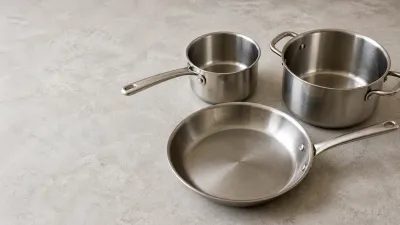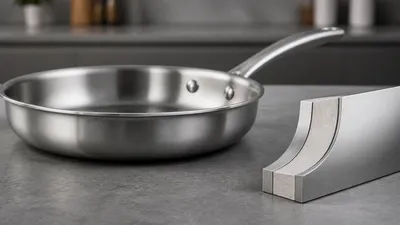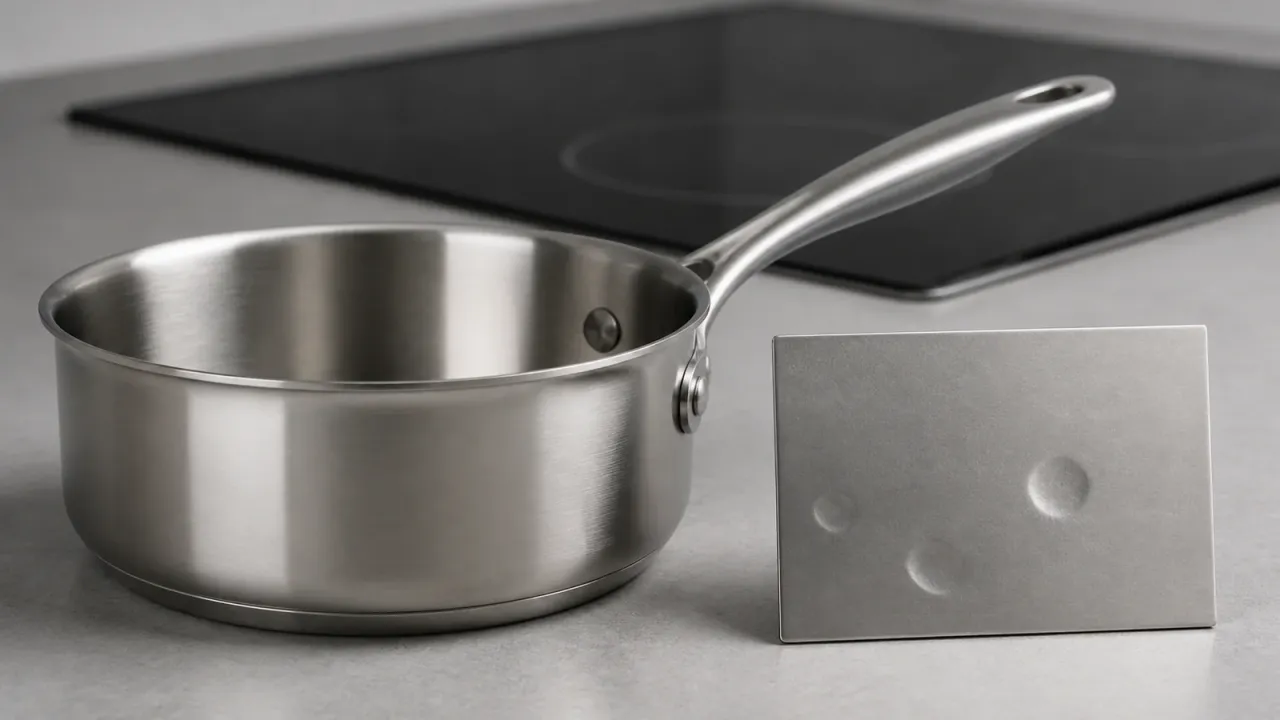
Stainless steel cookware pits when its protective passive film breaks down at small local areas, most often in chloride-bearing moisture that becomes concentrated by salt, heat, low pH, deposits, or stagnant crevices. A grade, finish, fabrication detail, or damaged spot can change the risk, but a photograph cannot prove that a mark is pitting or establish that a pitted pan is safe for food contact.
The practical response is to prevent concentrated salt and chloride contact, keep surfaces clean and dry, and treat a persistent cavity as a product-condition question. Cleaning may remove a deposit around a mark, but it cannot make a metal cavity disappear. Do not use a homemade chemical cure or a visual “safe enough” test on a pitted cooking surface.
What is pitting in stainless steel cookware?
Pitting is a highly localized form of corrosion that creates a small cavity in the exposed metal after the passive film fails at one or more points. Stainless steel normally forms a very thin chromium-rich oxide and hydroxide film when exposed to oxygen. That film slows the electrochemical reactions that would otherwise corrode the underlying metal.
The Outokumpu explanation of pitting corrosion describes pitting as local passive-film breakdown, commonly associated with chlorides, surface discontinuities, or damage. The exposed area can become a small anode next to a much larger still-passive surface, so a pit may deepen faster than its opening suggests. A small dark dot is therefore not automatically shallow or cosmetic.
Pitting is different from general discoloration. It removes or changes the metal at a localized point rather than simply leaving a film on top. It can occur on an apparently smooth surface, and corrosion products can partly cover the opening. That is why a casual wipe, fingernail check, or photograph cannot identify the mechanism or its depth with confidence.
How do salt and chloride cause pits?
Chloride ions can destabilize the passive film when they are present in a sufficiently aggressive local environment. The relevant exposure is not a universal kitchen concentration. A small amount of chloride can become much more aggressive when brine evaporates, salt crystals sit against a damp surface, a deposit traps liquid, or a crevice concentrates the solution.
Cooking salt is sodium chloride, so salt timing matters. Dry crystals left on a wet or heated stainless surface can dissolve into a concentrated chloride spot before they disperse. A salty liquid that remains in a pan or under a residue can also keep the surface wet and oxygen-limited. The BSSA food-processing corrosion guidance identifies chlorides, acidic conditions, and increased temperature as factors that promote pitting and crevice corrosion.
This does not mean that one grain of salt guarantees a pit or that adding salt at a particular moment makes every pan immune. There is no universal household chloride threshold that can predict pitting across grades, finishes, pan shapes, water chemistry, and exposure times. The useful habit is to dissolve salt promptly, avoid leaving concentrated brine or crystals against the steel, and rinse and dry the cool pan after salty cooking when the maker’s care instructions support that routine.
How do heat, acidity, deposits, and stagnation make pitting more likely?
Heat and low pH make a chloride-bearing environment more aggressive, while deposits and stagnant crevices let the local chemistry differ from the surrounding surface. Temperature alone does not diagnose pitting, but prolonged heat combined with wet salts, acid, or a trapped deposit gives the passive film a harder environment to maintain.
The Outokumpu corrosion-resistance guide lists chemical environment, pH, temperature, surface finish, product design, fabrication, contamination, and maintenance as factors that influence stainless corrosion. It also explains that deposits can limit oxygen and that chloride and acidity can build a more aggressive local condition.
Common cookware situations that can create those conditions include:
- adding salt crystals to a cool pan before cooking water has dispersed them
- allowing salty or acidic liquid to evaporate onto the surface
- leaving brine, sauce, or a wet food deposit under a rim or in a seam
- storing a damp pan with residue trapped against its surface
- using a cleaner or scouring tool that leaves chloride contamination, iron transfer, or deep scratches
- heating a pan while a concentrated deposit remains on the steel
- exposing a finish, weld, edge, or crevice to repeated wet-dry cycles without adequate cleaning
These are risk factors, not a visual diagnosis or a promise that a different routine will prevent every pit. A pan’s exact grade and finish still matter.
Can a stainless steel pan pit even if it is 304?
Yes. 304 is widely used and often suitable for kitchen and food-equipment environments, but it is not immune to chloride-driven pitting. A more corrosion-resistant grade may provide a larger margin in a demanding environment, yet grade selection cannot compensate for deposits, crevices, poor fabrication, surface contamination, or neglected care.
The 304 versus 316 stainless steel comparison explains why molybdenum-bearing 316 is often selected for more chloride-intensive conditions. That page owns the grade comparison. The narrower point here is that pitting resistance is a system question: alloy chemistry, finish, geometry, temperature, chloride concentration, exposure time, and maintenance interact.
Outokumpu notes that chromium, molybdenum, and nitrogen can improve resistance to pitting and crevice corrosion, while also warning that a calculated Pitting Resistance Equivalent is only a rough comparison and does not predict a real environment directly. Do not turn a grade number or a single PRE-style calculation into a cookware safety guarantee.
How do finish and fabrication affect pitting?
A smooth, clean, well-fabricated surface is generally easier to keep passive and clean than a rough surface with open seams, weld residue, deep scratches, or trapped deposits. Forming and welding can change local stresses and surface condition. Iron contamination from tools or steel wool can leave extraneous rust-like staining, while a weld that does not fully penetrate can create a crevice.
The BSSA food-processing sheet states that surface finish and condition are important to stainless-steel performance: smooth surfaces promote cleanability and reduce corrosion risk. Its guidance also identifies narrow solution-containing crevices, sharp re-entrant features, deposits, and heat-affected regions as possible sites for localized attack.
That does not mean every scratch causes a pit or every welded pan is defective. A scratch may be a surface groove without corrosion, and a sound welded seam may be designed for food contact. The relevant question is whether the exact surface remains intact, cleanable, and supported by the maker’s use and care instructions.
Is pitting the same as crevice corrosion?
No. Pitting begins as localized attack on a free surface, while crevice corrosion develops in a shielded or confined area where oxygen is limited and the local solution becomes more aggressive. The two mechanisms can overlap, especially where a deposit, rim, rivet, seam, or trapped food residue creates a stagnant pocket.
The BSSA corrosion-mechanisms guide explains that crevice corrosion is associated with low oxygen availability and chloride buildup in stagnant gaps or beneath deposits. It also notes that welds, fasteners, and joints can create crevices. A mark beside a rivet or under a rolled rim may therefore need a different assessment from a free-surface pit.
Do not widen a seam, pry at a rivet, or scrape inside a gap to investigate. Those actions can create the very damage that makes cleanability and corrosion harder to assess.
How can you tell pitting from scale, heat tint, rust transfer, or a scratch?
You cannot reliably identify the corrosion mechanism from a photo or a single appearance cue. You can clean and document a cool pan to separate a removable deposit from a persistent surface change, but confirmation of pitting, porosity, or a structural defect may require the manufacturer or a qualified materials professional.
These distinctions are useful as questions, not home diagnoses:
- Mineral scale can appear as white, chalky, raised spots or rings left by hard water. The white-spots guide explains why a deposit may change after a maker-approved cleaning step. A true cavity remains after the deposit is gone.
- Heat tint can look gold, blue, or rainbow-colored while remaining a smooth heat-related surface change. Color alone does not prove metal loss or pitting.
- Transferred rust can leave orange or brown residue when iron contamination or another rusty object contacts the pan. Outokumpu notes that extraneous rust from iron particles can discolor stainless steel without being the same as stainless pitting.
- A scratch is a line or groove that may be mechanical damage rather than a corrosion pit. A deep scratch can still reduce cleanability or expose a different layer, so do not dismiss it automatically.
- Porosity or a manufacturing void can look like a pinhole, inclusion, or cavity caused by production or fabrication rather than corrosion. Appearance alone cannot separate these causes.
- Crevice attack can concentrate under a rim, around a fastener, or within a seam, where it may be crevice corrosion or trapped residue rather than free-surface pitting.
If cleaning changes the mark, record what the maker-approved process removed. If a rough cavity, pinhole, spreading dark spot, leak, sharp edge, or exposed layer remains, stop treating it as a cosmetic stain.
Can salt before boiling water cause pitting?
It can increase the local risk when undissolved salt remains against wet, heated stainless steel, but it does not guarantee pitting and there is no universal salt-timing rule that applies to every pan. The practical prevention is to bring the water into motion first when the recipe and cookware instructions allow, add salt so it dissolves rather than sits on the steel, and avoid leaving salty water in the pan after cooking.
The reason is concentration and contact, not a special incompatibility between cookware and table salt. A dissolved, moving cooking liquid is different from a concentrated crystal or evaporating droplet trapped on a surface. Rinse and dry the cool pan after salty cooking, especially around rims, seams, and deposits. Follow the maker’s instructions if they specify a different care routine.
Do not use a universal “safe amount” of salt as a guarantee. Water hardness, chloride contamination from other products, temperature, grade, surface finish, and time all change the local conditions.
How can you prevent pitting in stainless cookware?
Prevention means limiting concentrated chloride contact and preserving a smooth, clean, well-drained surface. A conservative routine is:
- Dissolve salt promptly. Avoid leaving dry crystals against a wet or heated pan, and stir salted cooking water when appropriate.
- Do not store brine in the pan. Transfer leftovers and rinse salty or acidic residue according to the maker’s care instructions.
- Dry the pan and its seams. Moisture trapped under a rim, rivet, lid edge, or stacked pan can support stagnant conditions.
- Use compatible cleaners. Avoid chlorine bleach, chloride-contaminated products, and steel tools unless the exact maker explicitly permits them. Never mix cleaning chemicals.
- Protect the finish. Use the approved non-scratch tools and do not polish, sand, or grind a suspected pit.
- Keep deposits from baking on. Clean food, salt, and mineral residue before heating the empty pan again.
- Follow the product instructions. Grade, coating, base, handle, finish, dishwasher permission, and temperature limits belong to the exact cookware line.
These steps reduce common exposures but do not make a pan immune to localized corrosion. If the environment is unusually chloride-rich or the cookware is used in a commercial process, the grade and design should be selected by the maker or a corrosion professional rather than by a household rule.
If corrosion is accompanied by a rocking or distorted base, see why stainless steel pans warp for that separate structural problem.
How should you inspect a suspected pit?
Inspect a cool, clean, dry pan under good light, but treat inspection as documentation rather than a safety certification. Wash away removable residue using the exact cookware instructions, dry the surface, and photograph the area with the pan’s model information and purchase details. Compare the mark before and after cleaning without scraping or enlarging it.
Contact the manufacturer when the mark is persistent, the pan is under warranty, the material or finish is unknown, or the suspected pit is on the food-contact surface. Ask whether the maker considers the condition cosmetic, repairable, covered, or a reason to replace the pan. A materials or corrosion professional can assess an important or unusual failure more reliably than a home chemical test.
Stop using the pan for food contact while it is being assessed if you see a deep cavity, pinhole, leak, sharp raised edge, flaking surface, separated bonded layer, exposed core, or widespread active corrosion. Also stop if the pan has become unstable or cannot be cleaned reliably. Do not assume that a small-looking cavity is harmless because the opening is narrow; corrosion pits can extend below the visible surface.
Can you clean or repair a pitted stainless steel pan?
Cleaning can remove salt, scale, grease, or corrosion products around a mark, but it cannot restore metal that has been removed. A professional passivation process is not a universal home repair and should not be treated as proof that a damaged cooking surface is suitable for continued food contact.
Do not pour concentrated acid, bleach, pool chemicals, electrochemical solutions, or an improvised “rust remover” into a cookware pit. Do not use a grinder, file, drill, steel wool, or aggressive abrasive to make the cavity look smoother. Those methods can enlarge the defect, embed contamination, change the finish, or create an uneven surface that is harder to clean.
For ordinary deposits that are not pits, use the stainless-steel pan cleaning guide or the product maker’s approved method. If the surface remains physically depressed after compatible cleaning, move from cleaning advice to manufacturer or professional assessment.
Is pitted stainless steel cookware safe to use?
There is no appearance-only answer. A smooth stain or mineral deposit may be a different issue from a cavity, but a suspected pit in the food-contact surface should not be declared safe or unsafe without knowing its cause, depth, extent, surface condition, and the exact product guidance.
The broader stainless steel cookware safety guide explains why finished-article construction and intended use matter more than a broad material label. A pitted, flaking, separating, leaking, or difficult-to-clean surface deserves a maker decision or qualified assessment before it returns to food contact. If the maker cannot support continued use, replace the pan rather than attempting an unverified repair.
Frequently asked questions
Does salt always cause stainless steel cookware to pit?
No. Salt supplies chloride, but pitting depends on local concentration, moisture, temperature, acidity, exposure time, grade, surface condition, and geometry. Undissolved crystals or stagnant brine can raise risk without creating a universal threshold.
Can vinegar or tomato sauce cause pitting?
Acidic conditions can make localized corrosion more aggressive, especially when chloride and heat are also present. That does not mean every acidic meal pits stainless steel. Avoid long unattended residue, follow the maker’s care guidance, and ask for an assessment when a cavity remains.
Is pitting the same as rust?
Not necessarily. Rust-colored transfer or corrosion products may sit on the surface, while pitting is localized metal loss beneath a broken passive film. A photo cannot reliably distinguish transferred rust, scale, a scratch, a manufacturing void, crevice attack, and a true pit.
Can 304 stainless steel cookware pit?
Yes. 304 is corrosion-resistant but not immune to chloride-driven localized corrosion. A suitable grade, smooth finish, sound fabrication, clean surface, and appropriate environment work together.
Should you use a magnet or chemical test to identify a pit?
No. A magnet does not identify a corrosion mechanism, and a chemical test can damage a food-contact surface or create hazardous exposure. Use maker documentation and qualified assessment instead.
Can a pitted pan be made like new again?
Do not assume so. Cleaning can remove deposits, but it cannot replace missing metal. A professional may be able to assess or process some stainless components, but a home treatment is not a food-contact safety certification. Ask the manufacturer before using a suspected pitted pan again.
Sources
- Outokumpu, What makes stainless steel corrosion resistant? (retrieved 2026-08-22)
- Outokumpu, Testing stainless steel for resistance to pitting corrosion (retrieved 2026-08-22)
- British Stainless Steel Association, Corrosion hazards to stainless steels in food processing (retrieved 2026-08-22)
- British Stainless Steel Association, Corrosion mechanisms in stainless steel (retrieved 2026-08-22)
- U.S. Food and Drug Administration, Food Packaging and Other Food-Contact Substances (retrieved 2026-08-22)