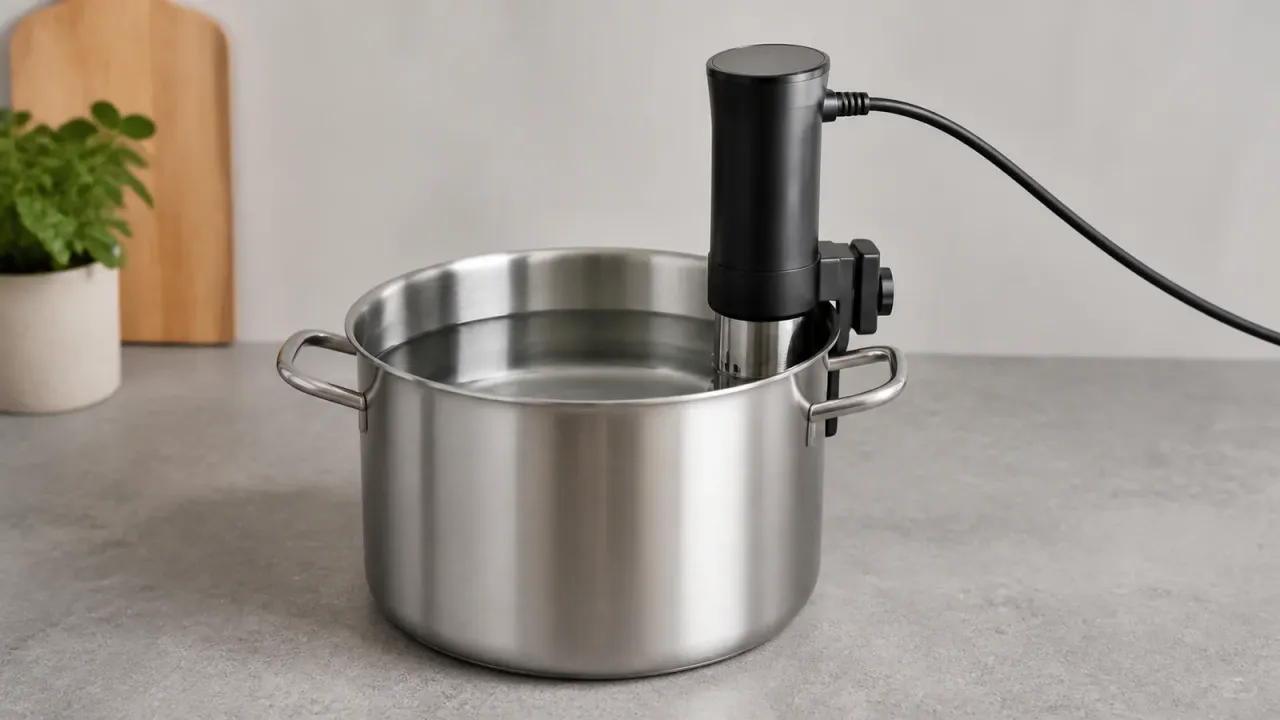
Yes, a stainless steel pot can hold a sous vide water bath when the vessel is stable and the immersion circulator’s instructions allow that setup. The food should remain in an intact, sealed bag, and the device’s water lines, clearance, electrical limits, and the food-safety process matter more than the word stainless on the pot.
This guide covers the vessel and water-bath setup. It does not provide a sous vide time or temperature schedule, approve every stainless container, or replace a tested recipe, the appliance manual, or food-safety guidance for the food you are preparing.
What role does stainless steel play in sous vide?
In a typical sous vide setup, the stainless pot is the water-bath vessel, the circulator heats and moves the water, and the food is separated from the bath by a sealed bag. The stainless body does not make the bag, circulator, or food-safety process automatically suitable.
The U.S. Food and Drug Administration’s Food Code describes sous vide packaging as raw or partially cooked food vacuum packaged in an impermeable bag, cooked in the bag, rapidly chilled, and refrigerated at temperatures that inhibit pathogen growth. That definition separates three questions that are easy to blend together:
- Is the pot compatible with the circulator and the amount of water needed?
- Is the bag sealed and suitable for the cooking use?
- Was the food cooked, cooled, and stored under a validated process?
Stainless steel can be a practical bath material because it is a rigid, heat-resistant vessel, but the complete pot still matters. A thin wall, damaged base, loose handle, non-stainless lining, or unknown coating can change the suitability of the finished item. For the broader food-contact distinction, see our guide to whether stainless steel cookware is safe.
Is a stainless steel pot compatible with an immersion circulator?
Often, but compatibility is model-specific. Use a pot only when the circulator maker’s instructions support that type of vessel and the assembled setup can stay upright without the appliance, cord, or bags being pulled against the rim.
Check the following before adding the food:
- The circulator can attach securely to the rim or to the vessel’s material. A magnetic foot is not a universal substitute for a clip; Breville’s Joule manual, for example, describes both a magnet for compatible steel cookware and a separate rim clip.
- The water level will stay between that model’s minimum and maximum lines after the bags are added. The food and displacement can raise the water level.
- The pot is deep and wide enough for the device’s stated limits and for water to move around the bags. Do not crowd bags against the intake, outlet, or heating area when the manual warns against obstructing circulation.
- The pot rests on a heat-safe, stable surface away from the counter edge. Do not move a vessel containing hot water unless the appliance instructions explain how to do so safely.
- The cord and plug remain above water and away from hot surfaces. Breville’s Joule instructions explicitly say never to submerge its cord.
The metal’s grade does not establish these operating limits. For example, Breville gives Joule-specific minimum and maximum water depths, while Anova tells users to keep the water above its MIN line and below its MAX line. Those numbers belong to those products, not to every immersion circulator or stainless pot.
How deep and wide should the stainless pot be?
Choose the vessel from the circulator’s dimensions and water limits, not from the pot’s material label or its advertised capacity. You need enough depth to cover the required portion of the device, enough volume for the bags to remain submerged, and enough open water for circulation.
Do not fill to the rim. Account for displacement from sealed bags, clips, racks, and the circulator, and leave the clearance the maker specifies. A shallow pan may fail to reach the minimum water line; a very tall or narrow pot may make the appliance unstable or leave too little room around the bags.
As a device-specific example, Breville’s Joule manual says the water should cover at least the bottom 1.5 inches of the device while staying no higher than 1 inch below the pot’s top. The same manual lists a maximum water depth of 8 inches and different approximate water volumes for covered and uncovered vessels. Anova’s current support guidance likewise says to keep the water above MIN, below MAX, and topped up during longer cooks when evaporation lowers the level.
Treat these figures as examples to show why the exact manual controls. They are not a universal stainless-steel pot specification.
Do you need a lid or cover for a stainless steel sous vide pot?
Not always, but a cover can reduce evaporation and heat loss during a long water-bath session. Anova recommends a cover or foil on its vessel to reduce heat-up time and improve efficiency, and its current lid page says a cover helps keep water from running low.
Use a lid, foil arrangement, or insulation accessory only when it fits the circulator and does not press on the device, trap the cord, block the controls, or make the vessel unstable. Do not make an airtight enclosure around an appliance unless its instructions specifically allow it. Leave a safe route for the circulator and monitor the water level anyway.
If the water drops below the device’s minimum line, stop and follow the appliance’s low-water procedure. Adding water to a running bath can also change the water level and temperature, so use the manual rather than guessing how much to add.
Can food touch the stainless steel pot directly?
No. In normal sous vide use, the food belongs in a sealed, impermeable or otherwise cooking-approved bag, not loose in the water. Anova’s setup guidance says to add food in a sealed bag and notes that the food itself does not touch the water. The stainless pot holds the bath; it is not a substitute for the bag.
Inspect the seal before the bag enters the bath. Keep the opening above the water when the bag design requires it, use a clip or rack only as directed, and arrange bags so they do not float into the circulator or cover its inlet and outlet. A punctured, leaking, or unsealed bag changes both the food-contact question and the reliability of the cook.
Do not infer that any plastic pouch is cooking-safe just because it is marketed as a storage bag. Follow the bag maker’s temperature, sealing, and intended-use instructions, and use the recipe or appliance guidance for the particular food. The FDA definition of sous vide packaging calls for an impermeable bag, but it does not turn every household bag into an approved cooking material.
Can salt or chlorides damage a stainless sous vide pot?
Stainless steel resists corrosion, but it is not immune to chloride-related pitting. World Stainless notes that stainless steels can suffer localized corrosion in chloride-bearing water and that salt and chloride-containing cleaning products can encourage pitting when used incorrectly.
For an ordinary water bath, do not add salt, bleach, or a chloride cleaner merely because the pot is stainless. Use the water and cleaning method specified by the appliance and pot makers. After use, empty the bath, rinse residue away, and dry the pot and any exposed metal parts. Do not leave salty water or food residue sitting in seams, rivets, scratches, or crevices.
A stain is not automatically a food-safety failure, but deep pits, active corrosion, a damaged lining, or a surface that is flaking or separating should take the pot out of service until the maker assesses it. Stainless composition alone cannot certify a damaged finished article.
Are sous vide time and temperature automatically safe?
No. A stainless pot can hold the bath without proving that the food reached a safe result. Food safety depends on the food, thickness, starting condition, bag seal, bath accuracy, time at temperature, and cooling and storage steps.
The FDA Food Code says heat processes for sous vide and cook-chill operations must be designed to destroy vegetative pathogens through pasteurization and have verified temperature control. That is a process-control requirement, not a universal home schedule. The FDA also warns that reduced-oxygen packaging needs appropriate controls because refrigeration and temperature abuse can create hazards.
Do not judge pasteurization from color, texture, or the absence of bubbles. Use a current, tested recipe or food-safety source for the specific food and device, and use an appropriate thermometer when the instructions call for verification. This article intentionally does not translate those sources into a time or temperature table.
How should you cool and store sous vide food?
If the food will not be eaten promptly, follow a tested rapid-cooling and refrigeration procedure while it remains sealed. The FDA’s sous vide definition includes rapid chilling and refrigerated storage, and USDA FSIS guidance treats sous vide packaging as refrigerated food rather than shelf-stable food.
Do not leave a sealed bag in a warm bath, on the counter, or in a switched-off circulator and assume the stainless pot will keep it safe. Move it into the cooling method specified by the recipe or food-safety authority, then refrigerate it promptly. Keep the refrigerator at the temperature recommended by current USDA guidance and use the recipe’s storage window rather than inventing one from the pot material.
When a power interruption, low-water shutoff, broken seal, or uncertain cooling step occurs, stop and assess the food using a reliable food-safety source. The pot cannot correct a process that was not controlled.
Is the stainless pot an electrical hazard with a circulator?
The pot is a water vessel, but the circulator is an electrical appliance. Keep the plug, cord connection, and any portion the manual says must stay dry above the bath. Breville’s Joule manual specifically says never to submerge its cord, and Anova’s setup guidance directs users to attach the cooker before plugging it in.
Keep the counter dry, inspect the cord and plug before use, and follow the exact appliance safety instructions and local electrical requirements. Do not place the device on a burner or in an oven unless the maker specifically designed that model for the use. If the appliance, cord, or pot is damaged, do not improvise a repair or continue the cook.
These are electrical and appliance limits, not properties that can be inferred from 304, 316, 18/10, or any other stainless label. For a separate appliance boundary, our guide to stainless steel in an oven explains why a cookware body’s material does not rate every attached component.
Should you sear the food in the stainless sous vide pot?
Usually no. The pot is holding the water bath, not providing the dry, high-heat surface used for finishing. Anova’s product guidance treats searing or grilling as a separate finishing step after the sous vide cook.
Remove the sealed food from the bath, open and dry it according to the recipe, and use a pan or grill whose complete construction is approved for that finishing method. Empty the water bath and let the stainless pot cool before cleaning. Do not heat an empty sous vide vessel, an attached circulator, or a wet bag on a burner.
Frequently asked questions
Can I use any stainless steel pot for sous vide?
No. Use a pot that can hold the required water level, attach the exact circulator securely, leave room for circulation, and remain stable on a heat-safe surface. The device manual controls when it differs from general stainless cookware advice.
Does stainless steel make sous vide food safe?
No. Stainless steel describes the vessel material. It does not validate the bag, cooking process, pasteurization step, cooling method, or storage time. Those controls must come from a tested food-specific procedure and current food-safety guidance.
Can I leave food in the bath after the circulator stops?
Do not assume that you can. A stopped circulator may allow the bath to drift, and a power interruption can break the tested process. Follow the recipe or food-safety authority’s instructions for checking, finishing, cooling, or discarding the food.
Can I use salt water in a stainless sous vide pot?
Do not make salt water the default. Chlorides can contribute to pitting on susceptible stainless surfaces, and the salt is not needed merely because the bath is stainless. Follow the appliance and recipe instructions, then rinse and dry the vessel.
Which sources support this guidance?
This is research-based guidance, not a hands-on test of a particular stainless pot, circulator, bag, or food. Device limits, bag instructions, and food-safety procedures vary, so the exact maker manual and a current food-safety authority take priority.
- U.S. Food and Drug Administration, Summary of Changes to the 2013 Food Code, sous vide packaging definition, accessed August 22, 2026.
- U.S. Food and Drug Administration, 2022 Food Code, reduced-oxygen packaging and sous vide process-control guidance, accessed August 22, 2026.
- USDA FSIS, Shelf-Stable Food, sous vide packaging and refrigeration guidance, accessed August 22, 2026.
- Anova Culinary, Hardware support, MIN/MAX water levels and cover guidance, accessed August 22, 2026.
- Anova Culinary, Precision Cooker, sealed-bag setup and product limits, accessed August 22, 2026.
- Breville, Joule instruction manual, vessel, water-depth, clip, and cord guidance, accessed August 22, 2026.
- World Stainless, Corrosion properties, chloride-related pitting guidance, accessed August 22, 2026.
For material context beyond the bath vessel, see our guide to what food-grade stainless steel means and the pros and cons of stainless steel cookware. Those guides explain finished-product claims without treating an alloy label as a universal approval.