Yes, Bar Keepers Friend can be used on some bare stainless steel, but it is not a universal permission for every silver-colored surface. Check the exact BKF variant, then check the maker’s instructions for the pan, sink, or appliance. A compatible bare surface still needs a small spot test, gentle grain-direction wiping where a grain is visible, the label’s short contact time, thorough rinsing, and drying.
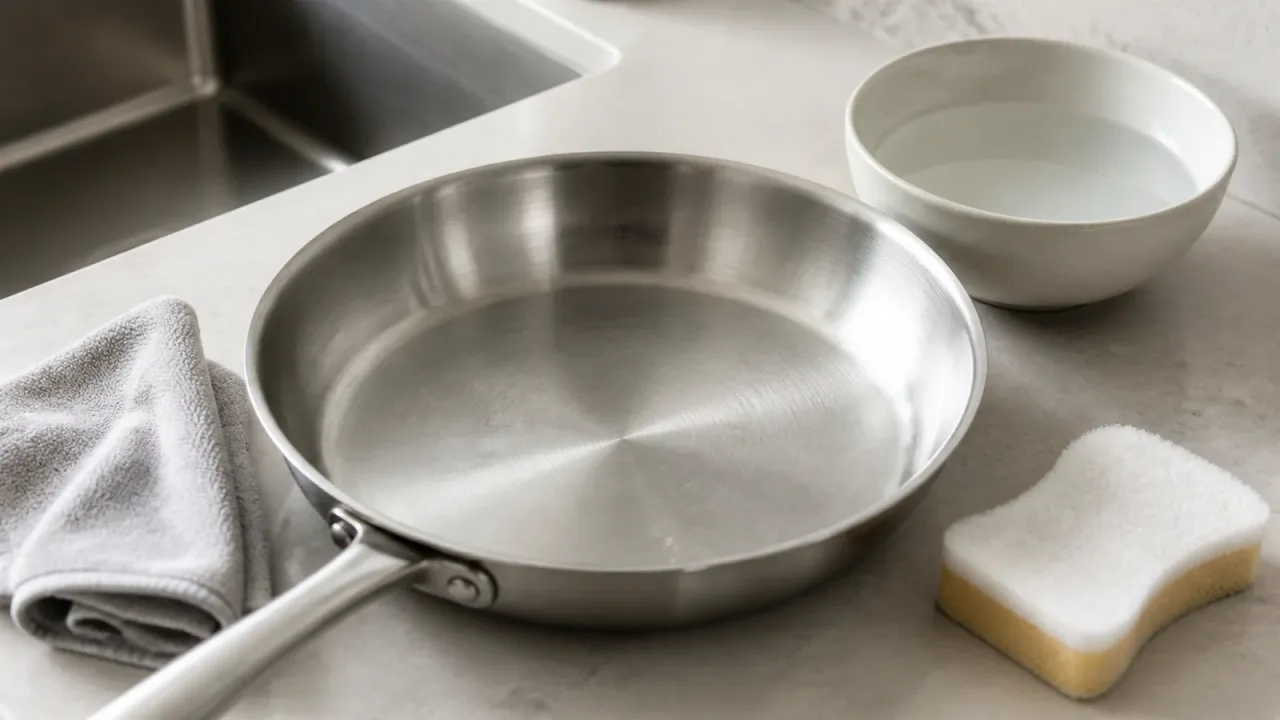
This article covers the current Bar Keepers Friend powder, cookware cleanser, soft cleanser, stainless steel polish, and spray or foam directions. It does not replace the label, Safety Data Sheet (SDS), or the manual for your exact surface. The hero is a conceptual illustration and does not verify any cleaner, finish, or hidden construction.
Hero illustration: an unbranded stainless pan and gentle cleaning tools shown for context; it does not verify cleaner compatibility or the finish of any product.
Can you use Bar Keepers Friend on stainless steel?
You can use a BKF product on compatible, uncoated stainless steel when both the product label and the surface maker allow it. The powder and liquid cleansers contain an abrasive component and are different from BKF Stainless Steel Cleaner & Polish, which is intended for routine stainless appliance care.
The practical answer depends on the surface:
| Surface | Conditional answer | Safer starting point |
|---|---|---|
| Bare stainless cookware | Often yes, if the cookware maker permits that cleanser | Warm water, dish soap, and a soft sponge |
| Bare stainless sink | Often yes, if the sink maker permits it | Mild soap and water, then a compatible cleanser for remaining marks |
| Traditional stainless appliance | Only if the appliance maker permits the exact variant | The appliance manual and its named cleaner |
| Fingerprint-resistant, black, or premium coated finish | Do not assume yes | Warm water, mild soap, and a soft cloth unless the maker says otherwise |
| Plated, PVD, painted, or otherwise unknown surface | Do not assume it is bare stainless | Stop and identify the finish first |
“Stainless steel” can describe a food-contact surface, an exterior skin, or a thin decorative finish over another material. A cleaner’s claim that it works on stainless steel cannot identify a coating or override a surface maker’s warning.
Which Bar Keepers Friend product should you use?
Choose the variant by the surface and soil, not by the brand name alone. Powder and liquid cleanser variants are the products with an abrasive ingredient, while the stainless polish is a non-cookware routine-care product according to BKF’s current product pages.
Cookware Cleanser & Polish
BKF’s Cookware Cleanser & Polish is labeled for baked-on food and discoloration on stainless steel, enamel, and glass cookware. Its current ingredient list names glass oxide abrasive, oxalic acid, and surfactant. The label direction is to sprinkle it on a wet surface, rub gently with a wet cloth or sponge, rinse thoroughly within one minute, and wipe dry. For a difficult stain, the label permits a paste for up to one minute, not a longer soak.
Read the current Cookware Cleanser & Polish directions before use. “Cookware” on the container does not make a coated, plated, or maker-prohibited pan suitable for the product.
Powder Cleanser
BKF Powder Cleanser is a separate powder variant with glass oxide abrasive, oxalic acid, and surfactant listed on the current product page. The directions are to sprinkle it on a wet surface, rub gently with a wet cloth or sponge, rinse within one minute, and wipe dry. The page also says to test a small hidden area first.
The Powder Cleanser page says its stainless-steel use includes some appliances, but it also distinguishes magnetic appliance finishes and recommends BKF Stainless Steel Cleaner & Polish for those surfaces. Treat that as product guidance, not a rule for every appliance brand.
Soft Cleanser
BKF Soft Cleanser is the ready-to-use liquid variant. Its current directions say to shake it, apply a small amount to a wet surface or damp sponge, avoid overapplying, rinse within one minute, wipe dry, and test an inconspicuous spot first. Its ingredient list includes water, oxalic acid, glass oxide abrasive, glycerin, citric acid, surfactants, and fragrance.
The Soft Cleanser directions say the product is for stainless steel and other listed surfaces. That does not establish permission for a fingerprint-resistant clear coat, a PVD finish, or a manufacturer’s proprietary coating.
Stainless Steel Cleaner & Polish
BKF Stainless Steel Cleaner & Polish is intended for stainless appliance surfaces, sinks, fixtures, range hoods, grills, and similar exteriors. The current directions say to shake it, spray the surface, wipe along the grain with a soft dry cloth, and buff dry. For heavy soil, the page allows about one minute of dwell before gentle work with a non-abrasive nylon-mesh sponge or microfiber towel.
Do not substitute this polish for a cookware cleanser just because both products mention stainless steel. BKF’s own Stainless Steel Cleaner & Polish guidance says it is for appliance-style surfaces, while its FAQ points pan users to Soft Cleanser or Powder Cleanser.
Superior Multi-Purpose Cleaner
BKF Superior Multi-Purpose Cleaner is a non-abrasive spray and foam variant for listed surfaces such as stainless steel, countertops, and tile. Its current directions say spray or mist from 6 to 8 inches, rub thoroughly, and rinse or wipe dry within one minute. For foam, the page permits a one-minute stand before wiping and rinsing. It specifically says to rinse cookware and food-contact surfaces after cleaning.
The Superior Multi-Purpose Cleaner directions do not turn the product into a universal cookware cleaner. Use the product named for the exact surface and soil, and rinse any food-contact item completely.
Is Bar Keepers Friend safe for every stainless steel finish?
No, because stainless-looking surfaces can have coatings, plating, PVD, paint, or a clear protective layer that changes the care rule. Bare stainless, traditional appliance stainless, and fingerprint-resistant appliance stainless are not interchangeable categories.
Bare or uncoated stainless cookware
Bare stainless cookware is the clearest case for a cookware-labeled BKF cleanser, but the cookware maker still controls. All-Clad’s current care guidance starts with warm water, gentle dish soap, and a soft sponge, then lists its own stainless cleaner for tougher marks while warning against steel wool, bleach-based cleaners, oven sprays, and harsh abrasives. A maker-approved BKF method should be treated the same way: short, local, gentle, and fully rinsed.
The guide to cleaning stainless steel pans can help identify whether the mark is stuck food, burnt oil, mineral deposit, heat tint, or structural damage before you choose a cleanser.
Traditional stainless appliance surfaces
Traditional appliance stainless may accept a compatible cleaner, but the appliance manual still matters. GE’s current stainless-care guidance allows BKF Soft Cleanser for rust, tarnish, and small blemishes on true stainless, with liquid cleanser only, a damp soft sponge, and wiping in the metal grain. That is GE guidance for its named traditional stainless surfaces, not a blanket instruction for other brands.
Whirlpool’s current traditional-stainless guidance says to use warm soapy water and a nonabrasive sponge, follow the grain, dry completely, and use only products designed for stainless steel. That wording supports checking the exact cleaner and finish rather than assuming a powder is acceptable.
Fingerprint-resistant, black, and premium finishes
Treat fingerprint-resistant, black, and premium stainless finishes as coated until the appliance maker says otherwise. GE says its fingerprint-resistant stainless has a clear coat and directs owners to mild soap, warm water, and a soft or microfiber cloth. GE specifically says not to use stainless steel cleaners, abrasive cleaners, bleach, vinegar or other acidic cleaners, oven cleaners, or abrasive cloths on that finish.
Whirlpool gives similar guidance for fingerprint-resistant stainless: warm water and mild soap, then a soft or microfiber cloth, while warning against abrasive or harsh cleaners, chlorine bleach, steel wool, gritty cloths, and paper towels. A BKF product page cannot override those finish-specific instructions.
Plated, PVD, painted, or unknown surfaces
Do not apply BKF to plated, PVD, painted, or unknown surfaces until the maker identifies the finish and permits that exact product. A surface may look like brushed stainless while its visible layer is a coating. Cleaning cannot restore a coating that has begun peeling, and abrasion can change a finish even when the underlying metal is stainless.
How should you use it on compatible bare stainless steel?
Use the least aggressive compatible BKF variant on a cool, wet, small area, then follow its label for a short contact time, gentle wiping, complete rinsing, and drying.
- Identify the surface and the residue. Confirm that the item is bare or maker-approved stainless, and separate burnt oil, mineral deposits, heat tint, rust, and structural damage before choosing a product.
- Read the exact BKF label and the surface maker’s instructions. Do not borrow a powder direction for Soft Cleanser, or a cookware direction for an appliance polish.
- Cool the item and remove loose soil with warm water and dish soap. Do not put a hot pan under cold water.
- Test an inconspicuous spot, especially on a polished surface, visible appliance panel, sink edge, or finish you cannot identify with certainty.
- Wet the surface. For powder, sprinkle only enough to control a damp slurry. For Soft Cleanser, use a small amount on a wet surface or damp sponge. Do not make a dry cloud of powder.
- Work with a soft cloth or non-scratch sponge and light pressure. Follow a visible brushed grain instead of scrubbing across it. On a mirror finish with no visible grain, use the lightest pressure and stop if the shine changes.
- Keep contact within the exact label limit. Current powder, Cookware Cleanser, and Soft Cleanser directions call for rinsing within one minute; the Cookware Cleanser label permits a difficult-stain paste for up to one minute.
- Rinse thoroughly, especially on cookware, sinks used for food preparation, and any food-contact item. Wipe dry and inspect before repeating a short treatment.
Do not leave a paste on overnight, use a stronger variant because the first pass was slow, or scrub harder to compensate for an unknown finish. The label’s short contact time is a limit, not a suggested starting point for a long soak.
What safety rules apply to Bar Keepers Friend?
Follow the exact product label and SDS, avoid ingestion and eye contact, use the label’s PPE and ventilation directions, and never mix BKF with another cleaner. BKF’s current product pages say to call a doctor immediately after accidental ingestion, flush eyes with water for 15 minutes after contact, and use gloves for prolonged use or sensitive skin.
The current product pages link separate SDS files for Cookware Cleanser, Powder Cleanser, Soft Cleanser, Stainless Steel Cleaner & Polish, and Superior Multi-Purpose Cleaner. Formulas and hazard information can differ by variant and market, so use the SDS linked from the product you actually have. Do not infer a universal respirator, glove material, exposure limit, or neutralization method from a different product.
Keep the container closed and avoid making dust or spray mist. Work with the ventilation named by the label or SDS, keep the product away from food while cleaning, wash residue from tools, and store the container where children and pets cannot reach it. If the label for your variant gives stricter instructions, follow those instructions.
Never mix BKF with bleach, ammonia, vinegar, acids, alkaline cleaners, or another product. Do not try to neutralize one cleaner with another. If you change methods, rinse the surface thoroughly first and start over with the next product only if the surface maker permits it. Poison Control’s household-cleaner guidance explains why common cleaner combinations can release dangerous gases.
When should you choose a milder method or stop cleaning?
Choose warm water and mild dish soap first when the residue is routine soil, and stop escalating when the finish, surface identity, or damage is uncertain. A stronger cleaner is not a substitute for diagnosis.
Use the stainless steel cleaner guide to separate cookware cleanser, appliance polish, and sink products. Use the focused burnt-oil removal guide when the mark is a sticky brown film rather than a mineral deposit or heat tint. BKF may remove a compatible stain, but it cannot repair scratches, pitting, peeling coatings, delamination, a loose handle, or a warped base.
For smooth blue, gold, purple, or rainbow color, compare the rainbow stains guide before using an abrasive cleanser. Heat tint is a different problem from burnt oil, and a gentle maker-approved method may be enough.
Stop if the test spot dulls, scratches, changes color, or exposes a different layer. Stop using a pan if its food-contact coating is peeling or bonded layers are separating. Stop using an appliance finish if the clear coat is lifting. Photograph the condition, record the model number, and ask the surface maker before trying another chemical.
Frequently asked questions
Can you use Bar Keepers Friend on a stainless steel pan?
You can use a cookware-labeled BKF cleanser on compatible bare stainless steel when the pan maker permits it. Use the exact label’s short contact time, light pressure, thorough rinsing, and drying. Do not transfer that permission to nonstick, enamel, PVD, plated, or unknown finishes.
Is Bar Keepers Friend abrasive?
The current Powder Cleanser, Cookware Cleanser, and Soft Cleanser ingredient lists include glass oxide abrasive. BKF’s Superior Multi-Purpose Cleaner is described as non-abrasive, while Stainless Steel Cleaner & Polish is positioned for routine appliance surfaces. “Non-abrasive” still does not override a coated appliance maker’s instructions.
Can you leave Bar Keepers Friend on overnight?
No. Current powder, Cookware Cleanser, and Soft Cleanser directions call for rinsing within one minute, with the Cookware Cleanser allowing a difficult-stain paste for up to one minute. Do not invent a longer dwell time for a stubborn mark.
Can Bar Keepers Friend remove scratches from stainless steel?
No cleaner can be assumed to remove scratches. Abrasion may alter the appearance of a brushed or polished surface, and it cannot repair a peeled coating, pit, warped base, or separated bonded layer. Follow the maker’s finish guidance and stop when a mark may be physical damage.
Can you use Bar Keepers Friend on a stainless steel refrigerator?
Only if the refrigerator maker permits the exact variant and the surface is a compatible traditional stainless finish. Fingerprint-resistant or black stainless doors often have a clear or colored coating, and makers such as GE and Whirlpool direct owners to mild soap and soft cloths instead of abrasive or specialty stainless cleaners.