The safest way to clean a stainless steel appliance is to check its model-specific care guide, switch it off or disconnect power as the guide requires, then use a soft cloth with mild soap and warm water. Wipe a traditional brushed finish in the direction of its grain, remove soap with a clean damp cloth, and dry the panel completely. Fingerprint-resistant, black, painted, and other coated finishes may have different limits, so do not assume a silver-looking panel is bare stainless steel.
Keep liquid away from controls, vents, dispensers, seams, gaskets, and other openings. Do not spray a cleaner into or onto those areas. A cleaner that is suitable for one appliance finish may leave streaks or damage another.
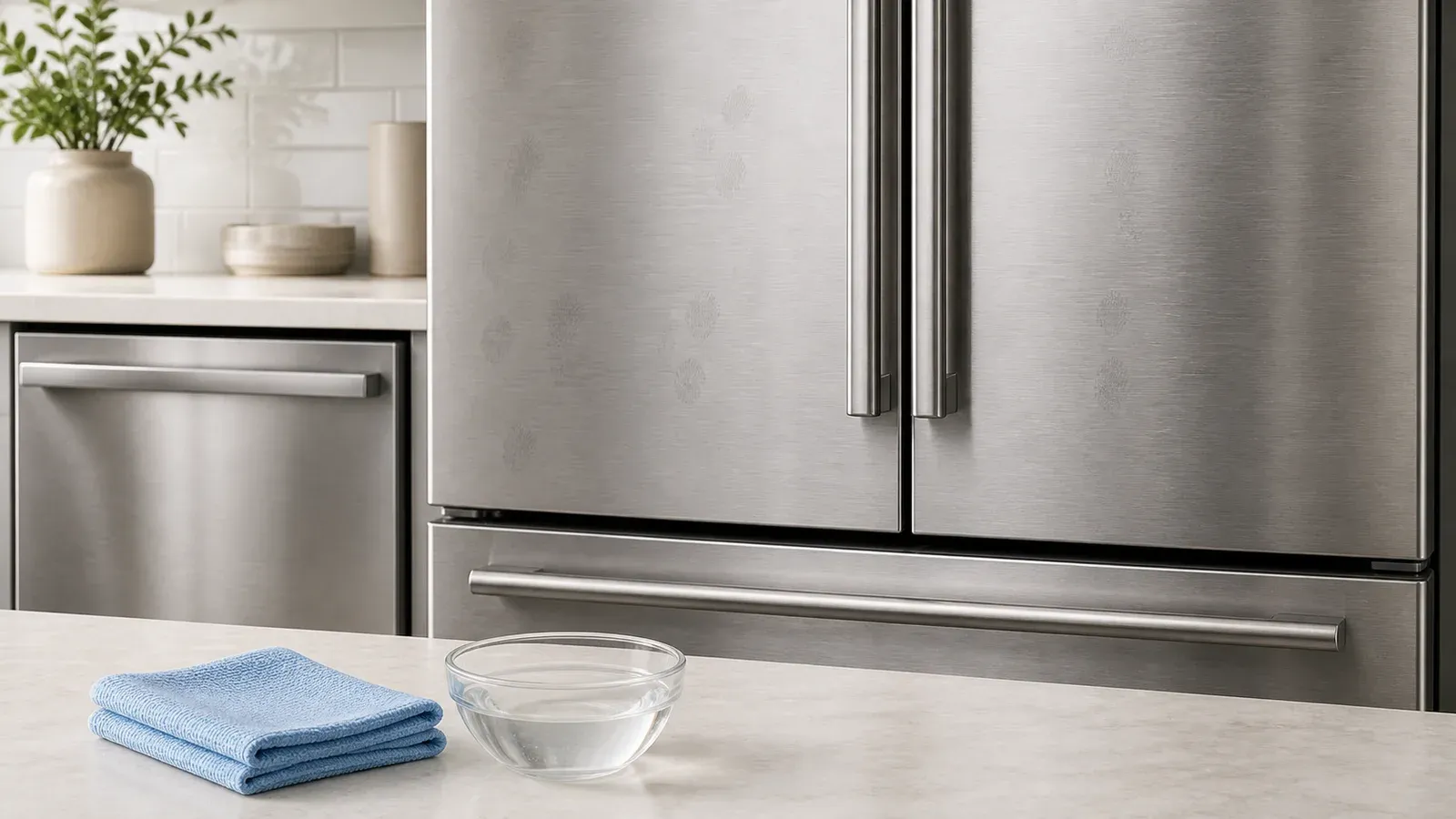
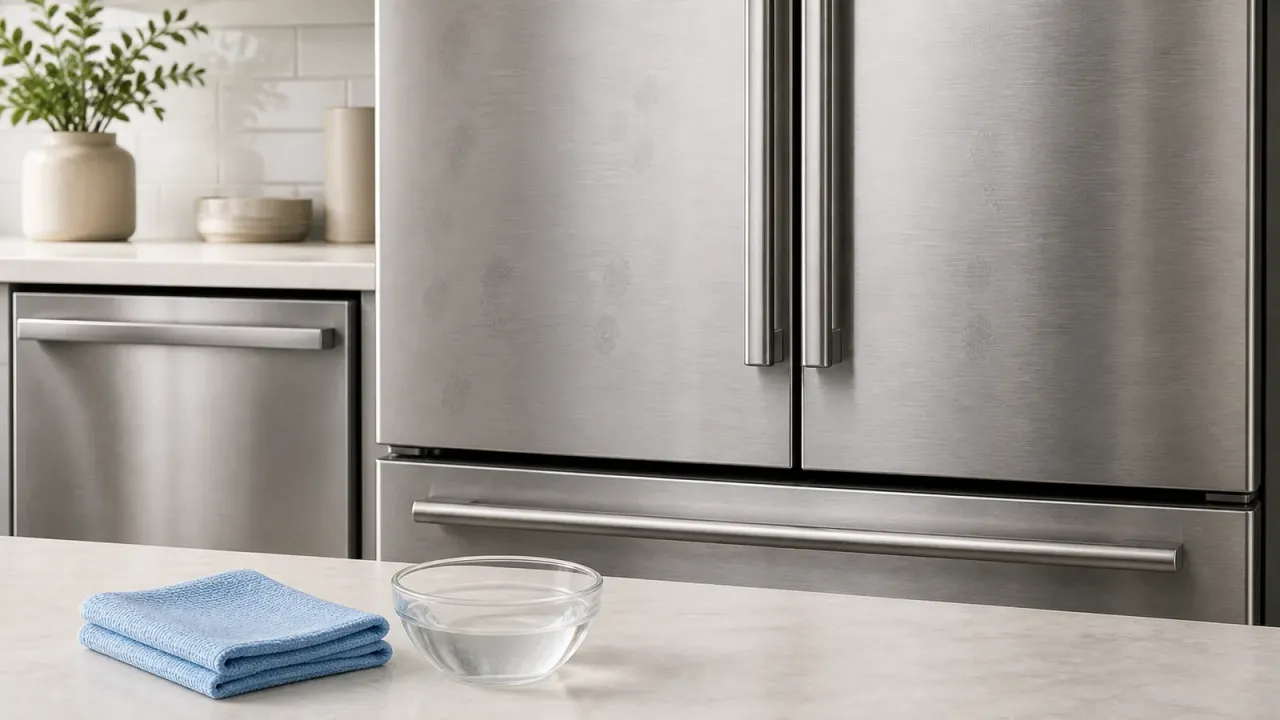
Illustration only: the cloth, water, fingerprints, and streaks are visual cues. This image does not verify hidden construction, finish type, or a real appliance’s cleaning instructions.
For cleaner selection, see our guide to the best stainless steel cleaners. It separates appliance products from cookware and sink treatments. This article covers routine exterior care for refrigerators, dishwashers, ranges, microwaves, and similar appliances. It does not cover appliance interiors, cookware interiors, broad scratch restoration, or a universal cleaner recipe.
What is the safest way to clean stainless steel appliances?
Use this conservative sequence for an intact exterior unless the owner’s manual gives a different method:
- Identify the appliance and finish. Find the model number and read the cleaning section of the owner’s manual. Look for terms such as traditional stainless, fingerprint-resistant, black stainless, metallic, painted, or clear-coated. A visual match is not proof of the construction.
- Turn the appliance off and make it safe. Stop cycles, turn controls off, and disconnect power when the manual directs it or when cleaning near controls, seams, or electrical components. Let hot surfaces cool. Never make a powered appliance wet just to save a step.
- Remove loose dust and crumbs. Use a dry, soft cloth before adding water. This reduces the chance of dragging grit across the finish.
- Dampen the cloth, not the appliance. If the manual permits soap and water, use a small amount of mild dish soap in warm water on a clean microfiber or other soft cloth. Wring it out so it is damp rather than dripping. Do not spray a panel, control, vent, dispenser, gasket, or opening directly.
- Wipe with the finish. On a brushed traditional stainless panel, follow the visible grain with light, even passes. If there is no visible grain, use the gentle method in the manual rather than guessing a direction.
- Remove residue. Use a second cloth dampened with clean water to lift soap or cleaner when the manual calls for rinsing. Keep the cloth away from openings and non-stainless trim unless the maker includes those parts in the instructions.
- Dry completely. Buff with a clean, dry, soft cloth in the same direction. Drying removes water that can leave spots and prevents a thin soap film from looking like fresh streaks.
- Inspect before escalating. If the panel is still marked, decide whether the residue is on the surface or the finish itself. Stop if the color, texture, coating, or sheen changes.
Whirlpool’s stainless-surface care guidance gives traditional stainless a warm, soapy wash, grain-direction wiping, and thorough drying. GE gives its fingerprint-resistant stainless a different routine: mild soap and warm water followed by a dry soft cloth. Those are manufacturer examples, not permission to copy one brand’s instructions to another model.
How can you tell what finish an appliance has?
Use the owner’s manual, model support page, or the manufacturer rather than relying on color, reflection, or the words “stainless look.” Appliance exteriors commonly fall into several groups:
| Finish or part | What the maker may allow | What remains unknown |
|---|---|---|
| Traditional brushed stainless | Mild soap and water, a soft cloth, grain-direction wiping, and complete drying are common starting points | Whether a specific polish or stain treatment is approved |
| Fingerprint-resistant stainless | Mild soap and water with a soft or microfiber cloth is common | Whether the panel has a clear coat, and which cleaners can dull it |
| Black stainless, painted, or metallic finish | The model guide’s finish-specific cloth and cleaner directions | Whether the visible color is a coating, plating, or another construction |
| Controls, trim, gaskets, and dispensers | A separate wipe-down method, often with very little moisture | Whether they can tolerate stainless polish or any liquid cleaner |
GE explains that its fingerprint-resistant stainless has a clear coat over the steel and says not to use stainless cleaners, abrasives, bleach, chlorine, paper towels, window sprays, ammonia, vinegar-based cleaners, oven cleaners, or alkaline cleaners on that finish. Whirlpool likewise warns that abrasive cloths, paper products, steel wool, powders, ammonia, citrus cleaners, vinegar-based cleaners, and oven cleaners can damage its fingerprint-resistant and black stainless finishes.
The practical rule is simple: a finish that looks like stainless steel may not be exposed stainless steel. If the manual is missing, use only the mildest damp-cloth method on a small, inconspicuous area and contact the maker before using polish, acids, abrasives, or a stain treatment.
How should you clean a traditional stainless steel exterior?
For a model whose manual identifies a traditional stainless exterior, start with warm water, a little mild detergent, and a soft cloth. Wipe evenly along the grain, use clean water to remove residue if directed, and dry the whole panel. Work in small sections so the cleaning solution does not dry in place.
Fingerprints usually need less product than people expect. A clean, dry microfiber cloth may lift fresh oil from a sound finish. If it does not, use the damp mild-soap method rather than adding more polish. Excess product is a common source of cloudy streaks, especially around handles and edges.
For a stubborn mark, first ask what it is. Dried food, mineral residue, heat discoloration, rust, a scratch, and a worn finish are different problems. Use a manufacturer-approved stainless product only when the manual permits it, and keep that product off plastic trim, rubber gaskets, painted parts, and controls. Whirlpool specifically says not to use stainless polish on non-stainless parts such as trim and door gaskets.
Do not treat Maytag’s consumer cleaning article as a universal formula. It offers examples for its appliance families and still tells readers to consult the owner’s manual. The model-specific Maytag range care page separately lists control-panel, fingerprint-resistant, and stainless-steel finish care.
How should you clean a fingerprint-resistant or coated panel?
Start with the finish maker’s simplest approved method: a clean soft or microfiber cloth, mild soap, and warm water, followed by thorough drying. Do not reach for a stainless polish just because the panel is silver. On a coated finish, polish, vinegar, ammonia, chlorine, abrasive powder, steel wool, paper towels, or oven cleaner can change the sheen or scratch the clear coat.
Use only enough water to dampen the cloth, and keep the cloth away from control gaps, vents, dispensers, and door seams. If a fingerprint remains, make another light pass rather than pressing harder. Pressure does not repair a coating and can make a dull spot more visible.
If you do not know whether the finish is coated, preserve that uncertainty. Locate the model instructions or ask the manufacturer. A hidden-spot test can show whether a product changes one area, but it cannot prove long-term compatibility, so it is not a substitute for the care guide.
How should you clean refrigerator doors, dishwasher fronts, and handles?
Treat each exterior surface as a separate part of the appliance:
- Refrigerator doors and drawers: wipe spills promptly, then clean the broad panel with the finish-approved cloth method. Dry around the lower edge, handle mounts, and door gasket without pushing liquid into the seal.
- Dishwasher fronts: clean the outside door only with the approved exterior method. Keep moisture out of the top control strip, door edge, latch area, and gaps around the handle. The stainless tub and racks are interior surfaces with separate instructions.
- Range and microwave exteriors: turn controls off and let hot surfaces cool. Follow the manual for the control panel, knobs, vent trim, door glass, and stainless frame rather than spreading one cleaner over all of them.
- Handles and trim: these may be plastic, rubber, painted metal, or a different stainless finish. Wipe them with the part-specific method and do not assume stainless polish belongs there.
Some refrigerators have water or ice dispensers. A Maytag refrigerator owner’s manual tells owners to disconnect power before exterior cleaning, wash, rinse, and dry the stainless parts, and keep stainless cleaner away from dispenser covers, trim, and door gaskets. That is a useful safety boundary, but the manual for the exact refrigerator controls.
What should you do with controls, vents, dispensers, and openings?
Use a barely damp cloth on the outside of these parts only if the manual allows it. Apply any approved solution to the cloth, never directly into a control panel, vent, dispenser, seam, gasket, or opening. Wipe around the part, then dry it immediately with a separate soft cloth.
Do not flood a touch panel or force liquid into the space around a knob. Do not remove a vent cover, dispenser component, or control assembly for cleaning unless the manual explains how. If liquid has entered an opening, stop using the appliance, disconnect power when it is safe to do so, and follow the maker’s service guidance.
Samsung’s fingerprint-cleaning guidance for a stainless microwave likewise says to put a small amount of cleaner on a cloth rather than spray directly, then rinse and dry. It also warns against steel wool, bleach, and mixing cleaning agents. That page is a model-family example, so your appliance manual still has priority.
The exterior is also not the same as an oven cavity, microwave cavity, filter, condenser, or dishwasher tub. Those parts can have heat, food-contact, airflow, or electrical constraints. Follow their separate sections in the manual instead of extending an exterior polish routine inward.
For shoppers comparing countertop ovens, our stainless-body and stainless-interior air-fryer oven guide keeps exterior, cavity, basket, and coating claims separate.
How do you remove fingerprints without streaks?
For a fresh fingerprint, try a clean, dry microfiber cloth first. If that does not work and the manual permits mild soap and water, dampen the cloth lightly, make one grain-direction pass on a brushed panel, then use a clean damp cloth to remove residue and a dry cloth to finish. Turn the cloth to a clean section as soon as it picks up oil.
Streaks usually come from one of four things:
- Cleaner was applied too heavily.
- Soap or polish was not removed.
- Water was left to dry on the panel.
- A coating, scratch, heat mark, mineral deposit, or other finish change is being mistaken for residue.
Do not add oil to hide a streak unless the exact appliance maker approves that product for that finish. An oily film can attract dust and make the next fingerprint harder to diagnose. Rinse and dry as directed instead.
Which cleaners and tools should you avoid?
Avoid the following unless the exact appliance maker explicitly approves them for the exact part and finish:
- vinegar, acids, or citrus-based cleaners;
- bleach, chlorine products, ammonia, or oven cleaner;
- abrasive powders, scouring creams, gritty cloths, or soap-filled pads;
- steel wool, metal scrapers, knives, and rough brushes;
- paper towels, newsprint, or any product that can scratch a clear coat;
- a stainless polish on plastic trim, rubber gaskets, painted parts, controls, or a coated panel;
- a cleaner sprayed directly toward controls, vents, dispensers, seams, or openings.
Never mix cleaners. Rinse and dry one product before considering another, and follow label ventilation and protective-equipment directions. Poison Control’s household-cleaner guidance explains why bleach mixed with acids or ammonia can create dangerous fumes. “Natural” does not mean compatible with every finish, and a liquid is not necessarily nonabrasive.
What should you do when streaks or stains remain?
Stop adding products and diagnose the mark after the panel is clean and dry. A removable film should change during the mild soap-and-water routine. If the color or texture does not change, it may be a scratch, heat discoloration, mineral deposit, corrosion, coating damage, or a mark on a neighboring trim part.
Use the maker’s service or care guidance for a finish-specific treatment. Do not sand, scour, scrape, or apply a restoration paste to an unidentified appliance panel. Our guide to making stainless steel look new again explains why bare cookware, sinks, and coated appliances need different limits. Does stainless steel tarnish? also separates surface deposits and discoloration from corrosion instead of treating every brown or dull mark as dirt.
Contact the manufacturer when a coating is peeling, the panel is pitted or deeply rusted, a mark follows a chemical spill, a control or dispenser was wetted, or the appliance behaves differently after cleaning. Include the model number and clear photos. Cleaning can remove residue; it cannot repair a damaged coating, dent, failed seal, or electrical fault.
When should you stop and contact the maker?
Stop routine cleaning and ask the maker or a qualified service professional when:
- the manual is unavailable and the finish is not identifiable;
- the surface changes color, gloss, texture, or adhesion after a product;
- a coating is lifting, cracking, or exposing a different layer;
- rust, pitting, deep scratches, or a warped panel remains after gentle cleaning;
- liquid reached a control, vent, dispenser, seam, or other opening;
- the appliance will not power on, shows an error, trips protection, leaks, or heats abnormally.
Take the model number, product finish name, cleaner label, and a description of what happened. Those details let the maker distinguish a removable stain from a finish or appliance problem.
How can you prevent new fingerprints and streaks?
Wipe spills and fingerprints while they are fresh, use a clean cloth for each stage, and dry the panel instead of letting water evaporate on it. Keep the care guide with the appliance and record the finish name if the maker provides one. Reserve polish or stronger treatment for the exact parts and products the maker approves.
Routine exterior care is intentionally modest: identify the finish, use the least aggressive approved method, keep liquid out of openings, follow the grain where applicable, rinse, dry, and stop when the surface no longer behaves like removable residue. For cookware interiors, use the separate stainless steel pan cleaning guide rather than transferring an appliance routine to a food-contact surface.
Frequently asked questions
Can I use vinegar on stainless steel appliances?
Only if the exact appliance maker approves vinegar for that exact finish and part. Some traditional-stainless guidance includes vinegar examples, while GE and Whirlpool prohibit vinegar-based cleaners on specified fingerprint-resistant or black finishes. Because the visible surface does not prove the construction, mild soap and water plus the model manual is the safer default.
Should I wipe stainless steel with the grain?
Yes, when a brushed grain is visible and the maker’s instructions do not say otherwise. Use light, even passes in that direction and dry the same way. If there is no visible grain, do not invent one; follow the product-specific method.
Can I spray cleaner directly on an appliance door?
Do not spray toward controls, vents, dispensers, seams, gaskets, or openings. Apply an approved solution to a cloth when the manual calls for that method. Even when a maker permits a product on a broad traditional-stainless panel, the rest of the appliance may contain parts that require less moisture.
How do I clean fingerprint-resistant stainless steel?
Read the exact model guide, then start with mild soap and warm water on a soft or microfiber cloth and dry completely. Do not use a stainless polish, vinegar, bleach, ammonia, abrasive, paper towel, or oven cleaner unless the maker specifically approves it for that finish.
Is appliance stainless steel the same as cookware stainless steel?
No. An appliance exterior may have a clear coat, paint, decorative finish, plastic trim, controls, or electrical openings. Cookware has food-contact and heat-related requirements. Use the appliance manual for an exterior panel and a cookware maker’s care instructions for a pan. Cleaning a stainless steel appliance does not authorize using the same treatment inside cookware.