To descale a stainless steel kettle safely, first confirm that the mark is a mineral deposit, then use only the descaler and directions approved for the exact model. Unplug and cool an electric kettle, remove its body from the base, and keep the base dry. Turn a stovetop kettle off the burner and let it cool before cleaning. Rinse as the maker directs until no cleaner or odor remains. Never mix cleaners, immerse an electrical base, scrape with metal, or copy a vinegar or citric-acid recipe from a different kettle.
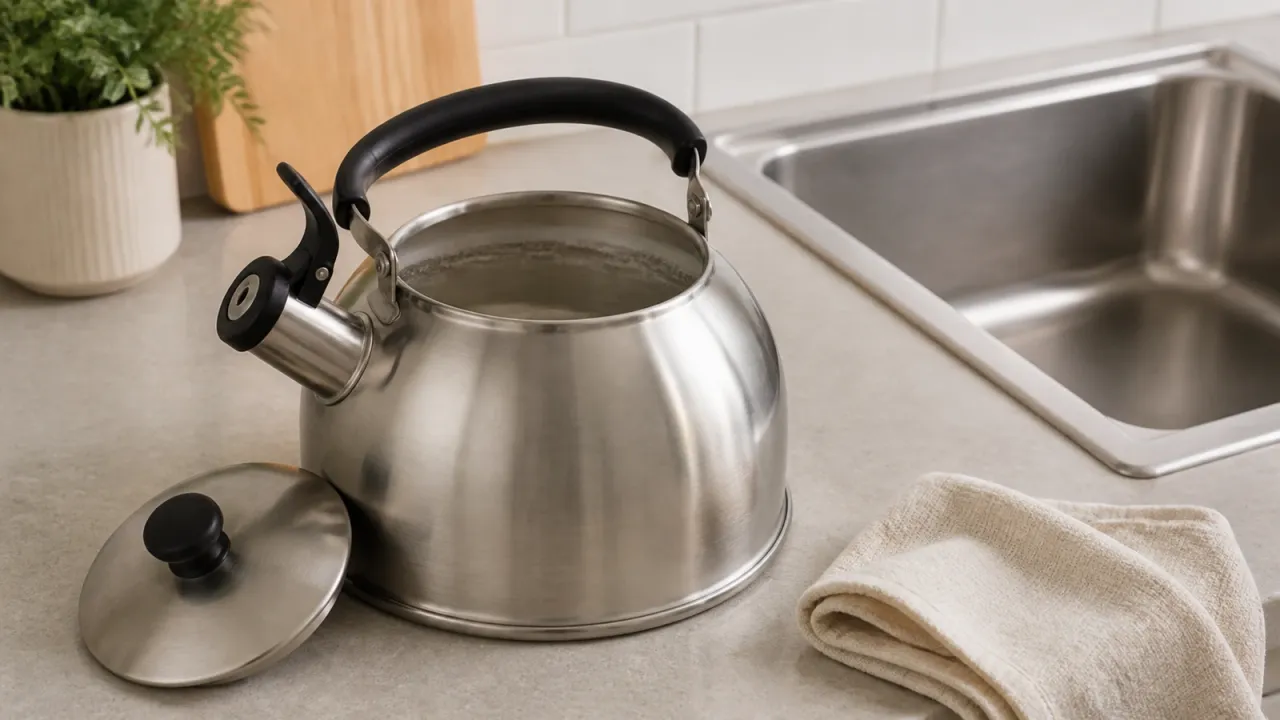
Illustration: an unbranded stainless steel kettle with a conceptual chalky scale ring beside a dry sink and cloth. The image is illustrative only and does not diagnose the condition of any real kettle.
This guide covers mineral scale inside stainless steel kettles, not kettle shopping, exterior polishing, or a universal chemical recipe. If you are choosing a replacement kettle, the stainless steel tea kettle guide covers stovetop and electric formats. For a white mark on cookware rather than inside a kettle, see white spots on stainless steel pans.
What is the safest way to descale a stainless steel kettle?
The safest sequence is to identify the deposit, read the exact care instructions, disconnect the kettle from heat or power, use one approved method, and rinse completely. The order matters because a kettle may have a coated interior, a non-steel lid or spout, an electric base, or a finish that changes the maker’s cleaning limits.
- Identify the exact kettle. Find the model number, manual, or current manufacturer care page. Note whether it is electric or stovetop, whether it has a coating or gauge, and which parts are removable.
- Let it become safe to handle. Empty the water. Unplug an electric kettle and remove the body from its base. Turn a stovetop kettle off the burner and let it cool. Do not clean an appliance while it is powered or hot.
- Start with the maker’s permitted method. Use the named kettle descaler, vinegar, citric acid, or other treatment only when the exact maker permits it. Follow the stated dilution, fill level, heating step, contact time, and rinse instructions exactly. If the maker gives no acid method, do not invent one.
- Keep the treatment inside compatible surfaces. Do not splash acid onto a painted or coated exterior, handle, electrical base, cord, or unknown component unless the maker says that surface is compatible.
- Rinse and inspect. Empty the solution and rinse as directed. Look inside the dry kettle for remaining scale, pitting, flaking, or an altered finish. Do not taste-test the rinse water. Repeat a chemical cycle only when the maker’s instructions allow it.
- Stop when the condition is uncertain. A deposit that will not release, a rough cavity, an exposed layer, a leak, or a damaged base needs maker support rather than stronger scrubbing.
There is no single safe concentration, boiling time, or soaking time for every stainless steel kettle. Those details belong to the exact product instructions.
How can you tell mineral scale from rust or damage?
A smooth white or off-white ring can be mineral scale, but appearance alone cannot prove what an unknown mark is. Use the surface and the behavior of the mark as a cautious starting point, not as a diagnosis.
| What you see | More likely possibility | Safer next step |
|---|---|---|
| White or pale gray chalky ring near the water line | Mineral scale from heated hard water | Check the maker’s approved descaling method |
| Smooth mark that changes after a permitted rinse | Surface deposit | Rinse, dry, and inspect rather than abrading it |
| Orange or brown roughness, pits, or a point that catches a fingernail | Rust transfer, corrosion, or metal damage | Stop escalating and ask the maker to assess it |
| Rainbow, blue, or gold color without a raised deposit | Heat-related discoloration or finish change | Use the maker’s finish-care instructions |
| Sticky, dark, or scented residue | Beverage or cleaning residue | Use the exact routine for that residue, not an acid by default |
| Flaking, bubbling, sharp edges, or a visible different layer | Coating or structural damage | Stop using the kettle until the maker advises you |
The U.S. Geological Survey explains that water hardness comes mainly from dissolved calcium and magnesium and that heating hard water can form solid calcium-carbonate deposits. That supports mineral scale as a plausible explanation for a pale ring, but it does not identify an individual kettle’s mark or prove that the kettle is safe to keep using. See the USGS hardness of water explanation for the underlying water chemistry.
For a stainless steel surface outside a kettle, the stainless steel tarnish guide covers other marks that can resemble corrosion. Do not move a pan, sink, or appliance cleaning recipe into a kettle without checking the kettle maker’s instructions.
What should you check before using vinegar or citric acid?
Check the exact model’s care page or manual before choosing either acid. “Stainless steel” describes one visible material, not every surface in the kettle, and it does not grant permission for every cleaner, concentration, temperature, or contact time.
Look for these details:
- Whether the maker names vinegar, citric acid, a commercial descaler, or no acid treatment at all.
- The required dilution, water amount, heat step, contact time, and number of clean-water rinses.
- Whether the treatment is for the interior only or also permits contact with the lid, gauge, spout, gasket, or other parts.
- Whether the kettle must be removed from an electrical base and whether any part is dishwasher safe.
- Which tools are permitted. Soft cloths, sponges, or brushes are different from steel wool, wire, knives, and metal scrapers.
If the manual is missing or the model has a coating, exposed heating element, decorative finish, or unusual insert, ask the maker before using an acid. A commercial descaler is not automatically safer than vinegar. Its label and the kettle manual must agree.
The stainless steel cleaner guide explains cleaner categories, but a cleaner listed there is not automatically suitable for a kettle interior, coating, gasket, or electrical appliance. Use it as background only after the exact kettle maker permits the product.
How should you descale an electric kettle?
For an electric kettle, disconnect power and keep the base, cord, and any electrical controls dry while you follow the maker’s interior descaling method. Do not treat an electric kettle like a stovetop pot.
Fellow’s current Clyde safety manual says to unplug before cleaning, let the kettle cool, never immerse the kettle or base, and wipe the exterior with a damp cloth or sponge. It directs owners to use a scale or lime remover according to that product’s instructions. The manual also says the Clyde cannot be used on a stove and that its parts are not dishwasher safe. Read the Fellow Clyde safety manual for those model-specific limits.
Fellow’s current Clyde gear guide gives additional exact-model examples: a half-vinegar, half-water solution brought to a boil and left for at least 30 minutes, or 500 mL of water with two spoonfuls of citric acid treated the same way. It also says to rinse thoroughly and avoid steel wool or abrasive brushes. Those measurements and times belong to Clyde’s guide. They are not a general recipe for another electric kettle. The Clyde descaling guide is the source for that example.
For an unidentified electric kettle, the safe boundary is narrower: unplug it, remove it from the base, cool it, and use only a current maker-approved method. If the maker permits no immersion, do not put the body or base in a sink. Wipe the outside separately, keep water away from connectors, and do not reconnect power until the outside and base are dry.
How should you descale a stovetop kettle?
For a stovetop kettle, remove it from the burner and let it cool before applying any maker-approved interior treatment. Keep acid away from an exterior coating, painted finish, handle, whistle, or gauge unless the maker specifically includes that part.
Made In’s current care guidance for its Stainless Steel Kettle gives a model-specific example: use equal parts water and white vinegar to cover the deposits, bring the mixture to a boil, turn off the burner, let it cool, then wash, rinse, and dry thoroughly. The same guidance says to use mild soap and water for routine care and soft tools rather than abrasive scrubbers. See Made In’s stovetop kettle care instructions.
That method should not be copied to a different stovetop kettle. For example, the current Le Creuset Stainless Steel Classic Whistling Kettle page specifies hand washing with warm soapy water and lists the compatible cooktops, but it does not publish an acid-descaling recipe on that product page. Treat the acid permission and details as unknown until the exact manual or maker confirms them.
Never leave a kettle on a hot burner while a cleaning solution is unattended. Never boil an empty kettle. If the maker does permit heating a descaling solution, use the stated fill level, burner instructions, ventilation, cooling step, and rinse process for that exact model.
What do current kettle makers actually publish?
Current maker guidance shows why a model-specific method is safer than a generic internet recipe.
| Exact maker example | What the current source says | What you should not infer |
|---|---|---|
| Fellow Clyde electric kettle | The safety manual requires an unplugged, cool kettle, a dry base, no immersion, and a scale or lime remover used according to its directions. The gear guide publishes its own vinegar and citric-acid examples. | Do not move Clyde’s measurements or heating steps to another electric kettle. |
| Made In Stainless Steel Kettle | Made In publishes a vinegar-and-water method followed by cooling, washing, rinsing, and drying, plus soft-tool guidance. | Do not assume another stovetop kettle has the same interior, finish, or acid permission. |
| Le Creuset Stainless Steel Classic Whistling Kettle | The current product page says hand wash with warm soapy water and does not state an acid recipe there. | Do not treat an omitted recipe as permission to invent one. |
The difference is useful evidence, not a contradiction to resolve by picking the most aggressive method. One maker may publish a detailed descaling procedure while another may require a manual or support contact. Follow the source for the kettle you own.
How should you rinse and inspect after descaling?
After the maker-approved treatment, empty the kettle and rinse it using the maker’s stated process until no visible cleaner, residue, or unusual odor remains. Do not combine a rinse with another cleaner, and do not assume that one rinse is enough if the product instructions require more.
Inspect the inside only after the kettle is cool and dry. A remaining white ring may call for another maker-approved cycle, not stronger acid or a longer soak. If the surface is rough, pitted, flaking, discolored beneath a coating, or visibly changed by the treatment, stop. Cleaning can remove a deposit; it cannot repair metal loss, coating failure, a warped body, or a damaged seal.
Wipe an electric kettle’s outside and base only as its manual permits, then let them dry fully before reconnecting. A stovetop kettle should also be dried before storage so new water deposits do not form on the surface. Do not use taste, smell, or a casual visual check as proof that a damaged kettle is safe.
What should you never do while descaling a kettle?
Avoid these shortcuts even when a deposit looks stubborn:
- Never mix vinegar, citric acid, descaler, bleach, or another cleaner. The U.S. Environmental Protection Agency’s cleaning guidance says never to mix cleaning products because toxic vapors can result.
- Never immerse an electric base, cord, plug, or powered kettle. Unplug first, keep the base out of the sink, and do not clean around an active electrical connection.
- Never scrape scale with a knife, metal spoon, wire brush, or steel wool. Use only a soft tool named or permitted by the exact maker.
- Never pour acid onto the outside, a coating, a painted finish, a handle, a gasket, or a gauge unless the maker includes that surface in the instructions.
- Never invent a concentration, boiling step, soak time, or repeat schedule because another kettle used it.
- Never put an electric kettle on a stovetop. An electric body that resembles a stovetop kettle is still an electrical appliance.
- Never leave a descaler or rinse water in the kettle longer than the exact directions allow, and never return it to use while cleaner residue remains.
If cleaners are accidentally mixed, move away from fumes and follow local emergency or poison-control guidance. Do not try to neutralize the mixture with another household chemical.
When should you stop and contact the maker?
Stop descaling and contact the maker when the mark is rough or pitted, the surface flakes, a coating lifts, a different layer is exposed, a seam leaks, or the kettle develops an electrical fault. A persistent odor, a damaged lid or whistle, a cracked handle, or a base that gets wet also needs product-specific guidance.
Contact the maker if the exact manual is unavailable, the model has changed, or the current online instructions conflict with an older label. Keep the model number and a photo of the dry condition. Do not keep escalating acid or abrasion while waiting for an answer.
If the kettle cannot be cleaned and reassembled according to its instructions, ask whether a replacement part exists. A kettle with damage in the water path, an exposed unknown layer, or an electrical defect may need replacement rather than another cleaning attempt.
How can you prevent scale from returning?
Empty and rinse the kettle after use, leave it open to dry when the maker allows, and follow the maker’s inspection or descaling guidance. Hard-water minerals are more likely to leave deposits when water is repeatedly heated and allowed to evaporate, but no universal descaling calendar fits every household.
If your water is hard, a filtered source may reduce the mineral load, but it does not replace the kettle maker’s care instructions. Do not store water in the kettle indefinitely, and do not boil it dry while trying to use up the last amount. Keep the exterior dry and check the interior periodically so a thin deposit does not become an unknown thick buildup.
For compatible products, a routine rinse and dry may be enough between maker-approved descaling cycles. If scale returns quickly, record the water source and model details and ask the maker whether a specific descaler or service interval applies. Do not switch to a stronger chemical just because the deposit returned.
Frequently asked questions
Can I use vinegar in every stainless steel kettle?
No. Vinegar is permitted for some exact kettle models and restricted or undocumented for others. Use it only when the current maker instructions name it, with that source’s dilution, heating, contact, and rinse directions. Never mix it with bleach or another cleaner.
Is citric acid better than vinegar for kettle scale?
Not as a universal rule. Fellow describes citric acid as stronger and less likely to leave a lingering scent in its Clyde guide, but that is not permission for every kettle. Use the acid, product, and concentration named by your kettle maker or a compatible descaler label.
How often should I descale a stainless steel kettle?
There is no universal interval. Water hardness, use, kettle design, and the maker’s instructions change the answer. Inspect for pale buildup and follow the exact schedule or trigger the maker publishes instead of choosing a fixed monthly recipe.
Can I scrape kettle scale with a knife or steel wool?
No. Metal tools and abrasive pads can scratch the interior, damage a finish, and leave contamination that looks like rust. Use a soft tool only when the exact maker permits it, and contact the maker when a deposit will not release.
Does white scale mean the stainless steel kettle is rusting?
Not necessarily. A smooth pale deposit can be mineral scale, while orange roughness, pits, flaking, or an exposed layer needs a more cautious assessment. Appearance alone cannot prove the condition, so stop cleaning and ask the maker when damage is possible.