To clean a stainless steel straw, flush warm water through it, wash with mild dish soap and a soft narrow brush that reaches the entire bore, rinse until no soap remains, and air-dry it fully. Check the exact maker’s care page first, especially for a coated finish, attached lid, dishwasher permission, or replacement rule.
This straw-only routine follows CDC cleaning guidance and current care instructions from YETI, Owala, and Klean Kanteen. It is research-based household advice, not a microbial test or a universal treatment for every alloy, finish, lid, or straw assembly.
What do you need to clean a stainless steel straw?
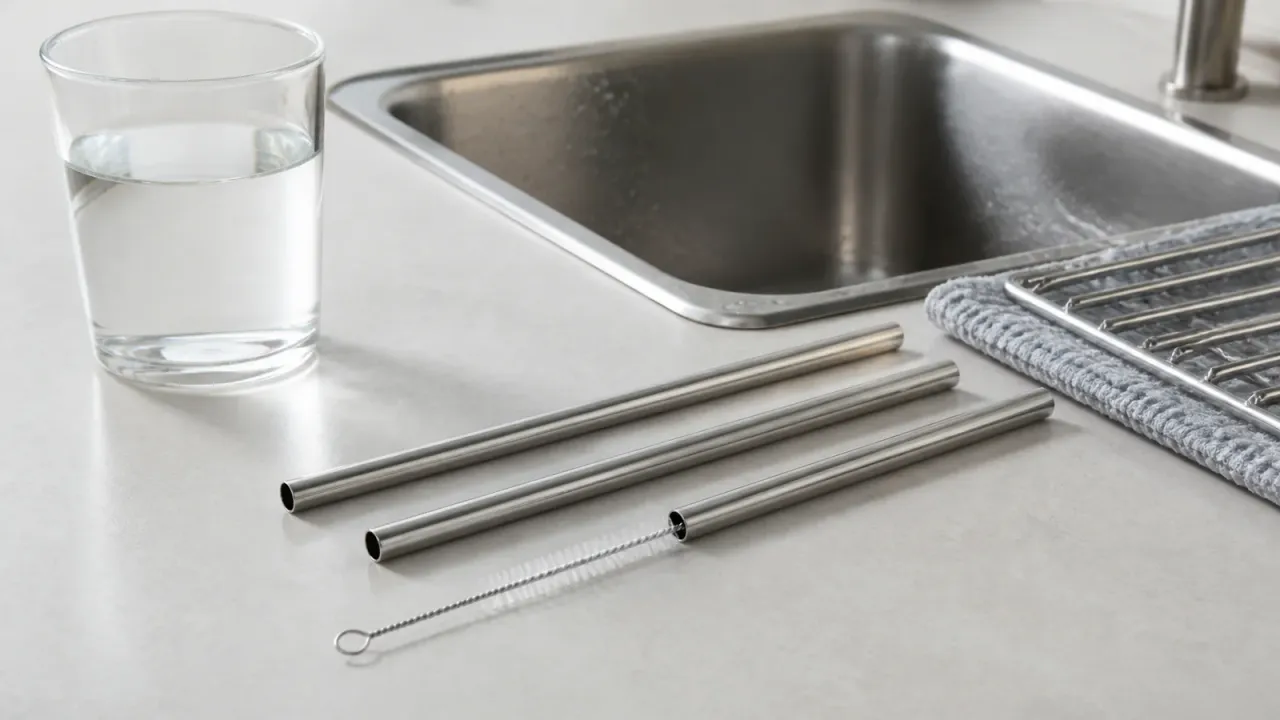
You need warm water, mild dish soap, a soft narrow straw brush, and a clean rack or other place where air can reach both openings while the straw dries.
- Choose a brush with soft bristles and a shaft long enough to reach the full interior. YETI’s straw-cap instructions also call for a soft-bristle brush long enough to reach all internal surfaces.
- Keep a soft cloth or non-abrasive sponge for the outside. Use a less aggressive tool for a coated or painted part if the maker calls for one.
- Keep the maker’s care page nearby if the straw is attached to a lid, has a silicone tip, or is part of an insulated drinkware assembly.
Do not add a cleaner concentration, soaking time, or heat step from another product’s instructions. Those details are model-specific. Do not start with steel wool, a wire brush, abrasive powder, chlorine bleach, or a surface polish.
What should you check before washing it?
Check the exact straw and drinkware model instructions before choosing a dishwasher, soak, heat treatment, cleaner, or disassembly step.
- A plain stainless tube, a coated straw, and a straw joined to silicone or plastic parts can have different care limits.
- Remove a straw, tip, gasket, or valve only when the maker shows that part as removable. Do not pry at a fixed seal or pressure valve.
- A stainless label does not prove that every attached part is dishwasher-safe. Unknown alloy, coating, and dishwasher compatibility remain unknown until the maker confirms them.
If the straw belongs to a bottle and you are comparing complete drinkware designs, see the best stainless steel water bottles guide for lid and care considerations. Travel-mug lids can have a different set of channels and parts, so the best stainless steel coffee and travel mugs guide is a better starting point for that purchase decision. Neither buying guide replaces the care instructions for the model you own.
How do you wash the inside and outside of a stainless steel straw?
Wash the full bore first, then the ends and outside, using gentle brushing and enough rinsing to remove the soap.
- Empty the straw and rinse it through both openings as soon as practical. A rinse removes loose drink residue, but it does not replace a soap-and-brush wash.
- Wet the straw and the brush with warm water. Add mild dish soap to the wash water or brush, using the maker’s directions if they specify a different product.
- Push the soft brush through the bore from one opening to the other. Work it back and forth gently, then repeat from the opposite opening so the brush reaches the full length. Do not force a brush that is too large, scrape the bore with a metal tool, or use a wire brush.
- Wash the outside, rims, bends, and any maker-approved removable tip with the same mild soapy water. Use a soft cloth or non-abrasive sponge on a finish that the maker says needs extra care.
- Rinse clean water through the bore and over the outside until no foam, slippery soap film, or visible residue remains. Rinsing both openings matters because a quick surface rinse may leave the interior untouched.
- Hold the straw toward a good light and look through each opening. Check for cloudy film, particles, an odor, pitting, a crack, a burr, or a coating that is lifting. If you still see residue, repeat the approved brush-and-rinse pass before storing it.
The brush is the important part of this routine because it supplies the mechanical action inside a narrow tube. CDC describes ordinary cleaning as water, soap, and scrubbing. That supports a clean surface, not a claim that the straw has been sterilized or tested free of every microorganism.
How should you dry and store a stainless steel straw?
Dry the bore and both ends completely before you put the straw back into a lid, pouch, drawer, or drinkware assembly.
- Shake off excess water, then place the straw on a clean rack with both openings exposed to air. Keep it angled or raised if that helps water drain from the bore.
- Keep an attached lid, silicone tip, gasket, or other approved removable part separate while it dries. Reassemble only as the maker shows.
- Do not cap or store the straw while you can see droplets inside it. A closed, damp bore is harder to inspect and can hold on to the next drink’s residue.
- Use the maker’s drying direction if it specifies a position or drying method. This guide does not set a universal number of minutes because straw size, room conditions, and assembly design vary.
YETI tells users to dry its straw-cap components thoroughly before reassembly and storage, and Klean Kanteen tells users to let a cleaned cap air-dry thoroughly. Those are useful maker-backed habits, but the exact parts and instructions for another straw may differ.
Can a stainless steel straw go in the dishwasher?
Only put it in the dishwasher when the exact maker says that the straw and any attached parts are compatible with that dishwasher method.
Owala says its stainless bottle lids are top-rack safe and its straws can go in the silverware bin. YETI gives separate instructions for a Straw Cap, including the cap on the top rack, the straw and circular gasket in the utensil compartment, and thorough drying before reassembly. These are model instructions, not a universal rating for all stainless steel straws.
If the model page is missing or unclear, hand wash with warm water, mild dish soap, and a soft brush. Do not infer that the straw, lid, gasket, coating, and insulated bottle share the same dishwasher permission. Follow the exact rack, temperature, and part-placement directions when the maker does approve a dishwasher.
How often should you wash a stainless steel straw?
Follow the maker’s schedule, and wash promptly whenever the drink leaves residue rather than treating a rinse as complete cleaning. The table below is a practical editorial baseline, not a universal timing rule.
| What went through the straw | Practical care | Limit |
|---|---|---|
| Plain water | Empty and rinse after use, then complete the soap-and-brush wash at the interval the maker gives for the model. | A quick rinse may not remove a film from the bore. |
| Sweet, milky, oily, pulpy, or powdered drinks | Wash promptly after each use and dry the bore before storage. | Do not copy a timing or soak recipe from another brand. |
| Visible film, particles, or odor | Wash the full bore and inspect both ends the same day. Repeat the approved brush-and-rinse pass if residue remains. | Persistent residue can mean the bore or an attached part cannot be cleaned safely. |
What if the straw still smells or has residue?
Repeat a full maker-approved wash and inspect the entire bore, rather than covering the odor with a stronger cleaner.
- Run the soft brush from both directions and look through the straw under good light. Check the rims and any bend where residue may collect.
- If the straw is part of a lid, clean the maker-approved cap, gasket, and drinking channel separately. Keep the focus on the straw, and do not force a fixed valve or seal.
- Rinse thoroughly and air-dry every part before testing the assembly again. If the smell returns, note whether it comes from the straw or another component.
- If you see mold-like material or growth in a crevice that you cannot reach, stop using the straw until the maker gives you a safe cleaning or replacement path. This guide cannot identify a substance from appearance alone.
Do not mix cleaners, pour chlorine bleach through the bore, or combine vinegar, baking soda, peroxide, or other products as an improvised recipe. CDC says to follow product labels, clean before sanitizing or disinfecting, and never mix chemicals. For exposed stainless surfaces elsewhere, the best stainless steel cleaners guide compares products, but a surface cleaner is not automatically suitable for a food-contact bore.
When should you replace a stainless steel straw?
Replace the straw, or stop using it while you ask the maker for a replacement, when damage or inaccessible residue means you cannot keep the bore clean, rinsed, and dry.
- Replace it if the tube is cracked, deeply pitted, split, sharply burred, or bent enough that a suitable brush cannot pass through.
- Stop using a coated straw if the coating is peeling, flaking, or changing the food-contact surface.
- Ask the maker about a replacement when odor or residue persists after the maker-approved cleaning routine, especially if the material is trapped in an unreachable section.
- Do not assume a harmless-looking discoloration is a defect, but do not keep using a straw with a sharp edge or a damaged food-contact surface while you guess. The maker can identify the construction and compatible replacement.
Klean Kanteen notes that smaller drinkware parts can wear out and provides replacement parts and maintenance kits. That supports replacing a failed component instead of scrubbing indefinitely, while the exact replacement decision remains specific to the straw and maker.
Does a stainless steel straw need sanitizing?
Routine cleaning and sanitizing are different jobs, so do not add a sanitizing treatment unless the exact maker or a relevant public-health instruction calls for one.
CDC defines cleaning as water, soap, and scrubbing, and separates it from sanitizing and disinfecting. If sanitizing is needed for a particular situation, clean first, then use only a product and method whose label and maker instructions cover that straw and its attached parts. Do not invent a bleach dilution, boiling time, peroxide treatment, or contact time, and never mix products.
YETI publishes a boiling-water step for specific Straw Cap components, including a cap and circular gasket. That does not authorize boiling every stainless straw, coating, lid, gasket, or insulated assembly. For broader food-contact questions, see are stainless steel containers safe for food storage, then return to the exact care page for the straw you own.
Sources and limits
This article was checked against current manufacturer care pages and CDC household cleaning guidance on August 21, 2026. It is conservative research-based household advice, not a laboratory test, microbial count, sterilization certification, or hands-on product test. The exact maker’s instructions control whenever they differ from this general routine.
- CDC cleaning and disinfecting guidance defines cleaning, sanitizing, and disinfecting and warns against mixing products.
- YETI Rambler cap and lid cleaning instructions documents soft-brush cleaning, dishwasher placement for a specific Straw Cap, component drying, and a model-specific deep-clean step.
- Owala frequently asked questions and product care documents top-rack lid care, silverware-bin straw care, straw-brush access, hand washing for stainless cups, and warnings against harsh chemicals.
- Klean Kanteen care and use documents warm soapy water, bottle-brush use, model-specific dishwasher limits, thorough air drying, and replacement-part support.