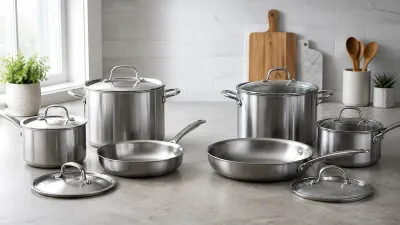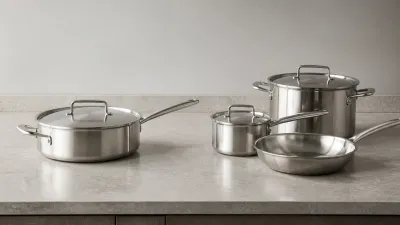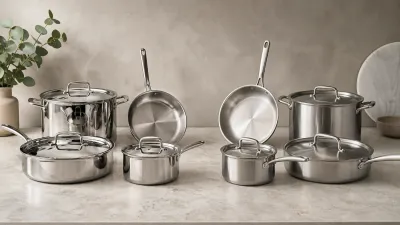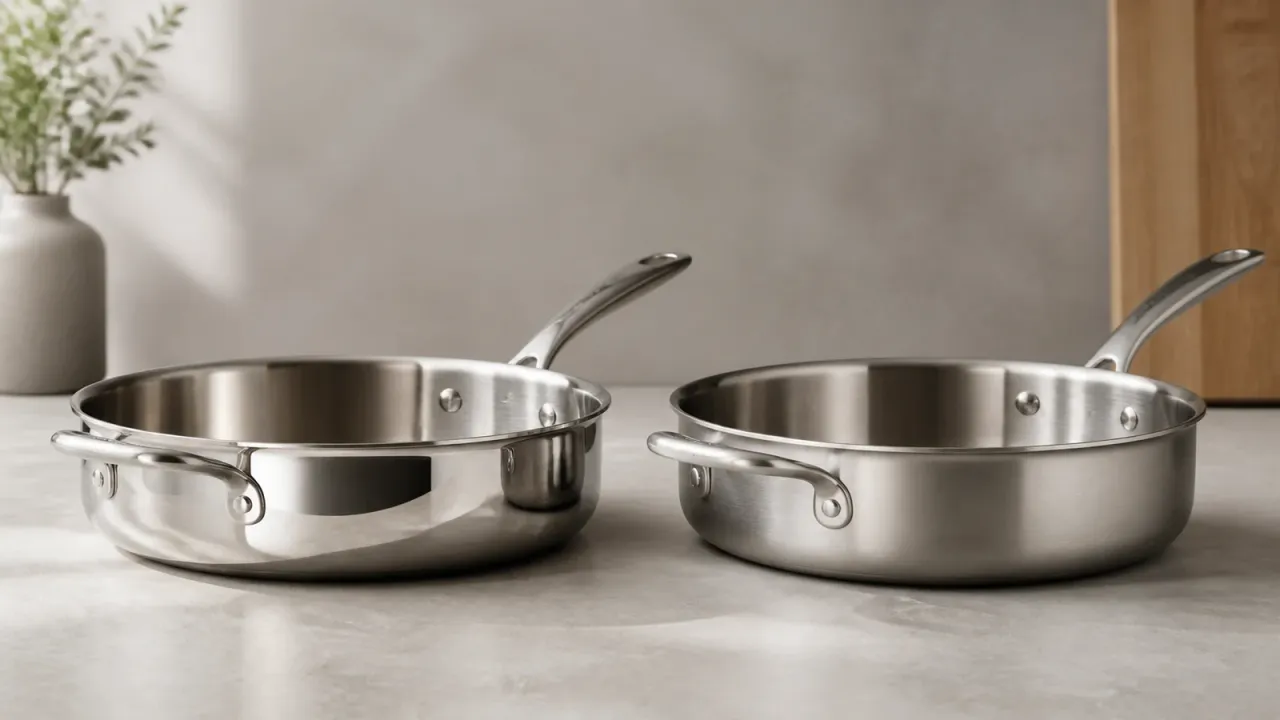
Choose brushed stainless steel cookware if you want a surface on which small scuffs and fingerprints are usually less conspicuous. Choose polished stainless steel if you prefer a brighter, mirror-like exterior and do not mind giving visible marks more attention. The finish is a surface treatment. It does not, by itself, identify the steel grade, clad construction, core, coating, heat performance, scratch resistance, or food-contact safety.
The short answer
| Decision | Polished finish | Brushed finish | Better fit |
|---|---|---|---|
| Appearance | Bright, reflective, and mirror-like | Directional grain with a softer satin look | Polished for display; brushed for a quieter look |
| Small scratches and fingerprints | Usually easier to notice | Often less visually conspicuous | Brushed for a lower-maintenance appearance |
| Cleanup | Follow the maker’s care instructions and avoid unapproved abrasives | Follow the maker’s care instructions and work with the grain when instructed | Tie, based on the exact model |
| Heat discoloration | A tint can contrast strongly with a mirror surface | A tint may be less obvious against the grain, but the finish does not prevent it | Neither finish changes the cause of heat tint |
| Food-contact surface | May be a different interior finish from the exterior | May be a different interior finish from the exterior | Check the exact product page |
| Alloy, core, or coating | Not established by the finish name | Not established by the finish name | Neither |
For most everyday kitchens, brushed is the easier visual choice. For an open shelf, serving presentation, or anyone who specifically wants a reflective look, polished can be the better choice. That recommendation concerns appearance and upkeep only. It is not a claim that one finish heats better or is safer with food.
What polished and brushed mean
A polished stainless surface has been smoothed and brought to a higher sheen. In cookware, “polished” can describe the outside, the inside, or both, so the word alone is incomplete. Hestan’s ProBond Luxe set page, for example, identifies a mirror-polished exterior and a satin-finished cooking surface on model 31768.
A brushed surface has a directional texture created by finishing the steel with an abrasive pattern. It scatters reflected light instead of returning one strong reflection. The exact pattern and the places where it appears still vary by model. On its current ProBond set page, Hestan identifies model 31562 as having a brushed stainless steel body with a polished rim.
Those examples show why finish claims must stay attached to an exact model. A maker can use polished steel for a rim and brushed steel for a body, or use a satin interior with a different exterior treatment. A product listing for another line is not enough evidence for this one.
Scratch visibility and everyday appearance
The practical difference is often how marks read in normal light. On a mirror surface, a fine scuff can interrupt a large reflection, and fingerprints can show as uneven patches. A brushed grain breaks up reflections and can make light wear less conspicuous when the mark follows or crosses a similar texture. It can still be visible, especially at an angle or when the scratch cuts across the grain.
Hestan makes this distinction directly in its finish comparison on the current maker pages: it says the polished ProBond Luxe shine can show scratches more easily than the brushed ProBond Forged finish. That is useful appearance guidance from the maker, not a scratch-resistance test. No finish should be treated as scratch-proof, and a product page does not tell us how a particular pan will look after a specific utensil, cleaner, or dishwasher cycle.
If fingerprints bother you, a brushed body usually asks for less frequent cosmetic polishing. If you want to inspect every mark and keep a high-gloss look, polished gives you a clearer visual target. In both cases, the rim, handles, lid, and cooking surface may have different finishes, so inspect the full product description rather than judging a single product photograph.
Cleanup and care
Finish can affect how residue and marks look, but it does not replace the manufacturer’s care instructions. Hestan lists both the Luxe and ProBond sets as dishwasher safe, while its care guidance cautions against abrasive cleansers and metal scouring pads for the polished Luxe finish. The Luxe care and finish details and ProBond care details apply to those exact lines, not automatically to every stainless pan.
For brushed steel, the grain gives you a visual direction to follow if the maker recommends wiping or cleaning with the grain. That does not make every abrasive safe. A soft cloth or non-abrasive sponge is a conservative starting point, followed by the exact model’s instructions. Hestan also notes that oil build-up can stain its ProBond stainless steel and provides a soft-scrubber and cleanser method in the product care section. Use that guidance only within its stated product context.
Polished steel can need more cosmetic attention because streaks and fingerprints remain visible after the cooking residue is gone. Brushed steel can look clean sooner, but its grooves still deserve complete rinsing and drying. Neither finish makes burnt-on food disappear, and neither is evidence that a pan is nonstick.
Heat discoloration
Blue, gold, or brown heat tint is a surface-appearance issue that can occur when stainless steel is exposed to high heat. A polished exterior may make the color contrast easier to see because it is set against a broad reflection. The directional texture of a brushed exterior may make the same tint less visually prominent. That is a difference in visibility, not proof that brushed steel runs cooler or resists discoloration.
The finish cannot establish how evenly a pan heats. Core material, thickness, construction, burner contact, and cooking conditions matter for that question. For background on those separate decisions, see what fully clad cookware means, 3-ply versus 5-ply cookware, disc-bottom versus fully clad cookware, and why stainless steel pans have aluminum cores.
Does the finish change the food-contact surface?
Sometimes it does, and sometimes it does not. “Polished exterior” is not a description of the cooking surface. The Hestan ProBond Luxe page separates its mirror-polished exterior from its satin-finished interior, while the ProBond page identifies its brushed body, polished rim, and 18/10 stainless steel interior. Those are exact model claims from the Luxe maker page and ProBond maker page.
That distinction matters for two reasons. First, an exterior finish may be chosen for appearance while the interior has its own texture and care needs. Second, a finish label cannot prove an alloy, a coating, or food-contact safety. For these Hestan models, the maker identifies 18/10 stainless steel as the interior or cooking surface and describes the construction separately. That is product-specific evidence, not a general rule about all polished or brushed cookware.
Finish is not grade, coating, or clad construction
“Polished” and “brushed” describe how a surface is finished. They do not tell you whether the pan is 18/10, 18/8, or another stainless formulation. They do not tell you whether the pan has a pure aluminum core, an aluminum disc, copper, or no conductive core. They also do not tell you whether a nonstick or ceramic coating is present.
The Hestan examples happen to document stainless interiors and tri-ply aluminum-core construction, but that evidence comes from the exact maker pages and product records. Do not transfer it to another line just because the product photo looks similar. If construction is your deciding factor, use the linked construction guides above and the maker’s model-specific specification.
The exact cookware sets we compared
These two Hestan sets were selected because the current Luxe maker page and ProBond maker page each identify the finish and where it appears, and each Amazon record could be matched to the maker’s model or SKU. Ratings, review counts, and availability are dated snapshots, not permanent product attributes.

Hestan ProBond Luxe 10-Piece Cookware Set
5 out of 5 (3 ratings, as of August 21, 2026)
A current 10-piece Hestan ProBond Luxe set with a mirror-polished exterior and satin interior.
- The exact maker page identifies SKU 31768, mirror-polished exterior, satin-finish interior, 18/10 cooking surface, and ProCore tri-ply body
- The exact-ASIN Amazon snapshot matched the model and showed In Stock on August 21, 2026
- Hestan lists dishwasher safety and cautions against abrasive cleansers and metal scouring pads
Pros
- Bright, high-reflectivity appearance
- Maker documentation separates exterior finish from the food-contact cooking surface
Cons
- Mirror finish can make scratches and fingerprints easier to notice
- The Amazon review sample was only 3 ratings at retrieval
Considerations
Choose this model for the polished exterior, not as evidence of better heat performance or safer food contact than the brushed set.

Hestan ProBond 10-Piece Ultimate Cookware Set
4.4 out of 5 (166 ratings, as of August 21, 2026)
A current 10-piece Hestan ProBond set with a brushed body, polished rim, and 18/10 stainless cooking surface.
- The exact maker page identifies SKU 31562, brushed stainless body, polished rim, and 18/10 stainless interior or cooking surface
- The exact-ASIN Amazon snapshot matched the 10-piece model and showed In Stock on August 21, 2026
- Hestan lists dishwasher safety, all-cooktop compatibility, and oven or broiler use to 600°F
Pros
- Brushed body is less visually demanding around fingerprints and light wear
- Finish and food-contact surface are separately documented
Cons
- Directional grain still requires care consistent with the maker's instructions
- The Amazon title does not expose finish language, so the finish claim relies on the current exact Hestan page
Considerations
Choose this model for the brushed exterior, not as evidence that brushed steel is a different alloy or construction.
Which finish should you choose?
Choose brushed when your priority is a calmer visual surface, less conspicuous everyday wear, or less frequent cosmetic polishing. Choose polished when a bright, reflective exterior is part of the appeal and you are comfortable following its care instructions closely enough to preserve that look.
If cooking performance is the real question, finish should not decide the purchase. Compare the exact pan’s construction, thickness, cooking-surface material, handles, lids, and care guidance. A brushed pan is not automatically cooler, more durable, or safer, and a polished pan is not automatically less capable.
How we compared
This is a research-based comparison, not a hands-on or side-by-side test. The evidence date for planning was August 20, 2026. On August 21, 2026, exact-ASIN Amazon records were checked for Hestan ProBond Luxe set B0FD46JX65 and Hestan ProBond set B08KZ7JJYR. Their model and maker SKU values, 31768 and 31562, were matched to the current exact Hestan product pages. The maker pages were used for finish location, material, food-contact surface, and care claims: Luxe has a mirror-polished exterior with a satin cooking surface, while ProBond has a brushed stainless body, polished rim, and 18/10 stainless cooking surface.
The comparison evaluated finish appearance, likely scratch visibility as a documented appearance tradeoff, cleanup guidance, heat-tint visibility, and whether the finish was documented on the food-contact surface or only on the exterior. It did not cook in the products, measure heat, test scratches, run dishwasher cycles, or infer food safety from finish. Amazon ratings, review counts, and availability are snapshots from August 21, 2026. Current exact maker pages control finish, material, and care claims when marketplace copy differs. Hestan’s Amazon copy listed a 600°F oven limit for both records, while the current Luxe maker page lists 800°F, so no cross-model heat or oven conclusion was drawn from that conflict.
The keyword opportunity was recorded on August 20, 2026 at 50 monthly searches, explicit keyword difficulty 0, and CPC 6.81, with commercial intent. The finish boundary was kept separate from steel grade, coatings, and clad-construction comparisons. Products without exact current maker evidence for both finish and finish location were not used as representative cards.