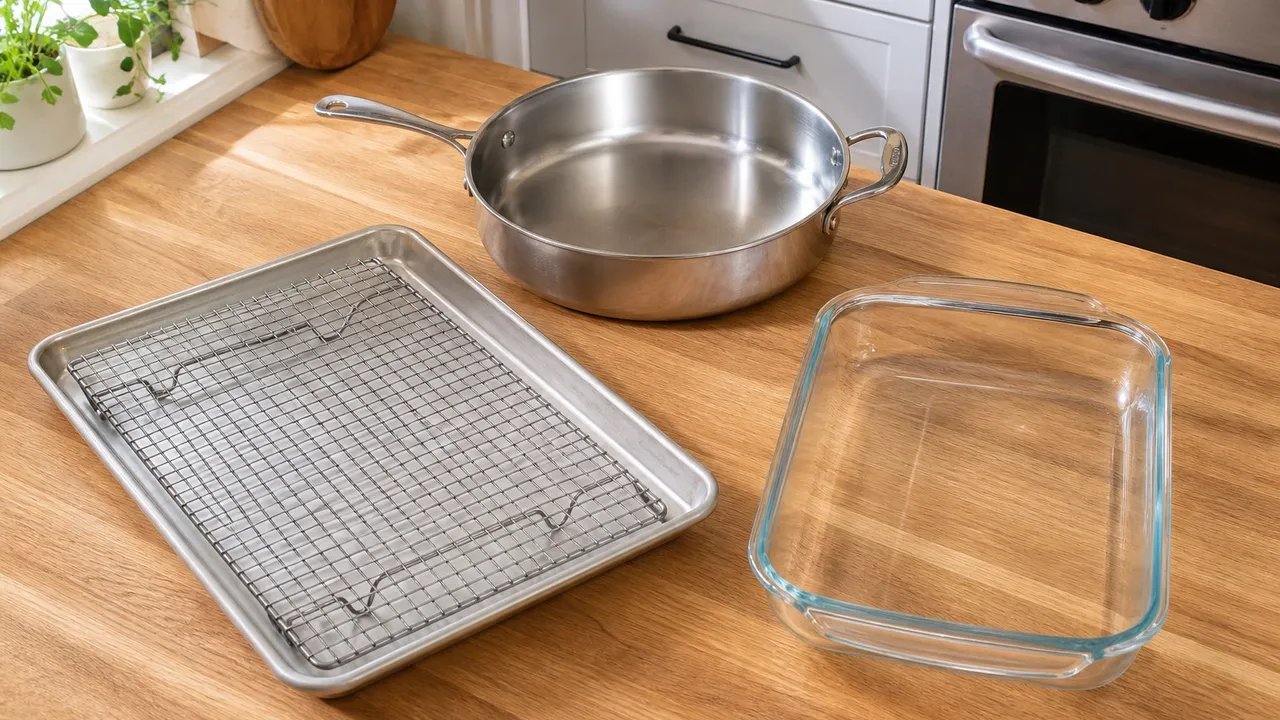
Use a rimmed sheet pan with an oven-safe wire rack instead of a roasting pan for chicken, vegetables, and many smaller cuts of meat. An oven-safe stainless steel skillet, deep baking dish, or Dutch oven also works when it leaves room for hot air and safely contains the drippings.
The best substitute depends on the food’s size and the amount of liquid or fat it will release. A flat cookie sheet without a rim is not a safe substitute for a juicy roast because drippings can spill onto the oven floor.
Roasting pan alternatives at a glance
| Substitute | Best for | Main caution |
|---|---|---|
| Rimmed sheet pan plus wire rack | Chicken, vegetables, small turkey, crisp browning | Shallow rim holds fewer drippings |
| Oven-safe skillet | Chicken pieces, pork loin, small roast | Limited capacity |
| Metal baking pan | Lasagna, vegetables, medium roasts | Thin pans can warp |
| Glass or ceramic baking dish | Casseroles and smaller moist roasts | Avoid broiler heat and sudden temperature changes |
| Dutch oven | Braises and covered roasts | High sides reduce surface browning |
| Disposable foil pan | One-time large roast | Flexible and easy to spill |
Best overall substitute: a rimmed sheet pan and wire rack
A heavy rimmed sheet pan provides broad exposure to oven heat, which encourages browning. Set an oven-safe wire rack inside it to lift poultry or meat above the drippings. The setup behaves much like a shallow roasting pan.
Choose a rack that sits securely inside the rim and is rated for the intended temperature. Some cooling racks have nonstick coatings or rubber feet that are not designed for oven heat. Stainless steel is the simplest material to verify.
If your existing tray is too small or lacks a rim, compare the dimensions and separate rack limits in our stainless steel baking sheet guide. A pan-and-rack set is useful only when both pieces fit the food and the oven.
This setup is especially good for:
- whole chicken
- turkey breast
- pork loin
- beef tenderloin
- vegetables
- small or spatchcocked turkey
Do not overload the shallow pan with a very fatty roast or large bird. If the drippings approach the rim, transfer them carefully to a saucepan during cooking.
Use an oven-safe skillet for smaller roasts
A 12-inch stainless steel skillet can roast a chicken, pork tenderloin, or several pieces of poultry. It also moves directly to the stovetop for gravy. Sloped sides let hot air reach the food, while the metal body tolerates temperature changes better than glass.
Check the handle and lid limits, not only the pan body. Our guide to whether stainless steel can go in the oven explains how to inspect grips, coatings, and manufacturer ratings. If you need a suitable pan, compare the best stainless steel frying pans.
A skillet does not need a rack for every recipe. Set a chicken on thick onion slices, carrots, or celery to lift it slightly and flavor the drippings. Keep vegetables in one layer where possible so they roast instead of steaming.
Use a baking dish when you need deeper sides
A rectangular metal baking pan or casserole dish can contain more liquid than a sheet pan. It is useful for a small turkey, ham, or roast surrounded by vegetables.
Metal responds quickly and is usually the better choice for high-heat dry roasting. Glass and ceramic retain heat and work well for moist recipes, but they require more care. Do not move a hot glass dish onto a wet or cold surface, and do not use it under the broiler unless its instructions explicitly permit that use.
Choose a dish that leaves at least a little clearance around the food. A roast wedged tightly against the walls traps steam and limits browning.
Use a Dutch oven for braising
A Dutch oven is the right substitute when the recipe includes a lid, a substantial amount of liquid, or a long slow cook. Its heavy body and close-fitting lid reduce evaporation and steady the temperature.
It is less effective for crisp skin because the high sides and lid hold moisture. Remove the lid near the end if the recipe allows, or choose a sheet pan for dry roasting. Our stockpot vs Dutch oven comparison explains why the wide, heavy Dutch oven is better for browning and braising than a tall stockpot.
Can you use a disposable foil pan?
Yes, but support it with a sturdy rimmed sheet pan before filling or lifting it. Thin foil flexes under a heavy roast and hot drippings. The sheet pan reduces the chance of the bottom folding or the sides collapsing.
Avoid cutting directly in the foil pan. Move the cooked roast to a carving board and pour drippings only after the pan is stable.
How to make a rack without a roasting rack
Use one of these simple supports:
- Arrange thick onion halves, carrots, and celery under the roast.
- Coil several lengths of aluminum foil into firm ropes and form a low spiral.
- Use an oven-safe stainless steel cooling rack that fits inside the pan.
The support only needs to raise the food enough for hot air and drippings to move underneath. Make it stable before the pan goes into the oven.
Keep drippings contained
Do not roast fatty meat on a flat cookie sheet. Use a pan with a continuous rim, keep it level, and leave enough capacity for rendered fat and juices.
When a dedicated roasting pan is worth buying
Buy a dedicated roaster when you regularly cook large poultry, want secure upright handles, need a fitted V-rack, or make gravy from a large volume of drippings. It is also easier to move a heavy roast when the pan and handles were designed for that job.
Our guide to the best stainless steel roasting pans compares three current options. If roasting is rare and storage is tight, a sheet pan and rack are more versatile.
Roasting pan substitute questions
Can you roast a turkey on a baking sheet?
A small or spatchcocked turkey can fit on a heavy rimmed baking sheet with an oven-safe rack. A large whole bird may release more liquid than the shallow rim can safely contain, so use a deeper supported pan.
If a sheet pan is the substitute, an oven-safe rack can improve airflow and lift food above drippings. The stainless steel cooling-rack guide explains fit and temperature limits.
Can you use a glass dish as a roasting pan?
Yes for appropriately sized food at temperatures allowed by the manufacturer. Avoid broiler heat and sudden temperature changes. Leave space around the roast and place the hot dish on a dry heat-safe surface.
Do you need a rack to roast meat?
No. A rack improves airflow and keeps food above the drippings, but thick vegetables can provide similar lift. Some braises intentionally cook the meat in liquid and do not need a rack.
Can a stockpot replace a roasting pan?
Only for recipes suited to its oven rating and deep shape. A stockpot’s tall sides shield food from direct heat, so it is better for wet cooking than crisp roasting. A skillet, shallow baking pan, or Dutch oven is usually a better substitute.