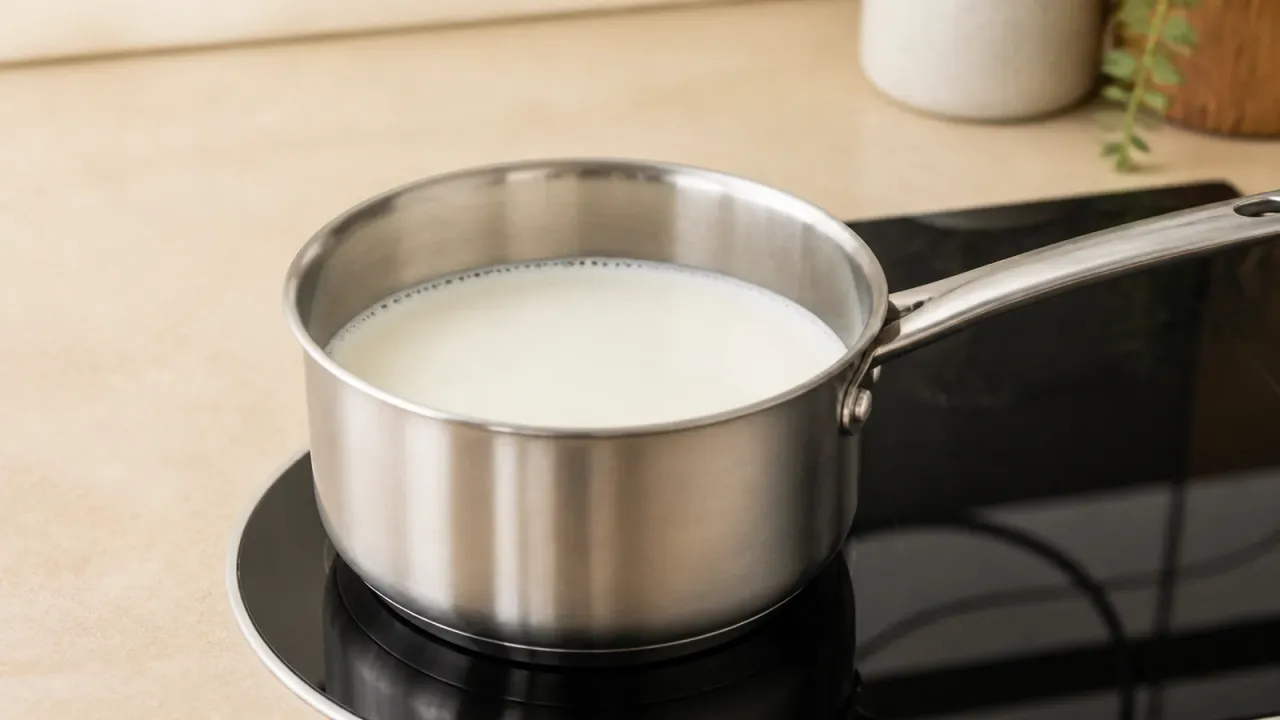
Yes. An intact stainless steel saucepan can be used to heat milk, including bringing it to a culinary boil, but milk needs controlled heat and attention because its proteins and other solids can form a film, stick, scorch, and rise before you notice. This cooking answer is not a pasteurization protocol, sterilization method, infant-formula instruction, or guarantee that the milk will not scorch.
This is a research-based answer, not a hands-on test of one pan or burner. Your cookware maker’s instructions take priority because bases, coatings, handles, and heat limits vary.
Why does milk stick or scorch in stainless steel?
Milk sticks or scorches when its proteins and other milk solids settle against a hot surface and form a film faster than the liquid can move them away. A milk skin can also form at the surface as it heats. The Utah State University extension food guide describes milk’s tendency to stick and scorch with direct, high heat and points to lower heat and stirring as ways to reduce the problem.
Stainless steel does not make this a material failure. It is a workable cooking surface, but it gives you little forgiveness when the bottom of the pan is much hotter than the milk above it. As the milk approaches a simmer, the surface can rise quickly, so a pan that looked calm a moment ago can foam toward the rim.
That is a narrower technique problem than the broader what not to cook in stainless steel question, which covers foods that are less forgiving rather than automatically unsafe.
Which stainless steel pan is best for milk?
A clean, sound saucepan with enough headroom and a food-contact surface intended for cookware is the sensible starting point. A substantial or clad base may spread heat more evenly, but it is not a promise that milk cannot scorch. Choose the pan by its exact maker instructions rather than by a generic stainless label.
Use a pan large enough that the milk sits well below the rim. A double boiler or other indirect-heating setup can be useful when a recipe calls for prolonged gentle heating. Oregon State University Extension describes a double boiler or a saucepan set in a larger pan as an option for controlled milk heating in its home pasteurization guidance. That source is not a culinary boiling recipe, so use the setup as a heat-control option, not as a substitute for a validated food-safety process.
Do not use a pan with a loose handle, a separating base, deep pitting, or a food-contact coating that is flaking or unidentified. If the product’s intended use or temperature limit is unclear, ask the maker before heating milk in it. Our guide to whether stainless steel cookware is safe explains why the finished food-contact article matters more than a broad material name.
How should you heat milk without scorching it?
Use low to moderate heat, stir frequently as the milk warms, and watch the surface instead of relying on a timer or universal burner number.
- Start with a clean pan and enough room for the milk to expand. Keep a heat-safe silicone or wooden utensil nearby.
- Begin at low or low-moderate heat and increase gradually only if the recipe requires it. All-Clad’s current care guidance likewise advises controlled heating and says to increase heat gradually rather than leaving an empty pan over high heat. The exact burner setting still depends on the pan, stove, quantity, and recipe.
- Stir often enough to move milk across the bottom, and stir more continuously as it gets hotter or thicker. Sweep the bottom gently rather than scraping hard at a film that has already set.
- Watch for warming at the edges, small bubbles, a skin, and a rising surface. If the recipe calls for a simmer, reduce the heat when the milk reaches that stage. If it truly calls for a boil, stay with the pan and be ready to lower or remove it as soon as the culinary endpoint is reached.
- Use a thermometer only when the recipe or an authoritative food-safety process specifies a target. A thermometer can measure temperature, but it does not by itself turn a culinary heating step into pasteurization or sterilization.
- Never leave heating milk unattended. Turn off the burner and move the pan only with a dry, secure grip when the milk begins to climb or the bottom starts to catch.
There is no universal burner setting or boiling time that prevents sticking for every pan. A low setting on one stove can be much more aggressive on another, and a full saucepan responds differently from a small quantity. Attention and gradual adjustments matter more than chasing a number.
For broader technique, our guide to keeping stainless steel pans from sticking covers heat, surface moisture, fat, and release. Milk has a different failure mode from a seared food, so its need for stirring and close observation still applies.
Does boiling milk pasteurize it?
Not automatically. A visible boil is a culinary observation, while pasteurization is a controlled time-and-temperature process that must heat the product uniformly.
The FDA’s dairy product manufacturing guidance lists validated pasteurization relationships such as 145°F for 30 minutes and 161°F for 15 seconds. Those figures describe a regulated process, not a casual instruction to boil milk at home. A pan can show bubbles without documenting the temperature and time of every part of the milk.
If your goal is to address the risks of raw milk, follow current public-health or extension instructions for that specific process. Oregon State University’s current home pasteurization guidance emphasizes slow, even heating and a thermometer. This article does not provide a pasteurization, sterilization, or raw-milk treatment procedure. Infant formula and breast-milk handling have separate instructions and are outside this article’s scope.
What should you do if milk sticks or scorches?
Turn off the heat, move the pan safely, and let it cool before soaking the residue in warm water and dish soap. Do not pour cold water into a very hot pan, and do not scrape a hot surface with a knife or aggressive metal tool.
Once the pan is safe to handle, loosen softened milk with a wooden or silicone utensil and a non-scratch sponge. Rinse and inspect before trying a maker-approved cookware cleanser. Never mix cleaning products. Our detailed guide to cleaning a burnt stainless steel pan gives a least-aggressive-first sequence and explains when a pan’s finish or construction changes the cleaning decision.
If the food-contact surface is pitted, peeling, separating, or otherwise structurally damaged after the incident, stop using the pan and ask the manufacturer to assess it. A brown film or heat tint is not automatically structural damage, but it should be cleaned and inspected rather than ignored.
How should you cool or store heated milk?
If you are storing heated milk, cool and refrigerate it promptly instead of leaving the saucepan on the counter. FoodSafety.gov’s cold-storage chart lists 40°F (4°C) or below for the refrigerator, and its guidance for people at risk says perishable food should not remain at room temperature for more than two hours, or one hour when the surrounding temperature is above 90°F.
For a large amount, a clean shallow container or an appropriate ice-water cooling method can help it cool more evenly. Follow the food-safety authority or recipe for the process, keep the milk protected from contamination, and refrigerate it at the stated temperature. Do not use a cooling shortcut that leaves the milk unattended near a hot burner.
Is stainless steel safe for milk?
Food-contact stainless steel cookware made and used as directed is generally an appropriate pan for milk, but the word “stainless” alone does not certify every finished product. The exact food-contact surface, any coating or lining, the pan’s condition, and the maker’s care instructions all matter.
For ordinary cooking, the practical boundary is simple: use sound cookware intended for food contact, control the heat, and stay with the pan. If you have a material allergy or a question about an unknown alloy or coating, ask the manufacturer what touches the food rather than inferring it from appearance.
Frequently asked questions
Can I boil milk in a stainless steel pot?
Yes, provided the pot is sound, intended for food contact, large enough for headroom, and watched closely. A saucepan is often easier to control because you can see and stir the milk readily.
Should I use high heat to boil milk faster?
No. High heat can make the bottom catch and the surface rise before you can respond. Start low or low-moderate, increase gradually only when needed, and follow the pan maker’s limits.
Is a double boiler necessary?
No. It is an optional way to soften direct heat when a recipe needs prolonged gentle warming. Direct stainless heating can work when you use room in the pan, controlled heat, stirring, and attention.
Can I use a thermometer instead of stirring?
No. A thermometer can answer a specific temperature question, but it does not prevent a hot spot or tell you that milk is not settling on the bottom. Stirring and observation remain part of the cooking method.
Can I leave milk on the stove while I do something else?
No. Milk can foam and rise quickly, and the bottom can scorch while the top still looks calm. Stay with the pan and turn the heat off if you need to step away.