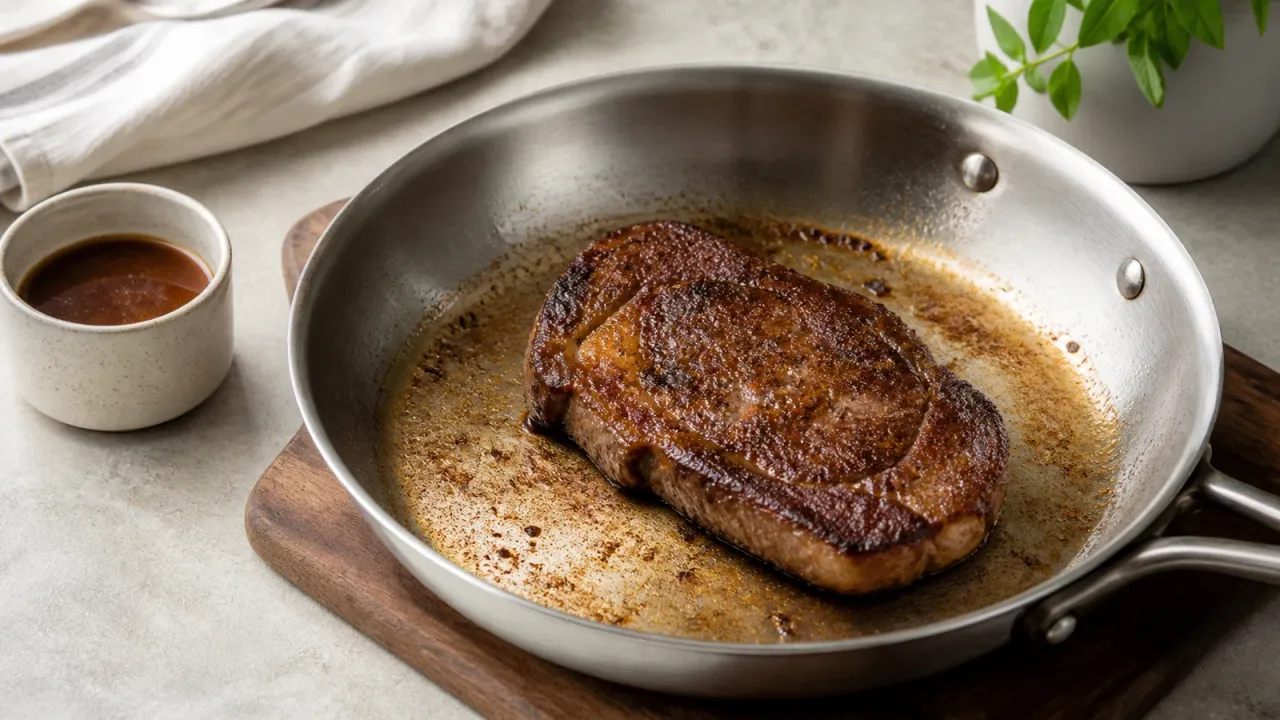
Cook steak in a stainless steel pan by watching the pan and the meat rather than following one burner setting or a fixed timer. Pat the steak dry, heat the pan until the oil shimmers without smoking, and wait for a browned crust before turning. An instant-read thermometer tells you what the center is doing, while thickness and carryover cooking determine how quickly the steak reaches its final temperature.
For food safety, the USDA FSIS safe-temperature chart says beef steaks should reach 145°F (62.8°C) before you remove them from the heat and rest for at least three minutes. That is a safety minimum, not a promise that the steak will have your preferred texture. The lower temperatures often used to describe rare or medium-rare are doneness preferences and should not be mistaken for a safety guarantee.
What should you do before the steak hits the pan?
Dry the steak and keep the setup simple before you heat the pan. Surface moisture has to evaporate before the meat can brown, so blot both sides well with paper towels. Keep the steak chilled until you are ready to cook it, season it shortly before it goes into the pan, and use a separate clean plate for the cooked steak.
A steak with some thickness gives you more time to build a crust before the center overshoots. A thin steak can reach its target quickly, especially in a hot pan. Do not use the same timing assumption for a thin strip steak and a thick ribeye. If you are new to stainless steel, the guide to keeping stainless steel pans from sticking explains why dry food and a properly heated surface matter.
Choose a pan that gives the steak room to lie flat. A crowded pan traps moisture and makes browning harder. A wide, heavy stainless steel frying pan also gives you more control when you need to move from searing to a gentler finish. See why stainless steel frying pans are a reliable choice for home cooks for the broader pan trade-offs.
How do you know the stainless steel pan is ready?
Use the pan’s surface behavior as your guide, because a burner dial does not describe the heat delivered by every stove and pan. Start with the empty, dry pan at a moderate setting and let it warm gradually. If you use the water test, a small drop should gather into a bead that moves across the surface instead of vanishing on contact. Wipe the pan completely dry before adding oil.
Add a thin film of a high-heat cooking oil and watch it. The oil should spread easily and shimmer. If it smokes heavily, the pan is too hot for the steak, so lift it from the burner briefly and let it settle before trying again. You want a steady sizzle when the steak lands, not a violent burst of smoke or a weak, silent contact.
The fuller explanation of these cues is in how to know when a stainless steel pan is ready. The goal is a repeatable visual and audible signal, not a universal number on the stove.
How should you sear the steak?
Lay the dry, seasoned steak into the oil and leave it alone long enough for the first surface to brown. Set it down away from you to reduce the chance of splashing hot oil, then listen for a steady sizzle. If the sound drops away and the meat looks pale, the pan may not have recovered enough heat. If the crust darkens very fast or the oil smokes, lower the heat or move the pan off the burner for a moment.
Stainless steel can hold onto a steak at first. That does not always mean something went wrong. As the surface dries and browns, it usually releases more easily. Slide a thin turner under an edge only to check whether the crust has formed. If the steak resists, give it more time instead of forcing it and tearing the surface.
When should you turn the steak?
Turn the steak when the cooked side has a deep brown crust and the steak nudges free with light pressure. The release cue is more useful than a prescribed number of minutes because steak thickness, starting temperature, pan mass, and burner output all change the rate of browning.
After turning, keep watching the crust and the oil. The second side may brown faster because the pan is now fully heated. Adjust the heat when the color is moving from brown to black or when the oil begins to smoke. If the steak is thick and the outside is ready before the center, finish it with gentler heat and check the center often rather than leaving it over the hottest part of the burner.
How do temperature, thickness, and carryover fit together?
Use an instant-read thermometer in the thickest part of the steak, entering from the side when the cut is thin. The USDA FSIS guide to food thermometers recommends checking the thickest part away from bone, fat, or gristle. Temperature is a better safety check than color, firmness, or grill marks.
The following ranges describe approximate culinary preferences for the final center temperature. They are not substitutes for the USDA safety minimum.
| Preferred finish | Approximate final center temperature | Safety meaning |
|---|---|---|
| Rare | 120–130°F (49–54°C) | Below the USDA minimum, so this is a preference range, not a safety target |
| Medium-rare | 130–135°F (54–57°C) | Below the USDA minimum, so do not treat the range as a safety guarantee |
| Medium | 135–145°F (57–63°C) | Only the upper end reaches the USDA minimum |
| Medium-well | 145–155°F (63–68°C) | Begins at the USDA minimum for steaks |
| Well-done | 155°F and higher (68°C and higher) | Above the USDA minimum |
These doneness bands come from the ThermoWorks steak temperature guide, while the safety floor comes from USDA FSIS. If you are cooking ground beef, a mechanically tenderized steak, an injected cut, or food for someone at higher risk from foodborne illness, follow the stricter applicable food-safety guidance rather than borrowing a rare-steak target.
Carryover cooking is the temperature rise that continues after the steak leaves the pan. A thin steak has less thermal mass and often rises only a little. A thick steak or one cooked with a strong temperature gradient can rise much more. Do not blindly subtract one fixed number from every target. Watch the thermometer, the steak’s thickness, and how aggressively the surface was heated. For the USDA minimum, the steak should read 145°F before removal, then rest for at least three minutes.
How do you turn the browned fond into a pan sauce?
Turn the browned bits left in the stainless steel pan into a sauce by deglazing them with a little liquid and reducing it. Move the steak to a clean plate to rest, then look at the pan. Golden-brown bits are useful fond. Black, acrid bits will make the sauce bitter, so wipe out a badly burned pan instead of trying to rescue it.
Pour off excess oil while leaving the fond behind. Return the pan to a heat level that keeps liquid at a gentle simmer, then add a splash of water, stock, or another suitable cooking liquid carefully. Scrape the bottom with a wooden or heat-safe utensil as the liquid loosens the browned pieces. Add the steak’s resting juices, let the liquid reduce until it tastes concentrated, and finish with a small piece of butter off the heat if you want a rounder sauce.
The Institute of Culinary Education’s pan-sauce lesson describes the same sequence: build fond, deglaze it into the sauce, then reduce the liquid to develop flavor and texture. Stainless steel is useful here because the browned residue remains on the pan surface instead of being hidden behind a nonstick coating.
What should you do if the steak sticks or the fond burns?
If the steak sticks, first check whether the browned crust is ready rather than pulling harder. A wet surface, a pan that has not recovered heat, or an early turn can all make release harder. Give the steak another moment, then test the edge again. If the crust is already dark, move the pan off the heat and finish the center more gently.
If the fond is black, discard it and start the sauce in a clean pan. Burnt fond does not become good fond after more liquid is added. If the center is under your target while the outside is already brown, use lower heat or a gentler finishing method and keep checking the thickest part. If a thin steak is already at its target, remove it promptly because its temperature can move quickly during the rest.
Stainless steel is a good surface for searing and deglazing, but it is not the right answer for every ingredient or technique. The guide to what not to cook in stainless steel covers foods that need a different approach.
Frequently asked questions
These answers cover the cues that cause the most uncertainty when steak meets stainless steel.
Should steak release before you turn it?
Yes. A steak often releases once its first side has formed a dry, browned crust. If it still grips the pan, wait and check again rather than scraping it loose. Release is a useful cooking cue, not a guarantee that the center has reached a safe temperature.
Is a stainless steel pan safe for steak?
Yes, stainless steel is a suitable cooking surface for steak, but the pan itself does not make the food safe. Check the steak’s internal temperature with a thermometer and follow the USDA minimum of 145°F with a three-minute rest for beef steaks.
Can a thick steak finish in the pan?
It can, but a thick steak may need a gentler finish after the crust is brown. Keep the surface from burning, check the thermal center, and account for carryover during the rest. A timer alone cannot tell you when a thick cut is ready.
Do you need wine to make a pan sauce?
No. Water or stock can loosen fond and make a useful base for a sauce. Add liquid carefully to the hot pan, scrape while it simmers, and reduce until the flavor is concentrated. Wine is an option, not a requirement.
Sources and safety guidance
These sources support the temperature, thermometer, carryover, and pan-sauce guidance in this article.